
 My Inquiry
 My Account


Infineon Technologies IRMCK371TR
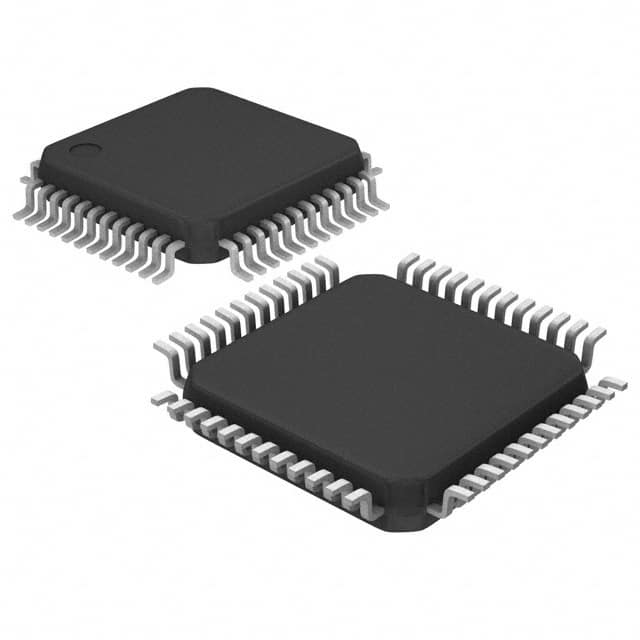
- Part No.:
- IRMCK371TR
- Manufacturer:
- Infineon Technologies
- Category:
- Motor Drivers, Controllers
- Package:
- 48-LQFP
- Datasheet:
-
 IRMCK371TR.pdf
- Description:
- IC MTRDRV 1.62-1.98/3-3.6V 48QFP
- Quantity:
- Payment:

- Shipping:

Inventory:2,144
Please send an inquiry. Send us your inquiry, and we will respond immediately.
Product details
Overview
IRMCK371 from International Rectifier is a sensorless motor control IC integrating a hardware Motion Control Engine (MCE) and an 8-bit 8051 microcontroller for inverter-driven appliance motors. It supports sinusoidal FOC of interior/surface permanent magnet and induction motors, features single-shunt current reconstruction, 12-bit A/D (2 μsec), 16-bit signed MCE computation, and operates at up to 128 MHz SYSCLK in QFP48 package.
For engineers reviewing the IRMCK371 datasheet, IRMCK371 pinout, IRMCK371 application, or IRMCK371 equivalent, key selection criteria include sensorless angle estimation latency (11 μsec), gate-kill digital filter latency (2 μsec), OTP-based production deployment, dual-port RAM coupling between MCE and 8051, and MATLAB/Simulink graphical programming support for motion algorithms.
Technical Context
The IRMCK371 implements two tightly coupled computation domains: a dedicated Motion Control Engine (MCE) executing pre-defined hardware blocks-including Angle Estimator, Vector Rotator, PI controller, and Low-Loss SVPWM-and an 8051 core running at 33 MHz with 2-cycle instruction execution (16 MIPS). Communication between engines occurs via dual-port RAM for real-time signal exchange.
Its analog subsystem includes four 12-bit A/D channels (2 μsec conversion), internal reference (AREF), and integrated single-shunt current feedback reconstruction circuitry eliminating external op-amps. Clocking uses a 60 MHz crystal with PLL generating 128 MHz SYSCLK and independent analog watchdog clock.
Key Specifications
| Parameter | Value and Actual Design Meaning |
|---|---|
| Max SYSCLK frequency | 128 MHz - determines maximum MCE loop rate and PWM update timing resolution |
| Sensorless computation time | 11 μsec typ - enables high-bandwidth torque control loops up to ~90 kHz |
| A/D converter resolution & speed | 12 bits / 2 μsec - supports precise phase current and DC bus voltage sampling per PWM cycle |
| MCE data range | 16-bit signed - ensures sufficient dynamic range for vector math without overflow in FOC inner loops |
| OTP program memory | 64K bytes - stores final production motion control firmware with no external memory dependency |
| GateKill latency | 2 μsec (digital filtered) - guarantees fast fault response for IGBT/MOSFET short-circuit protection |
| PWM carrier counter | 16-bit / SYSCLK - allows fine-grained carrier frequency tuning up to 128 MHz / 65536 = ~1.95 kHz min step |
Pinout & Package
IRMCK371 is housed in a lead-free 48-pin QFP package (7 mm × 7 mm, 0.5 mm pitch) with exposed thermal pad. Pin functions are grouped into Motion Peripheral Interface (SVPWM outputs, GATEKILL, SYNC), 8051 Peripheral Interface (UART, I²C, SPI, JTAG), Analog Interface (4× AIN, AREF, VDDA/AVSS), Power Interface (VDD1/VDD2, AVDD, PLLVDD/PLLVSS), and Test Interface (VPP, RESET).
| Pin/Terminal | Circuit Role | Design Meaning |
|---|---|---|
| VDD1, VDD2 | Digital power supply | 1.8V/3.3V CMOS core logic rails; separate domains reduce noise coupling to MCE |
| AVDD, AVSS | Analog power supply | Isolated analog domain for A/D and current sensing; improves SNR in motor current measurement |
| AIN0–AIN3 | Analog inputs | Four 12-bit A/D channels for phase current, DC bus voltage, temperature, and auxiliary sensing |
| GATEKILL | Fault shutdown output | Active-low, 2 μsec digital-filtered signal to disable gate drivers during overcurrent or overtemperature events |
| SYNC | Timing synchronization input | Aligns MCE computation start with PWM carrier zero-crossing to minimize sampling jitter |
| U0TX/U0RX | UART interface | Asynchronous serial communication at up to 57.6 kbps for host configuration and telemetry |
| XTAL0/XTAL1 | Clock oscillator terminals | Supports 60 MHz fundamental-mode crystal; internal PLL generates 128 MHz SYSCLK |
Key Features
| Feature | Design Value |
|---|---|
| Hardware Motion Control Engine (MCE) | Dedicated ASIC block implementing angle estimation, PI control, vector rotation, and SVPWM-offloads 100% of real-time FOC computation from CPU |
| Single-shunt current reconstruction | On-chip analog/digital circuitry reconstructs all three phase currents from one shunt resistor-eliminates 2 op-amps and 2 ADC channels |
| Graphical programming environment | Simulink-integrated compiler maps drag-and-drop control blocks to MCE hardware resources-no HDL or low-level register coding required |
| Dual-port RAM interface | 8 KB shared memory space enabling deterministic, lock-free data exchange between MCE and 8051 for command updates and status reporting |
| OTP-based production deployment | 64 KB one-time programmable memory stores final motion firmware-prevents field reprogramming and ensures version consistency |
Applications
| Washing Machine Drum Drive | Refrigerator Compressor Control |
|---|---|
Use Scenario: Variable-speed direct-drive drum motor requiring smooth low-RPM torque and stall detection during unbalanced loads. IC Role / Device Role / Timing Role: Sensorless FOC controller executing real-time angle estimation and torque regulation at 11 μsec loop interval; synchronizes A/D sampling to PWM carrier via SYNC input. Use Value: Eliminates position sensors and external op-amps, reducing BOM cost by ≥$1.20 while maintaining <2% torque ripple across 50–1200 RPM range. | Use Scenario: Inverter-driven hermetic compressor demanding high efficiency at partial load and rapid transient response to refrigerant pressure changes. IC Role / Device Role / Timing Role: Dual-engine controller: MCE handles inner-loop current regulation and flux weakening; 8051 manages system-level logic, defrost cycles, and UART communication with main controller. Use Value: Achieves >94% peak efficiency and <50 ms load-step recovery using hardware-accelerated vector math and 2-cycle 8051 instruction execution. |
| Dishwasher Circulation Pump | Range Hood Blower Fan |
Use Scenario: High-static-pressure brushless DC pump requiring quiet operation, soft-start, and dry-run protection. IC Role / Device Role / Timing Role: MCE executes sensorless startup sequence and continuous FOC; 8051 monitors thermistor input and controls fan speed profile via I²C. Use Value: Single-shunt reconstruction enables compact PCB layout; OTP memory ensures consistent acoustic performance calibration across production batches. | Use Scenario: Multi-speed blower with airflow optimization, overheat shutdown, and user-interface LED dimming. IC Role / Device Role / Timing Role: 8051 manages push-button input, PWM-dimmed LEDs, and thermal monitoring; MCE delivers precise torque control under varying duct resistance. Use Value: Integrated watchdog timer with independent analog clock prevents lockup during voltage droop; JTAG port enables in-system debug without removing IC from board. |
Equivalent & Alternatives
The following parts are listed as comparable options for similar sensorless motor control applications.
| Alternative Part | Technical Difference | Application Difference | Selection Advice |
|---|---|---|---|
| IRMCF371 | RAM-based version (48K bytes) instead of OTP; requires external EEPROM for boot code; same pinout and peripheral set | Targeted at development and low-volume prototyping where firmware iteration is frequent | Select IRMCF371 when iterative algorithm testing or field firmware updates are required |
| STSPIN32F0A | ARM Cortex-M0+ core (72 MHz), integrated 3-phase gate driver, no dedicated MCE hardware; relies on software FOC | Better suited for cost-sensitive, lower-performance fans/pumps where MCU flexibility outweighs deterministic latency | Select STSPIN32F0A when gate driver integration and smaller footprint outweigh need for sub-12 μsec sensorless loops |
Compared with IRMCF371, the IRMCK371 offers production-ready OTP security and eliminates external memory, while STSPIN32F0A trades MCE determinism for MCU programmability and integrated drivers-making IRMCK371 optimal for high-reliability, high-loop-rate appliance inverters.
Availability
IRMCK371 is available at Aetrix Electronics and suitable for washing machine drum drives, refrigerator compressors, dishwasher circulation pumps, and range hood blowers requiring stable component supply and long-term production continuity.
Supply support for IRMCK371 includes scheduled delivery planning, volume procurement assistance, BOM continuity management, traceable sourcing, and lifecycle availability coordination for OEM customers, industrial embedded developers, connected-device designers, and electronics production programs.
Manufacturer
International Rectifier (now part of Infineon Technologies since 2015) was a pioneer in power semiconductors and motion control ICs, specializing in high-efficiency power conversion solutions for industrial and consumer systems.
The IRMCK371 belongs to IR's Motion Control Engine product line, designed specifically to deliver deterministic, low-latency sensorless FOC for cost-sensitive, high-volume inverterized appliances-replacing DSP + FPGA combinations with a single monolithic IC.
FAQ
What programming tools are required for IRMCK371 development?
The IRMCK371 requires MATLAB/Simulink with IR's Motion Control Engine graphical compiler for MCE algorithm design, and standard 8051 toolchains (e.g., Keil C51) with JTAG emulation for 8051 firmware. No HDL or assembly coding is needed for the MCE-control blocks are mapped automatically to hardware resources.
Does IRMCK371 support sensorless startup for permanent magnet motors?
Yes-IRMCK371 implements a hardware-accelerated sensorless startup sequence within the MCE, using high-frequency injection and back-EMF integration to estimate rotor position before transition to closed-loop FOC. Startup is robust down to zero speed and validated for surface and interior PM motors.
Can IRMCK371 drive IGBTs directly, or is a gate driver required?
IRMCK371 does not integrate gate drivers. Its six PWM outputs (UH/UL, VH/VL, WH/WL) and GATEKILL signal are CMOS-level (1.8V/3.3V) and require external 3-phase gate driver ICs (e.g., IR2136, IRS21844) to interface with IGBTs or MOSFETs in the inverter stage.
How is current sensing implemented without external op-amps?
IRMCK371 integrates a dedicated single-shunt current reconstruction circuit that combines analog signal conditioning, digital timing alignment, and mathematical reconstruction logic. It samples shunt voltage at precise PWM modulation points and computes all three phase currents digitally-eliminating the need for two external op-amps and associated passive components.
IRMCK371TR Specifications
- Product attributes
- Attribute value
- Manufacturer:
- Infineon Technologies
- Series:
- MCE™
- Package/Case:
- 48-LQFP
- Packaging:
- Tape & Reel (TR)
- Product Status:
- Obsolete
- Motor Type - Stepper:
- -
- Motor Type - AC, DC:
- AC, Synchronous
- Function:
- Controller - Commutation, Direction Management
- Output Configuration:
- Pre-Driver - Half Bridge (3)
- Interface:
- I2C, RS-232, SPI
- Technology:
- IGBT
- Step Resolution:
- -
- Applications:
- Appliance
- Current - Output:
- -
- Voltage - Supply:
- 1.62V ~ 1.98V, 3V ~ 3.6V
- Voltage - Load:
- -
- Operating Temperature:
- -40°C ~ 85°C (TA)
- Grade:
- -
- Qualification:
- -
- Mounting Type:
- Surface Mount
- Supplier Device Package:
- 48-QFP (7x7)
IRMCK371TR FAQ
1.How can I place an order for IRMCK371TR through Aetrix?
Please submit a Request for Quotation (RFQ) for IRMCK371TR on Aetrix. Our sales agent will provide a competitive quotation and guide you through the order confirmation once you accept the terms.
2.Are the price and stock information for IRMCK371TR reliable?
The price and inventory of IRMCK371TR are updated periodically and may fluctuate due to market conditions. Stock and pricing data are typically refreshed every 24 hours. Quotation validity for IRMCK371TR is usually 5 days.
3.What payment methods are accepted for IRMCK371TR?
We accept Wire Transfer, PayPal, Credit Card, Western Union, MoneyGram, and Escrow for IRMCK371TR transactions.
Note: Certain payment methods may incur a processing fee.
4.How is shipping managed for IRMCK371TR?
IRMCK371TR orders can be shipped via leading logistics carriers, including DHL, UPS, FedEx, TNT, or Registered Mail.
Once your IRMCK371TR order is processed, you will receive an email with the shipment details and tracking number.
Note: Tracking information may take up to 24 hours to appear. Express delivery typically takes 3–5 business days.
5.How can I obtain technical support or documentation for IRMCK371TR?
For technical support, including IRMCK371TR datasheets, pinout diagrams, or application guidance, please contact our engineering support team. They can provide detailed documentation and assistance for your IRMCK371TR requirements.
6.How does Aetrix verify that IRMCK371TR is sourced from the original manufacturer or authorized distributors?
All IRMCK371TR products on Aetrix are procured from qualified distributors and authorized channels. Our dedicated quality assurance team conducts strict verification, including traceability checks and, if necessary, third-party testing. This ensures that IRMCK371TR meets industry standards.
7.What is the process for return or replacement of IRMCK371TR?
All IRMCK371TR units undergo pre-shipment inspection (PSI). If there is an issue with IRMCK371TR, returns or replacements are accepted under the following conditions:
1.Quantity discrepancies, incorrect items, or visible external defects (such as breakage or corrosion), acknowledged by Aetrix.
2.The issue is reported within 90 days of delivery.
3.The IRMCK371TR part is unused and in its original packaging.
Return procedure for IRMCK371TR:
1.Submit a request within 90 days.
2.Obtain a Return Material Authorization (RMA) from Aetrix.
IRMCK371TR Tags
-
DRV2603RUNR
Texas Instruments
-
DRV8837CDSGR
Texas Instruments
-
DRV8837DSGR
Texas Instruments
-
DRV8838DSGR
Texas Instruments
-
DRV8839DSSR
Texas Instruments
-
EMC2301-1-ACZL-TR
Microchip Technology
-
DRV8231ADSGR
Texas Instruments
-
EMC2302-2-AIZL-TR
Microchip Technology
-
DRV8800PWPR
Texas Instruments
-
DRV8835DSSR
Texas Instruments
-
EMC2303-1-KP-TR
Microchip Technology
-
DRV8876PWPR
Texas Instruments
Tech Hub

18650 battery guide covering lithium-ion cell basics, 3.6V/3.7V voltage, 4.2V charging, mAh and Wh capacity, protected cells, chargers, BMS, series-parallel packs, holders, welding and sourcing checks.…

Hall effect sensor guide covering working principle, linear and digital sensors, Arduino circuits, current sensing, speed detection, automotive applications, A3144 examples, signal filtering and datash…

Product Change Notification guide for electronic components, covering PCN meaning, PCN vs PDN/EOL, common change types, risk levels, form-fit-function review, engineering validation, BOM control, LTB/L…

A practical guide to blend door actuators, covering HVAC function, symptoms, location, AC and heater issues, reset and calibration, replacement cost, electrical diagnosis, compatibility checks, and rep…

Engineering guide to Raspberry Pi alternatives, covering chip-level differences, Orange Pi, ROCK, Jetson, Banana Pi, NanoPi, Compute Module, Pico, GPIO, camera, HAT compatibility, and replacement risks…
Engineering guide to dynamic load response testing for high-current buck converters, covering load step setup, slew rate, Vcore undershoot, overshoot, recovery time, probe location, output capacitors a…
Engineering guide to output capacitor selection for ASIC Vcore rails, covering bulk capacitors, polymer capacitors, MLCC decoupling, DC bias, ESR, ESL, placement, transient response and substitution ri…
Engineering guide to high-current ASIC Vcore rails, covering 12-phase buck architecture, PMBus control, dynamic load testing, output capacitor networks, smart power stage selection, thermal design and …
Voltage regulator guide covering linear, LDO, 7805, Zener, adjustable, buck, VRM and alternator regulators, with design checks, testing methods, troubleshooting and datasheet-based selection.
Amplifier guide covering voltage, current and power amplification, gain, feedback, amplifier classes, audio and RF applications, op-amp circuits, transimpedance amplifiers, datasheet selection and trou…


