
 My Inquiry
 My Account


Infineon Technologies KTY13-6
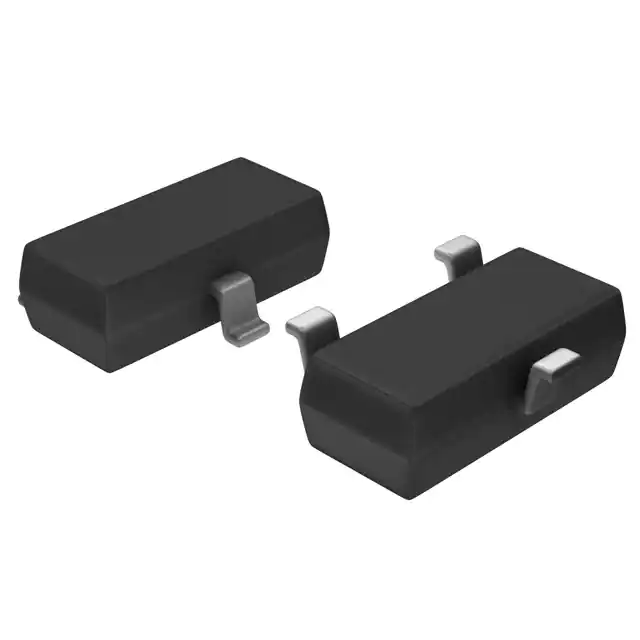
- Part No.:
- KTY13-6
- Manufacturer:
- Infineon Technologies
- Category:
- PTC Thermistors
- Package:
- TO-236-3, SC-59, SOT-23-3
- Datasheet:
-
 KTY13-6.pdf
- Description:
- SENSOR PTC 2KOHM 3% SOT23-3
- Quantity:
- Payment:

- Shipping:

Inventory:1,743
Please send an inquiry. Send us your inquiry, and we will respond immediately.
Product details
Overview
KTY13-6 from Infineon Technologies is a silicon-based positive temperature coefficient (PTC) temperature sensor in SOT-23 package, designed for analog temperature sensing in automotive and industrial control loops. It exhibits R₂₅ = 1980 Ω (min) / 2020 Ω (max) at 25 °C, operates from −50 °C to +150 °C, and delivers linear resistance vs. temperature behavior with ±1% or ±3% tolerance options.
For engineers reviewing the KTY13-6 datasheet, KTY13-6 pinout, KTY13-6 application, or KTY13-6 equivalent, this device serves as a low-cost, polarity-independent, two-terminal analog temperature transducer requiring only a stable 1 mA bias current - ideal for engine coolant, HVAC duct, and motor winding temperature monitoring where long-term stability and fast thermal response are critical.
Technical Context
The KTY13-6 uses an n-conducting silicon planar chip whose resistance follows a second-order polynomial: RT = R25 × [1 + α·ΔT + β·(ΔT)²], with α = 7.88×10⁻³ K⁻¹ and β = 1.937×10⁻⁵ K⁻² over −30 °C to +130 °C. Its symmetrical two-terminal construction eliminates polarity concerns in PCB layout and biasing.
Thermal time constant is 7 s in air and 1 s in oil, enabling rapid detection of localized temperature changes. Absolute maximum ratings include 25 V operating voltage and 7 mA continuous operating current, with peak current up to 10 mA for ≤10 ms pulses.
Key Specifications
| Parameter | Value and Actual Design Meaning |
|---|---|
| R₂₅ min/max | 1980 Ω / 2020 Ω at 25 °C - defines baseline resistance for calibration and analog signal scaling |
| Temp range | −50 °C to +150 °C - supports under-hood automotive and industrial motor applications |
| TCR curve | Second-order polynomial (α = 7.88×10⁻³ K⁻¹, β = 1.937×10⁻⁵ K⁻²) - enables <±0.5 °C error with digital compensation |
| τ in air/oil | 7 s / 1 s - determines minimum sampling interval for transient thermal event capture |
| Max Iop | 7 mA continuous - sets upper limit for bias resistor selection to avoid self-heating error |
| Polarity | Independent - simplifies PCB routing and eliminates orientation-dependent assembly errors |
Pinout & Package
Two-terminal SOT-23 package (JEDEC TO-236AB); terminals are symmetrical and non-polarized. No internal die bonding asymmetry - Pin 1 and Pin 2 are electrically identical and interchangeable.
| Pin/Terminal | Circuit Role | Design Meaning |
|---|---|---|
| Pin 1 | Anode/Cathode (bidirectional) | Electrically identical to Pin 2; either terminal may serve as current entry/exit point |
| Pin 2 | Anode/Cathode (bidirectional) | Electrically identical to Pin 1; no functional distinction - enables flexible layout routing |
Key Features
| Feature | Design Value |
|---|---|
| Positive temperature coefficient | Monotonic, predictable resistance increase with temperature - eliminates ambiguity in analog readout direction |
| Linear output approximation | Second-order polynomial fit yields <±0.5 °C error after digital compensation - reduces MCU processing overhead |
| Fast thermal response in oil | 1 s time constant - suitable for real-time motor winding hot-spot detection |
| Excellent long-term stability | Drift <0.1% per 1000 h at 125 °C - ensures calibration integrity over automotive service life |
Applications
| Engine Coolant Monitoring | HVAC Air Duct Sensing |
|---|---|
Use Scenario: Real-time measurement of liquid coolant temperature in ICE powertrain systems. IC Role / Device Role / Timing Role: Analog PTC transducer providing resistance-proportional signal to ECU ADC input. Use Value: Enables closed-loop fan control and overheat protection with <±1 °C accuracy after linearization. | Use Scenario: Continuous ambient air temperature tracking inside vehicle cabin HVAC ducts. IC Role / Device Role / Timing Role: Two-wire passive sensor interfaced to HVAC microcontroller via constant-current source. Use Value: Delivers repeatable, polarity-agnostic readings across wide temperature swing (−40 °C to +85 °C). |
| Industrial Motor Winding Protection | Power Supply Thermal Foldback |
Use Scenario: Embedded in stator windings to detect thermal overload before insulation failure. IC Role / Device Role / Timing Role: Directly mounted on copper winding; resistance change triggers shutdown logic. Use Value: 7 s air τ and 1 s oil τ allow timely intervention during rapid thermal rise events. | Use Scenario: Monitoring heatsink temperature near power MOSFETs in DC-DC converters. IC Role / Device Role / Timing Role: Bias-fed sensor feeding analog comparator or ADC to initiate thermal throttling. Use Value: ±1% R₂₅ tolerance and stable TCR enable precise foldback threshold setting without trimming. |
Equivalent & Alternatives
The following parts are listed as comparable options for similar PTC temperature sensing applications.
| Alternative Part | Technical Difference | Application Difference | Selection Advice |
|---|---|---|---|
| NTCG163JH103JT1 | NTC thermistor (negative coefficient), R₂₅ = 10 kΩ, B₂₅/₈₅ = 3435 K | Requires inverted signal interpretation and different linearization algorithm | Choose only if existing NTC signal chain and compensation firmware are already deployed |
| KTY83-110 | TO-92 package, R₂₅ = 1940–2060 Ω, τair = 40 s - slower response | Larger thermal mass limits use in fast-transient environments | Select when board space allows leaded package and slower dynamics are acceptable |
Compared with NTCG163JH103JT1 and KTY83-110, KTY13-6 offers faster thermal response (7 s vs. 40 s), SMT compatibility, and inherent linearity advantage over NTCs - making it optimal for compact, high-dynamics automotive and industrial sensing nodes.
Availability
KTY13-6 is available at Aetrix Electronics and suitable for engine management systems, HVAC control units, industrial motor drives, and power supply thermal monitoring requiring stable component supply across extended temperature ranges and multi-year production cycles.
Supply support for KTY13-6 includes scheduled delivery planning, volume procurement assistance, BOM continuity management, traceable sourcing, and lifecycle availability coordination for OEM customers, industrial embedded developers, connected-device designers, and electronics production programs.
Manufacturer
Infineon Technologies is a German semiconductor manufacturer specializing in power management, automotive ICs, and sensor solutions, with global manufacturing and quality certification to AEC-Q200 and ISO/TS 16949.
The KTY-series was developed specifically for high-reliability analog temperature sensing in harsh environments - targeting automotive under-hood, industrial motor, and power electronics thermal management where silicon PTC stability outperforms thermistors and RTDs.
FAQ
What is the recommended bias current for KTY13-6?
The datasheet specifies 1 mA as the standard operating current for resistance measurement. At this level, self-heating remains below 0.1 °C error in still air. Higher currents (up to 7 mA max) are allowed but require thermal derating and PCB copper area consideration to avoid measurement drift.
Can KTY13-6 be used in a Wheatstone bridge configuration?
Yes - its two-terminal symmetry and stable TCR make it suitable as one arm of a bridge. However, because it lacks built-in reference elements, external precision resistors are required for balanced operation and common-mode rejection. Bridge excitation must remain within 25 V absolute max rating.
How is temperature calculated from KTY13-6 resistance?
Temperature is derived using the second-order equation: T = [−α + √(α² − 4β(1 − RT/R25))]/(2β), where α = 7.88×10⁻³ K⁻¹ and β = 1.937×10⁻⁵ K⁻². This formula is valid from −30 °C to +130 °C and achieves <±0.5 °C accuracy with calibrated R25.
Does KTY13-6 require polarity-aware PCB layout?
No - the device has symmetrical construction with identical electrical behavior at both terminals. Pin 1 and Pin 2 are functionally interchangeable, eliminating orientation constraints during placement and reducing assembly defects in automated SMT lines.
KTY13-6 Specifications
- Product attributes
- Attribute value
- Manufacturer:
- Infineon Technologies
- Series:
- -
- Package/Case:
- TO-236-3, SC-59, SOT-23-3
- Packaging:
- Tape & Reel (TR)
- Product Status:
- Obsolete
- Resistance @ 25°C:
- 2 kOhms
- Resistance Tolerance:
- ±3%
- Operating Temperature:
- -50°C ~ 150°C
- Power - Max:
- -
- Mounting Type:
- Surface Mount
- Grade:
- -
- Qualification:
- -
- Supplier Device Package:
- SOT-23-3
KTY13-6 FAQ
1.How can I place an order for KTY13-6 through Aetrix?
Please submit a Request for Quotation (RFQ) for KTY13-6 on Aetrix. Our sales agent will provide a competitive quotation and guide you through the order confirmation once you accept the terms.
2.Are the price and stock information for KTY13-6 reliable?
The price and inventory of KTY13-6 are updated periodically and may fluctuate due to market conditions. Stock and pricing data are typically refreshed every 24 hours. Quotation validity for KTY13-6 is usually 5 days.
3.What payment methods are accepted for KTY13-6?
We accept Wire Transfer, PayPal, Credit Card, Western Union, MoneyGram, and Escrow for KTY13-6 transactions.
Note: Certain payment methods may incur a processing fee.
4.How is shipping managed for KTY13-6?
KTY13-6 orders can be shipped via leading logistics carriers, including DHL, UPS, FedEx, TNT, or Registered Mail.
Once your KTY13-6 order is processed, you will receive an email with the shipment details and tracking number.
Note: Tracking information may take up to 24 hours to appear. Express delivery typically takes 3–5 business days.
5.How can I obtain technical support or documentation for KTY13-6?
For technical support, including KTY13-6 datasheets, pinout diagrams, or application guidance, please contact our engineering support team. They can provide detailed documentation and assistance for your KTY13-6 requirements.
6.How does Aetrix verify that KTY13-6 is sourced from the original manufacturer or authorized distributors?
All KTY13-6 products on Aetrix are procured from qualified distributors and authorized channels. Our dedicated quality assurance team conducts strict verification, including traceability checks and, if necessary, third-party testing. This ensures that KTY13-6 meets industry standards.
7.What is the process for return or replacement of KTY13-6?
All KTY13-6 units undergo pre-shipment inspection (PSI). If there is an issue with KTY13-6, returns or replacements are accepted under the following conditions:
1.Quantity discrepancies, incorrect items, or visible external defects (such as breakage or corrosion), acknowledged by Aetrix.
2.The issue is reported within 90 days of delivery.
3.The KTY13-6 part is unused and in its original packaging.
Return procedure for KTY13-6:
1.Submit a request within 90 days.
2.Obtain a Return Material Authorization (RMA) from Aetrix.
KTY13-6 Tags
.jpg)
-
B59421A0075A062
EPCOS - TDK Electronics
-
B59641A0105A062
EPCOS - TDK Electronics

-
B59721A0100A062
EPCOS - TDK Electronics
-
B59701A0100A062
EPCOS - TDK Electronics
-
TFPT0603L1001FM
Vishay Dale
.jpg)
-
TFPT0805L1000FV
Vishay Dale
-
TFPT0603L1001FV
Vishay Dale
.jpg)
-
TFPT1206L1002FV
Vishay Dale

-
B59052D1090A040
EPCOS - TDK Electronics
-
102PS1G
Littelfuse Inc.
-
B59100M1100A070
EPCOS - TDK Electronics
-
STS110003CHIP
Cantherm
Tech Hub

18650 battery guide covering lithium-ion cell basics, 3.6V/3.7V voltage, 4.2V charging, mAh and Wh capacity, protected cells, chargers, BMS, series-parallel packs, holders, welding and sourcing checks.…

Hall effect sensor guide covering working principle, linear and digital sensors, Arduino circuits, current sensing, speed detection, automotive applications, A3144 examples, signal filtering and datash…

Product Change Notification guide for electronic components, covering PCN meaning, PCN vs PDN/EOL, common change types, risk levels, form-fit-function review, engineering validation, BOM control, LTB/L…

A practical guide to blend door actuators, covering HVAC function, symptoms, location, AC and heater issues, reset and calibration, replacement cost, electrical diagnosis, compatibility checks, and rep…

Engineering guide to Raspberry Pi alternatives, covering chip-level differences, Orange Pi, ROCK, Jetson, Banana Pi, NanoPi, Compute Module, Pico, GPIO, camera, HAT compatibility, and replacement risks…

Engineering guide to dynamic load response testing for high-current buck converters, covering load step setup, slew rate, Vcore undershoot, overshoot, recovery time, probe location, output capacitors a…

Engineering guide to output capacitor selection for ASIC Vcore rails, covering bulk capacitors, polymer capacitors, MLCC decoupling, DC bias, ESR, ESL, placement, transient response and substitution ri…
Engineering guide to high-current ASIC Vcore rails, covering 12-phase buck architecture, PMBus control, dynamic load testing, output capacitor networks, smart power stage selection, thermal design and …
Voltage regulator guide covering linear, LDO, 7805, Zener, adjustable, buck, VRM and alternator regulators, with design checks, testing methods, troubleshooting and datasheet-based selection.
Amplifier guide covering voltage, current and power amplification, gain, feedback, amplifier classes, audio and RF applications, op-amp circuits, transimpedance amplifiers, datasheet selection and trou…


