
 My Inquiry
 My Account


Infineon Technologies S6BT112A02SSBB002
- Part No.:
- S6BT112A02SSBB002
- Manufacturer:
- Infineon Technologies
- Category:
- Drivers, Receivers, Transceivers
- Package:
- 8-SOIC (0.154", 3.90mm Width)
- Datasheet:
-
 S6BT112A02SSBB002.pdf
- Description:
- IC TRANSCEIVER 1/1 8SOIC
- Quantity:
- Payment:

- Shipping:

Inventory:1,247
Please send an inquiry. Send us your inquiry, and we will respond immediately.
Product details
Overview
S6BT112A02SSBB002 from Infineon Technologies (formerly Cypress) is a CXPI transceiver IC for automotive network communication, serving as the physical layer interface between MCU UART and CXPI bus. It supports 2.4–20 kbps bit rate, operates from 5.3 V to 18 V, delivers 6 µA typical sleep current in slave mode, and features ±40 V BUS voltage tolerance with AEC-Q100 Grade-1 qualification - deployed in body control modules for door lock and mirror actuation.
For engineers reviewing the S6BT112A02SSBB002 datasheet, S6BT112A02SSBB002 pinout, S6BT112A02SSBB002 application, or S6BT112A02SSBB002 equivalent, key selection criteria include CXPI compliance (ISO 20794-4:2020, JASO D015-3:2015), master/slave node configuration via SELMS, BUS short-to-VBAT protection, low-EMI waveshaping, and direct battery operation with load dump immunity.
Technical Context
This transceiver implements a fully integrated CXPI PHY with internal LDO regulator, RC oscillator, and thermal shutdown circuitry. It supports dual operation modes - master (with external clock input or internal SSCG on S6BT112A01 only) and slave (clock output mode) - selected by the SELMS pin, and transitions through defined states including Sleep, Standby, and Active per ISO 20794-4 timing requirements.
Its BUS I/O stage includes overcurrent protection, loss-of-ground detection (<±1 mA leakage), and ±8 kV HBM ESD robustness on BUS/BAT pins. The NSLP pin controls entry/exit from Sleep mode, while TXD/RXD interface directly with MCU UART logic using open-drain outputs requiring external pull-ups per Table 7-1 of Rev. *H datasheet.
Key Specifications
| Parameter | Value and Actual Design Meaning |
|---|---|
| Interface Standard | Compliant with ISO 20794-4:2020, JASO D015-3:2015, and SAE J3076_201510 CXPI specifications |
| Bit Rate Range | 2.4 kbps to 20 kbps - enables flexible timing for low-speed body electronics messaging |
| Supply Voltage | 5.3 V to 18 V - allows direct connection to 12 V vehicle battery with jump-start and load-dump resilience |
| Sleep Current | 6 µA typical (slave mode) - minimizes quiescent draw during vehicle off-state |
| BUS Pin Tolerance | ±40 V - withstands transient surges without external TVS diodes |
| ESD Robustness | ±8 kV HBM on BUS and BAT pins - meets automotive ESD immunity requirements |
| AEC-Q100 Grade | Grade 1 (−40 °C to +125 °C ambient) - qualified for under-hood and cabin-mounted ECUs |
Pinout & Package
8-pin SOIC package, halogen-free, surface-mount, with 1.27 mm pitch and standard JEDEC MS-012AC outline.
| Pin/Terminal | Circuit Role | Design Meaning |
|---|---|---|
| RXD (Pin 1) | Open-drain receive data output | Drives MCU UART RX line; requires external pull-up resistor per datasheet Table 7-1 |
| NSLP (Pin 2) | Sleep mode control input | Low = enter Sleep mode; high = Normal/Standby; defines wake-up latency and power state transition |
| CLK (Pin 3) | Baud rate clock I/O | Input when SELMS = low (master); output when SELMS = high (slave); open-drain, needs pull-up |
| TXD (Pin 4) | Transmit data input | Accepts MCU UART TX signal; level-compatible with 3.3 V or 5 V logic |
| GND (Pin 5) | Signal ground reference | Common return path for internal regulators, PHY, and logic; separate from chassis ground |
| BUS (Pin 6) | CXPI differential bus interface | Half-duplex bidirectional I/O; integrates termination, waveshaping, and fault protection |
| BAT (Pin 7) | Main power supply input | Connects directly to vehicle battery; powers internal LDO and protects against 24 V jump-start |
| SELMS (Pin 8) | Master/slave node select | Low = master node (clock source); high = slave node (clock sink); configures internal clock path |
Key Features
| Feature | Design Value |
|---|---|
| Integrated LDO regulator | Provides stable 5 V VCC for internal logic and MCU interface, eliminating need for external regulator |
| Waveshaping filter | Reduces spectral emissions at fundamental and harmonic frequencies to meet CISPR 25 Class 5 limits |
| BUS short-to-VBAT protection | Automatically limits current and enters safe state if BUS shorts to battery voltage |
| Loss-of-ground detection | Maintains BUS pin leakage <±1 mA during GND disconnect, preventing false wake-up or bus contention |
| Thermal shutdown | Halts transmission and forces Safe State when die temperature exceeds 165 °C, with hysteresis recovery |
Applications
| Body Control Module (BCM) | Door Module |
|---|---|
Use Scenario: Centralized control of lighting, window lifts, and seat position memory in mid-tier passenger vehicles. IC Role / Device Role / Timing Role: CXPI PHY transceiver enabling low-power, noise-immune communication between BCM MCU and distributed nodes. Use Value: Enables deterministic 20 kbps messaging with <6 µA sleep current, extending battery life during vehicle park mode. | Use Scenario: Local actuation and feedback for power windows, locks, and mirror adjustment in front door assemblies. IC Role / Device Role / Timing Role: Slave-node transceiver synchronizing to master clock on CXPI bus; handles wake-on-BUS events. Use Value: Supports ±40 V BUS tolerance and load-dump immunity, eliminating need for discrete protection components. |
| Roof Module | Seat Control Unit |
Use Scenario: Integration of sunroof control, ambient lighting, and rain sensor signals into vehicle domain controller. IC Role / Device Role / Timing Role: Slave-node CXPI interface with low-EMI waveshaping for EMC-compliant routing near sensitive analog sensors. Use Value: Meets CISPR 25 radiated emissions limits without ferrite beads or shielding, reducing BOM cost. | Use Scenario: Motorized lumbar support, heating, and position memory in premium front seats. IC Role / Device Role / Timing Role: Master-node transceiver (when configured) providing baud-rate clock to downstream slave nodes. Use Value: Eliminates external crystal oscillator; internal RC OSC + optional SSCG reduces system-level EMI peaks. |
Equivalent & Alternatives
The following parts are listed as comparable options for similar CXPI transceiver applications.
| Alternative Part | Technical Difference | Application Difference | Selection Advice |
|---|---|---|---|
| NXP TJA1125 | Supports higher max bit rate (50 kbps); includes integrated watchdog and LIN passthrough | Targeted for gateway and multi-protocol domains; larger 16-pin HVQFN package | Select when LIN coexistence or >20 kbps bandwidth required; not drop-in compatible |
| Renesas RAA228000 | Includes built-in DC-DC buck converter; supports 3.3 V IO; no SSCG option | Optimized for ultra-low-power body nodes with single-supply architecture | Choose for systems requiring integrated 3.3 V rail generation and reduced external component count |
Compared with NXP TJA1125 and Renesas RAA228000, S6BT112A02SSBB002 offers optimal balance of CXPI compliance, 8-pin SOIC footprint, and battery-direct operation - ideal for cost-sensitive, space-constrained body electronics where 20 kbps suffices and external 5 V regulation exists.
Availability
S6BT112A02SSBB002 is available at Aetrix Electronics and suitable for body control modules, door modules, roof modules, and seat control units requiring stable component supply across automotive production lifecycles.
Supply support for S6BT112A02SSBB002 includes scheduled delivery planning, volume procurement assistance, BOM continuity management, traceable sourcing, and lifecycle availability coordination for OEM customers, industrial embedded developers, connected-device designers, and electronics production programs.
Manufacturer
Infineon Technologies is a global semiconductor leader headquartered in Munich, Germany, specializing in power systems, automotive ICs, and security solutions.
S6BT112A02SSBB002 belongs to Infineon's automotive connectivity portfolio, designed specifically for next-generation vehicle body networks requiring low-cost, low-power, and high-reliability CXPI implementation.
FAQ
Is S6BT112A02SSBB002 pin-compatible with S6BT112A01?
Yes - both share identical 8-pin SOIC package and pin assignment. The only functional difference is that S6BT112A01 includes an integrated Spread Spectrum Clock Generator (SSCG) for master-node EMI reduction, while S6BT112A02 omits this feature. No PCB redesign is needed when swapping between them.
What is the minimum external pull-up resistance required for RXD and CLK pins?
The datasheet specifies 4.7 kΩ as the recommended pull-up value for RXD and CLK pins when interfacing with 3.3 V or 5 V MCU logic. This ensures valid logic levels while maintaining rise time within CXPI timing budgets (≤1.5 µs for 20 kbps). Values below 2.2 kΩ may increase power consumption unnecessarily.
Does S6BT112A02SSBB002 support wake-up from Sleep mode via BUS activity?
Yes - it supports wake-up on valid CXPI frame detection while in Sleep mode. The BUS pin monitors for dominant pulses meeting JASO D015-3 wake pattern criteria. Upon detection, NSLP deasserts internally, exiting Sleep and asserting VCC-ready, enabling MCU to resume communication within ≤100 µs.
Can BAT pin be connected to a 24 V truck battery system?
No - the absolute maximum rating for BAT is 18 V. While the device survives 24 V jump-start transients (per ISO 7637-2 Pulse 4), sustained 24 V operation exceeds specification and risks permanent damage. For 24 V systems, use an external pre-regulator or select a transceiver rated for 27 V max, such as NXP TJA1125.
S6BT112A02SSBB002 Specifications
- Product attributes
- Attribute value
- Manufacturer:
- Infineon Technologies
- Series:
- -
- Package/Case:
- 8-SOIC (0.154", 3.90mm Width)
- Packaging:
- Tape & Reel (TR)
- Product Status:
- Active
- Type:
- Transceiver
- Protocol:
- CXPI
- Number of Drivers/Receivers:
- 1/1
- Duplex:
- -
- Receiver Hysteresis:
- 500 mV
- Data Rate:
- 20kbps
- Voltage - Supply:
- 5.3V ~ 18V
- Operating Temperature:
- -40°C ~ 125°C (TA)
- Grade:
- -
- Qualification:
- -
- Mounting Type:
- Surface Mount
- Supplier Device Package:
- 8-SOIC
S6BT112A02SSBB002 FAQ
1.How can I place an order for S6BT112A02SSBB002 through Aetrix?
Please submit a Request for Quotation (RFQ) for S6BT112A02SSBB002 on Aetrix. Our sales agent will provide a competitive quotation and guide you through the order confirmation once you accept the terms.
2.Are the price and stock information for S6BT112A02SSBB002 reliable?
The price and inventory of S6BT112A02SSBB002 are updated periodically and may fluctuate due to market conditions. Stock and pricing data are typically refreshed every 24 hours. Quotation validity for S6BT112A02SSBB002 is usually 5 days.
3.What payment methods are accepted for S6BT112A02SSBB002?
We accept Wire Transfer, PayPal, Credit Card, Western Union, MoneyGram, and Escrow for S6BT112A02SSBB002 transactions.
Note: Certain payment methods may incur a processing fee.
4.How is shipping managed for S6BT112A02SSBB002?
S6BT112A02SSBB002 orders can be shipped via leading logistics carriers, including DHL, UPS, FedEx, TNT, or Registered Mail.
Once your S6BT112A02SSBB002 order is processed, you will receive an email with the shipment details and tracking number.
Note: Tracking information may take up to 24 hours to appear. Express delivery typically takes 3–5 business days.
5.How can I obtain technical support or documentation for S6BT112A02SSBB002?
For technical support, including S6BT112A02SSBB002 datasheets, pinout diagrams, or application guidance, please contact our engineering support team. They can provide detailed documentation and assistance for your S6BT112A02SSBB002 requirements.
6.How does Aetrix verify that S6BT112A02SSBB002 is sourced from the original manufacturer or authorized distributors?
All S6BT112A02SSBB002 products on Aetrix are procured from qualified distributors and authorized channels. Our dedicated quality assurance team conducts strict verification, including traceability checks and, if necessary, third-party testing. This ensures that S6BT112A02SSBB002 meets industry standards.
7.What is the process for return or replacement of S6BT112A02SSBB002?
All S6BT112A02SSBB002 units undergo pre-shipment inspection (PSI). If there is an issue with S6BT112A02SSBB002, returns or replacements are accepted under the following conditions:
1.Quantity discrepancies, incorrect items, or visible external defects (such as breakage or corrosion), acknowledged by Aetrix.
2.The issue is reported within 90 days of delivery.
3.The S6BT112A02SSBB002 part is unused and in its original packaging.
Return procedure for S6BT112A02SSBB002:
1.Submit a request within 90 days.
2.Obtain a Return Material Authorization (RMA) from Aetrix.
S6BT112A02SSBB002 Tags

-
ATA6561-GAQW-N
Microchip Technology
-
ATA6561-GBQW-N
Microchip Technology
-
AM26LS32ACDR
Texas Instruments

-
SP485CN-L/TR
MaxLinear, Inc.
-
SP485EN-L/TR
MaxLinear, Inc.
-
SP485EEN-L/TR
MaxLinear, Inc.
-
SP485ECN-L/TR
MaxLinear, Inc.
-
THVD1400DR
Texas Instruments
-
AM26C31IDR
Texas Instruments

-
TLIN1021ADRQ1
Texas Instruments
-
MAX232IDR
Texas Instruments
-
AM26C32IDR
Texas Instruments
Tech Hub

18650 battery guide covering lithium-ion cell basics, 3.6V/3.7V voltage, 4.2V charging, mAh and Wh capacity, protected cells, chargers, BMS, series-parallel packs, holders, welding and sourcing checks.…

Hall effect sensor guide covering working principle, linear and digital sensors, Arduino circuits, current sensing, speed detection, automotive applications, A3144 examples, signal filtering and datash…

Product Change Notification guide for electronic components, covering PCN meaning, PCN vs PDN/EOL, common change types, risk levels, form-fit-function review, engineering validation, BOM control, LTB/L…

A practical guide to blend door actuators, covering HVAC function, symptoms, location, AC and heater issues, reset and calibration, replacement cost, electrical diagnosis, compatibility checks, and rep…

Engineering guide to Raspberry Pi alternatives, covering chip-level differences, Orange Pi, ROCK, Jetson, Banana Pi, NanoPi, Compute Module, Pico, GPIO, camera, HAT compatibility, and replacement risks…
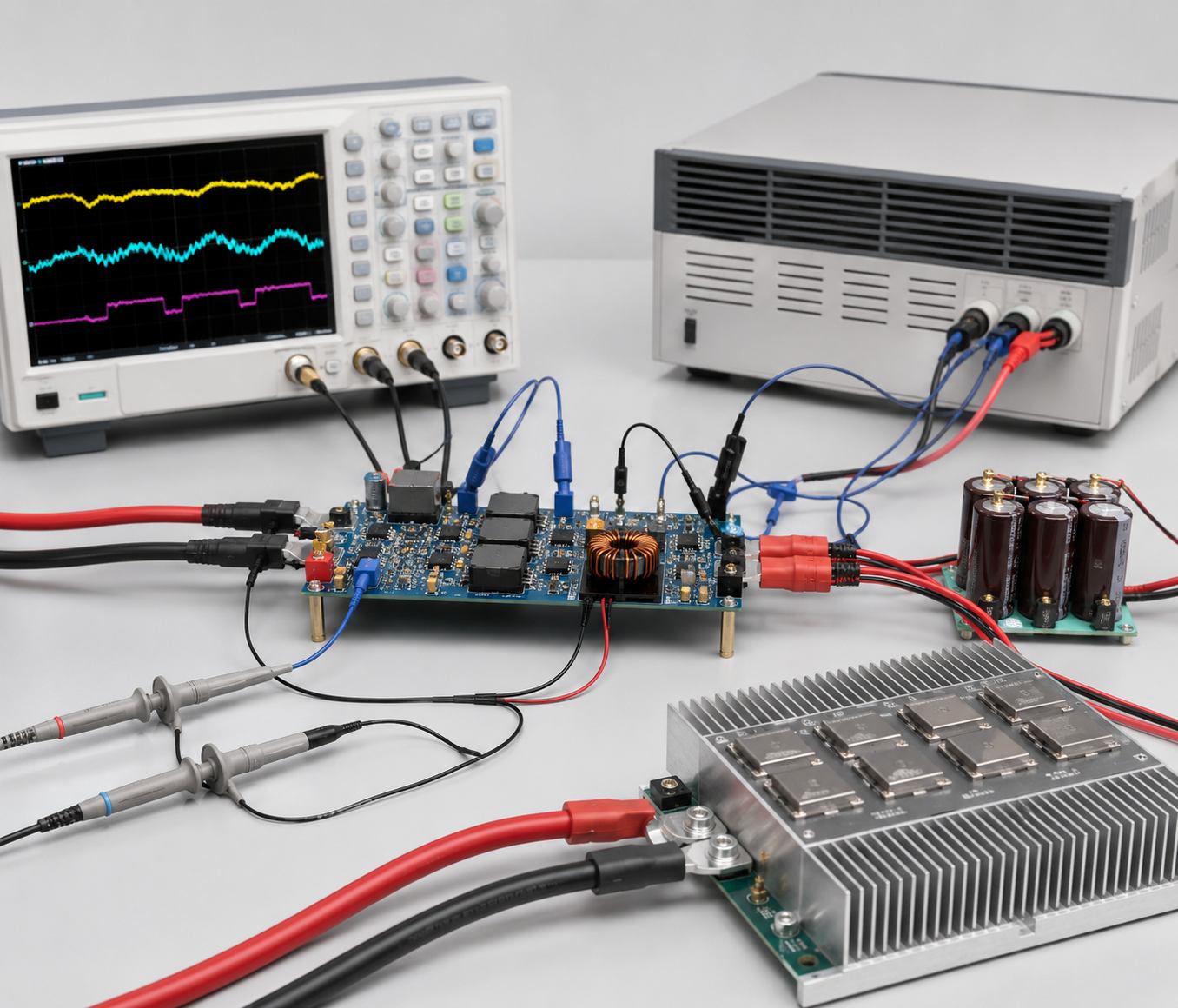
Engineering guide to dynamic load response testing for high-current buck converters, covering load step setup, slew rate, Vcore undershoot, overshoot, recovery time, probe location, output capacitors a…
Engineering guide to output capacitor selection for ASIC Vcore rails, covering bulk capacitors, polymer capacitors, MLCC decoupling, DC bias, ESR, ESL, placement, transient response and substitution ri…
Engineering guide to high-current ASIC Vcore rails, covering 12-phase buck architecture, PMBus control, dynamic load testing, output capacitor networks, smart power stage selection, thermal design and …
Voltage regulator guide covering linear, LDO, 7805, Zener, adjustable, buck, VRM and alternator regulators, with design checks, testing methods, troubleshooting and datasheet-based selection.
Amplifier guide covering voltage, current and power amplification, gain, feedback, amplifier classes, audio and RF applications, op-amp circuits, transimpedance amplifiers, datasheet selection and trou…


