Vishay General Semiconductor - Diodes Division BZG03C75TR
- Part No.:
- BZG03C75TR
- Manufacturer:
- Vishay General Semiconductor - Diodes Division
- Category:
- Single Zener Diodes
- Package:
- DO-214AC, SMA
- Datasheet:
-
BZG03C75TR.pdf
- Description:
- DIODE ZENER 75V 1.25W DO214AC
- Quantity:
- Payment:

- Shipping:

Inventory:4,454
Please send an inquiry. Send us your inquiry, and we will respond immediately.
Product details
Overview
BZG03C75TR from Vishay Semiconductors is a glass-passivated, surface-mount Zener diode rated for 75 V nominal Zener voltage (VZ = 70–79 V at IZT = 10 mA), 3 W steady-state power dissipation at Tamb = 100 °C with RthJA < 25 K/W, and 600 W non-repetitive surge capability (tp = 100 µs). It stabilizes reference voltages in industrial power supplies and overvoltage protection circuits.
For engineers reviewing the BZG03C75TR datasheet, BZG03C75TR pinout, BZG03C75TR application, or BZG03C75TR equivalent, key selection criteria include its DO-214AC package compatibility, ±5% VZ tolerance, 30 Ω dynamic resistance at 10 mA, temperature coefficient of +0.08%/K, and RoHS-compliant lead-free construction.
Technical Context
The BZG03C75TR operates as a precision voltage reference device using a silicon p-n junction with glass passivation for enhanced reliability and moisture resistance. Its thermal design supports mounting on Al2O3 ceramic substrates (RthJA = 100 K/W) or epoxy-glass PCBs (RthJA = 125–150 K/W), enabling stable operation up to 150 °C junction temperature.
It delivers regulated output under reverse-bias conditions with low leakage (IR ≤ 1 µA at VR = 56 V) and controlled forward conduction (VF = 1.2 V at IF = 0.5 A), supporting bidirectional transient suppression and clamping functions in DC power rails.
Key Specifications
| Parameter | Value and Actual Design Meaning |
|---|---|
| Zener voltage VZ | 70–79 V at 10 mA test current - defines stable regulation window for 75 V nominal systems |
| Power dissipation Pdiss | 3 W at Tamb = 100 °C with RthJA < 25 K/W - sets maximum continuous thermal load on PCB |
| Dynamic resistance rzj | 30 Ω typical at IZT = 10 mA - determines output impedance and regulation sensitivity to current changes |
| Temperature coefficient TKVZ | +0.08%/K typical - quantifies VZ drift per degree Celsius for high-stability designs |
| Surge power PZSM | 600 W for 100 µs pulse - enables transient overvoltage absorption without failure |
| Reverse leakage IR | ≤ 1 µA at VR = 56 V - ensures minimal standby current in voltage-sensing paths |
| Junction temperature Tj | 150 °C maximum - constrains thermal derating and heatsink requirements |
Pinout & Package
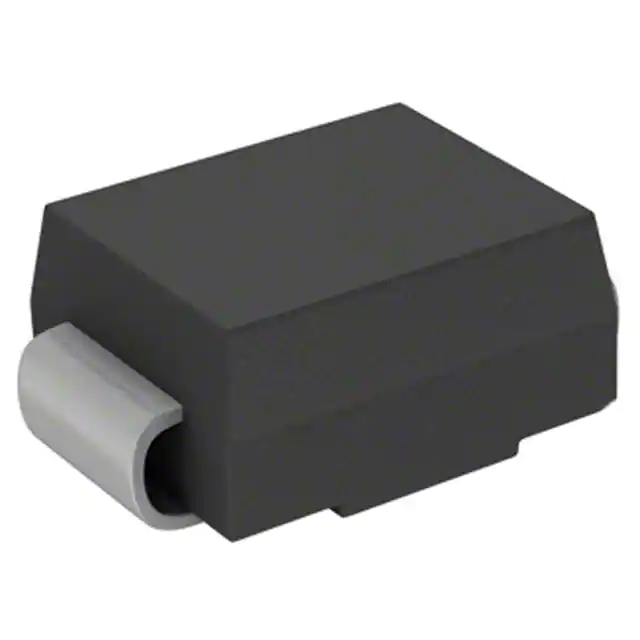
Package: DO-214AC (SMA), surface-mount, 2-terminal configuration with cathode band marking. Approximate weight: 77 mg.
| Pin/Terminal | Circuit Role | Design Meaning |
|---|---|---|
| Anode | Forward current entry / Reverse bias cathode reference | Connected to lower-potential node in clamping or regulation circuit |
| Cathode | Reverse breakdown terminal / Zener reference output | Provides stabilized voltage relative to anode; marked with band on package |
Key Features
| Feature | Design Value |
|---|---|
| Glass passivated junction | Enables high humidity resistance and long-term parameter stability in industrial environments |
| Wave and reflow solderable | Supports automated SMT assembly without special process modifications |
| Lead (Pb)-free and RoHS compliant | Fulfills EU Directive 2002/95/EC and WEEE 2002/96/EC for eco-conscious manufacturing |
| Fits 5 mm SMD footpads | Ensures mechanical compatibility with standard SMA land patterns on PCBs |
Applications
| Industrial Power Supply Regulation | Automotive ECU Voltage Reference |
|---|---|
Use Scenario: Stabilizing feedback voltage in isolated DC-DC converters for PLC modules and motor drives. IC Role / Device Role / Timing Role: Zener reference element providing precise 75 V threshold for error amplifier input. Use Value: Maintains ±5% output regulation across temperature (-65 to +150 °C) with 30 Ω dynamic impedance. | Use Scenario: Clamping battery-supplied microcontroller supply rail during load-dump transients. IC Role / Device Role / Timing Role: Overvoltage protection diode shunting excess energy to ground above 79 V. Use Value: Absorbs 600 W surge pulses without degradation, meeting ISO 7637-2 Pulse 5a requirements. |
| Telecom Line Card Protection | Renewable Energy Inverter Monitoring |
Use Scenario: Protecting analog front-end inputs from induced surges on 48 V telecom distribution lines. IC Role / Device Role / Timing Role: Bidirectional transient suppressor limiting voltage swing between anode and cathode. Use Value: Delivers 1.2 V forward drop at 0.5 A and sub-µA leakage at 56 V, minimizing signal path interference. | Use Scenario: Providing stable reference for DC-link voltage sensing in solar inverters operating at 600–1000 V bus levels. IC Role / Device Role / Timing Role: Secondary Zener reference cascaded with high-voltage divider for scaling accuracy. Use Value: Enables 0.08%/K temperature tracking to reduce calibration drift over wide ambient ranges. |
Equivalent & Alternatives
The following parts are listed as comparable options for similar Zener diode applications.
| Alternative Part | Technical Difference | Application Difference | Selection Advice |
|---|---|---|---|
| SMBJ75A | TVS diode with 75 V standoff voltage, 600 W peak pulse power, but higher clamping voltage (121 V) and no precise Zener regulation | Designed for transient suppression only-not suitable for precision voltage reference use | Select when surge immunity dominates over regulation accuracy |
| 1N5365B | Through-hole 75 V Zener, 5 W power rating, TO-204AA package, higher thermal resistance (RthJA ≈ 250 K/W) | Requires through-hole assembly and larger board area; less suitable for high-density SMT layouts | Select when higher continuous power and legacy through-hole compatibility are required |
Compared with SMBJ75A and 1N5365B, the BZG03C75TR uniquely combines SMT-compatible DO-214AC packaging, tight 70–79 V Zener tolerance, and 30 Ω dynamic resistance-making it optimal for space-constrained, precision-regulated 75 V reference designs where thermal performance and long-term stability are critical.
Availability
BZG03C75TR is available at Aetrix Electronics and suitable for industrial power supplies, automotive ECUs, telecom line cards, and renewable energy inverters requiring stable component supply and full traceability.
Supply support for BZG03C75TR includes scheduled delivery planning, volume procurement assistance, BOM continuity management, traceable sourcing, and lifecycle availability coordination for OEM customers, industrial embedded developers, connected-device designers, and electronics production programs.
Manufacturer
Vishay Semiconductors is a global leader in discrete semiconductors, specializing in high-reliability diodes, MOSFETs, optoelectronics, and passive components for industrial, automotive, and computing markets.
The BZG03C-Series targets high-stability, surface-mount Zener regulation in harsh environments-designed for applications demanding glass passivation, RoHS compliance, and robust surge handling without sacrificing voltage accuracy.
FAQ
What is the Zener voltage tolerance of BZG03C75TR?
The BZG03C75TR has a specified Zener voltage range of 70 V to 79 V at 10 mA test current, corresponding to a ±5% tolerance around the nominal 75 V rating. This tolerance is confirmed in the Electrical Characteristics table of Vishay Document Number 85593 Rev. 1.7 and applies under standard test conditions (Tamb = 25 °C).
Can BZG03C75TR be used in reflow soldering processes?
Yes, the BZG03C75TR is explicitly rated for both wave and reflow soldering per its datasheet. Its DO-214AC package and glass-passivated junction withstand standard Pb-free reflow profiles (e.g., JEDEC J-STD-020), making it compatible with automated SMT assembly lines without special thermal profiling.
What is the maximum junction temperature for BZG03C75TR?
The absolute maximum junction temperature for BZG03C75TR is 150 °C, as stated in the Absolute Maximum Ratings section of Vishay's Document Number 85593. Operation beyond this limit risks permanent parametric shift or catastrophic failure, and thermal design must ensure Tj remains within specification under worst-case power dissipation.
How does the temperature coefficient affect BZG03C75TR's performance?
The BZG03C75TR exhibits a typical temperature coefficient of +0.08%/K, meaning its Zener voltage increases by approximately 0.06 V per 10 °C rise in junction temperature. This positive drift is critical for predicting regulation accuracy across operating temperature ranges and must be factored into reference-circuit error budgets.
Is BZG03C75TR compliant with RoHS and lead-free requirements?
Yes, BZG03C75TR is certified lead (Pb)-free and compliant with RoHS Directive 2002/95/EC and WEEE Directive 2002/96/EC, as documented in Vishay's official datasheet (Rev. 1.7, 15-Sep-05). The component contains no restricted substances above allowable thresholds and supports environmentally responsible manufacturing.
BZG03C75TR Specifications
- Product attributes
- Attribute value
- Manufacturer:
- Vishay General Semiconductor - Diodes Division
- Series:
- BZG03C
- Package/Case:
- DO-214AC, SMA
- Packaging:
- Tape & Reel (TR)
- Product Status:
- Obsolete
- Voltage - Zener (Nom) (Vz):
- 75 V
- Tolerance:
- -
- Power - Max:
- 1.25 W
- Impedance (Max) (Zzt):
- 100 Ohms
- Current - Reverse Leakage @ Vr:
- 1 µA @ 56 V
- Voltage - Forward (Vf) (Max) @ If:
- 1.2 V @ 500 mA
- Operating Temperature:
- -65°C ~ 150°C
- Grade:
- -
- Qualification:
- -
- Mounting Type:
- Surface Mount
- Supplier Device Package:
- DO-214AC (SMA)
BZG03C75TR FAQ
1.How can I place an order for BZG03C75TR through Aetrix?
Please submit a Request for Quotation (RFQ) for BZG03C75TR on Aetrix. Our sales agent will provide a competitive quotation and guide you through the order confirmation once you accept the terms.
2.Are the price and stock information for BZG03C75TR reliable?
The price and inventory of BZG03C75TR are updated periodically and may fluctuate due to market conditions. Stock and pricing data are typically refreshed every 24 hours. Quotation validity for BZG03C75TR is usually 5 days.
3.What payment methods are accepted for BZG03C75TR?
We accept Wire Transfer, PayPal, Credit Card, Western Union, MoneyGram, and Escrow for BZG03C75TR transactions.
Note: Certain payment methods may incur a processing fee.
4.How is shipping managed for BZG03C75TR?
BZG03C75TR orders can be shipped via leading logistics carriers, including DHL, UPS, FedEx, TNT, or Registered Mail.
Once your BZG03C75TR order is processed, you will receive an email with the shipment details and tracking number.
Note: Tracking information may take up to 24 hours to appear. Express delivery typically takes 3–5 business days.
5.How can I obtain technical support or documentation for BZG03C75TR?
For technical support, including BZG03C75TR datasheets, pinout diagrams, or application guidance, please contact our engineering support team. They can provide detailed documentation and assistance for your BZG03C75TR requirements.
6.How does Aetrix verify that BZG03C75TR is sourced from the original manufacturer or authorized distributors?
All BZG03C75TR products on Aetrix are procured from qualified distributors and authorized channels. Our dedicated quality assurance team conducts strict verification, including traceability checks and, if necessary, third-party testing. This ensures that BZG03C75TR meets industry standards.
7.What is the process for return or replacement of BZG03C75TR?
All BZG03C75TR units undergo pre-shipment inspection (PSI). If there is an issue with BZG03C75TR, returns or replacements are accepted under the following conditions:
1.Quantity discrepancies, incorrect items, or visible external defects (such as breakage or corrosion), acknowledged by Aetrix.
2.The issue is reported within 90 days of delivery.
3.The BZG03C75TR part is unused and in its original packaging.
Return procedure for BZG03C75TR:
1.Submit a request within 90 days.
2.Obtain a Return Material Authorization (RMA) from Aetrix.
BZG03C75TR Tags
-
MMBZ5240B-7-F
Diodes Incorporated
-
BZT52C5V6T-7
Diodes Incorporated
-
MMSZ5231B-7-F
Diodes Incorporated

-
BZT52C15-7-F
Diodes Incorporated
-
BZX84C3V3LT1G
onsemi
-
MMSZ5245BS-7-F
Diodes Incorporated
-
MMSZ4682T1G
onsemi

-
BZT52C15S-7-F
Diodes Incorporated
-
MM5Z5V1ST1G
onsemi
-
SMAJ4744A-TP
Micro Commercial Co
-
BZT52C3V6LP-7
Diodes Incorporated
-
SMAZ12-13-F
Diodes Incorporated
Tech Hub

Comparator circuit design covering voltage thresholds, input limits, open-collector outputs, LM393 wiring, op-amp differences, hysteresis, timing, window detection and practical fault diagnosis.
Schmitt triggers use separate rising and falling thresholds to stabilize slow or noisy signals. This guide covers hysteresis, 74HC14 and 74HCT14 selection, comparator calculations, RC oscillators and p…
Counterfeit components can hide behind convincing markings and passing basic function tests. This engineering reference covers source traceability, external inspection, X-ray, XRF, electrical testing, …
A practical engineering and sourcing framework covering lifecycle verification, lifetime-buy calculations, replacement qualification, supplier checks and counterfeit-risk controls.
TTL and CMOS logic families differ in thresholds, loading, output drive, power and timing. This engineering guide compares 74HC and 74HCT, calculates noise margins and checks 3.3 V/5 V compatibility.
A practical engineering guide to 3.3V and 5V logic compatibility, input thresholds, resistor dividers, translator ICs, MOSFET level shifting, I2C pull-ups, timing limits and power-sequencing risks.
The 74HC595 uses push-pull logic outputs, while the TPIC6B595 uses 50 V open-drain DMOS sinks for higher-power loads. This guide compares timing, current limits, 3.3 V interfacing, load wiring, thermal…
The 74HC595 converts serial data into eight stable parallel outputs. This guide covers pin functions, shift and storage timing, OE and MR behavior, drive-current limits, cascading, voltage compatibilit…
A technical comparison of level-sensitive latches and edge-triggered flip-flops, covering timing windows, setup and hold limits, master–slave operation, time borrowing, race-through, HDL inference and…
A D latch stores one bit while Enable controls when data can pass. This reference covers gate-level operation, truth tables, transparency, setup and hold timing, LE versus OE, common ICs and practical …