Qorvo CMD282C3
- Part No.:
- CMD282C3
- Manufacturer:
- Qorvo
- Category:
- Attenuators
- Package:
- 12-WFQFN Exposed Pad
- Datasheet:
-
CMD282C3.pdf
- Description:
- DC-22 GHZ 2-BIT DIGITAL ATTENUAT
- Quantity:
- Payment:

- Shipping:

Inventory:1,769
Please send an inquiry. Send us your inquiry, and we will respond immediately.
Product details
Overview
CMD282C3 from Qorvo is a GaAs pHEMT MMIC low-noise amplifier operating from 2–20 GHz with 17 dB small-signal gain, 2.5 dB noise figure, and +22 dBm output IP3 at 10 GHz. It functions as a front-end LNA in wideband RF receiver chains for defense radar and electronic warfare systems.
For engineers reviewing the CMD282C3 datasheet, pinout, applications, or equivalent options, key selection criteria include its broadband 2–20 GHz coverage, low 2.5 dB NF, high linearity (+22 dBm OIP3), DC bias requirements (Vdd = +5 V, Id = 60 mA), and 50 Ω matched RF ports requiring no external matching.
Technical Context
The CMD282C3 employs a single-stage GaAs pHEMT design optimized for wideband low-noise amplification without internal matching networks. Its cascode topology enables stable operation across 2–20 GHz while maintaining unconditional stability (K > 1, μ > 1) per S-parameter data.
It requires only two external DC blocking capacitors and one RF choke for biasing; all RF ports are internally matched to 50 Ω, eliminating need for external impedance transformers or tuning stubs in most applications.
Key Specifications
| Parameter | Value and Actual Design Meaning |
|---|---|
| Frequency Range | 2–20 GHz: supports full-bandwidth operation in EW receivers and multi-band test equipment without re-tuning. |
| Small-Signal Gain | 17 dB @ 10 GHz: provides sufficient first-stage amplification to overcome subsequent mixer noise figure degradation. |
| Noise Figure | 2.5 dB @ 10 GHz: enables high sensitivity in low-SNR signal detection scenarios such as passive radar or SIGINT. |
| OIP3 | +22 dBm @ 10 GHz: ensures robust two-tone intermodulation performance in dense RF environments like EW jamming platforms. |
| Supply Voltage / Current | +5 V / 60 mA: compatible with standard 5 V supply rails and low-power system budgets in portable EW subsystems. |
| Input/Output Impedance | 50 Ω matched: allows direct integration into coaxial test fixtures and microstrip PCB layouts without matching circuitry. |
Pinout & Package
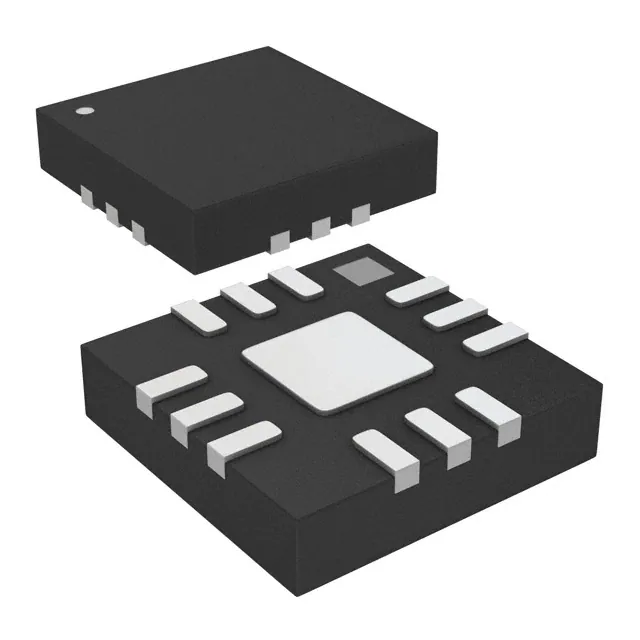
The CMD282C3 is housed in a leadless 3 mm × 3 mm ceramic surface-mount package (QFN) with exposed thermal pad for enhanced RF and thermal performance.
| Pin/Terminal | Circuit Role | Design Meaning |
|---|---|---|
| VDD | Positive DC supply | Connects to +5 V via RF choke; internal decoupling not provided - external 100 nF capacitor required. |
| RF_IN | Input RF port | 50 Ω matched input; DC-coupled - external blocking capacitor mandatory for AC-coupled systems. |
| RF_OUT | Output RF port | 50 Ω matched output; DC-coupled - external blocking capacitor mandatory for AC-coupled loads. |
| GND | Ground reference | All package-side GND pads and thermal pad must be soldered to solid ground plane for stability and thermal dissipation. |
Key Features
| Feature | Design Value |
|---|---|
| Ultra-wideband operation | 2–20 GHz continuous coverage enables single-LNA replacement of multiple narrowband amplifiers in EW front-ends. |
| Internally matched 50 Ω I/O | Eliminates discrete matching components, reducing board area and assembly cost in high-frequency PCB designs. |
| Unconditionally stable | K > 1 and μ > 1 across full band - no external stabilization networks required for reliable production deployment. |
| Low power consumption | 60 mA at +5 V enables use in battery-backed or thermally constrained EW modules without active cooling. |
Applications
| Electronic Warfare Receivers | Defense Radar Front-Ends |
|---|---|
Use Scenario: Wideband signal acquisition across HF–Ku band for real-time threat identification and direction finding. IC Role / Device Role / Timing Role: First-stage low-noise amplifier in superheterodyne receiver chain before downconversion. Use Value: 2.5 dB NF preserves weak signal integrity; 17 dB gain maintains cascade SNR ahead of lossy filters and mixers. | Use Scenario: Pulse-Doppler radar receiver requiring high dynamic range and minimal added noise in airborne platforms. IC Role / Device Role / Timing Role: Low-noise amplification of reflected RF pulses prior to analog-to-digital conversion. Use Value: +22 dBm OIP3 prevents in-band intermodulation distortion from clutter or jamming signals during pulse compression. |
| Multi-Band Test Equipment | SIGINT Systems |
Use Scenario: Broadband spectrum analyzers and vector signal analyzers needing flat gain and low distortion over 2–20 GHz. IC Role / Device Role / Timing Role: Calibration-grade gain block in instrument front-end architecture. Use Value: 17 dB gain with ±0.5 dB flatness reduces need for variable-gain stages and simplifies amplitude correction algorithms. | Use Scenario: Covert communications intelligence collection systems operating across multiple military frequency bands. IC Role / Device Role / Timing Role: Pre-amplifier in wideband antenna interface module feeding digital backend processors. Use Value: 2–20 GHz coverage captures legacy and modern waveforms (e.g., TACAN, Link 16, SATCOM) without hardware reconfiguration. |
Equivalent & Alternatives
The following parts are listed as comparable options for similar wideband LNA applications.
| Alternative Part | Technical Difference | Application Difference | Selection Advice |
|---|---|---|---|
| QPL9057 | Narrower bandwidth (0.6–6 GHz), lower NF (0.45 dB), higher gain (21.5 dB) | Optimized for sub-6 GHz 5G infrastructure and cellular base stations, not EW broadband needs | Select only if operating exclusively below 6 GHz and ultra-low NF is critical. |
| MACOM MAAL-011078 | Wider bandwidth (0.01–26.5 GHz), higher NF (3.5 dB), lower OIP3 (+19 dBm) | Used in lab-grade VNAs and EMC test receivers where ultimate linearity is secondary to frequency coverage | Prefer when absolute maximum bandwidth trumps noise and linearity specs. |
Compared with QPL9057 and MAAL-011078, the CMD282C3 uniquely balances 2–20 GHz coverage, 2.5 dB NF, and +22 dBm OIP3 - making it the only option qualified for demanding defense EW front-end designs requiring simultaneous broadband sensitivity and strong-signal resilience.
Availability
CMD282C3 is available at Aetrix Electronics and suitable for electronic warfare receivers, defense radar front-ends, and multi-band test equipment requiring stable component supply despite its Last Time Buy status.
Supply support for CMD282C3 includes scheduled delivery planning, volume procurement assistance, BOM continuity management, traceable sourcing, and lifecycle availability coordination for OEM customers, industrial embedded developers, connected-device designers, and electronics production programs.
Manufacturer
Qorvo is a U.S.-based fabless semiconductor company specializing in RF, power, and connectivity solutions for defense, infrastructure, and mobile markets.
The CMD282C3 belongs to Qorvo's high-frequency MMIC amplifier product line, engineered specifically for broadband electronic warfare and radar signal chain applications demanding wide instantaneous bandwidth and rugged RF performance.
FAQ
What is the operating frequency range of the CMD282C3?
The CMD282C3 operates continuously from 2 GHz to 20 GHz. This ultra-wideband coverage is verified by S-parameter measurements across the full band and enables single-device deployment in multi-octave electronic warfare and radar systems without band-switching hardware. The CMD282C3 maintains specified gain, noise figure, and linearity throughout this range under recommended bias conditions.
Does the CMD282C3 require external matching components?
No, the CMD282C3 features internally matched 50 Ω input and output ports. External DC blocking capacitors are required on both RF_IN and RF_OUT due to DC coupling, but no impedance-matching networks, stubs, or transformers are needed. This simplifies layout and improves repeatability in high-frequency PCB assemblies using the CMD282C3.
What is the noise figure specification for the CMD282C3?
The CMD282C3 has a typical noise figure of 2.5 dB at 10 GHz under standard test conditions (Vdd = +5 V, Id = 60 mA). This value is measured and guaranteed per Qorvo's production test flow and directly supports high-sensitivity applications such as passive radar detection and low-SNR SIGINT where preserving weak signal integrity is critical. The CMD282C3 maintains NF ≤ 3.2 dB across its full 2–20 GHz range.
Is the CMD282C3 unconditionally stable?
Yes, the CMD282C3 is unconditionally stable across its entire 2–20 GHz operating band, with Rollett stability factor K > 1 and μ > 1 at all frequencies under nominal bias. This eliminates the need for external stabilization networks or resistive loading, enabling robust integration into production EW and radar systems without risk of oscillation. Stability is confirmed in the CMD282C3 datasheet S-parameter files.
What does "Last Time Buy" mean for the CMD282C3?
"Last Time Buy" indicates that Qorvo has announced final manufacturing and sale of the CMD282C3, with no future production planned. Aetrix Electronics maintains active inventory and offers lifecycle coordination services - including lot traceability, extended warranty, and BOM continuity planning - to support ongoing use of the CMD282C3 in deployed defense and test systems where redesign is impractical or costly.
CMD282C3 Specifications
- Product attributes
- Attribute value
- Manufacturer:
- Qorvo
- Package/Case:
- 12-WFQFN Exposed Pad
- Series:
- -
- Packaging:
- Tape & Reel (TR)
- Product Status:
- Active
- Attenuation Value:
- 12dB
- Frequency Range:
- 0 Hz ~ 40 GHz
- Power (Watts):
- -
- Impedance:
- 50 Ohms
- Grade:
- -
- Qualification:
- -
CMD282C3 FAQ
1.How can I place an order for CMD282C3 through Aetrix?
Please submit a Request for Quotation (RFQ) for CMD282C3 on Aetrix. Our sales agent will provide a competitive quotation and guide you through the order confirmation once you accept the terms.
2.Are the price and stock information for CMD282C3 reliable?
The price and inventory of CMD282C3 are updated periodically and may fluctuate due to market conditions. Stock and pricing data are typically refreshed every 24 hours. Quotation validity for CMD282C3 is usually 5 days.
3.What payment methods are accepted for CMD282C3?
We accept Wire Transfer, PayPal, Credit Card, Western Union, MoneyGram, and Escrow for CMD282C3 transactions.
Note: Certain payment methods may incur a processing fee.
4.How is shipping managed for CMD282C3?
CMD282C3 orders can be shipped via leading logistics carriers, including DHL, UPS, FedEx, TNT, or Registered Mail.
Once your CMD282C3 order is processed, you will receive an email with the shipment details and tracking number.
Note: Tracking information may take up to 24 hours to appear. Express delivery typically takes 3–5 business days.
5.How can I obtain technical support or documentation for CMD282C3?
For technical support, including CMD282C3 datasheets, pinout diagrams, or application guidance, please contact our engineering support team. They can provide detailed documentation and assistance for your CMD282C3 requirements.
6.How does Aetrix verify that CMD282C3 is sourced from the original manufacturer or authorized distributors?
All CMD282C3 products on Aetrix are procured from qualified distributors and authorized channels. Our dedicated quality assurance team conducts strict verification, including traceability checks and, if necessary, third-party testing. This ensures that CMD282C3 meets industry standards.
7.What is the process for return or replacement of CMD282C3?
All CMD282C3 units undergo pre-shipment inspection (PSI). If there is an issue with CMD282C3, returns or replacements are accepted under the following conditions:
1.Quantity discrepancies, incorrect items, or visible external defects (such as breakage or corrosion), acknowledged by Aetrix.
2.The issue is reported within 90 days of delivery.
3.The CMD282C3 part is unused and in its original packaging.
Return procedure for CMD282C3:
1.Submit a request within 90 days.
2.Obtain a Return Material Authorization (RMA) from Aetrix.
CMD282C3 Tags

-
PAT0510S-C-3DB-T10
Susumu

-
PAT0510S-C-10DB-T10
Susumu

-
PAT0510S-C-2DB-T10
Susumu
-
PAT1220-C-10DB-T5
Susumu

-
PAT1220-C-6DB-T5
Susumu

-
PAT1220-C-0DB-T5
Susumu

-
PAT1220-C-3DB-T5
Susumu

-
PAT1220-C-5DB-T5
Susumu

-
PAT1220-C-8DB-T5
Susumu
-
MAADSS0008TR-3000
MACOM Technology Solutions

-
MAATSS0018TR-3000
MACOM Technology Solutions
-
PE43205B-Z
pSemi
Tech Hub
Comparator circuit design covering voltage thresholds, input limits, open-collector outputs, LM393 wiring, op-amp differences, hysteresis, timing, window detection and practical fault diagnosis.
Schmitt triggers use separate rising and falling thresholds to stabilize slow or noisy signals. This guide covers hysteresis, 74HC14 and 74HCT14 selection, comparator calculations, RC oscillators and p…
Counterfeit components can hide behind convincing markings and passing basic function tests. This engineering reference covers source traceability, external inspection, X-ray, XRF, electrical testing, …
A practical engineering and sourcing framework covering lifecycle verification, lifetime-buy calculations, replacement qualification, supplier checks and counterfeit-risk controls.
TTL and CMOS logic families differ in thresholds, loading, output drive, power and timing. This engineering guide compares 74HC and 74HCT, calculates noise margins and checks 3.3 V/5 V compatibility.
A practical engineering guide to 3.3V and 5V logic compatibility, input thresholds, resistor dividers, translator ICs, MOSFET level shifting, I2C pull-ups, timing limits and power-sequencing risks.
The 74HC595 uses push-pull logic outputs, while the TPIC6B595 uses 50 V open-drain DMOS sinks for higher-power loads. This guide compares timing, current limits, 3.3 V interfacing, load wiring, thermal…
The 74HC595 converts serial data into eight stable parallel outputs. This guide covers pin functions, shift and storage timing, OE and MR behavior, drive-current limits, cascading, voltage compatibilit…
A technical comparison of level-sensitive latches and edge-triggered flip-flops, covering timing windows, setup and hold limits, master–slave operation, time borrowing, race-through, HDL inference and…
A D latch stores one bit while Enable controls when data can pass. This reference covers gate-level operation, truth tables, transparency, setup and hold timing, LE versus OE, common ICs and practical …