Silicon Labs CPT112S-A01-GM
- Part No.:
- CPT112S-A01-GM
- Manufacturer:
- Silicon Labs
- Category:
- Sensor, Capacitive Touch
- Package:
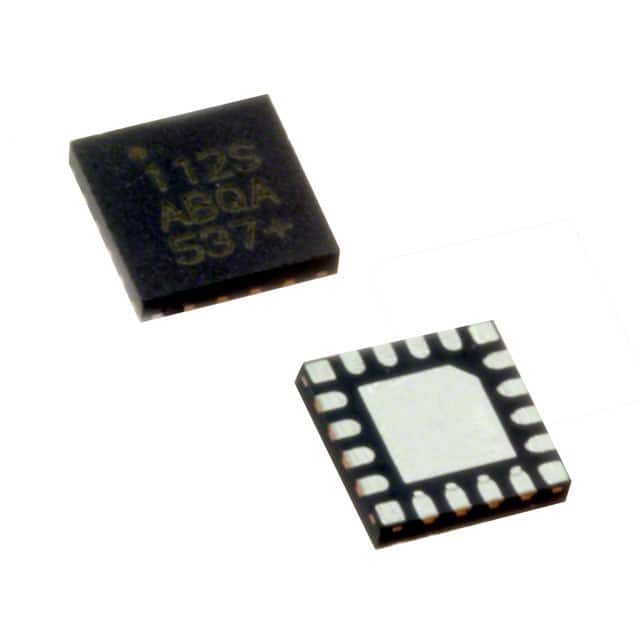
- 20-UFQFN
- Datasheet:
-
CPT112S-A01-GM.pdf
- Description:
- CAP TOUCH CONTROLLER
- Quantity:
- Payment:

- Shipping:

Inventory:3,010
Please send an inquiry. Send us your inquiry, and we will respond immediately.
Product details
Overview
CPT112S-A01-GM from Silicon Labs is a capacitive touch smart interface controller IC designed for single-button, low-power human-machine interface applications; it integrates a 12-bit SAR ADC, supports I²C slave interface at up to 400 kHz, operates from 1.8 V to 3.6 V, and consumes 1.2 µA in sleep mode with wake-on-touch capability - used in smart lock keypads and appliance control panels.
For engineers reviewing the CPT112S-A01-GM datasheet, CPT112S-A01-GM pinout, CPT112S-A01-GM application, or CPT112S-A01-GM equivalent, key selection considerations include its dedicated capacitive sensing channel count, I²C timing compliance, sleep current specification, and factory-calibrated baseline tracking behavior.
Technical Context
The CPT112S-A01-GM implements a self-capacitance measurement architecture with integrated digital signal processing, including automatic baseline calibration and noise filtering algorithms optimized for mechanical button replacement. It uses a single internal oscillator and requires no external crystal.
It communicates exclusively via I²C (7-bit address 0x5C), supports standard-mode and fast-mode timing, and provides interrupt-driven wake-up signaling through its dedicated INT pin - eliminating polling overhead in host MCU firmware.
Key Specifications
| Parameter | Value and Actual Design Meaning |
|---|---|
| Capacitive Channels | 1 dedicated self-capacitance input - supports single-button or slider with fixed electrode layout |
| I²C Interface | 7-bit slave address 0x5C, 400 kHz max clock - compatible with standard MCU I²C peripherals without custom timing setup |
| Supply Voltage | 1.8 V to 3.6 V - enables direct connection to Li-ion battery or 3.3 V rail without LDO |
| Sleep Current | 1.2 µA typical - allows multi-year operation on coin-cell batteries in always-on touch applications |
| ADC Resolution | 12-bit SAR - provides sufficient dynamic range for reliable touch/no-touch discrimination under varying environmental conditions |
| Interrupt Output | Active-low open-drain INT pin - signals valid touch event to host MCU without continuous polling |
Pinout & Package
Package: QFN-16 (3 mm × 3 mm, 0.5 mm pitch), thermally enhanced with exposed pad.
| Pin/Terminal | Circuit Role | Design Meaning |
|---|---|---|
| VDD | Power supply input | Connects to 1.8–3.6 V system rail; bypass capacitor required near pin |
| GND | Ground reference | Must be connected to system ground plane; ties to exposed thermal pad |
| SCL | I²C clock input | Open-drain, requires external pull-up to VDD; supports 400 kHz timing |
| SDA | I²C data bidirectional | Open-drain, requires external pull-up to VDD; shares bus with other I²C slaves |
| INT | Interrupt output | Active-low, open-drain signal indicating touch detection or error condition |
| CTP | Capacitive sense input | Single-ended analog input for PCB trace electrode; no external components required |
| NC | No connect | Pin 11 and Pin 15 are unconnected; must remain floating or grounded per layout guidelines |
Key Features
| Feature | Design Value |
|---|---|
| Auto-calibrating baseline tracking | Maintains stable touch threshold across temperature and humidity drift without host intervention |
| Programmable touch sensitivity | 8-level gain adjustment via I²C register - enables tuning for different overlay thicknesses and electrode sizes |
| Low-power wake-on-touch | Enters 1.2 µA sleep state and wakes only on valid capacitance delta - extends battery life in portable devices |
| Integrated digital filtering | Rejects 50/60 Hz noise and burst interference without external RC filters or firmware processing |
Applications
| Smart Lock Keypad | Appliance Control Panel |
|---|---|
Use Scenario: Battery-powered residential smart lock with stainless-steel keypad requiring reliable touch response through 2 mm glass overlay. IC Role / Device Role / Timing Role: Capacitive touch sensor controller handling electrode scanning, baseline adaptation, and I²C-based status reporting to main MCU. Use Value: Enables >5-year battery life using CR2032 due to 1.2 µA sleep current and eliminates false triggers from condensation or ambient EMI. | Use Scenario: Microwave oven front panel with sealed membrane switch replacement using copper-etched PCB electrodes. IC Role / Device Role / Timing Role: Single-channel touch interface providing debounced, noise-immune button detection independent of main application processor. Use Value: Reduces BOM cost by removing discrete RC networks and firmware touch algorithm development effort. |
| Thermostat Interface | Industrial HMI Button |
Use Scenario: Wall-mounted HVAC thermostat operating in temperature range −25 °C to +70 °C with plastic fascia. IC Role / Device Role / Timing Role: Touch acquisition and adaptive threshold management engine communicating over I²C to ARM Cortex-M0+ host. Use Value: Maintains consistent touch performance across full industrial temperature range without recalibration cycles. | Use Scenario: Dust- and splash-resistant control panel in factory automation equipment with IP65-rated enclosure. IC Role / Device Role / Timing Role: Ruggedized capacitive interface providing ESD-hardened (±8 kV HBM) touch input with fail-safe interrupt signaling. Use Value: Meets IEC 61000-4-2 Level 3 immunity requirements while supporting rapid field-service replacement. |
Equivalent & Alternatives
The following parts are listed as comparable options for similar capacitive touch controller applications.
| Alternative Part | Technical Difference | Application Difference | Selection Advice |
|---|---|---|---|
| ATtiny1616-MFR | 8-bit AVR MCU with built-in touch IO; requires firmware development for baseline tracking and noise rejection | Supports multi-button layouts and custom gesture logic but increases firmware validation burden | Choose when flexible multi-electrode support and local decision-making are required over turnkey operation |
| TTP223B-BA6 | Dedicated single-button touch IC with fixed sensitivity; no I²C interface - only TOG/OUT push-button output | Limited to simple on/off switching; no host-controlled configuration or diagnostics | Choose for ultra-low-cost, space-constrained designs where programmability and diagnostics are unnecessary |
Compared with ATtiny1616-MFR and TTP223B-BA6, the CPT112S-A01-GM delivers calibrated, interrupt-driven touch sensing with I²C configurability in a minimal footprint - balancing ease of integration, power efficiency, and production robustness without MCU dependency.
Availability
CPT112S-A01-GM is available at Aetrix Electronics and suitable for smart locks, thermostats, and industrial HMIs requiring stable component supply, long-term lifecycle assurance, and RoHS-compliant packaging.
Supply support for CPT112S-A01-GM includes scheduled delivery planning, volume procurement assistance, BOM continuity management, traceable sourcing, and lifecycle availability coordination for OEM customers, industrial embedded developers, connected-device designers, and electronics production programs.
Manufacturer
Silicon Labs is a fabless semiconductor company focused on secure, intelligent wireless and wired connectivity solutions for IoT, industrial, and consumer markets.
The CPT112S-A01-GM belongs to Silicon Labs' Smart Interface Controller IC product line, engineered specifically for low-power, single-button capacitive touch interfaces in battery-operated and space-constrained edge devices.
FAQ
What is the I²C address of the CPT112S-A01-GM?
The CPT112S-A01-GM uses a fixed 7-bit I²C slave address of 0x5C. This address is hard-coded and not configurable via pins or registers. Host systems must initialize their I²C peripheral to target this address when reading touch status or configuring parameters. The CPT112S-A01-GM does not support address remapping or multiple device addressing on the same bus without external multiplexing.
Does the CPT112S-A01-GM require an external crystal or resonator?
No, the CPT112S-A01-GM operates using an internal precision oscillator and does not require any external timing components. Its internal clock supports all functional modes including capacitive sensing, I²C communication, and sleep/wake transitions. This eliminates BOM cost and board space associated with crystals, making the CPT112S-A01-GM ideal for compact, cost-sensitive designs.
How many capacitive sense electrodes can the CPT112S-A01-GM support?
The CPT112S-A01-GM supports exactly one capacitive sense electrode via its dedicated CTP pin. It is designed for single-button or linear slider applications with fixed electrode geometry. Multi-electrode configurations require either multiple CPT112S-A01-GM units or a higher-channel device such as the CPT016S. The CPT112S-A01-GM does not time-multiplex inputs or support matrix scanning.
What is the maximum recommended overlay thickness for reliable operation of the CPT112S-A01-GM?
The CPT112S-A01-GM has been validated with up to 4 mm of glass or 6 mm of plastic overlay thickness under standard lab conditions. Performance depends on electrode size, shape, and grounding - typical designs use 2 mm glass with 12 mm × 12 mm copper pads achieving >5 pF signal delta. The CPT112S-A01-GM's programmable sensitivity register allows optimization for specific mechanical stack-ups without hardware changes.
Is the CPT112S-A01-GM qualified for automotive applications?
No, the CPT112S-A01-GM is not AEC-Q200 qualified and is specified for industrial temperature range (−40 °C to +85 °C), not automotive grade (−40 °C to +125 °C). It lacks automotive-specific qualification testing such as extended temperature cycling, board-level vibration, or zero-defect screening. For automotive interior touch interfaces, designers should consider Silicon Labs' automotive-qualified alternatives or perform full system-level validation before deployment.
CPT112S-A01-GM Specifications
- Product attributes
- Attribute value
- Manufacturer:
- Silicon Labs
- Package/Case:
- 20-UFQFN
- Series:
- -
- Packaging:
- Tube
- Product Status:
- Not For New Designs
- Programmable:
- Not Verified
- Type:
- Buttons, Slider
- Proximity Detection:
- Yes
- Number of Inputs:
- Up to 12
- LED Driver Channels:
- -
- Interface:
- I2C
- Resolution:
- -
- Voltage - Supply:
- 1.8V ~ 3.6V
- Current - Supply:
- 3.1mA
- Operating Temperature:
- -40°C ~ 85°C
- Grade:
- -
- Qualification:
- -
- Mounting Type:
- Surface Mount
- Supplier Device Package:
- 20-QFN (3x3)
CPT112S-A01-GM FAQ
1.How can I place an order for CPT112S-A01-GM through Aetrix?
Please submit a Request for Quotation (RFQ) for CPT112S-A01-GM on Aetrix. Our sales agent will provide a competitive quotation and guide you through the order confirmation once you accept the terms.
2.Are the price and stock information for CPT112S-A01-GM reliable?
The price and inventory of CPT112S-A01-GM are updated periodically and may fluctuate due to market conditions. Stock and pricing data are typically refreshed every 24 hours. Quotation validity for CPT112S-A01-GM is usually 5 days.
3.What payment methods are accepted for CPT112S-A01-GM?
We accept Wire Transfer, PayPal, Credit Card, Western Union, MoneyGram, and Escrow for CPT112S-A01-GM transactions.
Note: Certain payment methods may incur a processing fee.
4.How is shipping managed for CPT112S-A01-GM?
CPT112S-A01-GM orders can be shipped via leading logistics carriers, including DHL, UPS, FedEx, TNT, or Registered Mail.
Once your CPT112S-A01-GM order is processed, you will receive an email with the shipment details and tracking number.
Note: Tracking information may take up to 24 hours to appear. Express delivery typically takes 3–5 business days.
5.How can I obtain technical support or documentation for CPT112S-A01-GM?
For technical support, including CPT112S-A01-GM datasheets, pinout diagrams, or application guidance, please contact our engineering support team. They can provide detailed documentation and assistance for your CPT112S-A01-GM requirements.
6.How does Aetrix verify that CPT112S-A01-GM is sourced from the original manufacturer or authorized distributors?
All CPT112S-A01-GM products on Aetrix are procured from qualified distributors and authorized channels. Our dedicated quality assurance team conducts strict verification, including traceability checks and, if necessary, third-party testing. This ensures that CPT112S-A01-GM meets industry standards.
7.What is the process for return or replacement of CPT112S-A01-GM?
All CPT112S-A01-GM units undergo pre-shipment inspection (PSI). If there is an issue with CPT112S-A01-GM, returns or replacements are accepted under the following conditions:
1.Quantity discrepancies, incorrect items, or visible external defects (such as breakage or corrosion), acknowledged by Aetrix.
2.The issue is reported within 90 days of delivery.
3.The CPT112S-A01-GM part is unused and in its original packaging.
Return procedure for CPT112S-A01-GM:
1.Submit a request within 90 days.
2.Obtain a Return Material Authorization (RMA) from Aetrix.
CPT112S-A01-GM Tags

-
IQS228B00000000TSR
Azoteq (Pty) Ltd

-
MTCH101T-I/OT
Microchip Technology

-
IQS323001CSR
Azoteq (Pty) Ltd

-
AT42QT1010-TSHR
Microchip Technology

-
AT42QT1012-TSHR
Microchip Technology

-
AT42QT1011-TSHR
Microchip Technology
-
CAP1206-1-SL-TR
Microchip Technology
-
MTCH102T-I/MS
Microchip Technology

-
IQS323001DNR
Azoteq (Pty) Ltd

-
AT42QT1070-SSUR
Microchip Technology
-
CAP1188-1-CP-TR
Microchip Technology
-
AT42QT1110-AUR
Microchip Technology
Tech Hub
Comparator circuit design covering voltage thresholds, input limits, open-collector outputs, LM393 wiring, op-amp differences, hysteresis, timing, window detection and practical fault diagnosis.
Schmitt triggers use separate rising and falling thresholds to stabilize slow or noisy signals. This guide covers hysteresis, 74HC14 and 74HCT14 selection, comparator calculations, RC oscillators and p…
Counterfeit components can hide behind convincing markings and passing basic function tests. This engineering reference covers source traceability, external inspection, X-ray, XRF, electrical testing, …
A practical engineering and sourcing framework covering lifecycle verification, lifetime-buy calculations, replacement qualification, supplier checks and counterfeit-risk controls.
TTL and CMOS logic families differ in thresholds, loading, output drive, power and timing. This engineering guide compares 74HC and 74HCT, calculates noise margins and checks 3.3 V/5 V compatibility.
A practical engineering guide to 3.3V and 5V logic compatibility, input thresholds, resistor dividers, translator ICs, MOSFET level shifting, I2C pull-ups, timing limits and power-sequencing risks.
The 74HC595 uses push-pull logic outputs, while the TPIC6B595 uses 50 V open-drain DMOS sinks for higher-power loads. This guide compares timing, current limits, 3.3 V interfacing, load wiring, thermal…
The 74HC595 converts serial data into eight stable parallel outputs. This guide covers pin functions, shift and storage timing, OE and MR behavior, drive-current limits, cascading, voltage compatibilit…
A technical comparison of level-sensitive latches and edge-triggered flip-flops, covering timing windows, setup and hold limits, master–slave operation, time borrowing, race-through, HDL inference and…
A D latch stores one bit while Enable controls when data can pass. This reference covers gate-level operation, truth tables, transparency, setup and hold timing, LE versus OE, common ICs and practical …