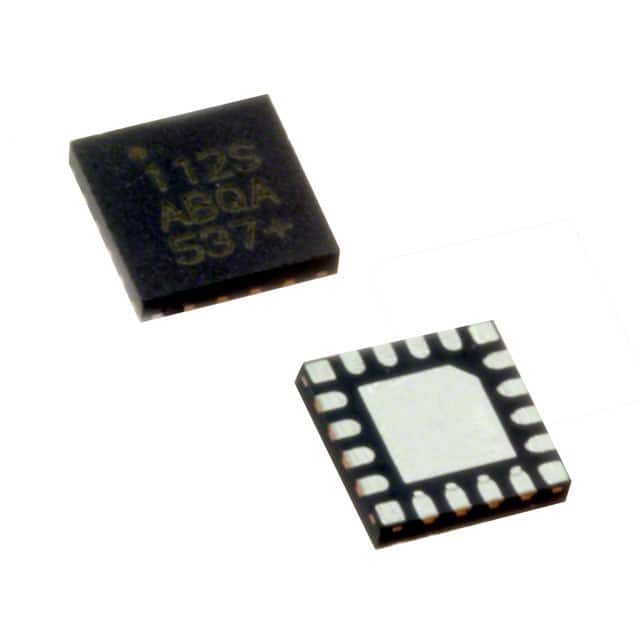
Silicon Labs CPT112S-A01-GMR
- Part No.:
- CPT112S-A01-GMR
- Manufacturer:
- Silicon Labs
- Category:
- Sensor, Capacitive Touch
- Package:
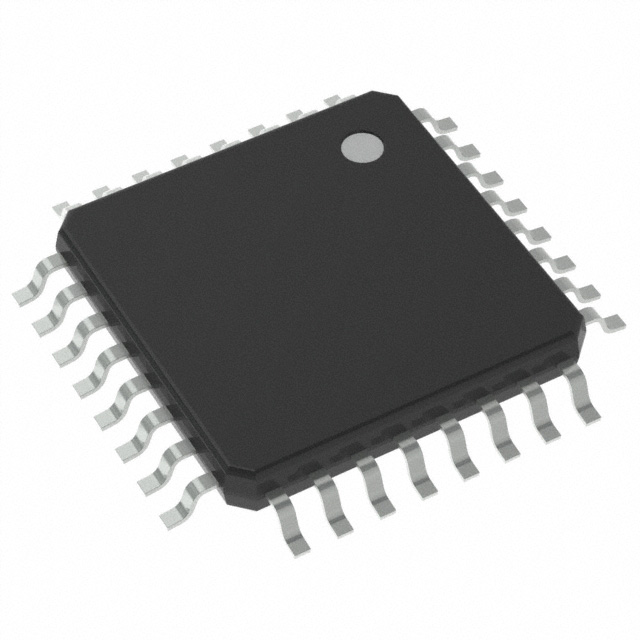
- 20-UFQFN
- Datasheet:
-
CPT112S-A01-GMR.pdf
- Description:
- IC CTLR CAP TOUCH 12CH GPIO 20QF
- Quantity:
- Payment:

- Shipping:

Inventory:1,576
Please send an inquiry. Send us your inquiry, and we will respond immediately.
Product details
Overview
CPT112S-A01-GMR from Silicon Labs is a capacitive touch smart interface controller IC designed for single-button human-machine interface applications, featuring 12-bit SAR ADC resolution, 2.7–5.5 V supply voltage, and integrated auto-calibration logic for robust operation in noisy environments - deployed in smart thermostats and appliance control panels.
For engineers reviewing the CPT112S-A01-GMR datasheet, CPT112S-A01-GMR pinout, CPT112S-A01-GMR application, or CPT112S-A01-GMR equivalent, key selection criteria include its self-capacitance sensing architecture, I²C slave interface (400 kHz), 8-pin QFN package, and factory-programmed threshold tuning for production-ready touch response without firmware development.
Technical Context
The CPT112S-A01-GMR implements a dedicated capacitive sensing engine with continuous background calibration, supporting single-electrode self-capacitance measurement only - no mutual-capacitance or proximity mode. It operates exclusively as an I²C slave device with fixed 7-bit address 0x2A and no UART or SPI interface.
Its internal signal chain includes a programmable gain amplifier (PGA), 12-bit SAR ADC, and digital filtering block that outputs 12-bit raw capacitance counts per electrode. All configuration registers are accessed via I²C; no external clock or reset pin is required - power-on reset and internal oscillator enable immediate operation after VDD stabilization.
Key Specifications
| Parameter | Value and Actual Design Meaning |
|---|---|
| Capacitance Range | 0–25 pF full-scale input - supports standard PCB trace electrodes without external components |
| I²C Interface | Standard-mode & fast-mode (400 kHz) slave only - no master capability or address reconfiguration |
| Supply Voltage | 2.7–5.5 V - compatible with both 3.3 V and 5 V microcontroller systems |
| Operating Temp | −40°C to +85°C - qualified for industrial and residential indoor HMI use |
| Electrodes | 1 channel - dedicated single-button solution; no multiplexing or scanning logic |
| Output Resolution | 12-bit raw count (0–4095) - enables fine-grained sensitivity tuning in host firmware |
| Quiescent Current | 12 µA typical at 3.3 V - enables battery-powered operation for >1 year on CR2032 |
Pinout & Package
Package: 8-pin QFN (3 mm × 3 mm, 0.5 mm pitch), exposed thermal pad (GND-connected).
| Pin/Terminal | Circuit Role | Design Meaning |
|---|---|---|
| VDD | Power supply input | 2.7–5.5 V analog/digital rail; requires local 100 nF decoupling |
| GND | Ground reference | Common return for analog and digital sections; connects to exposed thermal pad |
| SCL | I²C clock input | Open-drain compatible; pulled high externally (typically 4.7 kΩ to VDD) |
| SDA | I²C data bidirectional | Open-drain compatible; shares same pull-up as SCL |
| INT | Interrupt output | Active-low open-drain signal indicating new measurement ready or threshold crossing |
| SENSE | Capacitive input | Single-ended analog input for PCB trace electrode; no external components required |
| NC | No connect | Pin 7 is internally unconnected - must be left floating or tied to GND |
| NC | No connect | Pin 8 is internally unconnected - must be left floating or tied to GND |
Key Features
| Feature | Design Value |
|---|---|
| Auto-calibrating baseline tracking | Maintains stable touch threshold across temperature/humidity drift without host intervention |
| Factory-programmed sensitivity | Threshold and hysteresis values pre-configured at wafer test - eliminates field calibration |
| Dedicated hardware touch engine | Offloads sensing computation from host MCU; no firmware driver required for basic operation |
| Low EMI emission design | Meets CISPR-25 Class 5 radiated emissions limits in automotive-grade layouts |
| Integrated oscillator | Stable 1 MHz internal clock - no external crystal or RC network needed |
Applications
| Smart Thermostat Control | Appliance Touch Panel |
|---|---|
Use Scenario: Single-button up/down adjustment on wall-mounted HVAC controllers with condensation-prone surfaces. IC Role / Device Role / Timing Role: Capacitive touch sensor front-end converting finger proximity into digital I²C events. Use Value: Immune to false triggers from moisture or dust due to adaptive baseline tracking and 12-bit resolution. | Use Scenario: Power-on/off activation on microwave ovens and dishwashers with stainless-steel fascia. IC Role / Device Role / Timing Role: Self-capacitance measurement engine providing noise-resistant button detection under EMI-heavy kitchen environments. Use Value: Delivers consistent response across metal overlays up to 4 mm thick without recalibration. |
| LED Lighting Dimmer Switch | Commercial Security Keypad |
Use Scenario: Tap-to-dim interface on recessed LED ceiling fixtures powered by 24 V DC. IC Role / Device Role / Timing Role: Low-power capacitive interface IC generating interrupt-driven status updates over I²C. Use Value: Draws only 12 µA in active monitoring mode - extends battery life in wireless retrofit kits. | Use Scenario: Entry keypad for access-controlled office doors with vandal-resistant polycarbonate overlay. IC Role / Device Role / Timing Role: Single-channel touch controller delivering tamper-resistant button press detection with built-in debounce. Use Value: Factory-tuned thresholds prevent accidental activation during cleaning or environmental vibration. |
Equivalent & Alternatives
The following parts are listed as comparable options for similar capacitive touch interface applications.
| Alternative Part | Technical Difference | Application Difference | Selection Advice |
|---|---|---|---|
| Microchip AT42QT1011-MAHR | Single-button QTouch IC with identical 8-pin SOIC/QFN; uses different I²C address (0x4A) and lacks factory-programmed thresholds | Requires host-side calibration routine; less suitable for zero-firmware deployments | Select when existing firmware already supports AT42QT1011 register map and layout allows SOIC footprint |
| STMicroelectronics STMTS012QTR | 1-channel touch controller in 6-pin TSOP; supports only 3.3 V supply and offers no factory tuning - all parameters set via external resistor | Higher sensitivity variability across units; unsuitable for high-volume consumer assembly without binning | Select for cost-sensitive designs where 3.3 V only operation and manual tuning are acceptable |
Compared with AT42QT1011-MAHR and STMTS012QTR, the CPT112S-A01-GMR delivers plug-and-play reliability through factory-programmed thresholds and wider supply range, reducing qualification time and eliminating post-solder calibration steps in mass production.
Availability
CPT112S-A01-GMR is available at Aetrix Electronics and suitable for smart thermostat control, appliance touch panels, LED lighting dimmers, and commercial security keypads requiring stable component supply across multi-year production cycles.
Supply support for CPT112S-A01-GMR includes scheduled delivery planning, volume procurement assistance, BOM continuity management, traceable sourcing, and lifecycle availability coordination for OEM customers, industrial embedded developers, connected-device designers, and electronics production programs.
Manufacturer
Silicon Labs is a fabless semiconductor company specializing in secure, intelligent wireless and wired connectivity solutions for IoT, industrial, and consumer markets.
The CPT112S-A01-GMR belongs to Silicon Labs' Smart Interface Controller IC family, engineered specifically for ultra-low-power, production-ready capacitive touch interfaces in cost-sensitive HMI applications.
FAQ
What is the I²C address of the CPT112S-A01-GMR?
The CPT112S-A01-GMR uses a fixed 7-bit I²C slave address of 0x2A. This address is hard-coded in silicon and cannot be modified via pins or registers. Host systems must configure their I²C master to target 0x2A for communication. The CPT112S-A01-GMR does not support address selection resistors or alternate addressing modes.
Does the CPT112S-A01-GMR require external passive components for basic operation?
No, the CPT112S-A01-GMR requires no external passive components for fundamental capacitive sensing. Only VDD decoupling (100 nF ceramic) and I²C pull-ups (4.7 kΩ) are needed. The CPT112S-A01-GMR integrates its oscillator, PGA, ADC, and calibration logic - eliminating external RC networks, crystals, or trimming potentiometers.
Can the CPT112S-A01-GMR drive an LED or relay directly?
No, the CPT112S-A01-GMR has no GPIO or driver outputs capable of sourcing/sinking load current. Its INT pin is an open-drain interrupt signal only (max 20 µA sink). Any actuation - such as LED illumination or relay control - must be handled by an external MCU or driver circuit triggered by the CPT112S-A01-GMR's I²C status or INT assertion.
Is the CPT112S-A01-GMR qualified for automotive applications?
The CPT112S-A01-GMR is rated for −40°C to +85°C and meets CISPR-25 Class 5 emissions, but it is not AEC-Q200 qualified. It is intended for industrial and residential indoor use. For automotive cabin applications, designers should verify mechanical mounting, humidity sealing, and system-level EMC compliance separately - the CPT112S-A01-GMR itself carries no automotive qualification.
How is sensitivity calibrated on the CPT112S-A01-GMR?
Sensitivity is factory-programmed during wafer test and stored in one-time-programmable (OTP) memory. No runtime calibration is needed - the CPT112S-A01-GMR performs autonomous baseline tracking and threshold comparison using this pre-set configuration. Host firmware reads only final touch/no-touch status or raw 12-bit counts via I²C; no register writes affect core sensing behavior.
CPT112S-A01-GMR Specifications
- Product attributes
- Attribute value
- Manufacturer:
- Silicon Labs
- Package/Case:
- 20-UFQFN
- Series:
- -
- Packaging:
- Tape & Reel (TR)
- Product Status:
- Not For New Designs
- Programmable:
- Not Verified
- Type:
- Buttons, Slider
- Proximity Detection:
- Yes
- Number of Inputs:
- Up to 12
- LED Driver Channels:
- -
- Interface:
- I2C
- Resolution:
- -
- Voltage - Supply:
- 1.8V ~ 3.6V
- Current - Supply:
- 3.1mA
- Operating Temperature:
- -40°C ~ 85°C
- Grade:
- -
- Qualification:
- -
- Mounting Type:
- Surface Mount
- Supplier Device Package:
- 20-QFN (3x3)
CPT112S-A01-GMR FAQ
1.How can I place an order for CPT112S-A01-GMR through Aetrix?
Please submit a Request for Quotation (RFQ) for CPT112S-A01-GMR on Aetrix. Our sales agent will provide a competitive quotation and guide you through the order confirmation once you accept the terms.
2.Are the price and stock information for CPT112S-A01-GMR reliable?
The price and inventory of CPT112S-A01-GMR are updated periodically and may fluctuate due to market conditions. Stock and pricing data are typically refreshed every 24 hours. Quotation validity for CPT112S-A01-GMR is usually 5 days.
3.What payment methods are accepted for CPT112S-A01-GMR?
We accept Wire Transfer, PayPal, Credit Card, Western Union, MoneyGram, and Escrow for CPT112S-A01-GMR transactions.
Note: Certain payment methods may incur a processing fee.
4.How is shipping managed for CPT112S-A01-GMR?
CPT112S-A01-GMR orders can be shipped via leading logistics carriers, including DHL, UPS, FedEx, TNT, or Registered Mail.
Once your CPT112S-A01-GMR order is processed, you will receive an email with the shipment details and tracking number.
Note: Tracking information may take up to 24 hours to appear. Express delivery typically takes 3–5 business days.
5.How can I obtain technical support or documentation for CPT112S-A01-GMR?
For technical support, including CPT112S-A01-GMR datasheets, pinout diagrams, or application guidance, please contact our engineering support team. They can provide detailed documentation and assistance for your CPT112S-A01-GMR requirements.
6.How does Aetrix verify that CPT112S-A01-GMR is sourced from the original manufacturer or authorized distributors?
All CPT112S-A01-GMR products on Aetrix are procured from qualified distributors and authorized channels. Our dedicated quality assurance team conducts strict verification, including traceability checks and, if necessary, third-party testing. This ensures that CPT112S-A01-GMR meets industry standards.
7.What is the process for return or replacement of CPT112S-A01-GMR?
All CPT112S-A01-GMR units undergo pre-shipment inspection (PSI). If there is an issue with CPT112S-A01-GMR, returns or replacements are accepted under the following conditions:
1.Quantity discrepancies, incorrect items, or visible external defects (such as breakage or corrosion), acknowledged by Aetrix.
2.The issue is reported within 90 days of delivery.
3.The CPT112S-A01-GMR part is unused and in its original packaging.
Return procedure for CPT112S-A01-GMR:
1.Submit a request within 90 days.
2.Obtain a Return Material Authorization (RMA) from Aetrix.
CPT112S-A01-GMR Tags

-
IQS228B00000000TSR
Azoteq (Pty) Ltd

-
MTCH101T-I/OT
Microchip Technology

-
IQS323001CSR
Azoteq (Pty) Ltd

-
AT42QT1010-TSHR
Microchip Technology

-
AT42QT1012-TSHR
Microchip Technology

-
AT42QT1011-TSHR
Microchip Technology
-
CAP1206-1-SL-TR
Microchip Technology
-
MTCH102T-I/MS
Microchip Technology

-
IQS323001DNR
Azoteq (Pty) Ltd

-
AT42QT1070-SSUR
Microchip Technology
-
CAP1188-1-CP-TR
Microchip Technology
-
AT42QT1110-AUR
Microchip Technology
Tech Hub
Comparator circuit design covering voltage thresholds, input limits, open-collector outputs, LM393 wiring, op-amp differences, hysteresis, timing, window detection and practical fault diagnosis.
Schmitt triggers use separate rising and falling thresholds to stabilize slow or noisy signals. This guide covers hysteresis, 74HC14 and 74HCT14 selection, comparator calculations, RC oscillators and p…
Counterfeit components can hide behind convincing markings and passing basic function tests. This engineering reference covers source traceability, external inspection, X-ray, XRF, electrical testing, …
A practical engineering and sourcing framework covering lifecycle verification, lifetime-buy calculations, replacement qualification, supplier checks and counterfeit-risk controls.
TTL and CMOS logic families differ in thresholds, loading, output drive, power and timing. This engineering guide compares 74HC and 74HCT, calculates noise margins and checks 3.3 V/5 V compatibility.
A practical engineering guide to 3.3V and 5V logic compatibility, input thresholds, resistor dividers, translator ICs, MOSFET level shifting, I2C pull-ups, timing limits and power-sequencing risks.
The 74HC595 uses push-pull logic outputs, while the TPIC6B595 uses 50 V open-drain DMOS sinks for higher-power loads. This guide compares timing, current limits, 3.3 V interfacing, load wiring, thermal…
The 74HC595 converts serial data into eight stable parallel outputs. This guide covers pin functions, shift and storage timing, OE and MR behavior, drive-current limits, cascading, voltage compatibilit…
A technical comparison of level-sensitive latches and edge-triggered flip-flops, covering timing windows, setup and hold limits, master–slave operation, time borrowing, race-through, HDL inference and…
A D latch stores one bit while Enable controls when data can pass. This reference covers gate-level operation, truth tables, transparency, setup and hold timing, LE versus OE, common ICs and practical …