
 My Inquiry
 My Account


Infineon Technologies CY8CLED16P01-48LTXI
- Part No.:
- CY8CLED16P01-48LTXI
- Manufacturer:
- Infineon Technologies
- Category:
- Application Specific Microcontrollers
- Package:
- 48-VFQFN Exposed Pad
- Datasheet:
-
 CY8CLED16P01-48LTXI.pdf
- Description:
- IC MCU 8BIT 32KB FLASH 48QFN
- Quantity:
- Payment:

- Shipping:

Inventory:3,604
Please send an inquiry. Send us your inquiry, and we will respond immediately.
Product details
Overview
CY8CLED16P01-48LTXI from Cypress Semiconductor is an integrated Powerline Communication (PLC) SoC combining FSK-based PLC PHY, full network protocol stack (Data Link/Network/Transport layers), and a 24 MHz M8C processor with PSoC® analog/digital programmable resources. It supports up to 2400 bps bidirectional half-duplex communication over AC/DC powerlines (110V/240V AC, 12V/24V AC/DC), includes 8-bit CRC error detection, CSMA collision avoidance, and drives 16 HB LED channels via PrISM™ PWM. It is deployed in smart lighting control systems where powerline infrastructure serves as both power and data backbone.
For engineers reviewing the CY8CLED16P01-48LTXI datasheet, CY8CLED16P01-48LTXI pinout, CY8CLED16P01-48LTXI application, or CY8CLED16P01-48LTXI equivalent, key selection criteria include FSK modem frequency accuracy (131.8/133.3 kHz), CENELEC EN 50065-1/FCC Part 15 compliance readiness, I²C slave interface timing (50/100/400 kHz), PLT packet structure (6–20 byte header + 0–31 byte payload + CRC), and 16-channel LED dimming resolution (8–32 bits).
Technical Context
The CY8CLED16P01-48LTXI implements a dedicated FSK physical layer with configurable transmit frequencies (130.4/131.8 kHz for logic '1', 133.3 kHz for logic '0') and integrated HF band-pass filtering (125–140 kHz), IF filtering, correlator-based demodulation, and hysteresis-comparator digitization - all optimized for noisy powerline environments. Its network protocol embeds Carrier Sense Multiple Access (CSMA) with 85–115 ms random backoff and Band-In-Use (BIU) detection at ≥86 dBμVrms in 131.5–133.5 kHz.
As a PSoC-based SoC, it integrates a Harvard-architecture M8C core (24 MHz), 12 analog PSoC blocks (supporting 14-bit ADCs, 9-bit DACs, PGAs, filters), and 16 digital PSoC blocks (including UARTs, SPI, CRC/PRS modules). The device executes the full PLC stack-including PLT packet formation (preamble 0xAB, logical/extended/physical addressing), sequence numbering, retransmission logic, and group multicast-entirely on-chip without external firmware intervention.
Key Specifications
| Parameter | Value and Actual Design Meaning |
|---|---|
| PLC Modulation | Frequency Shift Keying (FSK) with fixed 131.8/133.3 kHz or configurable 130.4/133.3 kHz tones - enables robust noise immunity and regulatory compliance in CENELEC/FCC bands. |
| Max Data Rate | 2400 bps raw physical layer rate - defines maximum throughput for control packets in lighting automation networks with low-latency response requirements. |
| PLT Packet Structure | 6–20 byte header + 0–31 byte payload + 1-byte CRC - constrains application-layer message size and determines minimum overhead per command (e.g., DALI-to-PLC bridge commands). |
| I²C Interface | Slave mode only, supports 50/100/400 kHz clock - enables host microcontroller to configure LED dimming parameters and read PLC status registers without CPU load on CY8CLED16P01. |
| LED Channel Count | 16 independent high-brightness LED channels - supports multi-zone architectural lighting with per-channel PrISM™ modulation to suppress EMI and eliminate low-frequency flicker. |
| Addressing Support | 8-bit logical (256 nodes), 16-bit extended (65,536 nodes), or 64-bit physical (2⁶⁴ nodes) addressing - enables scalable deployment from residential to large commercial building networks. |
| Memory Resources | 32 KB flash (50,000 erase/write cycles), 2 KB SRAM, EEPROM emulation - sufficient for field-upgradable PLC protocol stack and lighting control firmware with persistent configuration storage. |
Pinout & Package
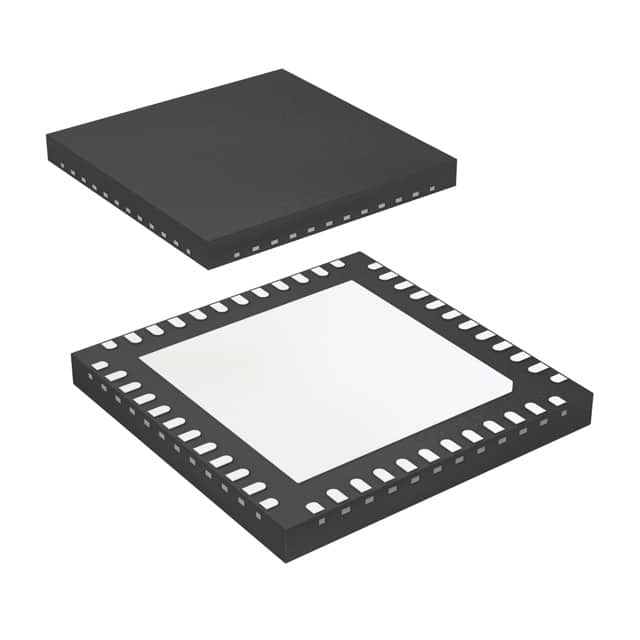
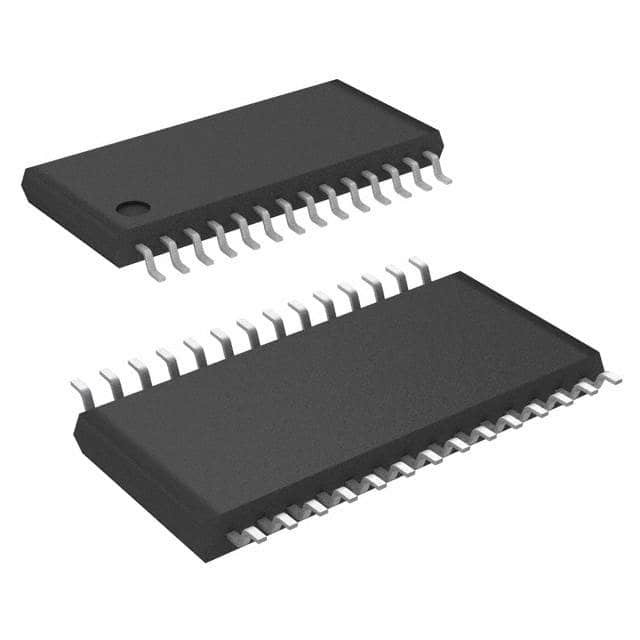
Package: 48-pin QFN (7 mm × 7 mm, 0.5 mm pitch), exposed thermal pad, RoHS-compliant - optimized for compact lighting driver PCBs with thermal management via soldered pad to ground plane.
| Pin/Terminal | Circuit Role | Design Meaning |
|---|---|---|
| VDD, VSS | Core power supply and ground | Accepts 3.3 V ±10%; decoupling required within 1 cm of pins to stabilize internal PLL and analog blocks during FSK transmission bursts. |
| P0[0]–P0[7], P1[0]–P1[7], P2[0]–P2[7], P3[0]–P3[7] | Configurable GPIO (32 total) | Support 25 mA sink / 10 mA source; each pin configurable as analog input (12 max), interrupt source, or digital peripheral I/O (I²C/SPI/UART). |
| SCL, SDA | I²C bus interface | Dedicated open-drain pins for host-controlled configuration; internal pull-ups disabled by default - external 4.7 kΩ pull-ups required for 400 kHz operation. |
| PLT_TX, PLT_RX | Powerline transceiver analog interface | Differential FSK signal paths to external coupling circuit; require matched 50 Ω trace routing and external low-pass filtering before transformer coupling to AC line. |
| RESET | Active-low reset input | Asynchronous reset asserting internal state machines and clearing packet buffers - must be held low ≥100 ns after power stabilization for reliable boot. |
Key Features
| Feature | Design Value |
|---|---|
| Integrated PLC Stack | On-chip implementation of MAC, data link, network, and transport layers eliminates need for external protocol controller or software stack integration effort. |
| PrISM™ LED Modulation | Patented pseudo-random interleaved sampling technique reduces radiated EMI by >10 dB and eliminates perceptible 100/120 Hz LED flicker without increasing thermal load. |
| CSMA with BIU Detection | Hardware-accelerated Band-In-Use sensing (86 dBμVrms threshold in 131.5–133.5 kHz) prevents packet collisions and ensures deterministic latency under burst noise conditions. |
| PLT Packet Engine | Hardware-assisted packet assembly/disassembly including preamble insertion (0xAB), header formatting, CRC calculation, and sequence number management - offloads host MCU. |
| Multi-Voltage Coupling Ready | Reference designs validated for 110V/240V AC and 12V/24V AC/DC lines with compliance to EN 50065-1:2001 and FCC Part 15 - reduces system-level certification risk. |
Applications
| Smart Residential Lighting | Commercial Building Automation |
|---|---|
|
Use Scenario: Retrofit LED luminaires in existing homes using AC mains wiring as communication medium, eliminating new control cabling. IC Role / Device Role / Timing Role: Acts as PLC node endpoint and HB LED driver - receives dimming/brightness commands via powerline, executes PrISM™ PWM, and reports status via PLT ACK packets. Use Value: Enables seamless integration with legacy wiring; supports up to 256 logical addresses per network, allowing room-level zoning without additional gateways. |
Use Scenario: Centralized lighting control across multi-floor office buildings using existing 240V AC distribution panels as data backbone. IC Role / Device Role / Timing Role: Functions as distributed PLC node with 16-channel LED control and DALI bridge capability - translates DALI commands from BMS into PLT packets and vice versa. Use Value: Eliminates dedicated lighting control bus (e.g., KNX, DALI trunk); leverages powerline for both power delivery and bi-directional command/response with <1.5 s timeout for remote data requests. |
| Industrial Machine Status Lighting | Municipal Streetlight Management |
|
Use Scenario: Machine-mounted status indicators (e.g., OK/Alarm/Standby) powered and controlled via 24V DC industrial bus wiring. IC Role / Device Role / Timing Role: Serves as ruggedized PLC endpoint with 12V/24V AC/DC coupling - interprets machine PLC outputs via I²C and drives RGB LEDs with flicker-free PrISM™ modulation. Use Value: Survives voltage transients on industrial DC lines; uses same coupling reference design as AC variants, reducing BOM variation across product lines. |
Use Scenario: Remote monitoring and dimming of solar-powered streetlights connected to shared 110V AC grid segments. IC Role / Device Role / Timing Role: Operates as autonomous PLC node with group addressing (e.g., "East Corridor" group ID 0x1A) - accepts broadcast dimming schedules and reports energy consumption via PLT payload. Use Value: Supports 65,536 extended logical addresses enabling city-wide scalability; CSMA backoff prevents congestion during nightly firmware updates across thousands of nodes. |
Equivalent & Alternatives
The following parts are listed as comparable options for similar PLC + LED control applications.
| Alternative Part | Technical Difference | Application Difference | Selection Advice |
|---|---|---|---|
| ST7580 | OFDM-based PLC PHY (CENELEC A/B bands), no integrated LED driver; requires external MCU and LED PWM IC. | Targets utility AMI metering, not lighting control; lacks native PrISM™ or multi-channel dimming logic. | Select when higher throughput (>10 kbps) and narrowband OFDM robustness are prioritized over integrated LED control. |
| TI PLC100 | FSK PHY only (no protocol stack); requires external ARM Cortex-M host running TI's PLC firmware stack. | Designed for industrial sensor networks; no LED driver peripherals or analog PSoC resources. | Select when full protocol stack customization is required and system already includes capable host MCU with flash/SRAM headroom. |
Compared with ST7580 and TI PLC100, the CY8CLED16P01-48LTXI uniquely integrates PLC PHY, full ISO/OSI-equivalent protocol stack, and 16-channel HB LED control in one die - reducing BOM count by ≥3 ICs and eliminating inter-IC timing synchronization challenges in lighting systems.
Availability
CY8CLED16P01-48LTXI is available at Aetrix Electronics and suitable for smart lighting control, building automation systems, industrial status indication, and municipal streetlight management requiring stable component supply and long-term lifecycle support.
Supply support for CY8CLED16P01-48LTXI includes scheduled delivery planning, volume procurement assistance, BOM continuity management, traceable sourcing, and lifecycle availability coordination for OEM customers, industrial embedded developers, connected-device designers, and electronics production programs.
Manufacturer
Cypress Semiconductor (now part of Infineon Technologies) is a fabless semiconductor company specializing in programmable system-on-chip (PSoC®) solutions, USB controllers, and mixed-signal ICs for embedded applications.
The CY8CLED16P01 belongs to Cypress's Powerline Communication + LED Control SoC product line, designed specifically to unify communication and lighting control functions onto a single chip for energy-efficient, retrofit-friendly smart lighting infrastructure.
FAQ
What powerline voltage ranges does the CY8CLED16P01-48LTXI support out-of-the-box?
The device supports 110V/240V AC and 12V/24V AC/DC powerlines via Cypress-provided reference coupling circuits. These designs comply with CENELEC EN 50065-1:2001 and FCC Part 15. Operation on other voltages (e.g., 48V DC) is possible with custom coupling circuitry meeting impedance and safety isolation requirements.
Does the CY8CLED16P01-48LTXI require external firmware to run the PLC protocol stack?
No. The PLC protocol stack - including CSMA arbitration, PLT packet formation, CRC generation, sequence numbering, and acknowledgment handling - is implemented in dedicated hardware and ROM-resident firmware. Only application-layer logic (e.g., LED mapping, group membership) requires host configuration via I²C.
Can the CY8CLED16P01-48LTXI operate as both PLC master and slave in the same network?
Yes. The network protocol supports peer-to-peer and master-slave topologies with multiple masters. Each node can initiate transmissions, respond to remote commands (e.g., TX_CommandID 0x01–0x0F), and participate in group broadcasts - enabling distributed control without centralized coordinator dependency.
How is LED dimming resolution configured per channel on the CY8CLED16P01-48LTXI?
Dimming resolution (8 to 32 bits) is set per channel via I²C register writes to the PrISM™ control registers. Higher bit depths increase dimming granularity but reduce maximum PWM frequency; 16-bit resolution typically delivers optimal balance between smoothness and response time for architectural lighting.
CY8CLED16P01-48LTXI Specifications
- Product attributes
- Attribute value
- Manufacturer:
- Infineon Technologies
- Series:
- PowerPSOC™ CY8CLED
- Package/Case:
- 48-VFQFN Exposed Pad
- Packaging:
- Tray
- Product Status:
- Obsolete
- Programmable:
- Not Verified
- Applications:
- Powerline Communication
- Core Processor:
- M8C
- Program Memory Type:
- FLASH (32KB)
- Controller Series:
- CY8CLED
- RAM Size:
- 2K x 8
- Interface:
- I2C, IrDA, SPI, UART/USART
- Number of I/O:
- 44
- Voltage - Supply:
- 4.75V ~ 5.25V
- Operating Temperature:
- -40°C ~ 85°C
- Grade:
- -
- Qualification:
- -
- Mounting Type:
- Surface Mount
- Supplier Device Package:
- 48-QFN (7x7)
CY8CLED16P01-48LTXI FAQ
1.How can I place an order for CY8CLED16P01-48LTXI through Aetrix?
Please submit a Request for Quotation (RFQ) for CY8CLED16P01-48LTXI on Aetrix. Our sales agent will provide a competitive quotation and guide you through the order confirmation once you accept the terms.
2.Are the price and stock information for CY8CLED16P01-48LTXI reliable?
The price and inventory of CY8CLED16P01-48LTXI are updated periodically and may fluctuate due to market conditions. Stock and pricing data are typically refreshed every 24 hours. Quotation validity for CY8CLED16P01-48LTXI is usually 5 days.
3.What payment methods are accepted for CY8CLED16P01-48LTXI?
We accept Wire Transfer, PayPal, Credit Card, Western Union, MoneyGram, and Escrow for CY8CLED16P01-48LTXI transactions.
Note: Certain payment methods may incur a processing fee.
4.How is shipping managed for CY8CLED16P01-48LTXI?
CY8CLED16P01-48LTXI orders can be shipped via leading logistics carriers, including DHL, UPS, FedEx, TNT, or Registered Mail.
Once your CY8CLED16P01-48LTXI order is processed, you will receive an email with the shipment details and tracking number.
Note: Tracking information may take up to 24 hours to appear. Express delivery typically takes 3–5 business days.
5.How can I obtain technical support or documentation for CY8CLED16P01-48LTXI?
For technical support, including CY8CLED16P01-48LTXI datasheets, pinout diagrams, or application guidance, please contact our engineering support team. They can provide detailed documentation and assistance for your CY8CLED16P01-48LTXI requirements.
6.How does Aetrix verify that CY8CLED16P01-48LTXI is sourced from the original manufacturer or authorized distributors?
All CY8CLED16P01-48LTXI products on Aetrix are procured from qualified distributors and authorized channels. Our dedicated quality assurance team conducts strict verification, including traceability checks and, if necessary, third-party testing. This ensures that CY8CLED16P01-48LTXI meets industry standards.
7.What is the process for return or replacement of CY8CLED16P01-48LTXI?
All CY8CLED16P01-48LTXI units undergo pre-shipment inspection (PSI). If there is an issue with CY8CLED16P01-48LTXI, returns or replacements are accepted under the following conditions:
1.Quantity discrepancies, incorrect items, or visible external defects (such as breakage or corrosion), acknowledged by Aetrix.
2.The issue is reported within 90 days of delivery.
3.The CY8CLED16P01-48LTXI part is unused and in its original packaging.
Return procedure for CY8CLED16P01-48LTXI:
1.Submit a request within 90 days.
2.Obtain a Return Material Authorization (RMA) from Aetrix.
CY8CLED16P01-48LTXI Tags
-
CYPD3175-24LQXQ
Infineon Technologies

-
SLB9672VU20FW1523XTMA1
Infineon Technologies
-
SLB9670VQ20FW785XTMA1
Infineon Technologies
-
SLB9672XU20FW1523XTMA1
Infineon Technologies
-
SLB9673XU20FW2613XTMA1
Infineon Technologies
-
CYPD3125-40LQXIT
Infineon Technologies
-
AT97SC3204-U2A1A-20
Microchip Technology
-
AT97SC3204-U2A1A-10
Microchip Technology
-
SLM9670AQ20FW1311XTMA1
Infineon Technologies
-
SLB9672XU20FW1613XTMA1
Infineon Technologies
-
SLB9672AU20FW1613XTMA1
Infineon Technologies
-
SLB9673AU20FW2613XTMA1
Infineon Technologies
Tech Hub

18650 battery guide covering lithium-ion cell basics, 3.6V/3.7V voltage, 4.2V charging, mAh and Wh capacity, protected cells, chargers, BMS, series-parallel packs, holders, welding and sourcing checks.…

Hall effect sensor guide covering working principle, linear and digital sensors, Arduino circuits, current sensing, speed detection, automotive applications, A3144 examples, signal filtering and datash…

Product Change Notification guide for electronic components, covering PCN meaning, PCN vs PDN/EOL, common change types, risk levels, form-fit-function review, engineering validation, BOM control, LTB/L…

A practical guide to blend door actuators, covering HVAC function, symptoms, location, AC and heater issues, reset and calibration, replacement cost, electrical diagnosis, compatibility checks, and rep…

Engineering guide to Raspberry Pi alternatives, covering chip-level differences, Orange Pi, ROCK, Jetson, Banana Pi, NanoPi, Compute Module, Pico, GPIO, camera, HAT compatibility, and replacement risks…

Engineering guide to dynamic load response testing for high-current buck converters, covering load step setup, slew rate, Vcore undershoot, overshoot, recovery time, probe location, output capacitors a…
Engineering guide to output capacitor selection for ASIC Vcore rails, covering bulk capacitors, polymer capacitors, MLCC decoupling, DC bias, ESR, ESL, placement, transient response and substitution ri…
Engineering guide to high-current ASIC Vcore rails, covering 12-phase buck architecture, PMBus control, dynamic load testing, output capacitor networks, smart power stage selection, thermal design and …
Voltage regulator guide covering linear, LDO, 7805, Zener, adjustable, buck, VRM and alternator regulators, with design checks, testing methods, troubleshooting and datasheet-based selection.
Amplifier guide covering voltage, current and power amplification, gain, feedback, amplifier classes, audio and RF applications, op-amp circuits, transimpedance amplifiers, datasheet selection and trou…


