
 My Inquiry
 My Account


Infineon Technologies SLB9670VQ20FW785XTMA1
- Part No.:
- SLB9670VQ20FW785XTMA1
- Manufacturer:
- Infineon Technologies
- Category:
- Application Specific Microcontrollers
- Package:
- 32-VFQFN Exposed Pad
- Datasheet:
-
 SLB9670VQ20FW785XTMA1.pdf
- Description:
- IC TPM VQFN
- Quantity:
- Payment:

- Shipping:

Inventory:4,106
Please send an inquiry. Send us your inquiry, and we will respond immediately.
Product details
Overview
SLB9670VQ20FW785XTMA1 from Infineon is a TPM 2.0 Trusted Platform Module implementing TCG family 2.0 specifications, featuring SPI interface (up to 43 MHz), FIPS 140-2 Level 2 validation (Certificate #3492), and hardware-based secure key generation. It delivers 24 PCRs (SHA-1/SHA-256), ≥6962 bytes free NV memory, and operates across -20°C to +85°C in battery-constrained platforms like Chromebooks and Windows laptops.
For engineers reviewing the SLB9670VQ20FW785XTMA1 datasheet, SLB9670VQ20FW785XTMA1 pinout, SLB9670VQ20FW785XTMA1 application, or SLB9670VQ20FW785XTMA1 equivalent, this page provides verified technical context on TPM2.0 compliance, SPI timing constraints, low-power wake behavior, and pin-level GPIO/PP signal handling per TCG specification alignment.
Technical Context
The SLB9670VQ20FW785XTMA1 implements a dedicated hardware root of trust with internal power management that automatically enters low-power state after each SPI command/response transaction and wakes instantly upon host-initiated SCLK activity. It supports only SPI Mode 0 with strict timing requirements: tSU(CS) = 10 ns min, tH(CS) = 10 ns min, and tSU(DO) = 5 ns min.
It integrates NIST SP800-90A-compliant RNG, full EK personalization, and firmware validated for Intel TXT, Microsoft Windows, and Google Chromebook platform certification. Its 1420-byte I/O buffer and 768-byte NV read/write limit define real-time command throughput boundaries in embedded OS environments.
Key Specifications
| Parameter | Value and Actual Design Meaning |
|---|---|
| SPI Clock Max | 43 MHz - Enables fast boot-time attestation without CPU polling overhead |
| Operating Temp | -20°C to +85°C - Validated for standard laptop and industrial edge compute thermal envelopes |
| Standby Current | Typ. 110 µA - Supports multi-week battery life in always-on security monitoring use cases |
| NV Memory Free | Min. 6962 bytes - Sufficient for storing multiple certificates, keys, and policy objects simultaneously |
| PCR Count | 24 - Matches TCG-defined platform measurement registers for OS integrity verification chains |
| I/O Buffer Size | 1420 bytes - Determines maximum command/response payload size without segmentation |
| Active Sessions | Up to 64 - Enables concurrent attestation, sealing, and key derivation operations in virtualized hosts |
Pinout & Package
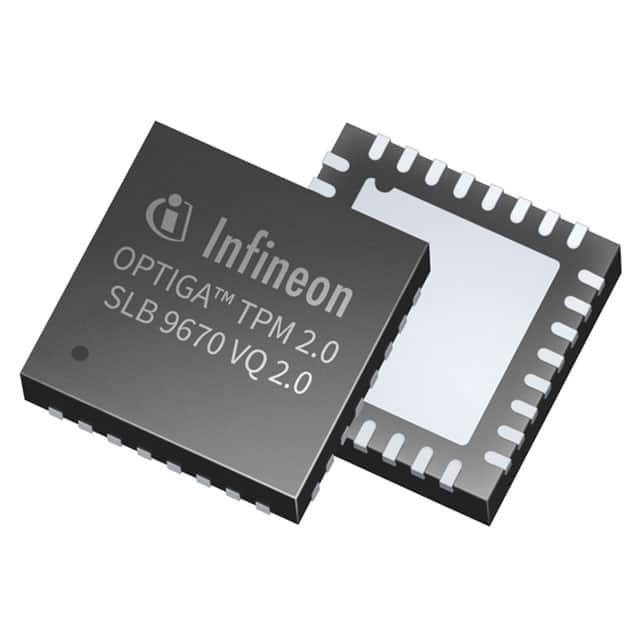
SLB9670VQ20FW785XTMA1 uses PG-VQFN-32-13 package (5 mm × 5 mm, 0.5 mm pitch, exposed thermal pad). Pin layout follows TCG-compliant VQFN mapping with dedicated SPI, reset, interrupt, and optional PP/GPIO signals.
| Pin/Terminal | Circuit Role | Design Meaning |
|---|---|---|
| 20, CS# | Chip Select Input | Active-low SPI enable; requires Schmitt-trigger input for noise immunity in noisy motherboard environments |
| 19, SCLK | SPI Clock Input | Mode 0 only; defines command timing boundary; no internal clock divider or frequency scaling |
| 21, MOSI | SPI Data Input | Host-to-TPM command stream; sampled on SCLK rising edge; no parity or error correction |
| 24, MISO | SPI Data Output | TPM-to-host response stream; tri-state output enables bus sharing with other peripherals |
| 18, PIRQ# | Interrupt Output | Open-drain active-low signal; requires external pull-up; asserts on asynchronous events (e.g., PCR extend completion) |
| 17, RST# | Reset Input | Hardware reset with weak internal pull-up; must be synchronized to PCIRST# for platform-level cold reset compliance |
| 6, GPIO | General Purpose I/O | Tri-state; unused in TPM2.0 mode; may be left floating with internal pull-up; not for user firmware control |
| 7, PP | Physical Presence | Schmitt-trigger input with internal pulldown; reserved for future TCG PP-enabled features; not functional in current firmware |
Key Features
| Feature | Design Value |
|---|---|
| FIPS 140-2 Level 2 Validation | Certificate #3492 (16 July 2019) - Meets U.S. federal cryptographic module requirements for secure key storage and operation |
| TCG TPM 2.0 Compliance | Full implementation of Part 1–3 specifications - Ensures interoperability with Linux kernel tpm_tis_spi driver and Windows TPM Base Services |
| Low-Power Transaction Wake | No explicit sleep command needed - Automatic entry/exit from 110 µA standby reduces firmware complexity and eliminates wake latency uncertainty |
| Endorsement Key Personalization | Factory-provisioned EK + X.509 certificate - Enables immediate attestation without post-manufacturing provisioning infrastructure |
| SHA-1 / SHA-256 PCR Support | 24 programmable PCRs - Allows simultaneous measurement of boot firmware, hypervisor, OS loader, and application layers in layered trust models |
Applications
| Laptop Platform Security | Industrial Edge Gateway |
|---|---|
Use Scenario: Secure boot and BitLocker encryption key binding on Windows 11 laptops. IC Role / Device Role / Timing Role: Root of trust for platform configuration measurement and sealed storage key derivation during POST and early OS load. Use Value: Prevents unauthorized firmware modification by validating PCR values before releasing decryption keys - enforced via hardware-isolated execution. |
Use Scenario: Firmware integrity attestation in factory-floor gateways running real-time Linux. IC Role / Device Role / Timing Role: TPM2.0 attestation agent verifying signed OTA updates before application to MCU flash. Use Value: Guarantees update authenticity using EK-signed certificates and prevents rollback via monotonic counters - independent of host OS security posture. |
| Chromebook Identity Management | Medical Device Data Integrity |
Use Scenario: User credential binding and Verified Boot enforcement on Google ChromeOS devices. IC Role / Device Role / Timing Role: Hardware-backed identity anchor enabling cryptographic proof of device health to cloud identity providers. Use Value: Enables zero-touch enrollment and conditional access policies based on measured boot state - meeting Google's Chromebook certification criteria. |
Use Scenario: HIPAA-compliant audit log signing in portable diagnostic equipment. IC Role / Device Role / Timing Role: Secure timestamped signature generator for sensor data packets using persistent keys stored in NV memory. Use Value: Provides non-repudiation for clinical data streams by binding signatures to hardware-generated keys - satisfying FDA 21 CFR Part 11 electronic record requirements. |
Equivalent & Alternatives
The following parts are listed as comparable options for similar TPM 2.0 security module applications.
| Alternative Part | Technical Difference | Application Difference | Selection Advice |
|---|---|---|---|
| SLB9670XQ20FW785XTMA1 | Enhanced temperature range (-40°C to +85°C); identical electrical and functional specs | Required for extended-temperature industrial or automotive cabin deployments | Select when ambient operating conditions exceed -20°C lower limit of SLB9670VQ20FW785XTMA1 |
| SLB9673VQ20FW785XTMA1 | Same PG-VQFN-32-13 package; adds support for I²C interface alongside SPI; higher NV memory (≥12 kB) | Enables dual-interface flexibility in space-constrained designs where I²C routing is preferred over SPI | Choose if system architecture requires fallback I²C communication or larger NV object storage capacity |
Compared with SLB9670XQ20FW785XTMA1, the VQ variant trades extended temperature tolerance for cost optimization in consumer-grade platforms; compared with SLB9673VQ20FW785XTMA1, it offers simpler SPI-only integration at lower BOM cost and reduced firmware driver complexity.
Availability
SLB9670VQ20FW785XTMA1 is available at Aetrix Electronics and suitable for laptop security modules, industrial edge gateways, Chromebook identity systems, and medical device data integrity solutions requiring stable component supply and long-term lifecycle assurance.
Supply support for SLB9670VQ20FW785XTMA1 includes scheduled delivery planning, volume procurement assistance, BOM continuity management, traceable sourcing, and lifecycle availability coordination for OEM customers, industrial embedded developers, connected-device designers, and electronics production programs.
Manufacturer
Infineon Technologies is a German semiconductor manufacturer specializing in power management, security, and sensing solutions for automotive, industrial, and IoT markets.
SLB9670VQ20FW785XTMA1 belongs to the OPTIGA™ TPM product line, designed specifically to deliver certified, hardware-rooted trust for endpoint platforms requiring FIPS-validated cryptographic services and TCG-compliant attestation.
FAQ
Is SLB9670VQ20FW785XTMA1 compatible with Linux kernel tpm_tis_spi driver?
Yes. The device implements standard TPM 2.0 SPI protocol compliant with TCG PC Client Platform TPM Profile (PTP) Specification v1.05. It supports SPI Mode 0 with tSU(CS) ≥10 ns and tH(CS) ≥10 ns, matching kernel driver timing assumptions. Verified operation confirmed with Linux 5.10+ kernels using default tpm_tis_spi probe parameters and no custom timing overrides.
Does SLB9670VQ20FW785XTMA1 require external pull-up resistors on PIRQ# or RST#?
PIRQ# requires an external pull-up resistor (typically 4.7 kΩ) because it is open-drain with no internal pull-up. RST# has a weak internal pull-up resistor (≈50 kΩ), but a stronger external pull-up (≤10 kΩ) is recommended for robust noise immunity in high-speed motherboard environments per Infineon's design guidelines in Section 3.1 of the datasheet.
What is the maximum sustained SPI clock frequency supported in production use?
The device supports up to 43 MHz SPI clock frequency under all specified operating conditions (VDD = 3.3 V ±5%, TA = -20°C to +85°C). This value is validated across process corners and voltage extremes, not just typical conditions. Operation above 43 MHz risks setup/hold violations on MISO due to fixed internal propagation delays documented in Table 13 (AC Characteristics).
Can GPIO and PP pins be used for custom firmware functionality?
No. GPIO (Pin 6) and PP (Pin 7) are reserved per TCG TPM 2.0 specification and have no firmware-accessible function in SLB9670VQ20FW785XTMA1. GPIO is internally disconnected in TPM2.0 mode and may float; PP is pulldown-biased but unused. Neither pin supports user-programmable I/O or interrupt generation - their roles are strictly defined for future TCG extensions.
SLB9670VQ20FW785XTMA1 Specifications
- Product attributes
- Attribute value
- Manufacturer:
- Infineon Technologies
- Series:
- OPTIGA™ TPM
- Package/Case:
- 32-VFQFN Exposed Pad
- Packaging:
- Tape & Reel (TR)
- Product Status:
- Active
- Programmable:
- Not Verified
- Applications:
- Trusted Platform Module (TPM)
- Core Processor:
- 16-Bit
- Program Memory Type:
- NVM (6.8kB)
- Controller Series:
- -
- RAM Size:
- -
- Interface:
- SPI
- Number of I/O:
- 1
- Voltage - Supply:
- 1.65V ~ 1.95V, 3V ~ 3.6V
- Operating Temperature:
- -20°C ~ 85°C (TA)
- Grade:
- -
- Qualification:
- -
- Mounting Type:
- Surface Mount
- Supplier Device Package:
- PG-VQFN-32-13
SLB9670VQ20FW785XTMA1 FAQ
1.How can I place an order for SLB9670VQ20FW785XTMA1 through Aetrix?
Please submit a Request for Quotation (RFQ) for SLB9670VQ20FW785XTMA1 on Aetrix. Our sales agent will provide a competitive quotation and guide you through the order confirmation once you accept the terms.
2.Are the price and stock information for SLB9670VQ20FW785XTMA1 reliable?
The price and inventory of SLB9670VQ20FW785XTMA1 are updated periodically and may fluctuate due to market conditions. Stock and pricing data are typically refreshed every 24 hours. Quotation validity for SLB9670VQ20FW785XTMA1 is usually 5 days.
3.What payment methods are accepted for SLB9670VQ20FW785XTMA1?
We accept Wire Transfer, PayPal, Credit Card, Western Union, MoneyGram, and Escrow for SLB9670VQ20FW785XTMA1 transactions.
Note: Certain payment methods may incur a processing fee.
4.How is shipping managed for SLB9670VQ20FW785XTMA1?
SLB9670VQ20FW785XTMA1 orders can be shipped via leading logistics carriers, including DHL, UPS, FedEx, TNT, or Registered Mail.
Once your SLB9670VQ20FW785XTMA1 order is processed, you will receive an email with the shipment details and tracking number.
Note: Tracking information may take up to 24 hours to appear. Express delivery typically takes 3–5 business days.
5.How can I obtain technical support or documentation for SLB9670VQ20FW785XTMA1?
For technical support, including SLB9670VQ20FW785XTMA1 datasheets, pinout diagrams, or application guidance, please contact our engineering support team. They can provide detailed documentation and assistance for your SLB9670VQ20FW785XTMA1 requirements.
6.How does Aetrix verify that SLB9670VQ20FW785XTMA1 is sourced from the original manufacturer or authorized distributors?
All SLB9670VQ20FW785XTMA1 products on Aetrix are procured from qualified distributors and authorized channels. Our dedicated quality assurance team conducts strict verification, including traceability checks and, if necessary, third-party testing. This ensures that SLB9670VQ20FW785XTMA1 meets industry standards.
7.What is the process for return or replacement of SLB9670VQ20FW785XTMA1?
All SLB9670VQ20FW785XTMA1 units undergo pre-shipment inspection (PSI). If there is an issue with SLB9670VQ20FW785XTMA1, returns or replacements are accepted under the following conditions:
1.Quantity discrepancies, incorrect items, or visible external defects (such as breakage or corrosion), acknowledged by Aetrix.
2.The issue is reported within 90 days of delivery.
3.The SLB9670VQ20FW785XTMA1 part is unused and in its original packaging.
Return procedure for SLB9670VQ20FW785XTMA1:
1.Submit a request within 90 days.
2.Obtain a Return Material Authorization (RMA) from Aetrix.
SLB9670VQ20FW785XTMA1 Tags
-
CYPD3175-24LQXQ
Infineon Technologies

-
SLB9672VU20FW1523XTMA1
Infineon Technologies
-
SLB9670VQ20FW785XTMA1
Infineon Technologies
-
SLB9672XU20FW1523XTMA1
Infineon Technologies
-
SLB9673XU20FW2613XTMA1
Infineon Technologies
-
CYPD3125-40LQXIT
Infineon Technologies
-
AT97SC3204-U2A1A-20
Microchip Technology
-
AT97SC3204-U2A1A-10
Microchip Technology
-
SLM9670AQ20FW1311XTMA1
Infineon Technologies
-
SLB9672XU20FW1613XTMA1
Infineon Technologies
-
SLB9672AU20FW1613XTMA1
Infineon Technologies
-
SLB9673AU20FW2613XTMA1
Infineon Technologies
Tech Hub

Jumper cables guide covering safe connection order, red and black clamp placement, final ground connection, cable gauge, length, clamp quality, copper vs CCA cables, jump starter comparison and battery…

LDO regulator guide covering low dropout voltage, power dissipation, thermal design, PSRR, output noise, capacitor stability, adjustable LDO circuits, LDO vs buck converter and datasheet selection chec…

Conditional Access Module guide covering CAM meaning, CI/CI+ interface, smart card authorization, DVB security workflow, TV and set-top box compatibility, internal electronics, ESD protection, connecto…

Guide to electronic component obsolescence covering EOL risk, PCN/PDN notices, last-time buy planning, replacement options, form-fit-function validation, counterfeit risk and BOM lifecycle management.

18650 battery guide covering lithium-ion cell basics, 3.6V/3.7V voltage, 4.2V charging, mAh and Wh capacity, protected cells, chargers, BMS, series-parallel packs, holders, welding and sourcing checks.…

Hall effect sensor guide covering working principle, linear and digital sensors, Arduino circuits, current sensing, speed detection, automotive applications, A3144 examples, signal filtering and datash…

Product Change Notification guide for electronic components, covering PCN meaning, PCN vs PDN/EOL, common change types, risk levels, form-fit-function review, engineering validation, BOM control, LTB/L…

A practical guide to blend door actuators, covering HVAC function, symptoms, location, AC and heater issues, reset and calibration, replacement cost, electrical diagnosis, compatibility checks, and rep…

Engineering guide to Raspberry Pi alternatives, covering chip-level differences, Orange Pi, ROCK, Jetson, Banana Pi, NanoPi, Compute Module, Pico, GPIO, camera, HAT compatibility, and replacement risks…
Engineering guide to dynamic load response testing for high-current buck converters, covering load step setup, slew rate, Vcore undershoot, overshoot, recovery time, probe location, output capacitors a…


