Vishay Siliconix DG441DJ
- Part No.:
- DG441DJ
- Manufacturer:
- Vishay Siliconix
- Package:
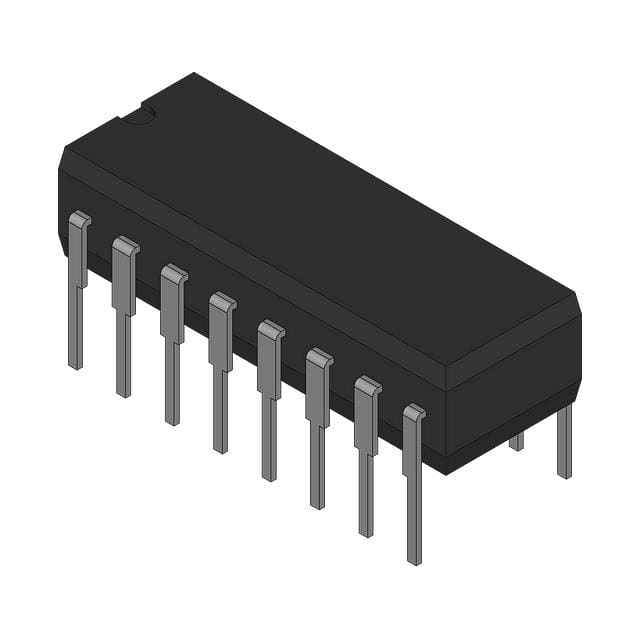
- 16-DIP (0.300", 7.62mm)
- Datasheet:
-
DG441DJ.pdf
- Description:
- IC SWITCH SPST-NCX4 85OHM 16DIP
- Quantity:
- Payment:

- Shipping:

Inventory:1,658
Please send an inquiry. Send us your inquiry, and we will respond immediately.
Product details
Overview
DG441DJ from Vishay Siliconix is a quad SPST analog switch with normally closed (NC) configuration, designed for high-speed, low-error analog and audio signal routing. It features 50 Ω typical on-resistance, 150 ns typical turn-on time, ±15 V dual-supply operation, and –1 pC charge injection-enabling precision sample-and-hold and battery-powered instrumentation.
For engineers reviewing the DG441DJ datasheet, DG441DJ pinout, DG441DJ application, or DG441DJ equivalent, key selection criteria include its NC switching logic, rail-to-rail analog signal range (±15 V), low leakage (<20 nA), TTL/CMOS-compatible digital inputs, and DIP-16 package suitability for legacy socket upgrades from DG201A/DG202.
Technical Context
The DG441DJ implements four independent CMOS transmission gates fabricated on a high-voltage silicon-gate process with epitaxial latchup protection. Each switch conducts bidirectionally when ON and blocks signals to supply rails when OFF.
Its control logic is active-low: INx = 0 V closes the switch (Sx–Dx path conductive); INx = 5 V opens it. Input thresholds are specified at 0.8 V (logic low) and 2.4 V (logic high), ensuring compatibility with both TTL and CMOS logic families across –40 °C to +85 °C.
Key Specifications
| Parameter | Value and Actual Design Meaning |
|---|---|
| Analog Signal Range | ±15 V - supports rail-to-rail signal switching without clipping in dual-supply systems |
| Drain-Source On-Resistance | 50 Ω typ. - minimizes voltage drop and gain error in precision signal paths |
| Turn-On Time | 150 ns typ. - enables fast multiplexing in data acquisition and ATE applications |
| Charge Injection | –1 pC - reduces pedestal error in sample-and-hold circuits |
| Off-Leakage Current | 0.01 nA typ. - preserves signal integrity in high-impedance sensor interfaces |
| Supply Voltage Range | V+ to V– = 44 V max - allows flexible biasing including ±15 V, ±12 V, or +12 V/0 V configurations |
| Digital Input Compatibility | TTL/CMOS - eliminates need for level-shifting circuitry in mixed-signal designs |
Pinout & Package
Package: 16-pin plastic DIP (Dual-In-Line), 0.3-inch wide body, through-hole mountable.
| Pin/Terminal | Circuit Role | Design Meaning |
|---|---|---|
| 1, 2, 3, 4 | IN1–IN4 | Digital control inputs; active-low logic determines switch state (low = closed) |
| 5, 6, 11, 12 | S1–S4 | Switch source terminals - bidirectional analog I/O nodes for NC configuration |
| 7, 8, 15, 16 | D1–D4 | Switch drain terminals - connected to Sx when INx is low; isolated otherwise |
| 9 | GND | Analog/digital ground reference - must be tied to system common for proper logic and analog performance |
| 10 | V– | Negative supply rail - sets lower bound of analog signal range and powers internal logic |
| 13 | V+ | Positive supply rail - sets upper bound of analog signal range and powers internal logic |
| 14 | NC | No connect - internally unconnected; must remain floating or grounded per layout best practice |
Key Features
| Feature | Design Value |
|---|---|
| Normally Closed (NC) Switching | Ensures fail-safe signal continuity during power loss or logic reset - critical in medical instrument safety paths |
| Low On-Resistance Match | 4 Ω max mismatch between channels - maintains channel-to-channel gain consistency in multi-path amplifiers |
| High Off Isolation | 60 dB at DC - prevents crosstalk between inactive analog channels in dense multiplexer layouts |
| Single-Supply Capability | Operates from +12 V/0 V - simplifies power architecture in portable and industrial controllers |
| Latchup-Immune Process | Epitaxial isolation layer - guarantees robust operation under transient overvoltage and ESD stress |
Applications
| Audio Signal Routing | Data Acquisition Multiplexing |
|---|---|
Use Scenario: Selecting between multiple microphone or line-level inputs in a studio mixer or conferencing system. IC Role / Device Role / Timing Role: Quad SPST NC analog switch providing low-distortion, low-noise signal path selection with <50 Ω on-resistance. Use Value: Preserves audio fidelity via minimal THD+N (<0.01%) and avoids pop/click artifacts due to –1 pC charge injection. | Use Scenario: Scanning 4 sensor channels (e.g., thermocouples, strain gauges) into a single ADC input in industrial PLC modules. IC Role / Device Role / Timing Role: Precision analog multiplexer enabling sequential sampling with 150 ns settling time and <20 nA off-leakage. Use Value: Maintains measurement accuracy by minimizing channel crosstalk (60 dB off-isolation) and pedestal error in sample-and-hold front-ends. |
| Medical Instrument Safety Path | Battery-Powered Test Equipment |
Use Scenario: Providing default-closed diagnostic signal path in ECG or EEG front-end that remains conductive during power-down or fault conditions. IC Role / Device Role / Timing Role: Fail-safe NC analog switch ensuring uninterrupted patient signal monitoring during brownout or controller reboot. Use Value: Meets IEC 60601-1 creepage/clearance requirements via 44 V max V+–V– rating and guaranteed NC behavior at zero control voltage. | Use Scenario: Enabling low-power mode in handheld multimeters or portable oscilloscopes by disconnecting unused analog sections. IC Role / Device Role / Timing Role: Ultra-low-power analog switch consuming only 0.2 mW static power and supporting 30 mA continuous current. Use Value: Extends battery life while maintaining fast response (150 ns tON) for real-time signal switching during auto-ranging operations. |
Equivalent & Alternatives
The following parts are listed as comparable options for similar quad SPST analog switch applications.
| Alternative Part | Technical Difference | Application Difference | Selection Advice |
|---|---|---|---|
| MAX4617CPN+ | SOIC-16, 35 Ω rDS(on), 125 ns tON, but NO NC function - all channels normally open | Requires redesign of fail-safe logic; unsuitable where default-closed path is mandatory | Select only if NO configuration suffices and SOIC footprint is preferred |
| ADG441BNZ | PDIP-16, identical NC function and pinout, but 45 Ω rDS(on), 130 ns tON, and –2 pC charge injection | Drop-in replacement for DG441DJ in existing DIP-16 layouts with slightly improved speed and on-resistance | Preferred for new designs requiring tighter specs; verify thermal derating (450 mW @ 75 °C) |
Compared with MAX4617CPN+ and ADG441BNZ, the DG441DJ provides unique normally closed operation in a legacy-compatible DIP-16 package, making it irreplaceable in safety-critical or retrofit applications where default conductivity and socket compatibility are required.
Availability
DG441DJ is available at Aetrix Electronics and suitable for audio signal routing, data acquisition multiplexing, medical instrument safety paths, and battery-powered test equipment requiring stable component supply and long-term obsolescence management.
Supply support for DG441DJ includes scheduled delivery planning, volume procurement assistance, BOM continuity management, traceable sourcing, and lifecycle availability coordination for OEM customers, industrial embedded developers, connected-device designers, and electronics production programs.
Manufacturer
Vishay Siliconix is a global semiconductor manufacturer specializing in discrete MOSFETs, diodes, optoelectronics, and precision analog switches with emphasis on high-reliability and high-voltage performance.
The DG441DJ belongs to Vishay's DG441/442 quad analog switch product line, engineered specifically for upgrading legacy DG201A/DG202 sockets in high-fidelity audio, medical, and aerospace-grade instrumentation where low on-resistance, low charge injection, and fail-safe NC behavior are essential.
FAQ
What is the switching logic configuration of the DG441DJ?
The DG441DJ implements a normally closed (NC) configuration: each switch conducts between its Sx and Dx terminals when the corresponding INx control input is logic low (≤0.8 V), and opens when INx is logic high (≥2.4 V). This ensures signal continuity during power-off or logic reset states - a critical feature for safety-critical analog paths in medical and industrial systems. The DG441DJ does not support normally open operation; that function is provided by the pin-compatible DG442DJ variant.
Can the DG441DJ operate from a single +12 V supply?
Yes, the DG441DJ supports single-supply operation with V+ = +12 V and V– = 0 V, delivering full functionality across its specified temperature range (–40 °C to +85 °C). In this configuration, the analog signal range is 0 V to +12 V, on-resistance increases to 100 Ω typ., and turn-on time extends to 300 ns typ. The DG441DJ maintains TTL/CMOS-compatible inputs and retains its NC behavior, making it suitable for portable and industrial controllers where dual supplies are impractical.
What is the maximum allowable voltage difference between V+ and V– for the DG441DJ?
The DG441DJ specifies a maximum V+ to V– differential of 44 V. This allows operation with common dual-supply configurations such as ±15 V (30 V total), ±12 V (24 V), or asymmetric rails like +20 V/–15 V (35 V), provided the absolute voltage ratings for GND-to-V– (25 V) and digital inputs (V– –2 V to V+ +2 V) are also respected. Exceeding 44 V risks permanent damage to the internal high-voltage silicon-gate structure.
How does the DG441DJ minimize errors in sample-and-hold circuits?
The DG441DJ minimizes sample-and-hold errors primarily through ultra-low charge injection (–1 pC typ.) and low on-resistance match (4 Ω max between channels). When the switch opens after sampling, the injected charge causes minimal pedestal voltage shift on the hold capacitor - directly improving DC accuracy. Its bidirectional conduction and rail-to-rail analog range (±15 V) further ensure linear sampling across full-scale input signals without clipping or distortion in precision instrumentation using the DG441DJ.
Is the DG441DJ pin-compatible with the DG201A it replaces?
Yes, the DG441DJ is a direct socket replacement for the DG201A in 16-pin DIP layouts, sharing identical pinout, NC functionality, and mechanical footprint. Key improvements include 50 Ω vs. 90 Ω on-resistance, 150 ns vs. 350 ns turn-on time, and –1 pC vs. –5 pC charge injection - resulting in higher bandwidth, lower distortion, and improved sample-and-hold accuracy. No PCB changes are required when upgrading from DG201A to DG441DJ, preserving legacy system reliability while enhancing performance.
DG441DJ Specifications
- Product attributes
- Attribute value
- Manufacturer:
- Vishay Siliconix
- Series:
- -
- Packaging:
- Tube
- Product Status:
- Obsolete
- Switch Circuit:
- SPST - NC
- Multiplexer/Demultiplexer Circuit:
- 1:1
- Number of Circuits:
- 4
- On-State Resistance (Max):
- 85Ohm
- Channel-to-Channel Matching (ΔRon):
- 4Ohm (Max)
- Voltage - Supply, Single (V+):
- 12V
- Voltage - Supply, Dual (V±):
- ±15V
- Switch Time (Ton, Toff) (Max):
- 220ns, 120ns
- -3db Bandwidth:
- -
- Charge Injection:
- -1pC
- Channel Capacitance (CS(off), CD(off)):
- 4pF, 4pF
- Current - Leakage (IS(off)) (Max):
- 500pA
- Crosstalk:
- -100dB @ 1MHz
- Operating Temperature:
- -40°C ~ 85°C (TA)
- Grade:
- -
- Qualification:
- -
- Mounting Type:
- Through Hole
- Supplier Device Package:
- 16-PDIP
DG441DJ FAQ
1.How can I place an order for DG441DJ through Aetrix?
Please submit a Request for Quotation (RFQ) for DG441DJ on Aetrix. Our sales agent will provide a competitive quotation and guide you through the order confirmation once you accept the terms.
2.Are the price and stock information for DG441DJ reliable?
The price and inventory of DG441DJ are updated periodically and may fluctuate due to market conditions. Stock and pricing data are typically refreshed every 24 hours. Quotation validity for DG441DJ is usually 5 days.
3.What payment methods are accepted for DG441DJ?
We accept Wire Transfer, PayPal, Credit Card, Western Union, MoneyGram, and Escrow for DG441DJ transactions.
Note: Certain payment methods may incur a processing fee.
4.How is shipping managed for DG441DJ?
DG441DJ orders can be shipped via leading logistics carriers, including DHL, UPS, FedEx, TNT, or Registered Mail.
Once your DG441DJ order is processed, you will receive an email with the shipment details and tracking number.
Note: Tracking information may take up to 24 hours to appear. Express delivery typically takes 3–5 business days.
5.How can I obtain technical support or documentation for DG441DJ?
For technical support, including DG441DJ datasheets, pinout diagrams, or application guidance, please contact our engineering support team. They can provide detailed documentation and assistance for your DG441DJ requirements.
6.How does Aetrix verify that DG441DJ is sourced from the original manufacturer or authorized distributors?
All DG441DJ products on Aetrix are procured from qualified distributors and authorized channels. Our dedicated quality assurance team conducts strict verification, including traceability checks and, if necessary, third-party testing. This ensures that DG441DJ meets industry standards.
7.What is the process for return or replacement of DG441DJ?
All DG441DJ units undergo pre-shipment inspection (PSI). If there is an issue with DG441DJ, returns or replacements are accepted under the following conditions:
1.Quantity discrepancies, incorrect items, or visible external defects (such as breakage or corrosion), acknowledged by Aetrix.
2.The issue is reported within 90 days of delivery.
3.The DG441DJ part is unused and in its original packaging.
Return procedure for DG441DJ:
1.Submit a request within 90 days.
2.Obtain a Return Material Authorization (RMA) from Aetrix.
DG441DJ Tags

-
SN74LVC1G3157DBVR
Texas Instruments
-
SN74LVC1G66DBVR
Texas Instruments
-
SN74LVC1G66DCKR
Texas Instruments
-
SN74LVC1G3157DSFR
Texas Instruments
-
1P1G3157QDCKRQ1
Texas Instruments
-
SN74LVC2G66DCUR
Texas Instruments
-
SN74LV4052APWR
Texas Instruments
-
74HC4051D,653
Nexperia USA Inc.
-
SN74LV4051APWR
Texas Instruments
-
CD74HC4052PWR
Texas Instruments
-
CD74HC4051PWR
Texas Instruments
-
TS5A3166DBVR
Texas Instruments
Tech Hub

Comparator circuit design covering voltage thresholds, input limits, open-collector outputs, LM393 wiring, op-amp differences, hysteresis, timing, window detection and practical fault diagnosis.
Schmitt triggers use separate rising and falling thresholds to stabilize slow or noisy signals. This guide covers hysteresis, 74HC14 and 74HCT14 selection, comparator calculations, RC oscillators and p…
Counterfeit components can hide behind convincing markings and passing basic function tests. This engineering reference covers source traceability, external inspection, X-ray, XRF, electrical testing, …
A practical engineering and sourcing framework covering lifecycle verification, lifetime-buy calculations, replacement qualification, supplier checks and counterfeit-risk controls.
TTL and CMOS logic families differ in thresholds, loading, output drive, power and timing. This engineering guide compares 74HC and 74HCT, calculates noise margins and checks 3.3 V/5 V compatibility.
A practical engineering guide to 3.3V and 5V logic compatibility, input thresholds, resistor dividers, translator ICs, MOSFET level shifting, I2C pull-ups, timing limits and power-sequencing risks.
The 74HC595 uses push-pull logic outputs, while the TPIC6B595 uses 50 V open-drain DMOS sinks for higher-power loads. This guide compares timing, current limits, 3.3 V interfacing, load wiring, thermal…
The 74HC595 converts serial data into eight stable parallel outputs. This guide covers pin functions, shift and storage timing, OE and MR behavior, drive-current limits, cascading, voltage compatibilit…
A technical comparison of level-sensitive latches and edge-triggered flip-flops, covering timing windows, setup and hold limits, master–slave operation, time borrowing, race-through, HDL inference and…
A D latch stores one bit while Enable controls when data can pass. This reference covers gate-level operation, truth tables, transparency, setup and hold timing, LE versus OE, common ICs and practical …