
 My Inquiry
 My Account


Analog Devices Inc./Maxim Integrated DS1220AB-150
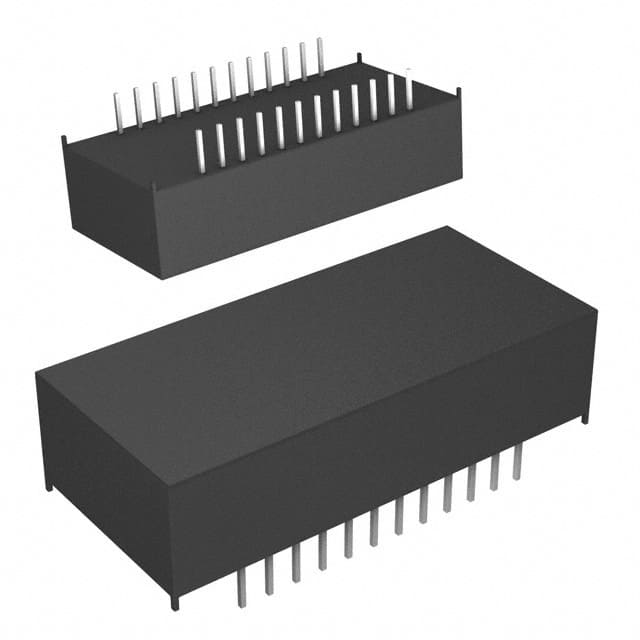
- Part No.:
- DS1220AB-150
- Manufacturer:
- Analog Devices Inc./Maxim Integrated
- Category:
- Memory
- Package:
- 24-DIP Module (0.600", 15.24mm)
- Datasheet:
-
 DS1220AB-150.pdf
- Description:
- IC NVSRAM 16KBIT PARALLEL 24EDIP
- Quantity:
- Payment:

- Shipping:

Inventory:2,303
Please send an inquiry. Send us your inquiry, and we will respond immediately.
Product details
Overview
DS1220AB-150 from Maxim Integrated (now Analog Devices) is a 16k nonvolatile static RAM organized as 2048 × 8 bits, featuring lithium-backed data retention, automatic write protection during power loss, and 100 ns read/write access time. It directly replaces 2k × 8 volatile SRAMs or EEPROMs in legacy industrial control and instrumentation systems requiring persistent memory without external support circuitry.
For engineers reviewing the DS1220AB-150 datasheet, DS1220AB-150 pinout, DS1220AB-150 application, or DS1220AB-150 equivalent, key selection criteria include its ±5% VCC tolerance, 4.75–5.25 V operating range, industrial-grade temperature option (-40°C to +85°C), and JEDEC-standard 24-pin extended DIP package with full pin compatibility to 2716 EPROM and 2816 EEPROM.
Technical Context
The DS1220AB-150 integrates a self-contained lithium battery and voltage-monitoring circuitry that triggers automatic write protection when VCC drops below 4.5 V (VTP = 4.5–4.75 V), switching to battery backup at ~3.0 V. Its CMOS architecture enables unlimited write cycles and eliminates need for refresh or wear leveling logic.
It operates in three distinct modes: standard read/write (CE/OE/WE-controlled), data retention (VCC < 4.5 V, all I/O high-Z), and battery-backed hold (VCC < 3.0 V). The device maintains full functional compatibility with microprocessor buses-no wait states, no glue logic-and supports direct substitution in existing 24-pin DIP layouts.
Key Specifications
| Parameter | Value and Actual Design Meaning |
|---|---|
| Memory Size | 16,384-bit (2048 × 8), byte-wide parallel interface matching legacy 2k × 8 SRAM footprint |
| Access Time | 100 ns max read/write cycle - enables direct replacement in 8085/8086/Z80-based systems without timing redesign |
| VCC Range | 4.75 V to 5.25 V (±5%) - ensures stable operation across noisy industrial 5 V rails |
| Data Retention | 10 years minimum without external power - guaranteed by internal lithium cell disconnected until first power-up |
| Write Protection Threshold | VTP = 4.5–4.75 V - initiates unconditional write lock before VCC decay causes data corruption |
| Operating Temp | -40°C to +85°C (IND variant) - qualified for embedded control in harsh environments like factory automation |
| Package | 24-pin 720-mil Extended DIP - matches 2716 EPROM and 2816 EEPROM pinout for drop-in PCB reuse |
Pinout & Package
DS1220AB-150 uses a JEDEC-standard 24-pin Extended Dual In-line Package (EDIP), 720 mil width, with through-hole mounting and wave/hand soldering compatibility. Pin 1 is index-marked; pin 14 is VCC, pin 12 is GND.
| Pin/Terminal | Circuit Role | Design Meaning |
|---|---|---|
| A0–A10 | Address Inputs | 11-bit address bus for selecting one of 2048 bytes; TTL-compatible, no pull-ups required |
| DQ0–DQ7 | Data I/O | Bidirectional 8-bit data bus; high-impedance when CE/OE inactive or during battery backup |
| CE | Chip Enable | Active-low chip select; controls device activation and write-cycle initiation with WE |
| WE | Write Enable | Active-low write strobe; determines write start/stop edges jointly with CE per JEDEC timing rules |
| OE | Output Enable | Active-low output control; disables drivers during writes to prevent bus contention |
| VCC | Power Supply | +5 V supply input (4.75–5.25 V); powers logic and enables lithium switch-on at first power application |
| GND | Ground | Reference return path for all signals and internal battery circuitry |
Key Features
| Feature | Design Value |
|---|---|
| Lithium freshness seal | Lithium energy source remains electrically disconnected until first VCC application > VTP, preserving full 10-year retention capacity |
| Automatic power-fail response | Sub-µs detection (tPD = 1.5 µs) of VCC decay below VTP triggers immediate write protect and high-Z I/O state |
| No external support circuitry | Integrated voltage monitor, battery switch, and backup controller eliminate need for discrete supervisors or backup capacitors |
| Unlimited write endurance | CMOS SRAM core enables infinite write cycles - no wear-out mechanism unlike EEPROM or Flash |
| Direct EPROM/EEPROM replacement | Pins match 2716 (UV-EPROM) and 2816 (EEPROM), enabling legacy system upgrades without PCB revision |
Applications
| Industrial Data Logger | Medical Device Memory Backup |
|---|---|
Use Scenario: Standalone environmental sensor node logging temperature, pressure, and humidity every 5 seconds with intermittent mains power. IC Role / Device Role / Timing Role: Nonvolatile SRAM storing last 1000 readings; retains data during brownouts or scheduled shutdowns. Use Value: Eliminates need for EEPROM write-delay overhead or Flash erase cycles - data written instantly and preserved for ≥10 years without power. | Use Scenario: Portable ECG monitor capturing waveform snapshots during patient transport where AC power is unavailable. IC Role / Device Role / Timing Role: Battery-backed memory holding raw analog-to-digital samples prior to USB upload; survives 30+ minute battery-only operation. Use Value: Guarantees zero data loss during power transitions - no firmware-level save routines or checksum validation required. |
| Legacy PLC Configuration Storage | Avionics Black Box Recorder |
Use Scenario: Programmable Logic Controller retaining ladder logic configuration and I/O mapping across firmware updates and power cycles. IC Role / Device Role / Timing Role: Direct replacement for obsolete 2816 EEPROM in 1980s-era PLC backplane; accessed via Z80 bus. Use Value: Enables field upgrade without board redesign - same pinout, faster 100 ns access, and infinite rewrites for dynamic config changes. | Use Scenario: Flight data recorder capturing engine parameters, attitude, and control surface positions at 100 Hz during emergency descent. IC Role / Device Role / Timing Role: High-reliability memory buffer between ADC and serial flash - holds last 5 seconds of data during crash-induced power loss. Use Value: Meets DO-160 Section 22 crash survivability requirements - data retained even if main power fails below 3.0 V. |
Equivalent & Alternatives
The following parts are listed as comparable options for similar nonvolatile SRAM applications.
| Alternative Part | Technical Difference | Application Difference | Selection Advice |
|---|---|---|---|
| DS1220AD-100+ | Wider VCC tolerance (±10%, 4.5–5.5 V); lower VTP (4.25–4.5 V); identical pinout and timing | Better suited for unregulated 5 V supplies with higher ripple; less margin before write protect triggers | Select DS1220AD-100+ only if system VCC varies beyond ±5%; otherwise DS1220AB-150 provides tighter regulation guardband |
| STK12C68-AI50 | Same 16k × 8 organization, 55 ns access, but uses external capacitor for backup; no integrated lithium | Requires external 0.47 F supercap and supervisor IC; shorter retention (~5 years); RoHS-compliant | Choose STK12C68-AI50 only when lithium-free design is mandated; DS1220AB-150 delivers longer retention with zero external components |
Compared with DS1220AD-100+, DS1220AB-150 offers stricter VCC regulation tolerance and higher write-protect threshold, improving immunity to marginal power conditions. Against STK12C68-AI50, DS1220AB-150 eliminates external backup components and doubles retention life - critical for sealed or inaccessible deployments.
Availability
DS1220AB-150 is available at Aetrix Electronics and suitable for industrial data loggers, medical device memory backup, and legacy PLC configuration storage requiring stable component supply, long-term lifecycle support, and guaranteed 10-year data retention under power-loss conditions.
Supply support for DS1220AB-150 includes scheduled delivery planning, volume procurement assistance, BOM continuity management, traceable sourcing, and lifecycle availability coordination for OEM customers, industrial embedded developers, connected-device designers, and electronics production programs.
Manufacturer
Maxim Integrated (acquired by Analog Devices in 2021) designs precision analog, mixed-signal, and nonvolatile memory solutions for industrial, medical, and automotive applications.
The DS1220AB-150 belongs to Maxim's NV SRAM product line, engineered specifically to replace aging EPROM, EEPROM, and battery-backed SRAM in mission-critical systems where data integrity during power interruption is non-negotiable.
FAQ
What is the guaranteed data retention period for DS1220AB-150?
The DS1220AB-150 guarantees a minimum 10-year data retention period in the absence of external power, measured from the time VCC is first applied. This is ensured by an internal lithium energy source that remains disconnected until initial power-up, preserving full battery capacity. The specification is design-guaranteed and not 100% tested per unit.
Does DS1220AB-150 require external support components for battery backup operation?
No, DS1220AB-150 requires no external support components. It integrates a lithium energy source, voltage-monitoring circuitry, and automatic power-switching logic. When VCC drops below 4.5 V, DS1220AB-150 autonomously enables write protection and switches to battery backup at ~3.0 V - all without external supervisors, capacitors, or diodes.
Is DS1220AB-150 pin-compatible with standard EPROM or EEPROM devices?
Yes, DS1220AB-150 uses a JEDEC-standard 24-pin extended DIP package and matches the pinout of the 2716 UV-EPROM and 2816 EEPROM. This allows direct substitution in legacy designs without PCB modification, while delivering faster 100 ns access and unlimited write endurance compared to those older technologies.
What is the operating voltage range for DS1220AB-150?
The DS1220AB-150 operates over a VCC range of 4.75 V to 5.25 V (±5% of 5 V), with full functionality including read/write and automatic write protection. Its write-protection threshold (VTP) is specified from 4.5 V to 4.75 V, ensuring reliable data safeguarding before VCC decay compromises memory integrity.
Can DS1220AB-150 be used in industrial temperature environments?
Yes, the DS1220AB-150 IND variant is rated for -40°C to +85°C operation and is qualified for industrial applications. This version maintains full 100 ns access time, 10-year data retention, and automatic power-fail response across the extended temperature range - making it suitable for factory automation, outdoor instrumentation, and transportation systems.
DS1220AB-150 Specifications
- Product attributes
- Attribute value
- Manufacturer:
- Analog Devices Inc./Maxim Integrated
- Series:
- -
- Package/Case:
- 24-DIP Module (0.600", 15.24mm)
- Packaging:
- Tube
- Product Status:
- Obsolete
- Programmable:
- Not Verified
- Memory Type:
- Non-Volatile
- Memory Format:
- NVSRAM
- Technology:
- NVSRAM (Non-Volatile SRAM)
- Memory Size:
- 16Kbit
- Memory Organization:
- 2K x 8
- Memory Interface:
- Parallel
- Clock Frequency:
- -
- Write Cycle Time - Word, Page:
- 150ns
- Access Time:
- 150 ns
- Voltage - Supply:
- 4.75V ~ 5.25V
- Operating Temperature:
- 0°C ~ 70°C (TA)
- Grade:
- -
- Qualification:
- -
- Mounting Type:
- Through Hole
- Supplier Device Package:
- 24-EDIP
DS1220AB-150 FAQ
1.How can I place an order for DS1220AB-150 through Aetrix?
Please submit a Request for Quotation (RFQ) for DS1220AB-150 on Aetrix. Our sales agent will provide a competitive quotation and guide you through the order confirmation once you accept the terms.
2.Are the price and stock information for DS1220AB-150 reliable?
The price and inventory of DS1220AB-150 are updated periodically and may fluctuate due to market conditions. Stock and pricing data are typically refreshed every 24 hours. Quotation validity for DS1220AB-150 is usually 5 days.
3.What payment methods are accepted for DS1220AB-150?
We accept Wire Transfer, PayPal, Credit Card, Western Union, MoneyGram, and Escrow for DS1220AB-150 transactions.
Note: Certain payment methods may incur a processing fee.
4.How is shipping managed for DS1220AB-150?
DS1220AB-150 orders can be shipped via leading logistics carriers, including DHL, UPS, FedEx, TNT, or Registered Mail.
Once your DS1220AB-150 order is processed, you will receive an email with the shipment details and tracking number.
Note: Tracking information may take up to 24 hours to appear. Express delivery typically takes 3–5 business days.
5.How can I obtain technical support or documentation for DS1220AB-150?
For technical support, including DS1220AB-150 datasheets, pinout diagrams, or application guidance, please contact our engineering support team. They can provide detailed documentation and assistance for your DS1220AB-150 requirements.
6.How does Aetrix verify that DS1220AB-150 is sourced from the original manufacturer or authorized distributors?
All DS1220AB-150 products on Aetrix are procured from qualified distributors and authorized channels. Our dedicated quality assurance team conducts strict verification, including traceability checks and, if necessary, third-party testing. This ensures that DS1220AB-150 meets industry standards.
7.What is the process for return or replacement of DS1220AB-150?
All DS1220AB-150 units undergo pre-shipment inspection (PSI). If there is an issue with DS1220AB-150, returns or replacements are accepted under the following conditions:
1.Quantity discrepancies, incorrect items, or visible external defects (such as breakage or corrosion), acknowledged by Aetrix.
2.The issue is reported within 90 days of delivery.
3.The DS1220AB-150 part is unused and in its original packaging.
Return procedure for DS1220AB-150:
1.Submit a request within 90 days.
2.Obtain a Return Material Authorization (RMA) from Aetrix.
DS1220AB-150 Tags
-
M24C02-WMN6TP
STMicroelectronics
-
AT24C02C-XHM-T
Microchip Technology
-
AT21CS01-STUM10-T
Microchip Technology

-
AT24C02C-SSHM-T
Microchip Technology
-
24LC01BT-I/OT
Microchip Technology
-
M24C02-FMC6TG
STMicroelectronics
-
AT24CS02-SSHM-T
Microchip Technology

-
93LC46BT-I/OT
Microchip Technology
-
AT24C04C-SSHM-T
Microchip Technology

-
24LC01BT-I/SN
Microchip Technology
-
24AA02UIDT-I/OT
Microchip Technology
-
AT24C08C-STUM-T
Microchip Technology
Tech Hub

Comparator circuit design covering voltage thresholds, input limits, open-collector outputs, LM393 wiring, op-amp differences, hysteresis, timing, window detection and practical fault diagnosis.
Schmitt triggers use separate rising and falling thresholds to stabilize slow or noisy signals. This guide covers hysteresis, 74HC14 and 74HCT14 selection, comparator calculations, RC oscillators and p…
Counterfeit components can hide behind convincing markings and passing basic function tests. This engineering reference covers source traceability, external inspection, X-ray, XRF, electrical testing, …

A practical engineering and sourcing framework covering lifecycle verification, lifetime-buy calculations, replacement qualification, supplier checks and counterfeit-risk controls.

TTL and CMOS logic families differ in thresholds, loading, output drive, power and timing. This engineering guide compares 74HC and 74HCT, calculates noise margins and checks 3.3 V/5 V compatibility.

A practical engineering guide to 3.3V and 5V logic compatibility, input thresholds, resistor dividers, translator ICs, MOSFET level shifting, I2C pull-ups, timing limits and power-sequencing risks.

The 74HC595 uses push-pull logic outputs, while the TPIC6B595 uses 50 V open-drain DMOS sinks for higher-power loads. This guide compares timing, current limits, 3.3 V interfacing, load wiring, thermal…

The 74HC595 converts serial data into eight stable parallel outputs. This guide covers pin functions, shift and storage timing, OE and MR behavior, drive-current limits, cascading, voltage compatibilit…

A technical comparison of level-sensitive latches and edge-triggered flip-flops, covering timing windows, setup and hold limits, master–slave operation, time borrowing, race-through, HDL inference and…

A D latch stores one bit while Enable controls when data can pass. This reference covers gate-level operation, truth tables, transparency, setup and hold timing, LE versus OE, common ICs and practical …


