
 My Inquiry
 My Account


Analog Devices Inc./Maxim Integrated DS1230Y-200
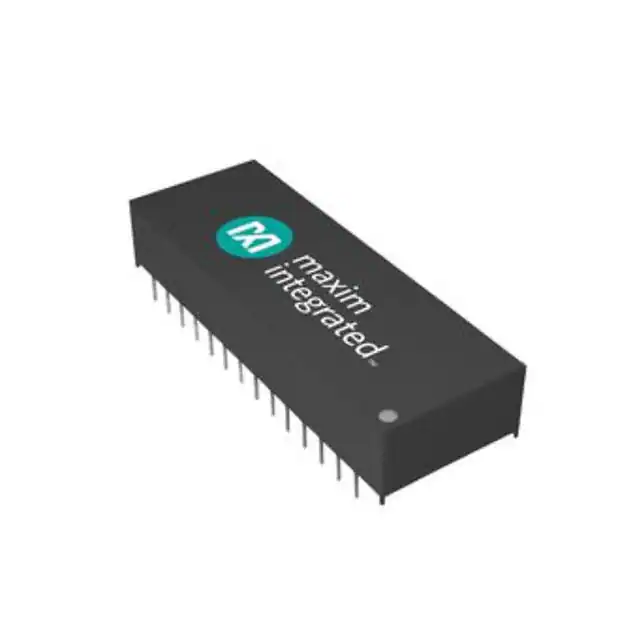
- Part No.:
- DS1230Y-200
- Manufacturer:
- Analog Devices Inc./Maxim Integrated
- Category:
- Memory
- Package:
- 28-DIP Module (0.600", 15.24mm)
- Datasheet:
-
 DS1230Y-200.pdf
- Description:
- IC NVSRAM 256KBIT PAR 28EDIP
- Quantity:
- Payment:

- Shipping:

Inventory:2,815
Please send an inquiry. Send us your inquiry, and we will respond immediately.
Product details
Overview
DS1230Y-200 from Maxim Integrated is a 256k (32k × 8) nonvolatile static RAM with integrated lithium backup, JEDEC-standard 28-pin DIP package, ±10% VCC operating range (4.5V–5.5V), 70 ns access time, and 10-year data retention without external power. It serves as a drop-in replacement for volatile SRAMs in battery-backed memory systems requiring guaranteed data integrity during power loss.
For engineers reviewing the DS1230Y-200 datasheet, DS1230Y-200 pinout, DS1230Y-200 application, or DS1230Y-200 equivalent, key selection criteria include write-protection voltage threshold (4.25V), standby current (50–150 µA), lithium-freshness seal activation, PowerCap compatibility, and industrial temperature option support.
Technical Context
The DS1230Y-200 integrates SRAM, lithium battery, and autonomous power-fail detection circuitry into a single monolithic DIP package. Its control logic continuously monitors VCC, triggering automatic write protection and lithium switchover when voltage falls below 4.25V, and restoring normal operation above 4.5V.
It supports standard microprocessor bus timing with CE/OE/WE control, full address/data multiplexing via A0–A14 and DQ0–DQ7, and operates across 0°C to +70°C (commercial) or –40°C to +85°C (IND variant). No external support circuitry is required for nonvolatile operation.
Key Specifications
| Parameter | Value and Actual Design Meaning |
|---|---|
| Memory Size | 262,144-bit (32,768 × 8), byte-wide parallel interface compatible with legacy 32k×8 SRAM sockets |
| Access Time | 70 ns - enables direct replacement of 70 ns static RAMs without timing redesign |
| VCC Range | 4.5V to 5.5V (±10%) - accommodates wider supply tolerance than DS1230AB, easing power rail design |
| Write Protection Threshold | 4.25V - triggers automatic data lockout earlier than DS1230AB (4.5V), enhancing margin against brownout corruption |
| Data Retention | 10 years minimum without external power - guaranteed by sealed lithium source and internal power-switching architecture |
| Standby Current | 50–150 µA at CE = VCC−0.5V - enables ultra-low-power hold mode in battery-critical applications |
| Operating Temperature | 0°C to +70°C (commercial); IND variant supports –40°C to +85°C - validated for embedded industrial control environments |
Pinout & Package
DS1230Y-200 uses a JEDEC-standard 28-pin Extended DIP (740-mil) package with integrated lithium battery and nonvolatile control circuitry. Pinout matches industry-standard 32k×8 SRAMs and 28256 EEPROMs for direct socket compatibility.
| Pin/Terminal | Circuit Role | Design Meaning |
|---|---|---|
| A0–A14 | Address Inputs | 15-bit address bus supporting full 32k-word addressing; TTL-compatible inputs |
| DQ0–DQ7 | Data I/O | Bi-directional 8-bit data bus with high-impedance outputs during deselect/write |
| CE | Chip Enable | Active-low chip select; initiates read/write when low with OE/WE conditions met |
| WE | Write Enable | Active-low write strobe; falling edge (with CE low) starts write cycle |
| OE | Output Enable | Active-low output enable; controls data bus drivers during read cycles only |
| VCC | Power Supply | +5V supply input; powers SRAM and control logic; triggers lithium activation on first power-up |
| GND | Ground | Reference return path for all signals and internal circuitry |
| NC | No Connect | Pins 1, 3, 4, and 33 are unconnected; must remain floating per datasheet |
Key Features
| Feature | Design Value |
|---|---|
| Automatic Power-Fail Response | Sub-µs detection of VCC decay below 4.25V triggers unconditional write protection and lithium switchover-no firmware or external supervisor needed |
| Lithium Freshness Seal | Factory-disconnected battery ensures full 10-year retention capacity; enabled only upon first VCC > 4.25V application |
| Unlimited Write Cycles | No endurance limit on SRAM writes-eliminates wear-leveling overhead and flash/EEPROM rewrite constraints |
| Standardized Pinout Compatibility | Matches 28-pin DIP SRAMs and 28256 EEPROMs-enables hardware reuse without PCB redesign |
| Low-Power CMOS Architecture | 50 µA typical standby current at VCC−0.5V enables long-term battery-backed retention in energy-constrained systems |
Applications
| Industrial PLC Data Logging | Medical Device Configuration Storage |
|---|---|
Use Scenario: Storing runtime parameters, calibration coefficients, and alarm history in programmable logic controllers during mains failure. IC Role / Device Role / Timing Role: Nonvolatile SRAM providing instant-access, byte-addressable memory with zero write latency and guaranteed retention during extended outages. Use Value: Eliminates boot-time EEPROM reload delays and avoids flash write-cycle bottlenecks during rapid parameter updates. | Use Scenario: Preserving patient-specific therapy settings and device configuration across power cycles in infusion pumps and diagnostic monitors. IC Role / Device Role / Timing Role: Battery-backed memory ensuring regulatory-compliant data persistence without external backup capacitors or supervisors. Use Value: Meets IEC 62304 Class C software requirements for data integrity during unexpected AC loss or battery swap. |
| Telecom Base Station Real-Time Clock Buffer | Automotive ECU Event Recorder |
Use Scenario: Holding RTC registers, time-stamped event logs, and network synchronization state during brief AC interruptions in remote radio units. IC Role / Device Role / Timing Role: Low-latency, high-reliability SRAM buffer interfacing directly to microcontroller address/data bus with no glue logic. Use Value: Maintains precise timekeeping continuity and eliminates NVRAM initialization delays after power restoration. | Use Scenario: Capturing pre-crash sensor data and fault codes in engine control units where power may collapse during collision events. IC Role / Device Role / Timing Role: Fail-safe memory capturing critical CAN bus messages and analog sensor snapshots within microseconds of VCC decay. Use Value: Provides deterministic, sub-1.5 µs power-fail detection and write-protection activation-meeting ISO 26262 ASIL-B timing requirements. |
Equivalent & Alternatives
The following parts are listed as comparable options for similar nonvolatile SRAM applications.
| Alternative Part | Technical Difference | Application Difference | Selection Advice |
|---|---|---|---|
| DS1230AB-70+ | Narrower VCC range (4.75V–5.25V); higher write-protection threshold (4.50V); same 70 ns speed and 28-pin DIP | Better suited for tightly regulated 5V rails; less tolerant of brownout conditions than DS1230Y-200 | Select DS1230AB-70+ when system VCC stability exceeds ±5% and higher VTP margin is preferred |
| STK12C68-AW50 | Same 256k size and 28-pin DIP; 50 ns access time; requires external battery and discrete supervisor circuit | Higher performance but adds BOM cost, layout area, and validation complexity for backup management | Choose STK12C68-AW50 only when sub-70 ns timing is mandatory and external component integration is acceptable |
Compared with DS1230AB-70+, the DS1230Y-200 offers wider supply tolerance and earlier write-protection activation-critical for brownout-prone industrial power supplies-while STK12C68-AW50 trades integration for raw speed and requires external backup design effort.
Availability
DS1230Y-200 is available at Aetrix Electronics and suitable for industrial PLC data logging, medical device configuration storage, and telecom base station real-time clock buffering requiring stable component supply, long-lifecycle support, and RoHS-compliant packaging.
Supply support for DS1230Y-200 includes scheduled delivery planning, volume procurement assistance, BOM continuity management, traceable sourcing, and lifecycle availability coordination for OEM customers, industrial embedded developers, connected-device designers, and electronics production programs.
Manufacturer
Maxim Integrated (now part of Analog Devices) is a semiconductor company specializing in high-performance analog, mixed-signal, and power management ICs for industrial, medical, and communications applications.
The DS1230Y-200 belongs to Maxim's nonvolatile SRAM product line, designed specifically to replace volatile memory in mission-critical systems where data integrity during power interruption is non-negotiable.
FAQ
What is the guaranteed data retention period for DS1230Y-200?
The DS1230Y-200 guarantees a minimum 10-year data retention period in the absence of external power, measured from the time VCC is first applied and the internal lithium energy source is activated. This specification is assured through component selection, process control, and design-not production-tested per unit-but backed by Maxim's reliability qualification standards.
Does DS1230Y-200 require external circuitry for battery backup operation?
No, the DS1230Y-200 does not require external circuitry for battery backup operation. It integrates a lithium energy source, power-fail detection logic, and automatic switchover circuitry into a single 28-pin DIP package. The lithium cell remains electrically disconnected until first application of VCC > 4.25V, ensuring full capacity retention.
How does DS1230Y-200 differ from DS1230AB-70+ in terms of voltage tolerance?
The DS1230Y-200 supports a ±10% VCC range (4.5V–5.5V), whereas the DS1230AB-70+ supports only ±5% (4.75V–5.25V). Additionally, DS1230Y-200 activates write protection at 4.25V versus 4.50V for DS1230AB-70+, giving it greater immunity to marginal brownout conditions before data corruption risk arises.
Is DS1230Y-200 pin-compatible with standard 32k × 8 SRAMs?
Yes, DS1230Y-200 uses a JEDEC-standard 28-pin DIP package with pinout identical to popular 32k × 8 volatile SRAMs and 28256 EEPROMs. This allows direct socket replacement without PCB modification-provided VCC and timing constraints align with its ±10% supply and 70 ns access specifications.
What temperature ranges are available for DS1230Y-200?
The DS1230Y-200 is offered in commercial (0°C to +70°C) and industrial (–40°C to +85°C) temperature grades. The industrial variant is designated DS1230Y-200IND+ and undergoes extended testing to ensure reliable nonvolatile operation across the full –40°C to +85°C range, including lithium performance and power-fail response consistency.
DS1230Y-200 Specifications
- Product attributes
- Attribute value
- Manufacturer:
- Analog Devices Inc./Maxim Integrated
- Series:
- -
- Package/Case:
- 28-DIP Module (0.600", 15.24mm)
- Packaging:
- Tube
- Product Status:
- Obsolete
- Programmable:
- Not Verified
- Memory Type:
- Non-Volatile
- Memory Format:
- NVSRAM
- Technology:
- NVSRAM (Non-Volatile SRAM)
- Memory Size:
- 256Kbit
- Memory Organization:
- 32K x 8
- Memory Interface:
- Parallel
- Clock Frequency:
- -
- Write Cycle Time - Word, Page:
- 200ns
- Access Time:
- 200 ns
- Voltage - Supply:
- 4.5V ~ 5.5V
- Operating Temperature:
- 0°C ~ 70°C (TA)
- Grade:
- -
- Qualification:
- -
- Mounting Type:
- Through Hole
- Supplier Device Package:
- 28-EDIP
DS1230Y-200 FAQ
1.How can I place an order for DS1230Y-200 through Aetrix?
Please submit a Request for Quotation (RFQ) for DS1230Y-200 on Aetrix. Our sales agent will provide a competitive quotation and guide you through the order confirmation once you accept the terms.
2.Are the price and stock information for DS1230Y-200 reliable?
The price and inventory of DS1230Y-200 are updated periodically and may fluctuate due to market conditions. Stock and pricing data are typically refreshed every 24 hours. Quotation validity for DS1230Y-200 is usually 5 days.
3.What payment methods are accepted for DS1230Y-200?
We accept Wire Transfer, PayPal, Credit Card, Western Union, MoneyGram, and Escrow for DS1230Y-200 transactions.
Note: Certain payment methods may incur a processing fee.
4.How is shipping managed for DS1230Y-200?
DS1230Y-200 orders can be shipped via leading logistics carriers, including DHL, UPS, FedEx, TNT, or Registered Mail.
Once your DS1230Y-200 order is processed, you will receive an email with the shipment details and tracking number.
Note: Tracking information may take up to 24 hours to appear. Express delivery typically takes 3–5 business days.
5.How can I obtain technical support or documentation for DS1230Y-200?
For technical support, including DS1230Y-200 datasheets, pinout diagrams, or application guidance, please contact our engineering support team. They can provide detailed documentation and assistance for your DS1230Y-200 requirements.
6.How does Aetrix verify that DS1230Y-200 is sourced from the original manufacturer or authorized distributors?
All DS1230Y-200 products on Aetrix are procured from qualified distributors and authorized channels. Our dedicated quality assurance team conducts strict verification, including traceability checks and, if necessary, third-party testing. This ensures that DS1230Y-200 meets industry standards.
7.What is the process for return or replacement of DS1230Y-200?
All DS1230Y-200 units undergo pre-shipment inspection (PSI). If there is an issue with DS1230Y-200, returns or replacements are accepted under the following conditions:
1.Quantity discrepancies, incorrect items, or visible external defects (such as breakage or corrosion), acknowledged by Aetrix.
2.The issue is reported within 90 days of delivery.
3.The DS1230Y-200 part is unused and in its original packaging.
Return procedure for DS1230Y-200:
1.Submit a request within 90 days.
2.Obtain a Return Material Authorization (RMA) from Aetrix.
DS1230Y-200 Tags
-
M24C02-WMN6TP
STMicroelectronics
-
AT24C02C-XHM-T
Microchip Technology
-
AT21CS01-STUM10-T
Microchip Technology

-
AT24C02C-SSHM-T
Microchip Technology
-
24LC01BT-I/OT
Microchip Technology
-
M24C02-FMC6TG
STMicroelectronics
-
AT24CS02-SSHM-T
Microchip Technology

-
93LC46BT-I/OT
Microchip Technology
-
AT24C04C-SSHM-T
Microchip Technology

-
24LC01BT-I/SN
Microchip Technology
-
24AA02UIDT-I/OT
Microchip Technology
-
AT24C08C-STUM-T
Microchip Technology
Tech Hub

Comparator circuit design covering voltage thresholds, input limits, open-collector outputs, LM393 wiring, op-amp differences, hysteresis, timing, window detection and practical fault diagnosis.
Schmitt triggers use separate rising and falling thresholds to stabilize slow or noisy signals. This guide covers hysteresis, 74HC14 and 74HCT14 selection, comparator calculations, RC oscillators and p…
Counterfeit components can hide behind convincing markings and passing basic function tests. This engineering reference covers source traceability, external inspection, X-ray, XRF, electrical testing, …

A practical engineering and sourcing framework covering lifecycle verification, lifetime-buy calculations, replacement qualification, supplier checks and counterfeit-risk controls.

TTL and CMOS logic families differ in thresholds, loading, output drive, power and timing. This engineering guide compares 74HC and 74HCT, calculates noise margins and checks 3.3 V/5 V compatibility.

A practical engineering guide to 3.3V and 5V logic compatibility, input thresholds, resistor dividers, translator ICs, MOSFET level shifting, I2C pull-ups, timing limits and power-sequencing risks.

The 74HC595 uses push-pull logic outputs, while the TPIC6B595 uses 50 V open-drain DMOS sinks for higher-power loads. This guide compares timing, current limits, 3.3 V interfacing, load wiring, thermal…

The 74HC595 converts serial data into eight stable parallel outputs. This guide covers pin functions, shift and storage timing, OE and MR behavior, drive-current limits, cascading, voltage compatibilit…

A technical comparison of level-sensitive latches and edge-triggered flip-flops, covering timing windows, setup and hold limits, master–slave operation, time borrowing, race-through, HDL inference and…

A D latch stores one bit while Enable controls when data can pass. This reference covers gate-level operation, truth tables, transparency, setup and hold timing, LE versus OE, common ICs and practical …


