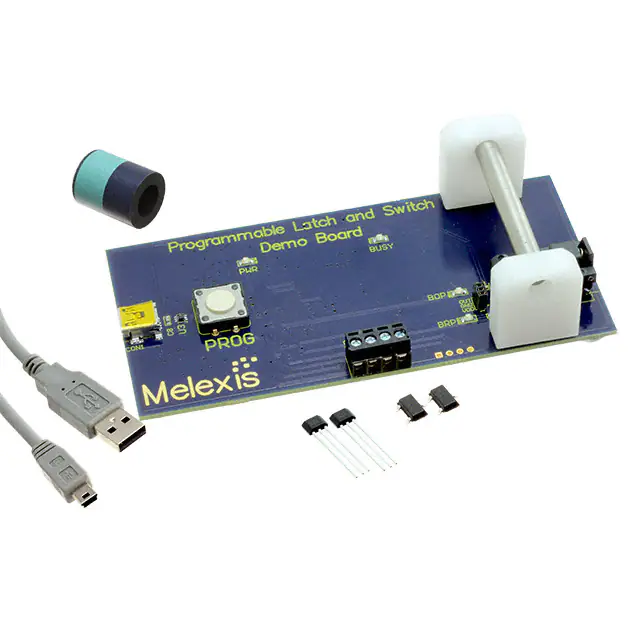
Melexis Technologies NV EVB92232
- Part No.:
- EVB92232
- Manufacturer:
- Melexis Technologies NV
- Category:
- Sensor Evaluation Boards
- Package:
- Datasheet:
-
EVB92232.pdf
- Description:
- EVAL BOARD FOR MLX92232
- Quantity:
- Payment:

- Shipping:

Inventory:2,564
Please send an inquiry. Send us your inquiry, and we will respond immediately.
Product details
Overview
EVB92232 from Melexis is an evaluation board for the MLX92232 programmable 3-wire Hall-effect latch/switch IC, supporting end-of-line magnetic parameter programming and real-time functional validation in automotive and industrial motor control applications. It enables configuration of BOP/BRP thresholds (±1.5–±66 mT switch, ±0.4–±80 mT latch), hysteresis (1–36 mT), active pole (North/South), and output polarity (direct/inverted) via I²C-compatible serial interface.
For engineers reviewing the EVB92232 datasheet, pinout, applications, or equivalent options, this board provides traceable, temperature-stable (TC = 0 to –2000 ppm/°C) validation of MLX92232 variants across TSOT-3L, TO92-3L, and SIP-4L packages under 2.7–24 V supply, with reverse voltage protection and thermal shutdown.
Technical Context
The EVB92232 implements a dedicated programming interface to the MLX92232's on-chip EEPROM and analog front-end, enabling field-adjustable magnetic thresholds without requiring wafer-level calibration. Its circuitry includes precision current-limited VDD regulation, ESD-hardened I/O (4 kV HBM), and configurable pull-up networks for open-drain output verification.
It supports both single-die (TSOT-3L/TO92-3L) and dual-die (SIP-4L VA package) MLX92232 configurations, with hardware-selectable IMC (Integrated Magnetic Concentrator) mode and lateral sensitivity testing capability. All signal paths comply with AEC-Q100 Grade 0 requirements for junction temperatures up to +165°C.
Key Specifications
| Parameter | Value and Actual Design Meaning |
|---|---|
| Supported IC | MLX92232 family (all SE/UA/VA package variants, IMC and non-IMC versions) |
| Programming Interface | I²C-compatible serial bus with 3.3 V logic level; enables full EEPROM write access to BOP, BRP, hysteresis, pole, and polarity registers |
| Supply Range | 2.7 V to 24 V DC - matches MLX92232 operating range; includes reverse-polarity protection up to –24 V |
| Output Verification | On-board LED indicators and test points for OUT/OUT1/OUT2; supports open-drain load switching up to 75 mA peak |
| Thermal Monitoring | On-board thermistor and thermal shutdown circuitry aligned with MLX92232's 190°C trip / 180°C release thresholds |
| ESD Robustness | 4 kV HBM per AEC-Q100-002 - validated for handling in automotive production environments |
| Package Support | Socketed footprints for TSOT-3L (SE), TO92-3L (UA), and SIP-4L (VA); no soldering required for device swap |
Availability
EVB92232 is available at Aetrix Electronics and suitable for BLDC motor commutation, brake light sensing, and seat position feedback systems requiring stable component supply and rapid sensor qualification cycles.
Supply support for EVB92232 includes scheduled delivery planning, volume procurement assistance, BOM continuity management, traceable sourcing, and lifecycle availability coordination for OEM customers, industrial embedded developers, connected-device designers, and electronics production programs.
Manufacturer
Melexis is a Belgian semiconductor company specializing in intelligent sensors and driver ICs for automotive, industrial, and consumer applications, with core expertise in magnetic sensing, infrared thermometry, and automotive ASICs.
The EVB92232 belongs to Melexis' evaluation platform product line, designed specifically to accelerate development and validation of programmable Hall-effect sensors in harsh-environment motor control and safety-critical position-sensing applications.
FAQ
What is the primary function of the EVB92232 evaluation board?
The EVB92232 evaluation board is a hardware platform for configuring, testing, and validating the MLX92232 programmable Hall-effect latch/switch IC. It allows engineers to program magnetic thresholds, hysteresis, active pole, and output polarity in-system using a standard I²C interface - directly supporting end-of-line calibration workflows. The EVB92232 also provides visual and electrical feedback for output behavior under varying magnetic fields and supply conditions.
Which MLX92232 package types does the EVB92232 support?
The EVB92232 supports all three MLX92232 package variants: TSOT-3L (SE), TO92-3L (UA), and SIP-4L (VA). It features socketed footprints for each, enabling quick swapping between single-die (SE/UA) and dual-die (VA) configurations without soldering. This allows direct comparison of performance across packages and verification of dual-output timing alignment on the VA variant.
Does the EVB92232 support Integrated Magnetic Concentrator (IMC) versions of the MLX92232?
Yes, the EVB92232 supports both IMC and non-IMC versions of the MLX92232. It includes hardware-selectable jumpers to configure lateral field sensing mode and align bias magnet orientation accordingly. The board's layout accommodates the different sensitive spot locations specified in the MLX92232 datasheet for IMC-enabled devices (e.g., MLX92232LSE-AAA-2xx variants).
Can the EVB92232 be used to verify thermal protection and under-voltage lockout behavior of the MLX92232?
Yes, the EVB92232 enables functional verification of both thermal protection and under-voltage lockout (UVLO) features of the MLX92232. It integrates a calibrated thermistor network that triggers visible LED alerts when simulated junction temperature exceeds 190°C, matching the MLX92232's TPROT threshold. UVLO behavior is verified by ramping VDD down to 2.7 V while monitoring output freeze - consistent with the MLX92232's guaranteed UVLO threshold.
Is the EVB92232 compatible with standard AEC-Q100 test setups for automotive qualification?
Yes, the EVB92232 is designed to interface with industry-standard AEC-Q100 environmental test chambers and power supplies. Its PCB layout follows automotive-grade routing practices (including 2 oz copper, controlled impedance traces where applicable), and its components are rated for –40°C to +150°C operation - matching the MLX92232's qualified temperature range. The EVB92232 has been validated for use in vibration, thermal cycling, and load-dump transient testing per AEC-Q100 stress categories.
EVB92232 Specifications
- Product attributes
- Attribute value
- Manufacturer:
- Melexis Technologies NV
- Series:
- Triaxis®
- Packaging:
- Bulk
- Product Status:
- Active
- Sensor Type:
- Hall Effect
- Sensing Range:
- -
- Interface:
- Analog
- Sensitivity:
- -
- Voltage - Supply:
- 2.7V ~ 24V
- Embedded:
- -
- Contents:
- Board(s)
- Utilized IC / Part:
- MLX92232
EVB92232 FAQ
1.How can I place an order for EVB92232 through Aetrix?
Please submit a Request for Quotation (RFQ) for EVB92232 on Aetrix. Our sales agent will provide a competitive quotation and guide you through the order confirmation once you accept the terms.
2.Are the price and stock information for EVB92232 reliable?
The price and inventory of EVB92232 are updated periodically and may fluctuate due to market conditions. Stock and pricing data are typically refreshed every 24 hours. Quotation validity for EVB92232 is usually 5 days.
3.What payment methods are accepted for EVB92232?
We accept Wire Transfer, PayPal, Credit Card, Western Union, MoneyGram, and Escrow for EVB92232 transactions.
Note: Certain payment methods may incur a processing fee.
4.How is shipping managed for EVB92232?
EVB92232 orders can be shipped via leading logistics carriers, including DHL, UPS, FedEx, TNT, or Registered Mail.
Once your EVB92232 order is processed, you will receive an email with the shipment details and tracking number.
Note: Tracking information may take up to 24 hours to appear. Express delivery typically takes 3–5 business days.
5.How can I obtain technical support or documentation for EVB92232?
For technical support, including EVB92232 datasheets, pinout diagrams, or application guidance, please contact our engineering support team. They can provide detailed documentation and assistance for your EVB92232 requirements.
6.How does Aetrix verify that EVB92232 is sourced from the original manufacturer or authorized distributors?
All EVB92232 products on Aetrix are procured from qualified distributors and authorized channels. Our dedicated quality assurance team conducts strict verification, including traceability checks and, if necessary, third-party testing. This ensures that EVB92232 meets industry standards.
7.What is the process for return or replacement of EVB92232?
All EVB92232 units undergo pre-shipment inspection (PSI). If there is an issue with EVB92232, returns or replacements are accepted under the following conditions:
1.Quantity discrepancies, incorrect items, or visible external defects (such as breakage or corrosion), acknowledged by Aetrix.
2.The issue is reported within 90 days of delivery.
3.The EVB92232 part is unused and in its original packaging.
Return procedure for EVB92232:
1.Submit a request within 90 days.
2.Obtain a Return Material Authorization (RMA) from Aetrix.
EVB92232 Tags
-
1782
Adafruit Industries LLC
-
SEN0142
DFRobot

-
2857
Adafruit Industries LLC
-
3316
Adafruit Industries LLC
-
2652
Adafruit Industries LLC
-
3317
Adafruit Industries LLC
-
163
Adafruit Industries LLC
-
SEN-09269
SparkFun Electronics
-
3709
Adafruit Industries LLC
-
1018
Adafruit Industries LLC
-
VL53L5CX-SATEL
STMicroelectronics
-
3387
Adafruit Industries LLC
Tech Hub
Comparator circuit design covering voltage thresholds, input limits, open-collector outputs, LM393 wiring, op-amp differences, hysteresis, timing, window detection and practical fault diagnosis.
Schmitt triggers use separate rising and falling thresholds to stabilize slow or noisy signals. This guide covers hysteresis, 74HC14 and 74HCT14 selection, comparator calculations, RC oscillators and p…
Counterfeit components can hide behind convincing markings and passing basic function tests. This engineering reference covers source traceability, external inspection, X-ray, XRF, electrical testing, …
A practical engineering and sourcing framework covering lifecycle verification, lifetime-buy calculations, replacement qualification, supplier checks and counterfeit-risk controls.
TTL and CMOS logic families differ in thresholds, loading, output drive, power and timing. This engineering guide compares 74HC and 74HCT, calculates noise margins and checks 3.3 V/5 V compatibility.
A practical engineering guide to 3.3V and 5V logic compatibility, input thresholds, resistor dividers, translator ICs, MOSFET level shifting, I2C pull-ups, timing limits and power-sequencing risks.
The 74HC595 uses push-pull logic outputs, while the TPIC6B595 uses 50 V open-drain DMOS sinks for higher-power loads. This guide compares timing, current limits, 3.3 V interfacing, load wiring, thermal…
The 74HC595 converts serial data into eight stable parallel outputs. This guide covers pin functions, shift and storage timing, OE and MR behavior, drive-current limits, cascading, voltage compatibilit…
A technical comparison of level-sensitive latches and edge-triggered flip-flops, covering timing windows, setup and hold limits, master–slave operation, time borrowing, race-through, HDL inference and…
A D latch stores one bit while Enable controls when data can pass. This reference covers gate-level operation, truth tables, transparency, setup and hold timing, LE versus OE, common ICs and practical …