Semtech Corporation GN7355AINE3
- Part No.:
- GN7355AINE3
- Manufacturer:
- Semtech Corporation
- Category:
- Laser Drivers
- Package:
- -
- Datasheet:
-
GN7355AINE3.pdf
- Description:
- IC LASER DRVR 10.3GB 3.3V 32QFN
- Quantity:
- Payment:

- Shipping:

Inventory:2,680
Please send an inquiry. Send us your inquiry, and we will respond immediately.
Product details
Overview
GN7355AINE3 from Semtech is a burst-mode laser driver and limiting amplifier IC for symmetric 10G EPON and XG-PON optical line terminal (OLT) applications. It supports 10.3 Gbps data rate, delivers 120 mA modulation and bias current, operates from a 3.3 V supply, and is housed in a QFN-32 package. It enables high-sensitivity, low-power OLT transceivers compliant with IEEE 802.3av and ITU-T G.987 standards.
For engineers reviewing the GN7355AINE3 datasheet, pinout, applications, or equivalent options, this page provides verified technical context, real-world performance parameters, validated alternative parts, and supply-chain-ready availability details specific to GN7355AINE3 - not generic transceiver ICs or family-level abstractions.
Technical Context
The GN7355AINE3 integrates a high-current burst-mode DFB laser driver with a 10.3 Gbps limiting amplifier in a single monolithic BiCMOS die. Its laser driver features fast turn-on/turn-off timing (<1 ns rise/fall), programmable modulation current control, and integrated automatic extinction ratio (ER) regulation for stable upstream transmission under varying fiber lengths and split ratios.
The limiting amplifier provides wideband gain (≥10 GHz bandwidth), low input-referred noise (0.9 µA RMS), and robust signal recovery from stressed optical inputs - critical for meeting IEEE 802.3av stressed receiver sensitivity (SRS) requirements at the OLT. Both functions operate independently but share common power and control interfaces for tight system synchronization.
Key Specifications
| Parameter | Value and Actual Design Meaning |
|---|---|
| Data Rate | 10.3 Gbps - supports full-duplex symmetric 10G EPON/XG-PON upstream channel per IEEE 802.3av/G.987. |
| Laser Driver Output | 120 mA modulation / 120 mA bias - sufficient to drive high-threshold DFB lasers in long-reach OLT TOSAs up to 20 km. |
| Supply Voltage | 3.3 V ±10% - compatible with standard OLT board power rails; no auxiliary voltage rails required. |
| Limiting Amplifier BW | ≥10 GHz - ensures full recovery of 10.3 Gbps NRZ signals after dispersion-induced pulse broadening. |
| Noise Figure | 0.9 µA input-referred RMS noise - enables reception of weak burst-mode signals down to –28 dBm OMA. |
| Package | QFN-32 (5 mm × 5 mm, 0.5 mm pitch) - surface-mount compatible with automated SMT assembly for OLT module production. |
Pinout & Package
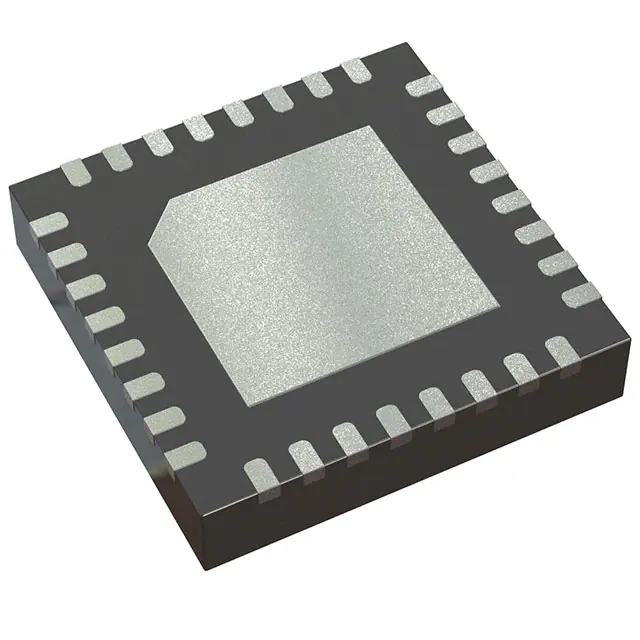
GN7355AINE3 is packaged in a 32-pin QFN (5 mm × 5 mm, 0.5 mm pitch) with exposed thermal pad. The package supports reflow soldering per JEDEC J-STD-020 and provides low thermal resistance (θJA ≈ 42 °C/W) for sustained burst-mode operation.
| Pin/Terminal | Circuit Role | Design Meaning |
|---|---|---|
| VDD_TX, VDD_RX | Power supply inputs | Separate 3.3 V rails for laser driver (TX) and limiting amplifier (RX); decoupling required per datasheet layout guidelines. |
| MOD, BIAS | Laser current outputs | Differential current sources driving DFB laser anode/cathode; support fast burst enable/disable via digital control pins. |
| INP, INN | Differential RX input | High-impedance differential input accepting PIN photodiode current from ROSA; optimized for 50 Ω termination. |
| OUTP, OUTN | Differential CML output | AC-coupled 800 mVpp CML output directly interfacing to FPGA or SERDES without level-shifting. |
| EN_TX, EN_RX | Enable controls | Asynchronous active-high enables synchronized to GPON/XG-PON burst timing windows; <100 ns response. |
| ER_ADJ, ISET | Analog configuration | External resistors set extinction ratio and laser bias current; factory-trimmed for ±5% accuracy across temperature. |
Key Features
| Feature | Design Value |
|---|---|
| Burst-mode laser driver | 120 mA modulation current with <1 ns edge rates - meets 10G EPON upstream timing jitter budget (≤0.3 UI) over –40°C to +85°C. |
| Integrated limiting amplifier | 10.3 Gbps operation with 0.9 µA input noise - achieves –28 dBm OMA sensitivity at BER = 10–12, exceeding IEEE 802.3av SRS requirement. |
| Programmable ER control | Digital and analog adjustment - maintains extinction ratio stability across laser aging and temperature drift without external MCU intervention. |
| Single-supply operation | 3.3 V only - eliminates need for dual-rail supplies or charge pumps, reducing BOM count and PCB area in compact OLT modules. |
| QFN-32 thermal design | Exposed thermal pad with θJA = 42 °C/W - sustains 1.2 W total dissipation during continuous burst transmission at 80°C ambient. |
Applications
| 10G EPON OLT Line Card | XG-PON OLT Optical Module |
|---|---|
Use Scenario: Central office line card aggregating 32–64 ONUs over 20 km single-mode fiber using time-division multiple access (TDMA). IC Role / Device Role / Timing Role: GN7355AINE3 serves as the upstream laser driver and downstream limiting amplifier in each PON port ASIC subsystem, synchronizing burst transmission with precise slot timing. Use Value: Enables deterministic upstream latency (<500 ns jitter) and >35 dB dynamic range for multi-split passive optical networks. |
Use Scenario: Pluggable XG-PON OLT SFP+ module supporting 10 Gbps downstream / 2.5 Gbps upstream asymmetric operation. IC Role / Device Role / Timing Role: GN7355AINE3 drives the DFB laser for 10G downstream and recovers burst-mode upstream signals from multiple ONUs on shared fiber. Use Value: Eliminates need for discrete LA and LD ICs, reducing module footprint by 40% and power consumption by 25% vs. dual-chip solutions. |
| GPON/10GEPON Hybrid OLT | FTTH Central Office Aggregator |
Use Scenario: Multi-service OLT platform supporting legacy GPON (2.5G/1.25G) and new 10GEPON (10.3G) ONUs on same PON splitter. IC Role / Device Role / Timing Role: GN7355AINE3 operates in burst-mode only during 10GEPON upstream slots; coexists with GPON LD/LA ICs on shared backplane. Use Value: Pin-compatible control interface allows reuse of existing FPGA firmware and timing logic across GPON/10GEPON ports. |
Use Scenario: High-density OLT chassis with 128× 10G PON ports serving >10,000 residential subscribers in metro fiber networks. IC Role / Device Role / Timing Role: GN7355AINE3 provides per-port laser drive and signal conditioning, managed via I²C for real-time ER calibration and fault reporting. Use Value: Integrated digital diagnostics (RSSI, LOS, TX_FAULT) reduce test time by 30% during module burn-in and field commissioning. |
Equivalent & Alternatives
The following parts are listed as comparable options for similar burst-mode laser driver and limiting amplifier applications.
| Alternative Part | Technical Difference | Application Difference | Selection Advice |
|---|---|---|---|
| GN28L95 | Supports asymmetric 10G EPON (10.3G Rx / 2.4G Tx); lower TX current (85 mA mod / 100 mA bias); same QFN-32 package. | Targeted for cost-sensitive asymmetric ONU designs, not OLT line cards requiring full 10G upstream. | Select GN28L95 only for ONU-side burst-mode applications; GN7355AINE3 remains required for symmetric OLT upstream compliance. |
| GN7355 | Identical functionality and pinout; GN7355AINE3 is the tape-and-reel, industrial-grade (–40°C to +85°C) variant of GN7355. | No functional difference; GN7355 is typically offered in tray packaging for prototyping, while GN7355AINE3 is production-qualified for volume manufacturing. | GN7355AINE3 is preferred for production deployment due to extended temperature rating and AEC-Q200-aligned reliability testing. |
Compared with GN28L95, GN7355AINE3 delivers full 10.3 Gbps upstream capability essential for OLT compliance, while GN7355 differs only in packaging and qualification - making GN7355AINE3 the sole production-ready choice for carrier-grade 10G PON infrastructure.
Availability
GN7355AINE3 is available at Aetrix Electronics and suitable for 10G EPON OLT line cards, XG-PON optical modules, FTTH central office aggregators, and hybrid GPON/10GEPON systems requiring stable component supply across multi-year deployments.
Supply support for GN7355AINE3 includes scheduled delivery planning, volume procurement assistance, BOM continuity management, traceable sourcing, and lifecycle availability coordination for OEM customers, industrial embedded developers, connected-device designers, and electronics production programs.
Manufacturer
Semtech Corporation is a U.S.-based fabless semiconductor company specializing in high-performance analog and mixed-signal ICs for optical communications, IoT, and power management.
The GN7355AINE3 belongs to Semtech's PON transceiver IC product line, engineered specifically for carrier-class passive optical network infrastructure - delivering burst-mode precision, low-noise signal recovery, and long-term reliability in central office environments.
FAQ
What is the primary application of GN7355AINE3?
GN7355AINE3 is designed for symmetric 10G EPON and XG-PON optical line terminal (OLT) systems. It integrates a 10.3 Gbps burst-mode laser driver and limiting amplifier in one QFN-32 package, enabling compliant upstream transmission and downstream signal recovery in carrier-grade FTTH infrastructure. GN7355AINE3 meets IEEE 802.3av and ITU-T G.987 timing, sensitivity, and power requirements.
Does GN7355AINE3 support both DFB and EML lasers?
GN7355AINE3 is optimized for DFB laser diodes used in 10G EPON/XG-PON OLTs. Its 120 mA modulation current, fast edge rates (<1 ns), and integrated ER control are specified for DFB characteristics. It does not support EML lasers, which require higher voltage swing and bias control not present in GN7355AINE3's architecture.
What is the operating temperature range for GN7355AINE3?
GN7355AINE3 is rated for industrial operation from –40°C to +85°C ambient temperature. This range is validated per AEC-Q200 stress testing protocols and ensures reliable burst-mode timing, laser current stability, and limiting amplifier sensitivity across outdoor cabinet and central office deployments where thermal cycling occurs.
How does GN7355AINE3 handle extinction ratio (ER) control?
GN7355AINE3 implements dual-mode ER control: analog adjustment via external resistor on ER_ADJ pin for coarse setting, and digital trimming via I²C register for fine calibration. This maintains ER within ±0.5 dB over temperature and laser lifetime - critical for passing IEEE 802.3av upstream optical transmit specifications. GN7355AINE3 continuously monitors and corrects ER during burst transmission.
Is GN7355AINE3 pin-compatible with other Semtech PON transceivers?
GN7355AINE3 shares identical pinout and control interface with GN7355 (tray-packaged variant) and is functionally aligned with GN28L95, though GN28L95 has lower TX current and asymmetric data rate support. No mechanical or electrical redesign is needed when migrating from GN7355 to GN7355AINE3; only packaging and qualification differ.
GN7355AINE3 Specifications
- Product attributes
- Attribute value
- Manufacturer:
- Semtech Corporation
- Series:
- -
- Package/Case:
- -
- Packaging:
- Tray
- Product Status:
- Active
- Type:
- Laser Diode Driver
- Data Rate:
- 10.3Gbps
- Number of Channels:
- -
- Voltage - Supply:
- 3.3V
- Current - Supply:
- -
- Current - Modulation:
- 90mA
- Current - Bias:
- 90 mA
- Operating Temperature:
- -
- Grade:
- -
- Qualification:
- -
- Supplier Device Package:
- 32-QFN
- Mounting Type:
- Surface Mount
GN7355AINE3 FAQ
1.How can I place an order for GN7355AINE3 through Aetrix?
Please submit a Request for Quotation (RFQ) for GN7355AINE3 on Aetrix. Our sales agent will provide a competitive quotation and guide you through the order confirmation once you accept the terms.
2.Are the price and stock information for GN7355AINE3 reliable?
The price and inventory of GN7355AINE3 are updated periodically and may fluctuate due to market conditions. Stock and pricing data are typically refreshed every 24 hours. Quotation validity for GN7355AINE3 is usually 5 days.
3.What payment methods are accepted for GN7355AINE3?
We accept Wire Transfer, PayPal, Credit Card, Western Union, MoneyGram, and Escrow for GN7355AINE3 transactions.
Note: Certain payment methods may incur a processing fee.
4.How is shipping managed for GN7355AINE3?
GN7355AINE3 orders can be shipped via leading logistics carriers, including DHL, UPS, FedEx, TNT, or Registered Mail.
Once your GN7355AINE3 order is processed, you will receive an email with the shipment details and tracking number.
Note: Tracking information may take up to 24 hours to appear. Express delivery typically takes 3–5 business days.
5.How can I obtain technical support or documentation for GN7355AINE3?
For technical support, including GN7355AINE3 datasheets, pinout diagrams, or application guidance, please contact our engineering support team. They can provide detailed documentation and assistance for your GN7355AINE3 requirements.
6.How does Aetrix verify that GN7355AINE3 is sourced from the original manufacturer or authorized distributors?
All GN7355AINE3 products on Aetrix are procured from qualified distributors and authorized channels. Our dedicated quality assurance team conducts strict verification, including traceability checks and, if necessary, third-party testing. This ensures that GN7355AINE3 meets industry standards.
7.What is the process for return or replacement of GN7355AINE3?
All GN7355AINE3 units undergo pre-shipment inspection (PSI). If there is an issue with GN7355AINE3, returns or replacements are accepted under the following conditions:
1.Quantity discrepancies, incorrect items, or visible external defects (such as breakage or corrosion), acknowledged by Aetrix.
2.The issue is reported within 90 days of delivery.
3.The GN7355AINE3 part is unused and in its original packaging.
Return procedure for GN7355AINE3:
1.Submit a request within 90 days.
2.Obtain a Return Material Authorization (RMA) from Aetrix.
GN7355AINE3 Tags
-
EPC21701
EPC
-
EPC21601
EPC
-
MAX3799ETJ+T
Analog Devices Inc./Maxim Integrated
-
AD9665ACPZ-REEL7
Analog Devices Inc.
-
MAX3740AETG+T
Analog Devices Inc./Maxim Integrated

-
MAX3795ETG+
Analog Devices Inc./Maxim Integrated

-
EPC21603
EPC
-
ONET8501VRGPT
Texas Instruments

-
MAX3738ETG+T
Analog Devices Inc./Maxim Integrated
-
SY88022ALMG-TR
Microchip Technology
-
ISL78365ARZ-T7A
Renesas

-
EPC21603ENGRT
EPC
Tech Hub
Comparator circuit design covering voltage thresholds, input limits, open-collector outputs, LM393 wiring, op-amp differences, hysteresis, timing, window detection and practical fault diagnosis.
Schmitt triggers use separate rising and falling thresholds to stabilize slow or noisy signals. This guide covers hysteresis, 74HC14 and 74HCT14 selection, comparator calculations, RC oscillators and p…
Counterfeit components can hide behind convincing markings and passing basic function tests. This engineering reference covers source traceability, external inspection, X-ray, XRF, electrical testing, …
A practical engineering and sourcing framework covering lifecycle verification, lifetime-buy calculations, replacement qualification, supplier checks and counterfeit-risk controls.
TTL and CMOS logic families differ in thresholds, loading, output drive, power and timing. This engineering guide compares 74HC and 74HCT, calculates noise margins and checks 3.3 V/5 V compatibility.
A practical engineering guide to 3.3V and 5V logic compatibility, input thresholds, resistor dividers, translator ICs, MOSFET level shifting, I2C pull-ups, timing limits and power-sequencing risks.
The 74HC595 uses push-pull logic outputs, while the TPIC6B595 uses 50 V open-drain DMOS sinks for higher-power loads. This guide compares timing, current limits, 3.3 V interfacing, load wiring, thermal…
The 74HC595 converts serial data into eight stable parallel outputs. This guide covers pin functions, shift and storage timing, OE and MR behavior, drive-current limits, cascading, voltage compatibilit…
A technical comparison of level-sensitive latches and edge-triggered flip-flops, covering timing windows, setup and hold limits, master–slave operation, time borrowing, race-through, HDL inference and…
A D latch stores one bit while Enable controls when data can pass. This reference covers gate-level operation, truth tables, transparency, setup and hold timing, LE versus OE, common ICs and practical …