Semtech Corporation SC461ULTRT
- Part No.:
- SC461ULTRT
- Manufacturer:
- Semtech Corporation
- Category:
- DC DC Switching Controllers
- Package:
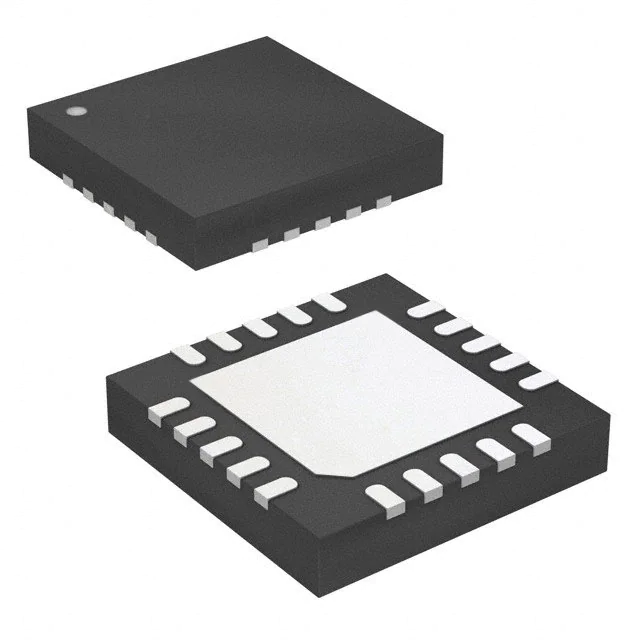
- 20-VFQFN Exposed Pad
- Datasheet:
-
SC461ULTRT.pdf
- Description:
- IC REGULATOR BUCK 20-MLPQ
- Quantity:
- Payment:

- Shipping:

Inventory:3,443
Please send an inquiry. Send us your inquiry, and we will respond immediately.
Product details
Overview
SC461ULTRT from Semtech is a synchronous EcoSpeed® DC-DC buck controller with integrated 5V/200mA LDO, pseudo-fixed frequency adaptive on-time control, and hiccup-mode fault recovery. It operates from 3V to 28V input, delivers 0.6V–5.5V output (extendable >5V with external components), supports up to 1MHz switching, and features independent enable controls for PWM and LDO-used in point-of-load power supplies for networking equipment.
For engineers reviewing the SC461ULTRT datasheet, pinout, applications, or equivalent options, key selection criteria include its 20-pin MLPQ-UT20 package, programmable soft-start and VIN UVLO, SmartDrive™ EMI reduction, TC-compensated RDS(ON) current sensing, and dual bias options (VLDO or external 5V).
Technical Context
The SC461ULTRT implements adaptive on-time control using output ripple as the PWM ramp signal, eliminating error amplifier compensation and enabling fast transient response. Its one-shot timer generates on-time proportional to VOUT/VIN, with RTON programming enabling frequency tuning up to 1MHz.
It integrates dual gate drivers (DH/DL) with shoot-through protection, bootstrap switch (16Ω), and smart power-save mode that disables low-side conduction when inductor current reaches zero for 8 consecutive cycles-reducing light-load losses while maintaining regulation via capacitor discharge.
Key Specifications
| Parameter | Value and Actual Design Meaning |
|---|---|
| Input Voltage Range | 3V to 28V - supports multi-cell battery systems and industrial DC rails without external pre-regulation. |
| Output Voltage Range | 0.6V to 5.5V - regulated by 0.6V ±0.6% internal reference; >5.5V achievable with external resistor divider on VOUT pin. |
| Switching Frequency | Up to 1MHz - programmable via RTON resistor; enables compact magnetics and high-density PCB layout. |
| LDO Output | 5V ±2.5%, 200mA - powers internal analog circuits or external bias; dropout voltage 1.4V at 50mA load. |
| Current Limit Sensing | TC-compensated RDS(ON) - eliminates external sense resistor; accuracy maintained across -40°C to +125°C junction range. |
| Protection Features | Hiccup restart, over-voltage (+20%), under-voltage (-25%), thermal shutdown (165°C), and Smart Power-Save over-voltage prevention. |
| Package | MLPQ-UT20, 3×3 mm - thermally enhanced exposed pad; RoHS/WEEE/halogen-free; 3000 pcs/reel. |
Pinout & Package
SC461ULTRT is housed in a 20-pin MLPQ-UT20 package (3×3 mm, 0.5 mm pitch) with exposed thermal pad connected to AGND. Pin functions are validated per Semtech SC461 datasheet Rev 2.1.
| Pin/Terminal | Circuit Role | Design Meaning |
|---|---|---|
| FB | Feedback input | Connects to resistor divider from VOUT; regulates output using 0.6V internal reference - valley ripple sensing enables fast transient response. |
| VOUT | Switcher output sense | Must not exceed VDDA; for >5V outputs, requires external divider to limit voltage at this pin to ≤VDDA. |
| DH / DL | High-/low-side gate drivers | Drive external N-channel MOSFETs; DH includes integrated bootstrap switch; shoot-through protection delay = 45 ns. |
| LX | Switching node | Connects to MOSFET bridge midpoint; used for zero-cross detection in power-save mode and ILIM current sensing. |
| ILIM | Current limit programming | Resistor from ILIM to LX sets cycle-by-cycle current limit threshold - TC-compensated for stable operation over temperature. |
| EN / ENL | Independent enables | EN controls PWM regulator; ENL enables LDO and programs VIN UVLO threshold via resistor divider - decouples bias and input monitoring. |
| PSV | Power-save mode control | Floating = power-save; pulled to VDDA = forced continuous mode - selects operating strategy based on load profile and efficiency targets. |
| TON | On-time programming | Resistor to AGND sets adaptive on-time duration and thus switching frequency - critical for optimizing EMI and efficiency trade-offs. |
| PGOOD | Open-drain status indicator | Signals valid regulation (±9% window around nominal); requires external pull-up; used for system sequencing and fault reporting. |
| SS | Soft-start timing | Capacitor to AGND programs startup ramp time and automatic hiccup recovery duration - prevents inrush and ensures controlled turn-on. |
Key Features
| Feature | Design Value |
|---|---|
| EcoSpeed® adaptive on-time control | Eliminates compensation network and enables <100 µs transient response - reduces output capacitance requirements by up to 40%. |
| SmartDrive™ gate drive | Two-stage DH turn-on - first slow, then fast after LX rises 0.8V - suppresses diode reverse-recovery noise and cuts EMI without snubbers. |
| Integrated 5V/200mA LDO | Self-bias capability eliminates need for external bias rail; supports VLDO-to-VDDA/VDDP connection - simplifies system power architecture. |
| Programmable VIN UVLO | Configurable threshold via ENL resistor divider - enables brown-in/brown-out behavior tailored to battery voltage profiles or supply stability requirements. |
| Hiccup-mode fault recovery | Automatic restart after over-current, over-voltage, or thermal shutdown - limits average power dissipation during sustained faults and protects external MOSFETs. |
Applications
| Networking Equipment Power | Point-of-Load Module Replacement |
|---|---|
Use Scenario: Providing 1.8V/10A to FPGA I/O banks in 1U rack-mounted switches with strict EMI limits and thermal constraints. IC Role / Device Role / Timing Role: Primary buck controller managing dynamic load steps; PGOOD coordinates with FPGA configuration logic; PSV enables efficiency optimization during idle periods. Use Value: Adaptive on-time delivers <50 mV undershoot on 0→10A step; SmartDrive™ meets CISPR-32 Class B conducted EMI without added filtering. | Use Scenario: Replacing legacy 5V-input POL modules in telecom line cards where board space is constrained and input voltage varies from 12V to 24V. IC Role / Device Role / Timing Role: Standalone buck controller driving discrete MOSFETs; TON and ILIM pins allow precise frequency and current limit tuning per module variant. Use Value: Wide 3–28V input range eliminates need for upstream pre-regulator; 3×3 mm MLPQ package saves >35% PCB area versus comparable QFN solutions. |
| Office Automation Systems | Industrial Embedded Computing |
Use Scenario: Generating 3.3V/6A for multifunction printer mainboard CPU and peripherals from 12V rail, with cold-start capability down to -40°C. IC Role / Device Role / Timing Role: Dual-rail controller supplying both processor core and I/O domains; ENL enables VIN UVLO hysteresis matching battery backup thresholds. Use Value: Pre-bias start-up allows seamless transition from battery to AC adapter; -40°C to +125°C operating junction range ensures reliability in unventilated enclosures. | Use Scenario: Powering ARM-based edge AI inference module requiring 1.1V/8A with tight output tolerance and immunity to voltage transients on shared 24V backplane. IC Role / Device Role / Timing Role: High-precision buck controller with 0.6V ±0.6% reference and programmable soft-start; PGOOD enables firmware-controlled power sequencing. Use Value: Load regulation <±0.5% across 0–8A; hiccup restart prevents latch-up during bus voltage dips - maintains system uptime in factory environments. |
Equivalent & Alternatives
The following parts are listed as comparable options for similar buck controller applications.
| Alternative Part | Technical Difference | Application Difference | Selection Advice |
|---|---|---|---|
| MP2451DT-LF-Z | Fixed 500kHz frequency; no integrated LDO; requires external bias; 16-pin SOIC package. | Lacks LDO and VIN UVLO programming; less suitable for self-biased or battery-critical designs. | Choose MP2451DT-LF-Z only if fixed-frequency operation and SOIC layout compatibility are prioritized over bias flexibility and thermal density. |
| TPS54202DRCT | Internal FETs (2A); no LDO; 3.5–36V input; 17-pin WSON; uses voltage-mode control with external compensation. | Lower current rating; no hiccup restart or SmartDrive™; slower transient response due to error amplifier loop. | Choose TPS54202DRCT only for low-power, cost-sensitive applications where integrated FETs reduce BOM count and voltage-mode stability is preferred. |
Compared with MP2451DT-LF-Z and TPS54202DRCT, SC461ULTRT uniquely combines adaptive on-time control, integrated 5V LDO, hiccup-mode protection, and SmartDrive™ EMI suppression in a 3×3 mm MLPQ package-making it optimal for space-constrained, high-efficiency, and noise-sensitive POL designs.
Availability
SC461ULTRT is available at Aetrix Electronics and suitable for networking equipment power, point-of-load module replacement, and industrial embedded computing requiring stable component supply and long-term production continuity.
Supply support for SC461ULTRT includes scheduled delivery planning, volume procurement assistance, BOM continuity management, traceable sourcing, and lifecycle availability coordination for OEM customers, industrial embedded developers, connected-device designers, and electronics production programs.
Manufacturer
Semtech Corporation is a U.S.-based fabless semiconductor company specializing in high-performance analog and mixed-signal ICs for power management, RF, and signal integrity markets.
The SC461ULTRT belongs to Semtech's EcoSpeed® DC-DC controller product line, designed specifically for high-efficiency, low-EMI, and thermally dense point-of-load applications in networking, computing, and industrial systems.
FAQ
What is the maximum supported switching frequency for SC461ULTRT?
The SC461ULTRT supports up to 1 MHz switching frequency, programmable via the external RTON resistor connected between the TON pin and AGND. The actual frequency depends on VIN, VOUT, and RTON value per the equation fSW ≈ VIN/(TON × VOUT), where TON is set by RTON. At VIN = 15V and VOUT = 3V with RTON = 300 kΩ, typical on-time is 1.7 µs, yielding ~294 kHz - higher frequencies require smaller RTON values within datasheet limits.
How does SC461ULTRT handle startup into a pre-biased output?
The SC461ULTRT supports pre-bias start-up: when enabled, it monitors VOUT during startup and avoids forcing current into an already charged rail. This prevents reverse current flow and potential damage to downstream components. The device enters normal regulation once VOUT drops below the programmed threshold, ensuring safe initialization in hot-swap or redundant power scenarios - a verified behavior confirmed in SC461 datasheet Figure 10.
Can SC461ULTRT generate output voltages above 5V?
Yes, SC461ULTRT can regulate output voltages above 5V using an external resistor divider connected to the VOUT pin, which must remain ≤VDDA. For example, a 12V output requires scaling VOUT to ≤5V before connecting to the pin. Additionally, the RTON value must be increased proportionally to maintain target on-time, as the controller uses the scaled VOUT voltage in its timing calculation - detailed in SC461 datasheet Section 15.
What is the purpose of the PSV pin on SC461ULTRT?
The PSV pin on SC461ULTRT selects between power-save mode (PSV floating) and forced continuous mode (PSV tied to VDDA). In power-save mode, the controller disables low-side conduction when inductor current reaches zero for 8 consecutive cycles - reducing switching losses at light loads. In forced continuous mode, both MOSFETs switch continuously for predictable frequency and improved light-load transient response - choice depends on efficiency vs. noise trade-off.
Does SC461ULTRT require external MOSFETs, and what are the driver specifications?
Yes, SC461ULTRT is a controller-only IC and requires external high-side and low-side N-channel MOSFETs. Its DH and DL drivers support peak currents of 2A (sourcing) and 4A (sinking), with typical pull-down RDS(ON) of 0.28Ω at VDDP = 5V. The integrated bootstrap switch (16Ω) eliminates need for external bootstrap diode, and shoot-through protection ensures 45 ns dead time - validated in Electrical Characteristics Table on page 7 of the SC461 datasheet.
SC461ULTRT Specifications
- Product attributes
- Attribute value
- Manufacturer:
- Semtech Corporation
- Series:
- -
- Package/Case:
- 20-VFQFN Exposed Pad
- Packaging:
- Tape & Reel (TR)
- Product Status:
- Obsolete
- Output Type:
- -
- Function:
- -
- Output Configuration:
- -
- Topology:
- -
- Number of Outputs:
- -
- Output Phases:
- -
- Voltage - Supply (Vcc/Vdd):
- -
- Frequency - Switching:
- -
- Duty Cycle (Max):
- -
- Synchronous Rectifier:
- -
- Clock Sync:
- -
- Serial Interfaces:
- -
- Control Features:
- -
- Operating Temperature:
- -
- Grade:
- -
- Qualification:
- -
- Mounting Type:
- Surface Mount
- Supplier Device Package:
- 20-MLPQ-UT (3x3)
SC461ULTRT FAQ
1.How can I place an order for SC461ULTRT through Aetrix?
Please submit a Request for Quotation (RFQ) for SC461ULTRT on Aetrix. Our sales agent will provide a competitive quotation and guide you through the order confirmation once you accept the terms.
2.Are the price and stock information for SC461ULTRT reliable?
The price and inventory of SC461ULTRT are updated periodically and may fluctuate due to market conditions. Stock and pricing data are typically refreshed every 24 hours. Quotation validity for SC461ULTRT is usually 5 days.
3.What payment methods are accepted for SC461ULTRT?
We accept Wire Transfer, PayPal, Credit Card, Western Union, MoneyGram, and Escrow for SC461ULTRT transactions.
Note: Certain payment methods may incur a processing fee.
4.How is shipping managed for SC461ULTRT?
SC461ULTRT orders can be shipped via leading logistics carriers, including DHL, UPS, FedEx, TNT, or Registered Mail.
Once your SC461ULTRT order is processed, you will receive an email with the shipment details and tracking number.
Note: Tracking information may take up to 24 hours to appear. Express delivery typically takes 3–5 business days.
5.How can I obtain technical support or documentation for SC461ULTRT?
For technical support, including SC461ULTRT datasheets, pinout diagrams, or application guidance, please contact our engineering support team. They can provide detailed documentation and assistance for your SC461ULTRT requirements.
6.How does Aetrix verify that SC461ULTRT is sourced from the original manufacturer or authorized distributors?
All SC461ULTRT products on Aetrix are procured from qualified distributors and authorized channels. Our dedicated quality assurance team conducts strict verification, including traceability checks and, if necessary, third-party testing. This ensures that SC461ULTRT meets industry standards.
7.What is the process for return or replacement of SC461ULTRT?
All SC461ULTRT units undergo pre-shipment inspection (PSI). If there is an issue with SC461ULTRT, returns or replacements are accepted under the following conditions:
1.Quantity discrepancies, incorrect items, or visible external defects (such as breakage or corrosion), acknowledged by Aetrix.
2.The issue is reported within 90 days of delivery.
3.The SC461ULTRT part is unused and in its original packaging.
Return procedure for SC461ULTRT:
1.Submit a request within 90 days.
2.Obtain a Return Material Authorization (RMA) from Aetrix.
SC461ULTRT Tags

-
UCC28C45DR
Texas Instruments

-
UCC28C40DR
Texas Instruments

-
UCC28C43DR
Texas Instruments

-
ZXSC410E6TA
Diodes Incorporated
-
LM3524DMX/NOPB
Texas Instruments
-
LM3489MMX/NOPB
Texas Instruments
-
MIC2102YML-TR
Microchip Technology

-
LM5148RGYR
Texas Instruments
-
TL598CDR
Texas Instruments
-
LM5155DSSR
Texas Instruments
-
LM25085MYX/NOPB
Texas Instruments

-
UCC2813DTR-0
Texas Instruments
Tech Hub
Comparator circuit design covering voltage thresholds, input limits, open-collector outputs, LM393 wiring, op-amp differences, hysteresis, timing, window detection and practical fault diagnosis.
Schmitt triggers use separate rising and falling thresholds to stabilize slow or noisy signals. This guide covers hysteresis, 74HC14 and 74HCT14 selection, comparator calculations, RC oscillators and p…
Counterfeit components can hide behind convincing markings and passing basic function tests. This engineering reference covers source traceability, external inspection, X-ray, XRF, electrical testing, …
A practical engineering and sourcing framework covering lifecycle verification, lifetime-buy calculations, replacement qualification, supplier checks and counterfeit-risk controls.
TTL and CMOS logic families differ in thresholds, loading, output drive, power and timing. This engineering guide compares 74HC and 74HCT, calculates noise margins and checks 3.3 V/5 V compatibility.
A practical engineering guide to 3.3V and 5V logic compatibility, input thresholds, resistor dividers, translator ICs, MOSFET level shifting, I2C pull-ups, timing limits and power-sequencing risks.
The 74HC595 uses push-pull logic outputs, while the TPIC6B595 uses 50 V open-drain DMOS sinks for higher-power loads. This guide compares timing, current limits, 3.3 V interfacing, load wiring, thermal…
The 74HC595 converts serial data into eight stable parallel outputs. This guide covers pin functions, shift and storage timing, OE and MR behavior, drive-current limits, cascading, voltage compatibilit…
A technical comparison of level-sensitive latches and edge-triggered flip-flops, covering timing windows, setup and hold limits, master–slave operation, time borrowing, race-through, HDL inference and…
A D latch stores one bit while Enable controls when data can pass. This reference covers gate-level operation, truth tables, transparency, setup and hold timing, LE versus OE, common ICs and practical …