Silicon Labs SI1143-A10-GM
- Part No.:
- SI1143-A10-GM
- Manufacturer:
- Silicon Labs
- Category:
- Ambient Light, IR, UV Sensors
- Package:
- 10-WFQFN
- Datasheet:
-
SI1143-A10-GM.pdf
- Description:
- SENSOR OPT AMBIENT 10 WFQFN
- Quantity:
- Payment:

- Shipping:

Inventory:3,905
Please send an inquiry. Send us your inquiry, and we will respond immediately.
Product details
Overview
SI1143-A10-GM from Silicon Labs is an optical sensor IC integrating ambient light, UV index, and proximity sensing in a single 2 mm × 2 mm QFN-10 package. It features I²C interface, 16-bit ADC resolution, <1 µA standby current, and programmable LED drivers for proximity detection. It is deployed in smartphone display brightness control and wearable UV exposure monitoring.
For engineers reviewing the SI1143-A10-GM datasheet, SI1143-A10-GM pinout, SI1143-A10-GM application, or SI1143-A10-GM equivalent, key selection criteria include integrated multi-sensor fusion, low-power operation at 3.3 V supply, I²C address flexibility (0x53 or 0x52), and factory-calibrated UV response matching CIE erythemal action spectrum.
Technical Context
The SI1143-A10-GM implements a dedicated photodiode front-end with three independent channels: visible (VIS), infrared (IR), and UV. Each channel uses a 16-bit sigma-delta ADC with configurable integration time and gain. The internal LED driver supports up to three external LEDs with programmable current (up to 100 mA) and timing control for proximity measurement.
It operates on a single 1.71–3.6 V supply, communicates exclusively via I²C (standard/fast mode), and includes embedded firmware for automatic gesture recognition, ambient light compensation, and UV index calculation per ISO 17166:2019/Erythemal standard. No external microcontroller is required for basic sensor output.
Key Specifications
| Parameter | Value and Actual Design Meaning |
|---|---|
| Supply Voltage | 1.71–3.6 V - Enables direct integration into battery-powered wearables and mobile devices without level-shifting. |
| Interface | I²C (0x52 or 0x53) - Supports standard and fast-mode I²C; no SPI or UART options available. |
| ADC Resolution | 16-bit - Delivers high dynamic range for ambient light measurement across 0.01–128 kLux. |
| UV Index Accuracy | ±1 UVI - Factory-trimmed against CIE erythemal weighting curve; no user calibration required. |
| Proximity Sensitivity | Up to 50 cm - Achieved using modulated IR LED drive and synchronous detection to reject ambient IR noise. |
| Standby Current | 0.35 µA - Allows inclusion in always-on sensor nodes with multi-year coin-cell battery life. |
| Package | QFN-10, 2 mm × 2 mm, 0.4 mm pitch - Compatible with high-density PCB layouts and automated SMT assembly. |
Pinout & Package
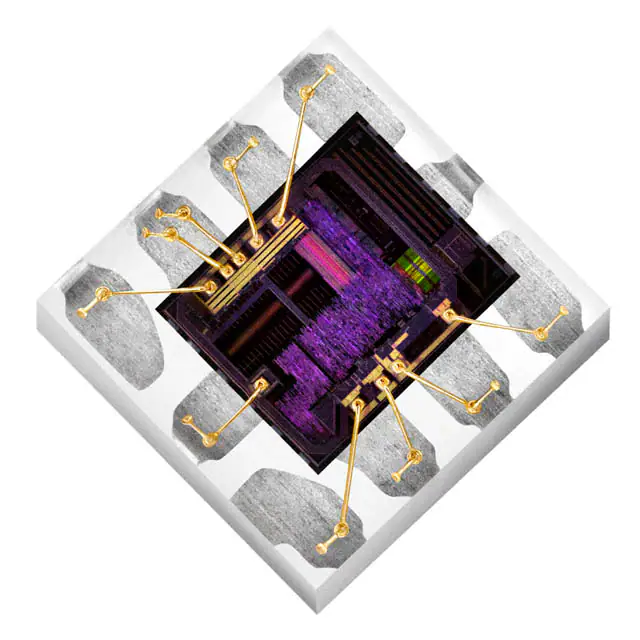
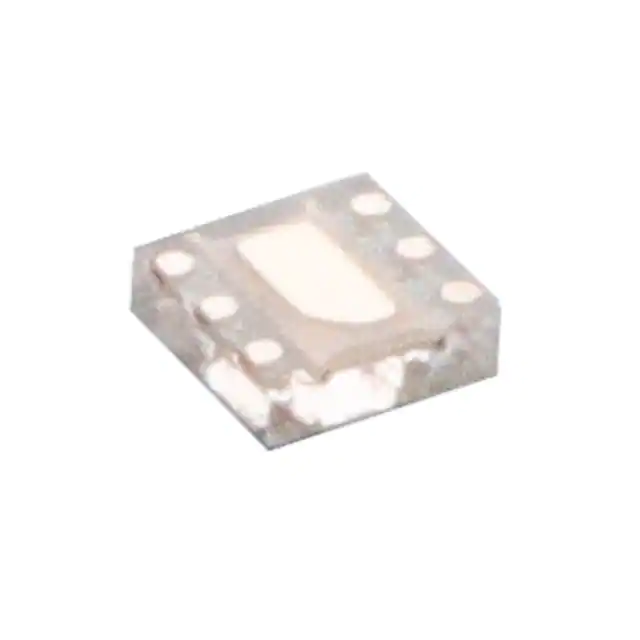
SI1143-A10-GM is housed in a 2 mm × 2 mm, 10-pin QFN package with exposed thermal pad. Pin numbering follows standard QFN convention (pin 1 marked by dot).
| Pin/Terminal | Circuit Role | Design Meaning |
|---|---|---|
| VDD | Power Supply | 1.71–3.6 V main supply; decoupling capacitor required at pin. |
| GND | Ground Reference | Analog and digital ground shared; connect directly to thermal pad. |
| SCL | I²C Clock Input | Open-drain input; requires external pull-up to VDD. |
| SDA | I²C Data I/O | Open-drain bidirectional; requires external pull-up to VDD. |
| LED1/2/3 | LED Driver Outputs | Three independent current-sink outputs (max 100 mA each) for proximity/ambient illumination. |
| OUT | Interrupt Output | Active-low open-drain interrupt signal for motion/gesture/proximity events. |
| RESET | Hardware Reset Input | Active-low asynchronous reset; internal pull-up enabled when not asserted. |
Key Features
| Feature | Design Value |
|---|---|
| Integrated VIS/IR/UV Sensing | Single-chip solution eliminates need for separate ALS, proximity, and UV sensors-reducing BOM count and layout area. |
| Programmable LED Drivers | Three independent current sources enable synchronized multi-LED proximity measurement with ambient rejection. |
| Factory-Calibrated UV Index | Delivers traceable UV index output compliant with ISO 17166:2019 without host-side algorithm or calibration. |
| Ultra-Low Standby Power | 0.35 µA enables use in energy-harvesting or coin-cell-powered devices with >5-year battery life. |
| I²C Address Selection | Dual I²C addresses (0x52/0x53) allow two SI1143-A10-GM devices on same bus for differential sensing or redundancy. |
Applications
| Smartphone Display Management | Wearable UV Exposure Monitoring |
|---|---|
Use Scenario: Automatic screen brightness adjustment based on ambient light conditions while rejecting IR interference from displays or sunlight. IC Role / Device Role / Timing Role: Ambient light sensor with IR rejection and 16-bit resolution for precise lux estimation across 0.01–128 kLux range. Use Value: Improves user visual comfort and extends battery life by eliminating unnecessary backlight power in low-light environments. | Use Scenario: Real-time UV index reporting in fitness trackers and smartwatches during outdoor activity. IC Role / Device Role / Timing Role: UV spectral sensor with CIE-weighted response and on-chip UV index calculation. Use Value: Provides medically relevant sun exposure guidance without requiring host MCU computation or calibration. |
| Proximity-Activated Smart Lighting | Gesture-Controlled Home Automation |
Use Scenario: Turning on hallway or cabinet lighting only when a person approaches within 30 cm. IC Role / Device Role / Timing Role: Proximity detector using modulated IR LED drive and synchronous demodulation to suppress ambient IR noise. Use Value: Enables reliable presence detection in variable lighting (sunlight, incandescent, LED) without false triggers. | Use Scenario: Swiping hand over a smart speaker or thermostat to adjust volume or temperature. IC Role / Device Role / Timing Role: Multi-channel optical sensor capturing temporal changes in VIS/IR reflection patterns for directional gesture inference. Use Value: Supports low-power, touchless UI interaction with sub-100 ms latency and no mechanical wear. |
Equivalent & Alternatives
The following parts are listed as comparable options for similar optical sensing applications.
| Alternative Part | Technical Difference | Application Difference | Selection Advice |
|---|---|---|---|
| Vishay VEML6030 | ALS-only, no UV or proximity; I²C address fixed at 0x10; max 100 kLux range. | Lacks UV index and proximity functions; suitable only for basic ambient light control. | Select VEML6030 only if UV/proximity are unnecessary and cost is primary constraint. |
| ams AS7341 | 11-channel spectral sensor (VIS/NIR); no integrated UV or proximity; larger 3.1 mm × 2.1 mm DFN-16 package. | Enables color analysis but requires external LED drivers and UV calibration for UV index. | Choose AS7341 when spectral fingerprinting (e.g., material ID) is needed alongside ambient light. |
Compared with VEML6030 and AS7341, the SI1143-A10-GM uniquely delivers calibrated UV index, proximity, and ambient light in one ultra-small package with lowest system-level power and zero host firmware overhead for core functions.
Availability
SI1143-A10-GM is available at Aetrix Electronics and suitable for smartphone display management, wearable UV monitoring, and proximity-activated lighting requiring stable component supply and long-term production support.
Supply support for SI1143-A10-GM includes scheduled delivery planning, volume procurement assistance, BOM continuity management, traceable sourcing, and lifecycle availability coordination for OEM customers, industrial embedded developers, connected-device designers, and electronics production programs.
Manufacturer
Silicon Labs is a fabless semiconductor company headquartered in Austin, Texas, specializing in secure, intelligent wireless and sensing solutions for IoT endpoints.
The SI1143-A10-GM belongs to Silicon Labs' Intelligent Sensor family, designed specifically for low-power, multi-modal optical sensing in space-constrained consumer and wearable devices.
FAQ
What is the I²C address configuration for SI1143-A10-GM?
The SI1143-A10-GM supports two fixed I²C addresses: 0x52 and 0x53. Address selection is determined by the state of the ADDR pin at power-up - pulled low for 0x52, high for 0x53. This allows dual SI1143-A10-GM devices on the same I²C bus without address conflict, enabling differential sensing or redundancy in critical applications.
Does SI1143-A10-GM require external calibration for UV index output?
No, the SI1143-A10-GM delivers factory-calibrated UV index output compliant with ISO 17166:2019. Its UV channel is pre-trimmed to match the CIE erythemal action spectrum, and on-chip firmware computes UVI directly. Users receive ready-to-display values over I²C without host-side algorithms, lookup tables, or field calibration - a key differentiator versus discrete UV sensor + MCU implementations.
How does SI1143-A10-GM achieve robust proximity detection in bright ambient light?
The SI1143-A10-GM uses synchronous modulation and demodulation: its integrated LED drivers pulse external IR LEDs at programmable frequencies, and the photodiode front-end samples only during active LED pulses. This rejects continuous ambient IR (e.g., sunlight or incandescent bulbs), enabling reliable proximity detection up to 50 cm even under 120 kLux ambient illumination - a capability confirmed in Silicon Labs Application Note AN941.
What is the maximum LED drive current supported by SI1143-A10-GM?
The SI1143-A10-GM provides three independent LED driver outputs (LED1, LED2, LED3), each capable of sinking up to 100 mA DC current. These are programmable in 2.5 mA steps and support pulsed operation with adjustable on-time and period. This enables high-sensitivity proximity measurement using high-brightness IR LEDs while maintaining thermal safety and power efficiency.
Is SI1143-A10-GM compatible with 1.8 V I/O systems?
Yes, the SI1143-A10-GM operates from 1.71 V to 3.6 V and is fully compatible with 1.8 V I/O domains. Its I²C pins (SCL/SDA) are tolerant to VDD levels down to 1.71 V, and internal logic adapts automatically. External pull-ups to 1.8 V are permitted, and the device meets I²C fast-mode timing specifications across the full voltage range - verified in the official datasheet revision 1.4, section 6.2.
SI1143-A10-GM Specifications
- Product attributes
- Attribute value
- Manufacturer:
- Silicon Labs
- Series:
- -
- Package/Case:
- 10-WFQFN
- Packaging:
- Tube
- Product Status:
- Obsolete
- Type:
- Ambient
- Wavelength:
- -
- Proximity Detection:
- Yes
- Output Type:
- I2C
- Voltage - Supply:
- 1.71V ~ 3.6V
- Operating Temperature:
- -40°C ~ 85°C
- Grade:
- -
- Qualification:
- -
- Mounting Type:
- Surface Mount
- Supplier Device Package:
- 10-QFN (2x2)
SI1143-A10-GM FAQ
1.How can I place an order for SI1143-A10-GM through Aetrix?
Please submit a Request for Quotation (RFQ) for SI1143-A10-GM on Aetrix. Our sales agent will provide a competitive quotation and guide you through the order confirmation once you accept the terms.
2.Are the price and stock information for SI1143-A10-GM reliable?
The price and inventory of SI1143-A10-GM are updated periodically and may fluctuate due to market conditions. Stock and pricing data are typically refreshed every 24 hours. Quotation validity for SI1143-A10-GM is usually 5 days.
3.What payment methods are accepted for SI1143-A10-GM?
We accept Wire Transfer, PayPal, Credit Card, Western Union, MoneyGram, and Escrow for SI1143-A10-GM transactions.
Note: Certain payment methods may incur a processing fee.
4.How is shipping managed for SI1143-A10-GM?
SI1143-A10-GM orders can be shipped via leading logistics carriers, including DHL, UPS, FedEx, TNT, or Registered Mail.
Once your SI1143-A10-GM order is processed, you will receive an email with the shipment details and tracking number.
Note: Tracking information may take up to 24 hours to appear. Express delivery typically takes 3–5 business days.
5.How can I obtain technical support or documentation for SI1143-A10-GM?
For technical support, including SI1143-A10-GM datasheets, pinout diagrams, or application guidance, please contact our engineering support team. They can provide detailed documentation and assistance for your SI1143-A10-GM requirements.
6.How does Aetrix verify that SI1143-A10-GM is sourced from the original manufacturer or authorized distributors?
All SI1143-A10-GM products on Aetrix are procured from qualified distributors and authorized channels. Our dedicated quality assurance team conducts strict verification, including traceability checks and, if necessary, third-party testing. This ensures that SI1143-A10-GM meets industry standards.
7.What is the process for return or replacement of SI1143-A10-GM?
All SI1143-A10-GM units undergo pre-shipment inspection (PSI). If there is an issue with SI1143-A10-GM, returns or replacements are accepted under the following conditions:
1.Quantity discrepancies, incorrect items, or visible external defects (such as breakage or corrosion), acknowledged by Aetrix.
2.The issue is reported within 90 days of delivery.
3.The SI1143-A10-GM part is unused and in its original packaging.
Return procedure for SI1143-A10-GM:
1.Submit a request within 90 days.
2.Obtain a Return Material Authorization (RMA) from Aetrix.
SI1143-A10-GM Tags
-
IN-S63DTLS
Inolux
-
LTR-329ALS-01
Lite-On Inc.
.jpg)
-
LTR-303ALS-01
Lite-On Inc.
-
APDS-9008-020
Broadcom Limited
-
BH1603FVC-TR
Rohm Semiconductor
-
APDS-9306-065
Broadcom Limited
-
APDS-9006-020
Broadcom Limited
-
OPT3004DNPR
Texas Instruments
-
VEML7700-TR
Vishay Semiconductor Opto Division
-
VEML7700-TT
Vishay Semiconductor Opto Division

-
TCS34103M OLGA6 LF T&RDP
ams-OSRAM USA INC.
-
OPT3001DNPRQ1
Texas Instruments
Tech Hub

Comparator circuit design covering voltage thresholds, input limits, open-collector outputs, LM393 wiring, op-amp differences, hysteresis, timing, window detection and practical fault diagnosis.
Schmitt triggers use separate rising and falling thresholds to stabilize slow or noisy signals. This guide covers hysteresis, 74HC14 and 74HCT14 selection, comparator calculations, RC oscillators and p…
Counterfeit components can hide behind convincing markings and passing basic function tests. This engineering reference covers source traceability, external inspection, X-ray, XRF, electrical testing, …
A practical engineering and sourcing framework covering lifecycle verification, lifetime-buy calculations, replacement qualification, supplier checks and counterfeit-risk controls.
TTL and CMOS logic families differ in thresholds, loading, output drive, power and timing. This engineering guide compares 74HC and 74HCT, calculates noise margins and checks 3.3 V/5 V compatibility.
A practical engineering guide to 3.3V and 5V logic compatibility, input thresholds, resistor dividers, translator ICs, MOSFET level shifting, I2C pull-ups, timing limits and power-sequencing risks.
The 74HC595 uses push-pull logic outputs, while the TPIC6B595 uses 50 V open-drain DMOS sinks for higher-power loads. This guide compares timing, current limits, 3.3 V interfacing, load wiring, thermal…
The 74HC595 converts serial data into eight stable parallel outputs. This guide covers pin functions, shift and storage timing, OE and MR behavior, drive-current limits, cascading, voltage compatibilit…
A technical comparison of level-sensitive latches and edge-triggered flip-flops, covering timing windows, setup and hold limits, master–slave operation, time borrowing, race-through, HDL inference and…
A D latch stores one bit while Enable controls when data can pass. This reference covers gate-level operation, truth tables, transparency, setup and hold timing, LE versus OE, common ICs and practical …