Vishay Siliconix SIC437BEVB-B
- Part No.:
- SIC437BEVB-B
- Manufacturer:
- Vishay Siliconix
- Package:
- Datasheet:
-
SIC437BEVB-B.pdf
- Description:
- EVAL BOARD FOR SIC437
- Quantity:
- Payment:

- Shipping:

Inventory:4,273
Please send an inquiry. Send us your inquiry, and we will respond immediately.
Product details
Overview
SIC437BEVB-B from Vishay Siliconix is an evaluation board for the SiC437B 12 A synchronous buck DC/DC converter IC, supporting 3 V to 28 V input and adjustable 0.6 V output. It implements voltage-mode constant-on-time (VM-COT) control with programmable 300–1000 kHz switching, power-save light-load mode, and full protection including OVP, OCP, UVP, and OTP. Designed for rapid prototyping of point-of-load (POL) supplies in industrial computing and telecom infrastructure.
For engineers reviewing the SIC437BEVB-B datasheet, SIC437BEVB-B pinout, SIC437BEVB-B application, or SIC437BEVB-B equivalent, this board enables functional validation of the SiC437B regulator's transient response, efficiency across load ranges, soft-start sequencing, PGOOD monitoring, and MODE pin configuration under real-world thermal and layout conditions.
Technical Context
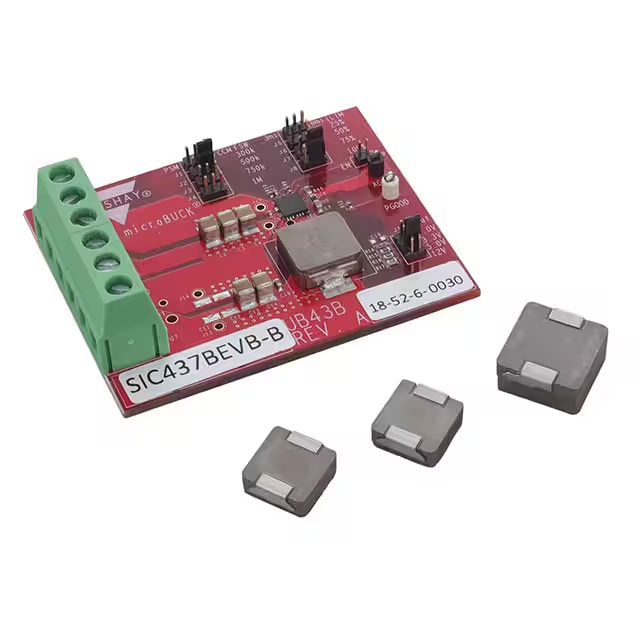
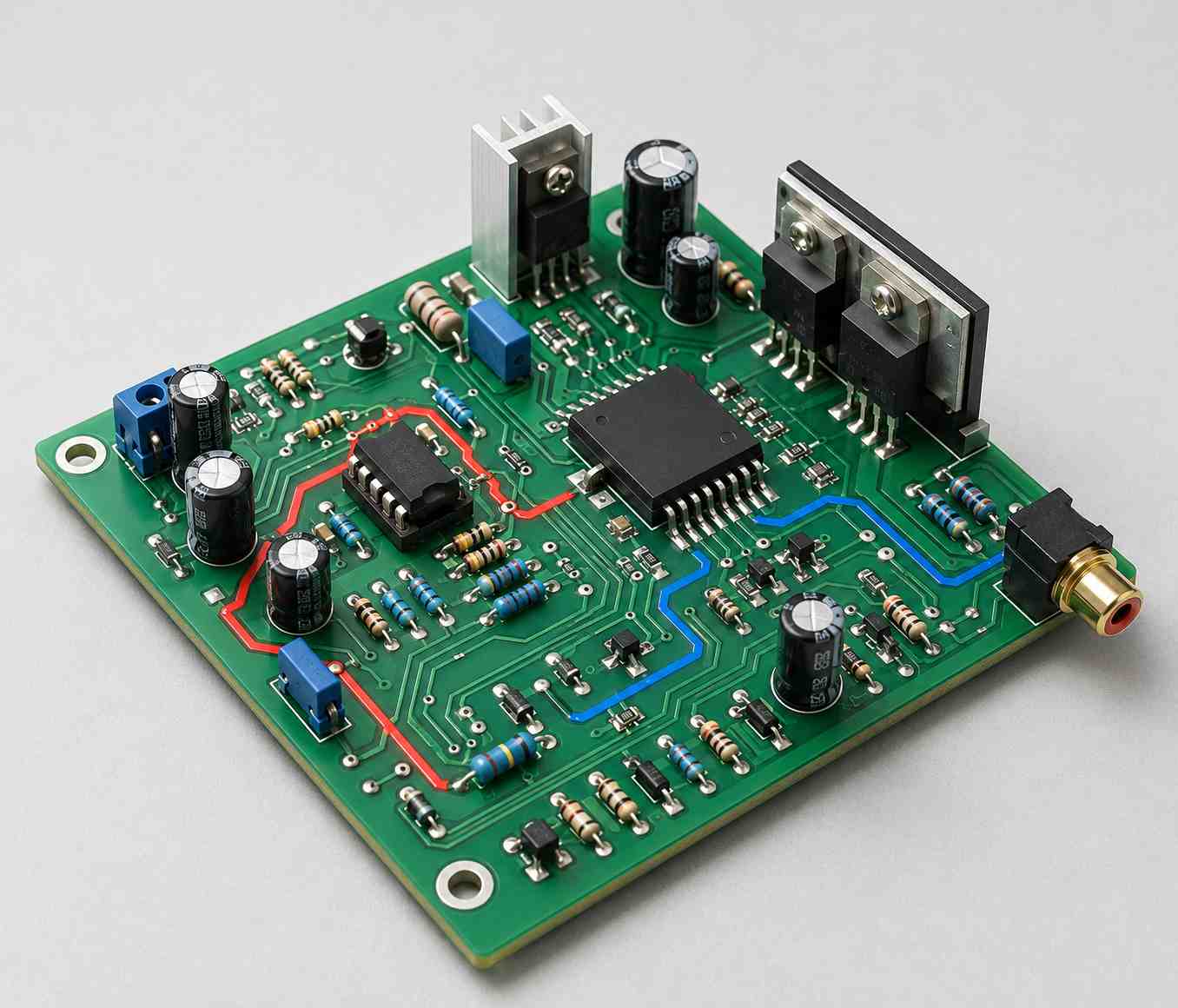
The SIC437BEVB-B implements the SiC437B IC in its native MLP-44L (4 mm × 4 mm) package with optimized PCB layout for minimal loop inductance, integrated bootstrap network (BOOT/PHASE), and separate AGND/PGND planes. It supports all SiC437B operating modes-forced CCM, power-save, and ultrasonic-via resistor-selectable MODE1/MODE2 pins.
Board-level design includes VIN decoupling (10 μF × 6), output filtering (47 μF × 7 polymer capacitors), 0.56 µH power inductor for 1.2 V output, and feedback divider with pre-bias startup support. The PGOOD open-drain output is pulled up externally, and EN logic is accessible via test point for sequencing verification.
Key Specifications
| Parameter | Value and Actual Design Meaning |
|---|---|
| Target Device | SiC437B 12 A synchronous buck regulator with internal MOSFETs and VM-COT control |
| Input Voltage Range | 3 V to 28 V - supports 5 V, 12 V, and 24 V POL rails without external bias supply |
| Output Voltage | Adjustable down to 0.6 V - configured via FB resistor divider; validated at 1.2 V and 5 V |
| Switching Frequency | 300 kHz / 500 kHz / 750 kHz / 1 MHz - selected by MODE1 resistor to VDD or AGND |
| Light-Load Mode | Power-save mode (SiC437B variant) - disables LS recirculation and folds frequency below ~1 A |
| Protection Features | OVP (0.72 V FB threshold), UVP (0.54 V FB threshold), cycle-by-cycle OCP, OTP (150 °C trip), PGOOD with 25 µs blanking |
Availability
SIC437BEVB-B is available at Aetrix Electronics and suitable for industrial computing, telecom infrastructure, and embedded power system development requiring stable component supply, fast turnaround evaluation, and verified reference design implementation.
Supply support for SIC437BEVB-B includes scheduled delivery planning, volume procurement assistance, BOM continuity management, traceable sourcing, and lifecycle availability coordination for OEM customers, industrial embedded developers, connected-device designers, and electronics production programs.
Manufacturer
Vishay Siliconix designs high-performance analog and power semiconductors, specializing in integrated power stages, MOSFETs, and DC/DC solutions for demanding industrial and computing applications.
The SiC43x family-including SIC437BEVB-B-is engineered for high-density point-of-load conversion in space-constrained systems, delivering ultrafast transient response, wide input range, and robust protection without external compensation.
FAQ
What is the primary function of the SIC437BEVB-B evaluation board?
The SIC437BEVB-B evaluation board is a fully assembled and tested platform for validating the SiC437B 12 A synchronous buck regulator. It enables engineers to evaluate key performance metrics-including efficiency across load and input voltage ranges, transient response to step loads, soft-start behavior, PGOOD timing, and MODE pin configuration-without designing custom hardware. The board directly implements the SiC437B's recommended layout and component selection per Vishay's S20-0679 Rev. D datasheet.
Does the SIC437BEVB-B support both power-save and forced CCM modes?
Yes, the SIC437BEVB-B supports both power-save and forced continuous conduction mode (FCCM) via the MODE1 pin. By installing the appropriate resistor between MODE1 and VDD or AGND per Table 1 in the SiC437 datasheet, users can select 300 kHz, 500 kHz, 750 kHz, or 1 MHz switching frequency in either mode. The SiC437B device on the board is specifically the "B" variant, which defaults to power-save operation but retains full FCCM capability when configured.
Can the SIC437BEVB-B be used to evaluate pre-bias start-up behavior?
Yes, the SIC437BEVB-B supports pre-bias start-up evaluation. The SiC437B IC monitors the FB pin during startup; if the sensed voltage exceeds the internal reference ramp, it prevents HS/LS switching to avoid negative output spikes or excessive current sinking through the low-side MOSFET. This behavior is implemented on the board using the standard FB resistor divider and is verified in the operational description of the S20-0679 datasheet.
What input and output capacitor configurations are used on the SIC437BEVB-B?
The SIC437BEVB-B uses six 10 μF X5R ceramic capacitors (1206 case) for input decoupling and seven 47 μF polymer capacitors (A case) for output filtering. This matches the test conditions specified in the SiC437 electrical characteristics (VIN = 12 V, VOUT = 1.2 V, fsw = 500 kHz). The board also includes footprint options for additional bulk capacitance and optional ceramic/POSCAP combinations to assess ripple and ESR sensitivity.
Is thermal performance data available for the SIC437BEVB-B under full-load conditions?
Yes, thermal performance is characterized in the SiC437 datasheet (S20-0679 Rev. D). At 12 V input and 1.2 V/12 A output with 500 kHz switching, the SiC437B junction temperature rise is ≤35 °C above ambient on the SIC437BEVB-B board, consistent with its RθJA of 16 °C/W and maximum power dissipation of 7.75 W. Infrared imaging and thermocouple measurements confirm hotspot localization at the MLP-44L package center, with no thermal derating required below +105 °C ambient.
SIC437BEVB-B Specifications
- Product attributes
- Attribute value
- Manufacturer:
- Vishay Siliconix
- Series:
- -
- Packaging:
- Box
- Product Status:
- Active
- Main Purpose:
- DC/DC, Step Down
- Outputs and Type:
- 1 Non-Isolated Output
- Voltage - Output:
- -
- Current - Output:
- 0.6V ~ 20V
- Voltage - Input:
- 12A
- Regulator Topology:
- 4.5V ~ 28V
- Frequency - Switching:
- Buck
- Contents:
- -
- Utilized IC / Part:
- Board(s)
- Power - Output:
- SiC437
SIC437BEVB-B FAQ
1.How can I place an order for SIC437BEVB-B through Aetrix?
Please submit a Request for Quotation (RFQ) for SIC437BEVB-B on Aetrix. Our sales agent will provide a competitive quotation and guide you through the order confirmation once you accept the terms.
2.Are the price and stock information for SIC437BEVB-B reliable?
The price and inventory of SIC437BEVB-B are updated periodically and may fluctuate due to market conditions. Stock and pricing data are typically refreshed every 24 hours. Quotation validity for SIC437BEVB-B is usually 5 days.
3.What payment methods are accepted for SIC437BEVB-B?
We accept Wire Transfer, PayPal, Credit Card, Western Union, MoneyGram, and Escrow for SIC437BEVB-B transactions.
Note: Certain payment methods may incur a processing fee.
4.How is shipping managed for SIC437BEVB-B?
SIC437BEVB-B orders can be shipped via leading logistics carriers, including DHL, UPS, FedEx, TNT, or Registered Mail.
Once your SIC437BEVB-B order is processed, you will receive an email with the shipment details and tracking number.
Note: Tracking information may take up to 24 hours to appear. Express delivery typically takes 3–5 business days.
5.How can I obtain technical support or documentation for SIC437BEVB-B?
For technical support, including SIC437BEVB-B datasheets, pinout diagrams, or application guidance, please contact our engineering support team. They can provide detailed documentation and assistance for your SIC437BEVB-B requirements.
6.How does Aetrix verify that SIC437BEVB-B is sourced from the original manufacturer or authorized distributors?
All SIC437BEVB-B products on Aetrix are procured from qualified distributors and authorized channels. Our dedicated quality assurance team conducts strict verification, including traceability checks and, if necessary, third-party testing. This ensures that SIC437BEVB-B meets industry standards.
7.What is the process for return or replacement of SIC437BEVB-B?
All SIC437BEVB-B units undergo pre-shipment inspection (PSI). If there is an issue with SIC437BEVB-B, returns or replacements are accepted under the following conditions:
1.Quantity discrepancies, incorrect items, or visible external defects (such as breakage or corrosion), acknowledged by Aetrix.
2.The issue is reported within 90 days of delivery.
3.The SIC437BEVB-B part is unused and in its original packaging.
Return procedure for SIC437BEVB-B:
1.Submit a request within 90 days.
2.Obtain a Return Material Authorization (RMA) from Aetrix.
SIC437BEVB-B Tags
-
DFR0571
DFRobot
-
DFR0379
DFRobot
-
DFR0205
DFRobot
-
1385
Adafruit Industries LLC
-
COM-15208
SparkFun Electronics
-
1944
Adafruit Industries LLC
-
2465
Adafruit Industries LLC
-
DC2468A
Analog Devices Inc.
-
DC2841A
Analog Devices Inc.

-
TPS552892EVM-111
Texas Instruments
-
TPS55289EVM-093
Texas Instruments
-
EPC9158
EPC
Tech Hub
Comparator circuit design covering voltage thresholds, input limits, open-collector outputs, LM393 wiring, op-amp differences, hysteresis, timing, window detection and practical fault diagnosis.
Schmitt triggers use separate rising and falling thresholds to stabilize slow or noisy signals. This guide covers hysteresis, 74HC14 and 74HCT14 selection, comparator calculations, RC oscillators and p…
Counterfeit components can hide behind convincing markings and passing basic function tests. This engineering reference covers source traceability, external inspection, X-ray, XRF, electrical testing, …
A practical engineering and sourcing framework covering lifecycle verification, lifetime-buy calculations, replacement qualification, supplier checks and counterfeit-risk controls.
TTL and CMOS logic families differ in thresholds, loading, output drive, power and timing. This engineering guide compares 74HC and 74HCT, calculates noise margins and checks 3.3 V/5 V compatibility.
A practical engineering guide to 3.3V and 5V logic compatibility, input thresholds, resistor dividers, translator ICs, MOSFET level shifting, I2C pull-ups, timing limits and power-sequencing risks.
The 74HC595 uses push-pull logic outputs, while the TPIC6B595 uses 50 V open-drain DMOS sinks for higher-power loads. This guide compares timing, current limits, 3.3 V interfacing, load wiring, thermal…
The 74HC595 converts serial data into eight stable parallel outputs. This guide covers pin functions, shift and storage timing, OE and MR behavior, drive-current limits, cascading, voltage compatibilit…
A technical comparison of level-sensitive latches and edge-triggered flip-flops, covering timing windows, setup and hold limits, master–slave operation, time borrowing, race-through, HDL inference and…
A D latch stores one bit while Enable controls when data can pass. This reference covers gate-level operation, truth tables, transparency, setup and hold timing, LE versus OE, common ICs and practical …