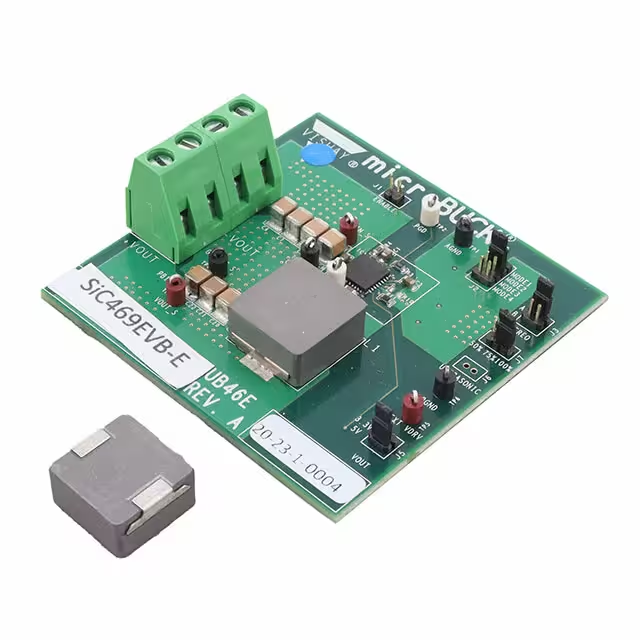
Vishay Siliconix SIC469EVB-E
- Part No.:
- SIC469EVB-E
- Manufacturer:
- Vishay Siliconix
- Package:
- Datasheet:
-
SIC469EVB-E.pdf
- Description:
- EVAL BOARD FOR SIC469
- Quantity:
- Payment:

- Shipping:

Inventory:4,791
Please send an inquiry. Send us your inquiry, and we will respond immediately.
Product details
Overview
SIC469EVB-E from Vishay Siliconix is an evaluation board designed to demonstrate and validate the SiC469 2 A synchronous buck DC/DC converter in the MLP55-27L package. It supports 4.5 V to 60 V input, delivers adjustable output down to 0.8 V, operates up to 2 MHz, and enables rapid prototyping for industrial power supplies and embedded systems requiring high efficiency and fast transient response.
For engineers reviewing the SIC469EVB-E datasheet, SIC469EVB-E pinout, SIC469EVB-E application, or SIC469EVB-E equivalent, this board provides verified reference design implementation, real-world thermal performance data, configurable soft-start and current-limit settings, and direct access to all control signals (EN, MODE, ILIMIT, fSW, SS) for system-level validation under varying load and input conditions.
Technical Context
The SIC469EVB-E implements the SiC469 microBUCK® regulator in voltage-mode constant-on-time (COT) architecture with adaptive zero-current detection. It integrates a 2 A power stage with internal high-side and low-side n-channel MOSFETs, supports pre-bias start-up, and enables diode emulation mode for light-load efficiency optimization.
Board-level features include full protection monitoring (OCP, OVP, UVP, OTP), open-drain PGOOD signaling, user-adjustable switching frequency (100 kHz–2 MHz via RfSW), and programmable soft-start (via CSS). All critical bias rails (VCIN, VDRV, VDD) and feedback paths (VFB, VOUT) are accessible for measurement and tuning.
Key Specifications
| Parameter | Value and Actual Design Meaning |
|---|---|
| Base IC | SiC469 - 2 A, 4.5 V–60 V input synchronous buck regulator with integrated MOSFETs |
| Input Range | 4.5 V to 60 V DC - supports wide industrial and telecom supply rails without external pre-regulation |
| Output Voltage | Adjustable from 0.8 V - set via external resistor divider on VFB; ±1 % accuracy over –40 °C to +125 °C |
| Switching Frequency | 100 kHz to 2 MHz - configured by resistor on fSW pin; enables optimization of size vs. efficiency trade-offs |
| Current Limit | 2 A nominal valley current limit - selectable at 50 %, 75 %, or 100 % via ILIMIT pin connection (AGND/floating/VDD) |
| Protection Features | OCP, OVP (120 % VOUT), UVP (20 % VOUT), OTP (150 °C trip, 35 °C hysteresis), UVLO, and hiccup-mode recovery |
| Thermal Performance | MLP55-27L package with 2 °C/W junction-to-case thermal resistance - validated on board with standard 2-layer PCB layout |
Availability
SIC469EVB-E is available at Aetrix Electronics and suitable for industrial automation, telecom power supplies, and robotics development requiring stable component supply, quick-turn evaluation, and production-ready reference design validation.
Supply support for SIC469EVB-E includes scheduled delivery planning, volume procurement assistance, BOM continuity management, traceable sourcing, and lifecycle availability coordination for OEM customers, industrial embedded developers, connected-device designers, and electronics production programs.
Manufacturer
Vishay Siliconix is a global leader in discrete semiconductors and passive components, specializing in high-efficiency power management solutions for demanding industrial, automotive, and computing applications.
The SiC46x family-including the SiC469 implemented on SIC469EVB-E-is engineered for wide-input, high-density DC/DC conversion in space-constrained systems where fast transient response, light-load efficiency, and robust fault protection are critical.
FAQ
What is the primary function of the SIC469EVB-E evaluation board?
The SIC469EVB-E evaluation board is a fully assembled and tested platform that demonstrates the operation of the SiC469 2 A synchronous buck regulator. It enables engineers to verify electrical performance-including efficiency, transient response, and protection behavior-under real-world conditions before integrating the SiC469 into their own designs. The SIC469EVB-E includes all necessary passive components, test points, and configuration jumpers to evaluate the SIC469EVB-E across its full operating range.
Does the SIC469EVB-E support adjustable output voltage, and how is it configured?
Yes, the SIC469EVB-E supports adjustable output voltage from 0.8 V using the SiC469's internal 0.8 V reference and external resistor divider on the VFB pin. The board ships with default resistors set for a common output (e.g., 3.3 V or 5 V), but users can replace RFB_H and/or RFB_L to achieve any target voltage per the formula VOUT = 0.8 V × (1 + RFB_H/RFB_L). This configuration is fully compatible with the SIC469EVB-E layout and maintains ±1 % regulation accuracy across temperature.
Can the SIC469EVB-E be used to evaluate light-load efficiency improvements?
Yes, the SIC469EVB-E enables direct evaluation of light-load efficiency enhancements provided by the SiC469's power-save mode. By configuring the MODE pin (via RMODE) and enabling diode emulation, the board reduces switching losses and eliminates reverse inductor current-verified through measured efficiency curves at loads as low as 10 mA. This behavior is intrinsic to the SiC469 silicon and reproducible on the SIC469EVB-E without firmware or external controllers.
How is overcurrent protection implemented and tested on the SIC469EVB-E?
Overcurrent protection on the SIC469EVB-E is implemented via valley-current sensing in the SiC469, with three user-selectable thresholds (50 %, 75 %, or 100 % of nominal 2 A limit) set by connecting the ILIMIT pin to AGND, floating, or VDD. The SIC469EVB-E includes test points and jumper options to configure and validate OCP response-including hiccup-mode recovery after fault clearance-using standard lab equipment such as electronic loads and oscilloscopes.
Is the SIC469EVB-E compatible with Vishay's PowerCAD design tool?
Yes, the SIC469EVB-E is fully supported by Vishay PowerCAD online simulation software. Users can input their target specifications (input/output voltage, current, ripple, thermal constraints) and generate optimized external component values-including inductor, output capacitors, RfSW, and RMODE-that align directly with the SIC469EVB-E's physical layout and component footprints. This ensures seamless transition from simulation to hardware validation using the SIC469EVB-E.
SIC469EVB-E Specifications
- Product attributes
- Attribute value
- Manufacturer:
- Vishay Siliconix
- Series:
- -
- Packaging:
- Box
- Product Status:
- Active
- Main Purpose:
- DC/DC, Step Down
- Outputs and Type:
- 1 Non-Isolated Output
- Voltage - Output:
- -
- Current - Output:
- 0.8V ~ 15V
- Voltage - Input:
- 2A
- Regulator Topology:
- 4.5V ~ 60V
- Frequency - Switching:
- Buck
- Contents:
- -
- Utilized IC / Part:
- Board(s)
- Power - Output:
- SIC469
SIC469EVB-E FAQ
1.How can I place an order for SIC469EVB-E through Aetrix?
Please submit a Request for Quotation (RFQ) for SIC469EVB-E on Aetrix. Our sales agent will provide a competitive quotation and guide you through the order confirmation once you accept the terms.
2.Are the price and stock information for SIC469EVB-E reliable?
The price and inventory of SIC469EVB-E are updated periodically and may fluctuate due to market conditions. Stock and pricing data are typically refreshed every 24 hours. Quotation validity for SIC469EVB-E is usually 5 days.
3.What payment methods are accepted for SIC469EVB-E?
We accept Wire Transfer, PayPal, Credit Card, Western Union, MoneyGram, and Escrow for SIC469EVB-E transactions.
Note: Certain payment methods may incur a processing fee.
4.How is shipping managed for SIC469EVB-E?
SIC469EVB-E orders can be shipped via leading logistics carriers, including DHL, UPS, FedEx, TNT, or Registered Mail.
Once your SIC469EVB-E order is processed, you will receive an email with the shipment details and tracking number.
Note: Tracking information may take up to 24 hours to appear. Express delivery typically takes 3–5 business days.
5.How can I obtain technical support or documentation for SIC469EVB-E?
For technical support, including SIC469EVB-E datasheets, pinout diagrams, or application guidance, please contact our engineering support team. They can provide detailed documentation and assistance for your SIC469EVB-E requirements.
6.How does Aetrix verify that SIC469EVB-E is sourced from the original manufacturer or authorized distributors?
All SIC469EVB-E products on Aetrix are procured from qualified distributors and authorized channels. Our dedicated quality assurance team conducts strict verification, including traceability checks and, if necessary, third-party testing. This ensures that SIC469EVB-E meets industry standards.
7.What is the process for return or replacement of SIC469EVB-E?
All SIC469EVB-E units undergo pre-shipment inspection (PSI). If there is an issue with SIC469EVB-E, returns or replacements are accepted under the following conditions:
1.Quantity discrepancies, incorrect items, or visible external defects (such as breakage or corrosion), acknowledged by Aetrix.
2.The issue is reported within 90 days of delivery.
3.The SIC469EVB-E part is unused and in its original packaging.
Return procedure for SIC469EVB-E:
1.Submit a request within 90 days.
2.Obtain a Return Material Authorization (RMA) from Aetrix.
SIC469EVB-E Tags
-
DFR0571
DFRobot
-
DFR0379
DFRobot
-
DFR0205
DFRobot
-
1385
Adafruit Industries LLC
-
COM-15208
SparkFun Electronics
-
1944
Adafruit Industries LLC
-
2465
Adafruit Industries LLC
-
DC2468A
Analog Devices Inc.
-
DC2841A
Analog Devices Inc.

-
TPS552892EVM-111
Texas Instruments
-
TPS55289EVM-093
Texas Instruments
-
EPC9158
EPC
Tech Hub

Comparator circuit design covering voltage thresholds, input limits, open-collector outputs, LM393 wiring, op-amp differences, hysteresis, timing, window detection and practical fault diagnosis.
Schmitt triggers use separate rising and falling thresholds to stabilize slow or noisy signals. This guide covers hysteresis, 74HC14 and 74HCT14 selection, comparator calculations, RC oscillators and p…
Counterfeit components can hide behind convincing markings and passing basic function tests. This engineering reference covers source traceability, external inspection, X-ray, XRF, electrical testing, …
A practical engineering and sourcing framework covering lifecycle verification, lifetime-buy calculations, replacement qualification, supplier checks and counterfeit-risk controls.
TTL and CMOS logic families differ in thresholds, loading, output drive, power and timing. This engineering guide compares 74HC and 74HCT, calculates noise margins and checks 3.3 V/5 V compatibility.
A practical engineering guide to 3.3V and 5V logic compatibility, input thresholds, resistor dividers, translator ICs, MOSFET level shifting, I2C pull-ups, timing limits and power-sequencing risks.
The 74HC595 uses push-pull logic outputs, while the TPIC6B595 uses 50 V open-drain DMOS sinks for higher-power loads. This guide compares timing, current limits, 3.3 V interfacing, load wiring, thermal…
The 74HC595 converts serial data into eight stable parallel outputs. This guide covers pin functions, shift and storage timing, OE and MR behavior, drive-current limits, cascading, voltage compatibilit…
A technical comparison of level-sensitive latches and edge-triggered flip-flops, covering timing windows, setup and hold limits, master–slave operation, time borrowing, race-through, HDL inference and…
A D latch stores one bit while Enable controls when data can pass. This reference covers gate-level operation, truth tables, transparency, setup and hold timing, LE versus OE, common ICs and practical …