Vishay Siliconix SIC474EVB-B
- Part No.:
- SIC474EVB-B
- Manufacturer:
- Vishay Siliconix
- Package:
- Datasheet:
-
SIC474EVB-B.pdf
- Description:
- EVAL BOARD FOR SIC474
- Quantity:
- Payment:

- Shipping:

Inventory:3,396
Please send an inquiry. Send us your inquiry, and we will respond immediately.
Product details
Overview
SIC474EVB-B from Vishay Siliconix is an evaluation board for the SiC474 3 A synchronous buck DC/DC converter, designed to demonstrate high-efficiency power conversion from 4.5 V to 55 V input to adjustable output voltages down to 0.8 V. It implements voltage-mode constant-on-time (COT) control with programmable switching frequency (100 kHz–2 MHz), integrated MOSFETs in MLP55-27L package, and full protection features including OCP, OVP, UVP, SCP, and OTP - validated for industrial computing, telecom power supplies, and robotics applications.
For engineers reviewing the SIC474EVB-B datasheet, SIC474EVB-B pinout, SIC474EVB-B application, or SIC474EVB-B equivalent, this board enables rapid validation of SiC474 performance under real-world load transients, light-load efficiency optimization (including ultrasonic mode), ripple injection tuning via VSNS network, soft-start configuration, and multi-mode operation (forced CCM, power-save, or ultrasonic) across wide VIN ranges.
Technical Context
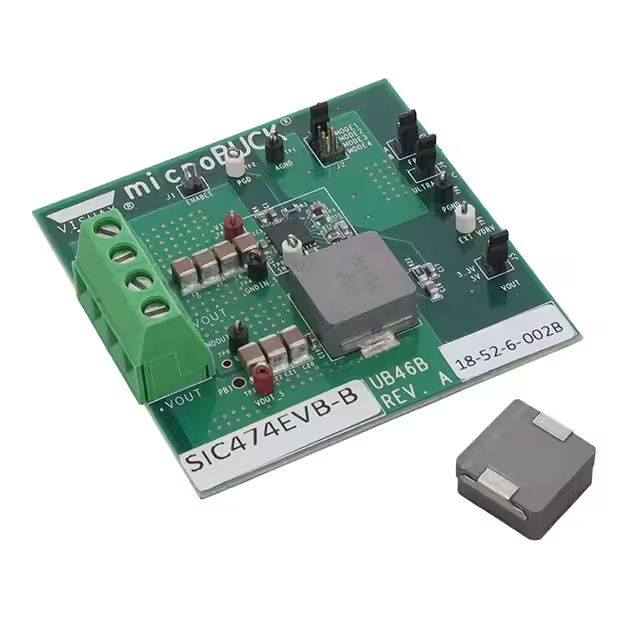
The SIC474EVB-B implements the SiC474 IC in a fully populated, optimized layout with external components pre-selected for stability and transient response: includes Rfsw for 500 kHz nominal switching, RILIM set for 5 A valley current limit, RMODE configured for power-save mode, and VRAMP network (Rx, Cx, Cy) tuned for ceramic-output-capacitor compatibility. It supports pre-bias startup and output voltage tracking via dedicated pins.
Board-level design incorporates thermal vias under the MLP55-27L footprint, split AGND/PGND planes with controlled coupling, low-inductance VIN/CIN routing, and accessible test points for VFB, COMP, VSNS, PGOOD, and SW node probing - enabling direct measurement of loop stability, current-limit accuracy, and transient recovery behavior per Vishay's S25-1437 Rev. J specification.
Key Specifications
| Parameter | Value and Actual Design Meaning |
|---|---|
| Target Device | SiC474 3 A synchronous buck regulator (MLP55-27L, 27-pin) |
| Input Voltage Range | 4.5 V to 55 V - validated with 12 V, 24 V, and 48 V sources per typical application curves |
| Output Voltage | Adjustable from 0.8 V - set by external resistor divider on VFB pin; factory-configured for 5 V or 12 V |
| Switching Frequency | Programmable 100 kHz–2 MHz - Rfsw sets nominal 500 kHz; ultrasonic mode enabled by ULTRASONIC = VDD |
| Protection Features | OCP (5 A typ.), OVP (+20% VFB), UVP (−80% VFB), OTP (150 °C trip), SCP auto-retry, PGOOD open-drain flag |
| Control Interface | EN pin (HV-compatible), MODE pin (4 selectable modes), SS pin (capacitor-programmed ramp), ULTRASONIC pin (VDD/floating) |
| Thermal Design | Optimized copper pour + thermal vias under IC; junction-to-ambient θJA ≈ 12 °C/W measured per MLP55-27L spec |
Availability
SIC474EVB-B is available at Aetrix Electronics and suitable for industrial computing, telecom power supply development, and robotics prototyping requiring stable component supply, traceable evaluation hardware, and documented reference design validation.
Supply support for SIC474EVB-B includes scheduled delivery planning, volume procurement assistance, BOM continuity management, traceable sourcing, and lifecycle availability coordination for OEM customers, industrial embedded developers, connected-device designers, and electronics production programs.
Manufacturer
Vishay Siliconix is a global leader in discrete semiconductors and passive components, specializing in high-performance power management solutions with emphasis on efficiency, reliability, and thermal robustness.
The SiC47x family - including the SiC474 supported by SIC474EVB-B - was engineered for wide-input-voltage, high-density DC/DC conversion in space-constrained industrial, telecom, and automation systems where fast transient response and light-load efficiency are critical.
FAQ
What is the primary function of the SIC474EVB-B evaluation board?
The SIC474EVB-B evaluation board is a fully assembled reference design platform for the Vishay SiC474 3 A synchronous buck regulator. It enables engineers to validate key performance parameters - including efficiency across load and input voltage ranges, transient response with ceramic output capacitors, soft-start behavior, protection feature activation (OCP, OVP, UVP), and multi-mode operation (power-save vs. forced CCM) - without custom PCB development. The board includes all necessary passives, thermal management, and test points aligned to Vishay's S25-1437 Rev. J specification.
Does the SIC474EVB-B support ultrasonic switching mode, and how is it enabled?
Yes, the SIC474EVB-B supports ultrasonic switching mode to suppress audible noise during light-load operation. This mode is enabled by connecting the ULTRASONIC pin (Pin 18) to VDD (5 V); when floating, ultrasonic mode is disabled and the SiC474 defaults to power-save or forced continuous conduction mode. The board includes a solder jumper or test point for this configuration, allowing direct verification of >20 kHz minimum frequency under discontinuous conduction mode per Vishay's specification table.
How is output voltage programmed on the SIC474EVB-B, and what is its accuracy?
Output voltage on the SIC474EVB-B is programmed using an external resistor divider connected between VOUT, VFB (Pin 22), and AGND - per the SiC474's feedback architecture. The board ships with default resistors setting either 5 V or 12 V output, achieving ±1 % regulation accuracy over −40 °C to +125 °C junction temperature, as confirmed by the SiC474's internal 0.8 V reference (792–808 mV range) and low VFB bias current (2 nA max).
Can the SIC474EVB-B be used to evaluate loop stability with all-ceramic output capacitors?
Yes, the SIC474EVB-B includes a complete VRAMP ripple injection network (Rx, Cx, Cy) connected to the VSNS pin (Pin 20), specifically designed to ensure stable operation with low-ESR ceramic output capacitors. This network delivers ≥100 mV VRAMP amplitude - meeting Vishay's minimum requirement to prevent subharmonic oscillation and noise sensitivity - while maintaining fast transient response, as verified in Fig. 7 and Section 7 of S25-1437 Rev. J.
What protection features are implemented and testable on the SIC474EVB-B?
All SiC474-integrated protections are implemented and directly testable on the SIC474EVB-B: over-current protection (OCP) triggered at ~5 A (set by RILIM), output overvoltage protection (OVP) at +20% of VFB reference, output undervoltage protection (UVP) at −80% of VFB with auto-retry, short-circuit protection (SCP), over-temperature protection (OTP) at 150 °C with 35 °C hysteresis, and input UVLO on VDD/VDRV rails. PGOOD open-drain status is accessible via test point for system sequencing validation.
SIC474EVB-B Specifications
- Product attributes
- Attribute value
- Manufacturer:
- Vishay Siliconix
- Series:
- -
- Packaging:
- Box
- Product Status:
- Active
- Main Purpose:
- DC/DC, Step Down
- Outputs and Type:
- 1 Non-Isolated Output
- Voltage - Output:
- -
- Current - Output:
- 0.8V ~ 50V
- Voltage - Input:
- 3A
- Regulator Topology:
- 4.5V ~ 55V
- Frequency - Switching:
- Buck
- Contents:
- -
- Utilized IC / Part:
- Board(s)
- Power - Output:
- SIC474
SIC474EVB-B FAQ
1.How can I place an order for SIC474EVB-B through Aetrix?
Please submit a Request for Quotation (RFQ) for SIC474EVB-B on Aetrix. Our sales agent will provide a competitive quotation and guide you through the order confirmation once you accept the terms.
2.Are the price and stock information for SIC474EVB-B reliable?
The price and inventory of SIC474EVB-B are updated periodically and may fluctuate due to market conditions. Stock and pricing data are typically refreshed every 24 hours. Quotation validity for SIC474EVB-B is usually 5 days.
3.What payment methods are accepted for SIC474EVB-B?
We accept Wire Transfer, PayPal, Credit Card, Western Union, MoneyGram, and Escrow for SIC474EVB-B transactions.
Note: Certain payment methods may incur a processing fee.
4.How is shipping managed for SIC474EVB-B?
SIC474EVB-B orders can be shipped via leading logistics carriers, including DHL, UPS, FedEx, TNT, or Registered Mail.
Once your SIC474EVB-B order is processed, you will receive an email with the shipment details and tracking number.
Note: Tracking information may take up to 24 hours to appear. Express delivery typically takes 3–5 business days.
5.How can I obtain technical support or documentation for SIC474EVB-B?
For technical support, including SIC474EVB-B datasheets, pinout diagrams, or application guidance, please contact our engineering support team. They can provide detailed documentation and assistance for your SIC474EVB-B requirements.
6.How does Aetrix verify that SIC474EVB-B is sourced from the original manufacturer or authorized distributors?
All SIC474EVB-B products on Aetrix are procured from qualified distributors and authorized channels. Our dedicated quality assurance team conducts strict verification, including traceability checks and, if necessary, third-party testing. This ensures that SIC474EVB-B meets industry standards.
7.What is the process for return or replacement of SIC474EVB-B?
All SIC474EVB-B units undergo pre-shipment inspection (PSI). If there is an issue with SIC474EVB-B, returns or replacements are accepted under the following conditions:
1.Quantity discrepancies, incorrect items, or visible external defects (such as breakage or corrosion), acknowledged by Aetrix.
2.The issue is reported within 90 days of delivery.
3.The SIC474EVB-B part is unused and in its original packaging.
Return procedure for SIC474EVB-B:
1.Submit a request within 90 days.
2.Obtain a Return Material Authorization (RMA) from Aetrix.
SIC474EVB-B Tags
-
DFR0571
DFRobot
-
DFR0379
DFRobot
-
DFR0205
DFRobot
-
1385
Adafruit Industries LLC
-
COM-15208
SparkFun Electronics
-
1944
Adafruit Industries LLC
-
2465
Adafruit Industries LLC
-
DC2468A
Analog Devices Inc.
-
DC2841A
Analog Devices Inc.

-
TPS552892EVM-111
Texas Instruments
-
TPS55289EVM-093
Texas Instruments
-
EPC9158
EPC
Tech Hub
Comparator circuit design covering voltage thresholds, input limits, open-collector outputs, LM393 wiring, op-amp differences, hysteresis, timing, window detection and practical fault diagnosis.
Schmitt triggers use separate rising and falling thresholds to stabilize slow or noisy signals. This guide covers hysteresis, 74HC14 and 74HCT14 selection, comparator calculations, RC oscillators and p…
Counterfeit components can hide behind convincing markings and passing basic function tests. This engineering reference covers source traceability, external inspection, X-ray, XRF, electrical testing, …
A practical engineering and sourcing framework covering lifecycle verification, lifetime-buy calculations, replacement qualification, supplier checks and counterfeit-risk controls.
TTL and CMOS logic families differ in thresholds, loading, output drive, power and timing. This engineering guide compares 74HC and 74HCT, calculates noise margins and checks 3.3 V/5 V compatibility.
A practical engineering guide to 3.3V and 5V logic compatibility, input thresholds, resistor dividers, translator ICs, MOSFET level shifting, I2C pull-ups, timing limits and power-sequencing risks.
The 74HC595 uses push-pull logic outputs, while the TPIC6B595 uses 50 V open-drain DMOS sinks for higher-power loads. This guide compares timing, current limits, 3.3 V interfacing, load wiring, thermal…
The 74HC595 converts serial data into eight stable parallel outputs. This guide covers pin functions, shift and storage timing, OE and MR behavior, drive-current limits, cascading, voltage compatibilit…
A technical comparison of level-sensitive latches and edge-triggered flip-flops, covering timing windows, setup and hold limits, master–slave operation, time borrowing, race-through, HDL inference and…
A D latch stores one bit while Enable controls when data can pass. This reference covers gate-level operation, truth tables, transparency, setup and hold timing, LE versus OE, common ICs and practical …