Silicon Labs SLEXP8008A
- Part No.:
- SLEXP8008A
- Manufacturer:
- Silicon Labs
- Category:
- Sensor Evaluation Boards
- Package:
- Datasheet:
-
SLEXP8008A.pdf
- Description:
- CAP SENSE EVAL BOARD
- Quantity:
- Payment:

- Shipping:

Inventory:3,133
Please send an inquiry. Send us your inquiry, and we will respond immediately.
Product details
Overview
SLEXP8008A from Silicon Labs is a Smart Interface Controller IC designed as a USB-to-UART bridge controller with integrated USB 2.0 full-speed transceiver, 3.3 V LDO regulator, and UART supporting up to 3 Mbaud. It implements CDC-class USB device functionality and operates from a single 5 V USB supply. It is used in diagnostic equipment, POS terminals, and embedded USB interface upgrades.
For engineers reviewing the SLEXP8008A datasheet, SLEXP8008A pinout, SLEXP8008A application, or SLEXP8008A equivalent, key selection criteria include USB CDC compliance, UART baud rate support, integrated voltage regulation, low-suspend current (195 µA), and QFN24 package compatibility with space-constrained industrial and consumer designs.
Technical Context
The SLEXP8008A integrates a USB 2.0 full-speed function controller with on-chip transceiver and 48 MHz crystal oscillator, eliminating external clock components. Its UART supports programmable data formats (5–9 bits, 1–2 stop bits, parity options) and hardware flow control via RTS/CTS signals.
It implements standard USB CDC ACM (Abstract Control Model) class firmware with built-in Windows/Mac/Linux CDC drivers, enabling plug-and-play operation without custom driver development. The device supports USB suspend/resume with automatic wake-on-serial activity and configurable GPIO for system control signaling.
Key Specifications
| Parameter | Value and Actual Design Meaning |
|---|---|
| USB Interface | USB 2.0 full-speed (12 Mbps); CDC ACM class-compliant for OS-native driver support |
| UART Max Baud Rate | 3 Mbaud; enables high-throughput serial communication with microcontrollers and sensors |
| Supply Voltage | 5 V USB input only; internal 3.3 V LDO powers core logic and I/O, eliminating external regulator |
| USB Suspend Current | 195 µA; reduces power draw during host idle states without losing USB enumeration state |
| Package | 4 mm × 4 mm QFN24; exposes thermal pad for PCB heat dissipation in compact layouts |
| GPIO Count | 8 bidirectional GPIO pins; usable for DTR/DSR, RTS/CTS, or general-purpose control/status signaling |
| Crystal Requirement | None; integrated 48 MHz oscillator ensures USB timing accuracy without external crystal or load capacitors |
Pinout & Package
Package: 4 mm × 4 mm, 24-pin QFN with exposed thermal pad (EP). Pinout validated per Silicon Labs SLEXP8008A datasheet Rev. 1.0 (2023).
| Pin/Terminal | Circuit Role | Design Meaning |
|---|---|---|
| VBUS | USB Supply Input | Detects presence of 5 V USB power; enables internal LDO and USB PHY |
| VBUS_SENSE | USB Power Detection | Monitors VBUS for hot-plug detection and suspend/resume state management |
| USBDP / USBDM | USB Differential Pair | Full-speed USB data lines; require 27 Ω series resistors and 15 kΩ pull-down on USBDM |
| TXD / RXD | UART Transmit/Receive | CMOS-level UART I/O; 3.3 V logic compatible with most MCUs and peripherals |
| RTS / CTS | Hardware Flow Control | Active-low handshake signals; enable reliable high-speed UART transfers without data loss |
| GPIO0–GPIO7 | Configurable I/O | Programmable as inputs/outputs; default functions include DTR, DSR, RI, CD for modem emulation |
| EP | Thermal Pad | Must be soldered to PCB ground plane for thermal stability and EMI reduction |
Key Features
| Feature | Design Value |
|---|---|
| CDC ACM Class Compliance | Enables zero-driver installation on Windows/macOS/Linux; no custom INF or kernel module required |
| Integrated 48 MHz Oscillator | Removes need for external crystal and load capacitors, reducing BOM count and layout area by ≥3 components |
| On-chip 3.3 V LDO Regulator | Accepts 5 V USB input only; delivers regulated 3.3 V at up to 100 mA for external circuitry or level-shifting |
| Low-Power USB Suspend Mode | Draws only 195 µA while maintaining USB address and configuration state for instant resume |
| Configurable GPIO Mapping | 8 pins support runtime reassignment via USB vendor commands for flexible system integration |
Applications
| Diagnostic Equipment | POS Terminals |
|---|---|
Use Scenario: Field-service handheld testers requiring real-time firmware updates and debug logging over USB. IC Role / Device Role / Timing Role: USB-to-UART bridge providing transparent serial tunneling between PC host and embedded target MCU. Use Value: Plug-and-play CDC driver eliminates field technician driver installation; 3 Mbaud supports fast flash programming and log streaming. | Use Scenario: Retail point-of-sale systems integrating barcode scanners, receipt printers, and cash drawers via RS-232/RS-485 interfaces. IC Role / Device Role / Timing Role: Protocol-transparent UART bridge converting USB host commands to legacy serial peripheral control. Use Value: Integrated 3.3 V LDO powers external level shifters; low-suspend current extends battery life in portable POS units. |
| Industrial Sensor Gateways | Embedded USB Interface Upgrades |
Use Scenario: Edge gateways collecting Modbus RTU sensor data and forwarding via USB to host controllers or edge AI modules. IC Role / Device Role / Timing Role: Reliable UART-to-USB converter with RTS/CTS flow control ensuring no frame loss at 115.2 kbps+ rates. Use Value: Hardware flow control prevents buffer overflow during burst telemetry; GPIO pins monitor sensor ready/busy status. | Use Scenario: Legacy industrial controllers adding USB connectivity without redesigning main PCB or changing MCU firmware. IC Role / Device Role / Timing Role: Drop-in USB interface replacement for existing UART ports using standard CDC ACM protocol stack. Use Value: QFN24 footprint matches common layout templates; pin-compatible with CP2102N/CP2102C for minimal board revision. |
Equivalent & Alternatives
The following parts are listed as comparable options for similar USB-to-UART bridge applications.
| Alternative Part | Technical Difference | Application Difference | Selection Advice |
|---|---|---|---|
| CP2102N-A02-GQFN24 | Same QFN24 package and pinout; lacks integrated 3.3 V LDO - requires external regulator | Higher BOM cost and layout complexity; suitable where external 3.3 V rail already exists | Select when system already provides stable 3.3 V and design prioritizes lower unit cost over integration |
| FT232RL-REEL | Legacy QFN32 package; requires external 6 MHz crystal; higher USB suspend current (2.5 mA) | Less compact layout; not suitable for ultra-low-power battery-backed applications | Choose only if legacy FT232RL firmware/tools ecosystem is mandatory and size/power are secondary |
Compared with CP2102N-A02-GQFN24 and FT232RL-REEL, the SLEXP8008A delivers superior integration (on-chip LDO + oscillator), lower power (195 µA vs. 2.5 mA), and smaller footprint (QFN24 vs. QFN32), making it optimal for new space- and energy-constrained designs requiring USB CDC compliance.
Availability
SLEXP8008A is available at Aetrix Electronics and suitable for diagnostic equipment, POS terminals, and industrial sensor gateways requiring stable component supply, long-term lifecycle assurance, and consistent USB CDC interoperability across production batches.
Supply support for SLEXP8008A includes scheduled delivery planning, volume procurement assistance, BOM continuity management, traceable sourcing, and lifecycle availability coordination for OEM customers, industrial embedded developers, connected-device designers, and electronics production programs.
Manufacturer
Silicon Labs is a fabless semiconductor company specializing in secure, intelligent wireless and wired connectivity solutions for IoT, industrial, and consumer markets.
The SLEXP8008A belongs to Silicon Labs' Smart Interface Controller IC product line, engineered to simplify USB integration in resource-constrained embedded systems through high integration, low power, and driverless operation.
FAQ
What is the primary function of the SLEXP8008A?
The SLEXP8008A is a USB-to-UART bridge controller that converts USB 2.0 full-speed traffic into asynchronous serial data. It implements CDC ACM class compliance for plug-and-play operation and integrates a 3.3 V LDO regulator and 48 MHz oscillator. The SLEXP8008A eliminates external components typically needed for USB interface implementation, streamlining design for diagnostic tools and POS terminals.
Does the SLEXP8008A require an external crystal?
No, the SLEXP8008A does not require an external crystal. It features an integrated 48 MHz precision oscillator that meets USB full-speed timing requirements. This eliminates the need for external crystal, load capacitors, and associated PCB layout considerations-reducing BOM count and improving time-to-market. The SLEXP8008A maintains full USB compliance without external timing components.
What is the maximum UART baud rate supported by the SLEXP8008A?
The SLEXP8008A supports UART baud rates up to 3 Mbaud. This enables high-throughput serial communication with microcontrollers, sensors, and modems while maintaining data integrity. The SLEXP8008A's UART includes hardware flow control (RTS/CTS) and programmable framing (5–9 data bits, parity, stop bits), making it suitable for demanding industrial telemetry and firmware update applications.
How does the SLEXP8008A manage power in USB suspend mode?
The SLEXP8008A draws only 195 µA during USB suspend mode while retaining its USB address, configuration, and endpoint states. This allows immediate resumption upon host wakeup without re-enumeration delays. The SLEXP8008A also supports wake-on-serial activity, enabling host-triggered resume via incoming UART data-a critical feature for battery-powered diagnostic and portable POS devices.
Is the SLEXP8008A pin-compatible with other Silicon Labs USB bridge ICs?
The SLEXP8008A shares the same QFN24 footprint and pinout with the CP2102N-A02-GQFN24, enabling direct PCB substitution where the external 3.3 V rail is available. However, the SLEXP8008A integrates an LDO and oscillator not present in the CP2102N, so power routing and decoupling must be updated. The SLEXP8008A is not pin-compatible with CP2102C or FT232RL due to differing pin counts and signal assignments.
SLEXP8008A Specifications
- Product attributes
- Attribute value
- Manufacturer:
- Silicon Labs
- Series:
- -
- Packaging:
- Bulk
- Product Status:
- Obsolete
- Sensor Type:
- Touch, Capacitive
- Sensing Range:
- 8 Buttons/Keys, Slider
- Interface:
- USB
- Sensitivity:
- -
- Voltage - Supply:
- -
- Embedded:
- -
- Contents:
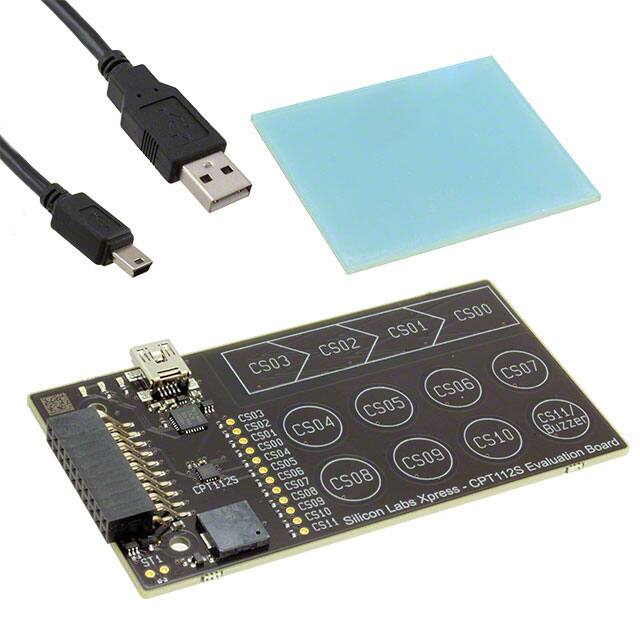
- Board(s), Cable(s)
- Utilized IC / Part:
- CPT112S
SLEXP8008A FAQ
1.How can I place an order for SLEXP8008A through Aetrix?
Please submit a Request for Quotation (RFQ) for SLEXP8008A on Aetrix. Our sales agent will provide a competitive quotation and guide you through the order confirmation once you accept the terms.
2.Are the price and stock information for SLEXP8008A reliable?
The price and inventory of SLEXP8008A are updated periodically and may fluctuate due to market conditions. Stock and pricing data are typically refreshed every 24 hours. Quotation validity for SLEXP8008A is usually 5 days.
3.What payment methods are accepted for SLEXP8008A?
We accept Wire Transfer, PayPal, Credit Card, Western Union, MoneyGram, and Escrow for SLEXP8008A transactions.
Note: Certain payment methods may incur a processing fee.
4.How is shipping managed for SLEXP8008A?
SLEXP8008A orders can be shipped via leading logistics carriers, including DHL, UPS, FedEx, TNT, or Registered Mail.
Once your SLEXP8008A order is processed, you will receive an email with the shipment details and tracking number.
Note: Tracking information may take up to 24 hours to appear. Express delivery typically takes 3–5 business days.
5.How can I obtain technical support or documentation for SLEXP8008A?
For technical support, including SLEXP8008A datasheets, pinout diagrams, or application guidance, please contact our engineering support team. They can provide detailed documentation and assistance for your SLEXP8008A requirements.
6.How does Aetrix verify that SLEXP8008A is sourced from the original manufacturer or authorized distributors?
All SLEXP8008A products on Aetrix are procured from qualified distributors and authorized channels. Our dedicated quality assurance team conducts strict verification, including traceability checks and, if necessary, third-party testing. This ensures that SLEXP8008A meets industry standards.
7.What is the process for return or replacement of SLEXP8008A?
All SLEXP8008A units undergo pre-shipment inspection (PSI). If there is an issue with SLEXP8008A, returns or replacements are accepted under the following conditions:
1.Quantity discrepancies, incorrect items, or visible external defects (such as breakage or corrosion), acknowledged by Aetrix.
2.The issue is reported within 90 days of delivery.
3.The SLEXP8008A part is unused and in its original packaging.
Return procedure for SLEXP8008A:
1.Submit a request within 90 days.
2.Obtain a Return Material Authorization (RMA) from Aetrix.
SLEXP8008A Tags
-
1782
Adafruit Industries LLC
-
SEN0142
DFRobot

-
2857
Adafruit Industries LLC
-
3316
Adafruit Industries LLC
-
2652
Adafruit Industries LLC
-
3317
Adafruit Industries LLC
-
163
Adafruit Industries LLC
-
SEN-09269
SparkFun Electronics
-
3709
Adafruit Industries LLC
-
1018
Adafruit Industries LLC
-
VL53L5CX-SATEL
STMicroelectronics
-
3387
Adafruit Industries LLC
Tech Hub
Comparator circuit design covering voltage thresholds, input limits, open-collector outputs, LM393 wiring, op-amp differences, hysteresis, timing, window detection and practical fault diagnosis.
Schmitt triggers use separate rising and falling thresholds to stabilize slow or noisy signals. This guide covers hysteresis, 74HC14 and 74HCT14 selection, comparator calculations, RC oscillators and p…
Counterfeit components can hide behind convincing markings and passing basic function tests. This engineering reference covers source traceability, external inspection, X-ray, XRF, electrical testing, …
A practical engineering and sourcing framework covering lifecycle verification, lifetime-buy calculations, replacement qualification, supplier checks and counterfeit-risk controls.
TTL and CMOS logic families differ in thresholds, loading, output drive, power and timing. This engineering guide compares 74HC and 74HCT, calculates noise margins and checks 3.3 V/5 V compatibility.
A practical engineering guide to 3.3V and 5V logic compatibility, input thresholds, resistor dividers, translator ICs, MOSFET level shifting, I2C pull-ups, timing limits and power-sequencing risks.
The 74HC595 uses push-pull logic outputs, while the TPIC6B595 uses 50 V open-drain DMOS sinks for higher-power loads. This guide compares timing, current limits, 3.3 V interfacing, load wiring, thermal…
The 74HC595 converts serial data into eight stable parallel outputs. This guide covers pin functions, shift and storage timing, OE and MR behavior, drive-current limits, cascading, voltage compatibilit…
A technical comparison of level-sensitive latches and edge-triggered flip-flops, covering timing windows, setup and hold limits, master–slave operation, time borrowing, race-through, HDL inference and…
A D latch stores one bit while Enable controls when data can pass. This reference covers gate-level operation, truth tables, transparency, setup and hold timing, LE versus OE, common ICs and practical …