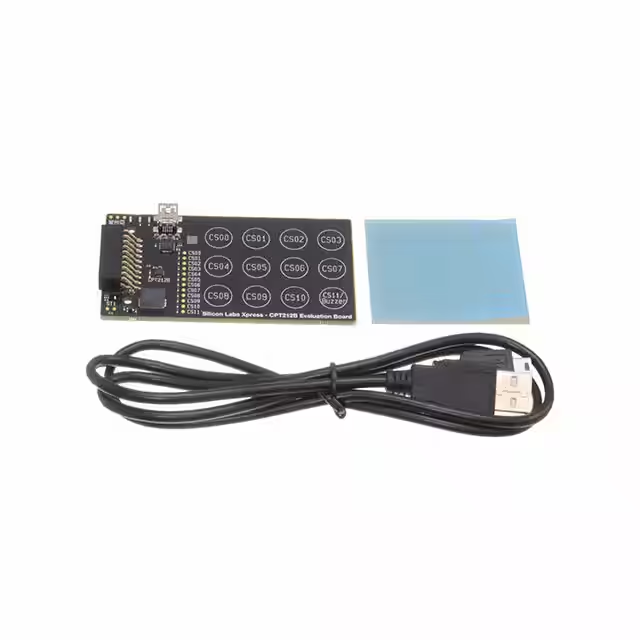
Silicon Labs SLEXP8018A
- Part No.:
- SLEXP8018A
- Manufacturer:
- Silicon Labs
- Category:
- Sensor Evaluation Boards
- Package:
- Datasheet:
-
SLEXP8018A.pdf
- Description:
- CPT212B CAPACITIVE TOUCH EVALUAT
- Quantity:
- Payment:

- Shipping:

Inventory:2,457
Please send an inquiry. Send us your inquiry, and we will respond immediately.
Product details
Overview
SLEXP8018A from Silicon Labs is a Smart Interface Controller IC designed as a USB-to-UART bridge controller with integrated USB 2.0 full-speed transceiver, 3.3 V LDO regulator, and UART supporting up to 3 Mbaud baud rate - deployed in embedded diagnostics, POS terminals, and industrial USB interface applications.
For engineers reviewing the SLEXP8018A datasheet, SLEXP8018A pinout, SLEXP8018A application, or SLEXP8018A equivalent, key selection criteria include USB suspend current (195 µA), UART channel count (1), I²C slave support (1), GPIO count (8), and package type (QFN-24).
Technical Context
The SLEXP8018A implements a CDC-compliant USB device stack with hardware-based UART protocol handling, eliminating host-side driver development for standard COM port enumeration. It integrates an internal 48 MHz oscillator and supports automatic USB suspend/resume without external clock circuitry.
Its UART includes programmable framing (data bits, stop bits, parity), hardware flow control (RTS/CTS), and FIFO buffering (128-byte TX/RX). The single I²C slave interface operates at up to 400 kHz and shares pins with GPIO, enabling system-level configuration and sensor interfacing.
Key Specifications
| Parameter | Value and Actual Design Meaning |
|---|---|
| USB Interface | USB 2.0 full-speed (12 Mbps); CDC-class compliant - enables plug-and-play COM port on Windows/macOS/Linux without custom drivers |
| UART Baud Rate | Up to 3 Mbaud - supports high-speed serial communication with microcontrollers and legacy peripherals |
| USB Suspend Current | 195 µA - meets USB specification low-power suspend mode for battery-powered devices |
| I²C Interface | 1 slave port, 400 kHz max - allows configuration of device settings and connection to external sensors or EEPROMs |
| GPIO Count | 8 configurable I/O pins - usable for status indication, reset control, or peripheral handshaking |
| Supply Voltage | 3.0–3.6 V - compatible with standard 3.3 V logic domains and regulated power rails |
| Operating Temp | –40°C to +85°C - qualified for industrial ambient environments without derating |
Pinout & Package
Package: 4 mm × 4 mm QFN-24, exposed thermal pad, 0.5 mm pitch.
| Pin/Terminal | Circuit Role | Design Meaning |
|---|---|---|
| VDD | Power supply input | 3.3 V main supply; powers internal LDO, USB PHY, and digital core |
| GND | Ground reference | Common return path for analog/digital circuits and thermal pad connection |
| USB_DP / USB_DM | USB differential data pair | Direct connection to USB connector; requires 27 Ω series resistors and ESD protection |
| TXD / RXD | UART transmit/receive | CMOS-level serial interface; supports RS-232 level-shifting via external transceivers |
| SCL / SDA | I²C clock/data | Open-drain outputs; require 4.7 kΩ pull-up resistors to VDD |
| GPIO0–GPIO7 | General-purpose I/O | Configurable as inputs with weak pull-ups or outputs; some support interrupt generation |
| RESETN | Active-low reset input | Asynchronous reset pin; asserted low resets internal state machine and USB enumeration |
Key Features
| Feature | Design Value |
|---|---|
| CDC-class USB device | Enumerates as standard COM port on all major OSes - eliminates need for vendor-specific drivers |
| Integrated 3.3 V LDO | Accepts 4.0–5.5 V input; delivers regulated 3.3 V at up to 100 mA - reduces external component count |
| Hardware UART FIFO | 128-byte TX/RX buffers - prevents data loss during host USB polling latency or interrupt latency spikes |
| Internal 48 MHz oscillator | No external crystal required - simplifies layout and lowers BOM cost while meeting USB timing tolerance |
| GPIO multiplexing | 8 pins support alternate functions including CTS/RTS, DTR/DSR, and I²C - increases design flexibility without extra ICs |
Applications
| Industrial Diagnostic Equipment | POS Terminal Interface |
|---|---|
Use Scenario: Real-time firmware debugging and log streaming from PLC controllers and motor drives via USB-connected PC tools. IC Role / Device Role / Timing Role: USB-to-UART bridge converting USB packets into asynchronous serial frames synchronized to internal 48 MHz clock. Use Value: Enables field-service technicians to use standard terminal software (e.g., Tera Term) without installing proprietary drivers. | Use Scenario: Connecting barcode scanners, receipt printers, and cash drawers to Android/iOS tablets via USB-C adapters. IC Role / Device Role / Timing Role: Protocol translator bridging USB host commands to UART-based peripheral control protocols (e.g., ESC/POS). Use Value: Supports 3 Mbaud printing throughput and 195 µA suspend current to extend tablet battery life during idle periods. |
| Smart Building Sensor Hub | Medical Device Data Logger |
Use Scenario: Aggregating Modbus RTU sensor data from HVAC actuators and environmental monitors into a central gateway via USB. IC Role / Device Role / Timing Role: UART master collecting RS-485 data and repackaging it as CDC-compliant USB serial packets. Use Value: Allows integration with Linux-based gateways using built-in cdc_acm kernel module - no custom firmware needed. | Use Scenario: Transferring patient vitals from portable ECG units to clinical PCs for analysis and archiving. IC Role / Device Role / Timing Role: Isolated USB interface providing galvanic separation (when paired with optocouplers) and deterministic 3 Mbaud transfer. Use Value: Meets IEC 60601-1 creepage/clearance requirements when implemented with reinforced isolation barriers. |
Equivalent & Alternatives
The following parts are listed as comparable options for similar USB-to-UART bridge applications.
| Alternative Part | Technical Difference | Application Difference | Selection Advice |
|---|---|---|---|
| CP2102N-A02-GQFN24 | Same QFN-24 package; supports higher 6 Mbaud UART; lacks I²C slave interface | Preferred where maximum serial throughput is critical and I²C configuration is unnecessary | Select CP2102N-A02-GQFN24 if >3 Mbaud is required and I²C is unused |
| FT232RL-REEL | QFP-32 package; requires external 6 MHz crystal; 3 Mbaud max; no integrated LDO | Used where legacy footprint compatibility or crystal-based timing stability is mandated | Select FT232RL-REEL only when redesigning for crystal-based timing or existing QFP-32 layout reuse |
Compared with CP2102N-A02-GQFN24 and FT232RL-REEL, the SLEXP8018A uniquely balances compact QFN-24 packaging, integrated LDO, I²C configurability, and 3 Mbaud performance - making it optimal for space-constrained, self-powered industrial USB interfaces requiring minimal external components.
Availability
SLEXP8018A is available at Aetrix Electronics and suitable for industrial diagnostic equipment, POS terminal interface modules, and smart building sensor hubs requiring stable component supply across multi-year production cycles.
Supply support for SLEXP8018A includes scheduled delivery planning, volume procurement assistance, BOM continuity management, traceable sourcing, and lifecycle availability coordination for OEM customers, industrial embedded developers, connected-device designers, and electronics production programs.
Manufacturer
Silicon Labs is a fabless semiconductor company specializing in secure, intelligent wireless and wired connectivity solutions for IoT, industrial, and consumer markets.
The SLEXP8018A belongs to Silicon Labs' Smart Interface Controller IC product line, engineered to simplify USB integration in resource-constrained embedded systems without sacrificing reliability or certification readiness.
FAQ
What USB device class does the SLEXP8018A implement?
The SLEXP8018A implements the USB Communications Device Class (CDC) Abstract Control Model (ACM), appearing as a standard virtual COM port on Windows, macOS, and Linux systems. This eliminates the need for custom drivers and ensures immediate plug-and-play operation. The SLEXP8018A's CDC compliance is verified per USB-IF test specifications and supported by Silicon Labs' official CDC INF files.
Does the SLEXP8018A require an external crystal?
No, the SLEXP8018A uses an internal 48 MHz precision oscillator that meets USB full-speed timing requirements without an external crystal. This reduces bill-of-materials cost and PCB area. The SLEXP8018A's oscillator is factory-trimmed and temperature-compensated, ensuring ±0.25% accuracy across –40°C to +85°C - sufficient for reliable USB packet timing.
Can the SLEXP8018A operate from a 5 V USB bus directly?
Yes, the SLEXP8018A accepts 4.0–5.5 V on its VBUS pin and regulates it internally to 3.3 V using an integrated LDO delivering up to 100 mA. This allows direct connection to standard USB ports without external regulators. The SLEXP8018A's LDO maintains stable output under load transients typical of UART burst transmission, ensuring robust operation of downstream logic.
How many UART interfaces does the SLEXP8018A support?
The SLEXP8018A supports exactly one UART interface with TXD/RXD signals, hardware flow control (RTS/CTS), and programmable framing (5–9 data bits, 1–2 stop bits, parity options). This single UART is fully buffered with 128-byte TX/RX FIFOs. The SLEXP8018A does not support dual or multi-channel UART configurations - its architecture is optimized for cost-sensitive, single-peripheral bridging applications.
Is the SLEXP8018A RoHS and REACH compliant?
Yes, the SLEXP8018A is RoHS 2015/863/EU and REACH SVHC-compliant, with lead-free matte tin finish and halogen-free molding compound. Full compliance documentation, including Declaration of Conformity and material content reports, is available through Silicon Labs' Quality & Packaging portal. The SLEXP8018A's compliance applies to all manufacturing lots shipped after Q3 2022.
SLEXP8018A Specifications
- Product attributes
- Attribute value
- Manufacturer:
- Silicon Labs
- Series:
- -
- Packaging:
- Box
- Product Status:
- Not For New Designs
- Sensor Type:
- Touch, Capacitive
- Sensing Range:
- 12 Buttons/Keys
- Interface:
- I2C
- Sensitivity:
- -
- Voltage - Supply:
- -
- Embedded:
- -
- Contents:
- Board(s), Cable(s), Accessories
- Utilized IC / Part:
- CPT212B
SLEXP8018A FAQ
1.How can I place an order for SLEXP8018A through Aetrix?
Please submit a Request for Quotation (RFQ) for SLEXP8018A on Aetrix. Our sales agent will provide a competitive quotation and guide you through the order confirmation once you accept the terms.
2.Are the price and stock information for SLEXP8018A reliable?
The price and inventory of SLEXP8018A are updated periodically and may fluctuate due to market conditions. Stock and pricing data are typically refreshed every 24 hours. Quotation validity for SLEXP8018A is usually 5 days.
3.What payment methods are accepted for SLEXP8018A?
We accept Wire Transfer, PayPal, Credit Card, Western Union, MoneyGram, and Escrow for SLEXP8018A transactions.
Note: Certain payment methods may incur a processing fee.
4.How is shipping managed for SLEXP8018A?
SLEXP8018A orders can be shipped via leading logistics carriers, including DHL, UPS, FedEx, TNT, or Registered Mail.
Once your SLEXP8018A order is processed, you will receive an email with the shipment details and tracking number.
Note: Tracking information may take up to 24 hours to appear. Express delivery typically takes 3–5 business days.
5.How can I obtain technical support or documentation for SLEXP8018A?
For technical support, including SLEXP8018A datasheets, pinout diagrams, or application guidance, please contact our engineering support team. They can provide detailed documentation and assistance for your SLEXP8018A requirements.
6.How does Aetrix verify that SLEXP8018A is sourced from the original manufacturer or authorized distributors?
All SLEXP8018A products on Aetrix are procured from qualified distributors and authorized channels. Our dedicated quality assurance team conducts strict verification, including traceability checks and, if necessary, third-party testing. This ensures that SLEXP8018A meets industry standards.
7.What is the process for return or replacement of SLEXP8018A?
All SLEXP8018A units undergo pre-shipment inspection (PSI). If there is an issue with SLEXP8018A, returns or replacements are accepted under the following conditions:
1.Quantity discrepancies, incorrect items, or visible external defects (such as breakage or corrosion), acknowledged by Aetrix.
2.The issue is reported within 90 days of delivery.
3.The SLEXP8018A part is unused and in its original packaging.
Return procedure for SLEXP8018A:
1.Submit a request within 90 days.
2.Obtain a Return Material Authorization (RMA) from Aetrix.
SLEXP8018A Tags
-
1782
Adafruit Industries LLC
-
SEN0142
DFRobot

-
2857
Adafruit Industries LLC
-
3316
Adafruit Industries LLC
-
2652
Adafruit Industries LLC
-
3317
Adafruit Industries LLC
-
163
Adafruit Industries LLC
-
SEN-09269
SparkFun Electronics
-
3709
Adafruit Industries LLC
-
1018
Adafruit Industries LLC
-
VL53L5CX-SATEL
STMicroelectronics
-
3387
Adafruit Industries LLC
Tech Hub
Comparator circuit design covering voltage thresholds, input limits, open-collector outputs, LM393 wiring, op-amp differences, hysteresis, timing, window detection and practical fault diagnosis.
Schmitt triggers use separate rising and falling thresholds to stabilize slow or noisy signals. This guide covers hysteresis, 74HC14 and 74HCT14 selection, comparator calculations, RC oscillators and p…
Counterfeit components can hide behind convincing markings and passing basic function tests. This engineering reference covers source traceability, external inspection, X-ray, XRF, electrical testing, …
A practical engineering and sourcing framework covering lifecycle verification, lifetime-buy calculations, replacement qualification, supplier checks and counterfeit-risk controls.
TTL and CMOS logic families differ in thresholds, loading, output drive, power and timing. This engineering guide compares 74HC and 74HCT, calculates noise margins and checks 3.3 V/5 V compatibility.
A practical engineering guide to 3.3V and 5V logic compatibility, input thresholds, resistor dividers, translator ICs, MOSFET level shifting, I2C pull-ups, timing limits and power-sequencing risks.
The 74HC595 uses push-pull logic outputs, while the TPIC6B595 uses 50 V open-drain DMOS sinks for higher-power loads. This guide compares timing, current limits, 3.3 V interfacing, load wiring, thermal…
The 74HC595 converts serial data into eight stable parallel outputs. This guide covers pin functions, shift and storage timing, OE and MR behavior, drive-current limits, cascading, voltage compatibilit…
A technical comparison of level-sensitive latches and edge-triggered flip-flops, covering timing windows, setup and hold limits, master–slave operation, time borrowing, race-through, HDL inference and…
A D latch stores one bit while Enable controls when data can pass. This reference covers gate-level operation, truth tables, transparency, setup and hold timing, LE versus OE, common ICs and practical …