
 My Inquiry
 My Account


Infineon Technologies SP300V5.0-E206-0
- Part No.:
- SP300V5.0-E206-0
- Manufacturer:
- Infineon Technologies
- Category:
- Specialized Sensors
- Package:
- Datasheet:
-
 SP300V5.0-E206-0.pdf
- Description:
- SENSOR TIRE PRESSURE DIGITAL
- Quantity:
- Payment:

- Shipping:

Inventory:3,238
Please send an inquiry. Send us your inquiry, and we will respond immediately.
Product details
Overview
SP300V5.0-E206-0 from Infineon Technologies is a fully integrated tire pressure monitoring (TPM) sensor ASIC with embedded microcontroller, pressure transducer (100–450 kPa range), temperature sensor (−40 to +125°C), supply voltage monitor (±100 mV error), and dual LF receivers for wake-up triggering. It operates from 2.1–3.6 V, consumes as low as 0.4 µA in power-down mode, and targets direct mounting on automotive wheel rims.
For engineers reviewing the SP300V5.0-E206-0 datasheet, SP300V5.0-E206-0 pinout, SP300V5.0-E206-0 application, or SP300V5.0-E206-0 equivalent, key selection criteria include its 450 kPa pressure range without acceleration sensing, P-DSOSP-14-6 package compatibility, thermal shutdown at 102–123°C, and ASK-based 125 kHz LF receiver interface for TPMS system synchronization.
Technical Context
The SP300V5.0-E206-0 implements a mixed-signal ASIC architecture integrating a RISC microcontroller, 11-bit pressure ADC, 10-bit temperature ADC, 9-bit supply voltage ADC, and two independent ASK-demodulating LF input channels. Its measurement pipeline supports configurable sampling intervals via a programmable LP oscillator with 0.5–4.0 s tick options.
Thermal protection is implemented via dual-threshold shutdown logic (ϑSHTD = 102–123°C; ϑREL = 100–121°C), and system clocking uses an internal MCLK (1.8–2.2 MHz) with ±20% LP oscillator accuracy over −40 to +125°C ambient. The device excludes the optional acceleration sensor found in E1xx variants.
Key Specifications
| Parameter | Value and Actual Design Meaning |
|---|---|
| Pressure Range | 100–450 kPa - calibrated for passenger vehicle tire monitoring with ±7 kPa max error at 0–50°C. |
| Temperature Range | −40 to +125°C - supports full automotive under-hood and wheel-mount operation with ±3°C error at −20 to +70°C. |
| Supply Voltage | 2.1–3.6 V - includes Vmin detection circuit triggering low-battery alert at 2.0–2.2 V threshold. |
| Power-Down Current | 0.4–0.6 µA @ 25°C - enables multi-year battery life in sealed TPMS transmitters. |
| LF Carrier Frequency | 121.25–128.75 kHz - matches global TPMS base-station LF wake-up standards (e.g., SAE J2534, ISO 21848). |
| ADC Resolution | 11-bit pressure, 10-bit temperature, 9-bit supply voltage - enables high-resolution digital output without external signal conditioning. |
| Thermal Shutdown | Triggers at 102–123°C; releases reset at 100–121°C - prevents latch-up during brake-heat exposure on wheel assemblies. |
Pinout & Package
Packaged in P-DSOSP-14-6 - a 14-pin, leadless, exposed-pad, surface-mount ceramic package optimized for mechanical robustness and thermal dissipation in rotating wheel environments.
| Pin/Terminal | Circuit Role | Design Meaning |
|---|---|---|
| VDD | Supply Input | Primary power rail (2.1–3.6 V); powers all analog and digital blocks including LF receivers. |
| GND | Ground Reference | Common return for analog/digital domains; connected to exposed thermal pad for heat sinking. |
| LF1_IN / LF2_IN | LF Receiver Inputs | Differential ASK demodulation inputs for two independent 125 kHz LF wake-up channels. |
| OSC_IN / OSC_OUT | System Clock Interface | Connects to external crystal or drives internal MCLK oscillator (1.8–2.2 MHz). |
| RESET_N | Active-Low Reset | Asynchronous reset input; also used for factory programming and debug access. |
| GPIO1–GPIO3 | General-Purpose I/O | Configurable digital I/Os supporting wake-up events, LED control, or external sensor interfacing. |
| TEMP_OUT | Analog Temperature Output | Optional buffered analog voltage proportional to die temperature (calibrated per unit). |
| VPRESS | Pressure Transducer Output | Capacitive pressure sensor interface; internal sigma-delta modulator converts to digital value. |
Key Features
| Feature | Design Value |
|---|---|
| Dual LF Receivers | Enables redundant wake-up from vehicle LF antennas while supporting directional localization via channel timing difference. |
| Integrated EEPROM | Stores calibration coefficients, unique ID, and configuration data - eliminates external nonvolatile memory and reduces BOM count. |
| Thermal Shut-Down Logic | Prevents permanent damage during brake-heat exposure by forcing safe reset before silicon exceeds safe junction temperature. |
| Low-Power Interval Timer | Programmable 0.5/1.0/2.0/4.0 s tick intervals allow flexible sleep/wake scheduling without external real-time clock. |
| On-Chip Signal Conditioning | Eliminates need for external op-amps, filters, or ADCs - pressure, temperature, and supply voltage are digitized internally. |
Applications
| Direct-Mount TPMS Transmitter | OE Tire Pressure Sensor Module |
|---|---|
|
Use Scenario: Mounted directly on aluminum or steel wheel rim inside tire assembly, transmitting pressure data via UHF RF link upon LF wake-up. IC Role / Device Role / Timing Role: Primary sensing and processing unit - performs pressure acquisition, temperature compensation, LF-triggered wake-up, and digital packet formatting. Use Value: Enables compact, self-contained transmitter design with no external signal conditioning or clock sources required. |
Use Scenario: Integrated into Tier-1 TPMS module housing RF IC, antenna, and battery; deployed across OEM vehicle platforms. IC Role / Device Role / Timing Role: Core sensor front-end - provides calibrated digital pressure/temperature/voltage outputs synchronized to LF command timing. Use Value: Reduces module footprint and improves production yield by eliminating calibration trim components and discrete ADCs. |
| Aftermarket TPMS Service Kit | Commercial Vehicle Tire Monitor |
|
Use Scenario: Used in universal service sensors programmed via diagnostic tool to match vehicle-specific protocols (e.g., Ford, GM, Toyota). IC Role / Device Role / Timing Role: Programmable sensor node - leverages on-chip EEPROM and GPIOs to support multiple OEM ID schemes and wake-up patterns. Use Value: Allows single hardware SKU to serve diverse vehicle models without redesign or firmware re-spin. |
Use Scenario: Deployed on heavy-duty truck or bus wheels where extended temperature range and thermal resilience are critical. IC Role / Device Role / Timing Role: High-reliability pressure monitor - operates continuously at 125°C ambient with thermal shutdown preventing data corruption. Use Value: Maintains functional integrity during prolonged braking cycles where rim temperatures exceed 100°C. |
Equivalent & Alternatives
The following parts are listed as comparable options for similar tire pressure monitoring sensor applications.
| Alternative Part | Technical Difference | Application Difference | Selection Advice |
|---|---|---|---|
| NXP MPXY8300 | Single LF receiver; 100–500 kPa pressure range; no on-chip EEPROM; requires external voltage reference. | Lacks dual-LF redundancy and factory-trimmed calibration storage - increases module-level calibration effort. | Select when cost sensitivity outweighs need for autonomous calibration retention and dual-LF robustness. |
| Sensata SC1x Series | Discrete MEMS + MCU solution; 100–450 kPa range; higher typical current (2.1 µA power-down); no integrated LF receiver. | Requires external LF IC and additional PCB area - increases bill-of-materials and assembly complexity. | Select when legacy design reuse or specific AEC-Q200 qualification path mandates discrete architecture. |
Compared with MPXY8300 and SC1x, SP300V5.0-E206-0 delivers lower system-level power consumption, reduced component count via integrated LF receivers and EEPROM, and tighter pressure error specification (±7 kPa vs. ±10–15 kPa) within its 100–450 kPa operating band.
Availability
SP300V5.0-E206-0 is available at Aetrix Electronics and suitable for direct-mount TPMS transmitters, OE tire sensor modules, and aftermarket service kits requiring stable component supply, long-term automotive qualification, and consistent calibration traceability.
Supply support for SP300V5.0-E206-0 includes scheduled delivery planning, volume procurement assistance, BOM continuity management, traceable sourcing, and lifecycle availability coordination for OEM customers, industrial embedded developers, connected-device designers, and electronics production programs.
Manufacturer
Infineon Technologies AG is a German semiconductor manufacturer specializing in automotive, power management, and sensor solutions, with core expertise in MEMS, RF, and high-reliability IC design.
The SP30 product line was developed specifically for automotive TPMS applications, emphasizing integration of pressure, temperature, supply monitoring, and LF wake-up in a single AEC-Q100 qualified ASIC to reduce system cost and improve field reliability.
FAQ
Does SP300V5.0-E206-0 include an acceleration sensor?
No. SP300V5.0-E206-0 is explicitly configured without the acceleration sensor - confirmed by its ordering code suffix "E206-0", which denotes the 100–450 kPa variant with no acceleration measurement capability. This distinguishes it from E1xx variants that include a ±12 to +115 g accelerometer.
What is the function of the exposed thermal pad in the P-DSOSP-14-6 package?
The exposed pad serves as both mechanical anchor and thermal conduction path to the PCB, dissipating heat generated during pressure measurement bursts and LF receiver operation. It must be soldered to a thermally enhanced copper pour to maintain junction temperature within −40 to +125°C limits during continuous operation.
Can SP300V5.0-E206-0 operate with only one LF receiver enabled?
Yes. The device supports independent enable/disable control of LF1_IN and LF2_IN via register configuration. Enabling only one channel reduces standby current by ~1.5 µA at 25°C and simplifies antenna layout in space-constrained wheel designs.
Is SP300V5.0-E206-0 qualified to AEC-Q100?
Yes. The SP30 family, including SP300V5.0-E206-0, is qualified to AEC-Q100 Grade 0 (−40 to +150°C ambient) for automotive applications. Full qualification documentation, including HTOL, TC, and ESD test reports, is available under NDA from Infineon Technologies.
SP300V5.0-E206-0 Specifications
- Product attributes
- Attribute value
- Manufacturer:
- Infineon Technologies
- Series:
- -
- Packaging:
- Tape & Reel (TR)
- Product Status:
- Obsolete
- Sensor Type:
- Tire Pressure Monitoring (TPMS)
- Output Type:
- Digital
- Operating Temperature:
- -
- Grade:
- -
- Qualification:
- -
SP300V5.0-E206-0 FAQ
1.How can I place an order for SP300V5.0-E206-0 through Aetrix?
Please submit a Request for Quotation (RFQ) for SP300V5.0-E206-0 on Aetrix. Our sales agent will provide a competitive quotation and guide you through the order confirmation once you accept the terms.
2.Are the price and stock information for SP300V5.0-E206-0 reliable?
The price and inventory of SP300V5.0-E206-0 are updated periodically and may fluctuate due to market conditions. Stock and pricing data are typically refreshed every 24 hours. Quotation validity for SP300V5.0-E206-0 is usually 5 days.
3.What payment methods are accepted for SP300V5.0-E206-0?
We accept Wire Transfer, PayPal, Credit Card, Western Union, MoneyGram, and Escrow for SP300V5.0-E206-0 transactions.
Note: Certain payment methods may incur a processing fee.
4.How is shipping managed for SP300V5.0-E206-0?
SP300V5.0-E206-0 orders can be shipped via leading logistics carriers, including DHL, UPS, FedEx, TNT, or Registered Mail.
Once your SP300V5.0-E206-0 order is processed, you will receive an email with the shipment details and tracking number.
Note: Tracking information may take up to 24 hours to appear. Express delivery typically takes 3–5 business days.
5.How can I obtain technical support or documentation for SP300V5.0-E206-0?
For technical support, including SP300V5.0-E206-0 datasheets, pinout diagrams, or application guidance, please contact our engineering support team. They can provide detailed documentation and assistance for your SP300V5.0-E206-0 requirements.
6.How does Aetrix verify that SP300V5.0-E206-0 is sourced from the original manufacturer or authorized distributors?
All SP300V5.0-E206-0 products on Aetrix are procured from qualified distributors and authorized channels. Our dedicated quality assurance team conducts strict verification, including traceability checks and, if necessary, third-party testing. This ensures that SP300V5.0-E206-0 meets industry standards.
7.What is the process for return or replacement of SP300V5.0-E206-0?
All SP300V5.0-E206-0 units undergo pre-shipment inspection (PSI). If there is an issue with SP300V5.0-E206-0, returns or replacements are accepted under the following conditions:
1.Quantity discrepancies, incorrect items, or visible external defects (such as breakage or corrosion), acknowledged by Aetrix.
2.The issue is reported within 90 days of delivery.
3.The SP300V5.0-E206-0 part is unused and in its original packaging.
Return procedure for SP300V5.0-E206-0:
1.Submit a request within 90 days.
2.Obtain a Return Material Authorization (RMA) from Aetrix.
SP300V5.0-E206-0 Tags

-
AS7057-BWLT WLP LF T&R
ams-OSRAM USA INC.
-
LSM6DSO32XTR
STMicroelectronics
-
AS3935-BQFT
ScioSense
-
BAF147B002-00A0
Amphenol Advanced Sensors (Thermometrics)
-
MAX86174AENE+T
Analog Devices Inc./Maxim Integrated
-
VL53L8CXV0GC/1
STMicroelectronics
-
BME680
Bosch Sensortec
-
SEN-12969
SparkFun Electronics
-
BME688
Bosch Sensortec
-
MAXM86161EFD+T
Analog Devices Inc./Maxim Integrated
-
A111-001-T&R
Acconeer AB

-
MAX30101EFD+T
Analog Devices Inc./Maxim Integrated
Tech Hub

18650 battery guide covering lithium-ion cell basics, 3.6V/3.7V voltage, 4.2V charging, mAh and Wh capacity, protected cells, chargers, BMS, series-parallel packs, holders, welding and sourcing checks.…

Hall effect sensor guide covering working principle, linear and digital sensors, Arduino circuits, current sensing, speed detection, automotive applications, A3144 examples, signal filtering and datash…

Product Change Notification guide for electronic components, covering PCN meaning, PCN vs PDN/EOL, common change types, risk levels, form-fit-function review, engineering validation, BOM control, LTB/L…

A practical guide to blend door actuators, covering HVAC function, symptoms, location, AC and heater issues, reset and calibration, replacement cost, electrical diagnosis, compatibility checks, and rep…

Engineering guide to Raspberry Pi alternatives, covering chip-level differences, Orange Pi, ROCK, Jetson, Banana Pi, NanoPi, Compute Module, Pico, GPIO, camera, HAT compatibility, and replacement risks…
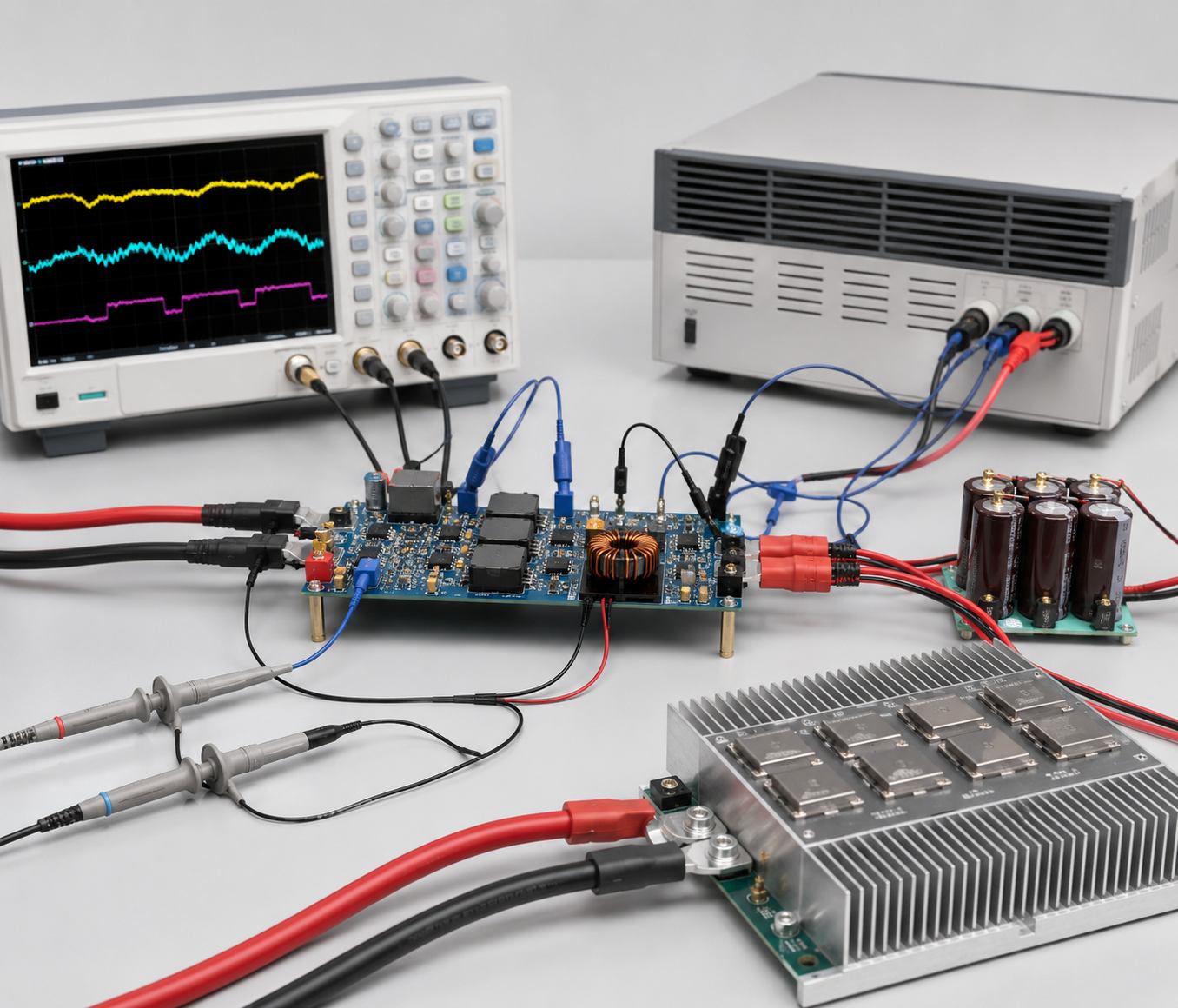
Engineering guide to dynamic load response testing for high-current buck converters, covering load step setup, slew rate, Vcore undershoot, overshoot, recovery time, probe location, output capacitors a…

Engineering guide to output capacitor selection for ASIC Vcore rails, covering bulk capacitors, polymer capacitors, MLCC decoupling, DC bias, ESR, ESL, placement, transient response and substitution ri…
Engineering guide to high-current ASIC Vcore rails, covering 12-phase buck architecture, PMBus control, dynamic load testing, output capacitor networks, smart power stage selection, thermal design and …
Voltage regulator guide covering linear, LDO, 7805, Zener, adjustable, buck, VRM and alternator regulators, with design checks, testing methods, troubleshooting and datasheet-based selection.
Amplifier guide covering voltage, current and power amplification, gain, feedback, amplifier classes, audio and RF applications, op-amp circuits, transimpedance amplifiers, datasheet selection and trou…


