
 My Inquiry
 My Account


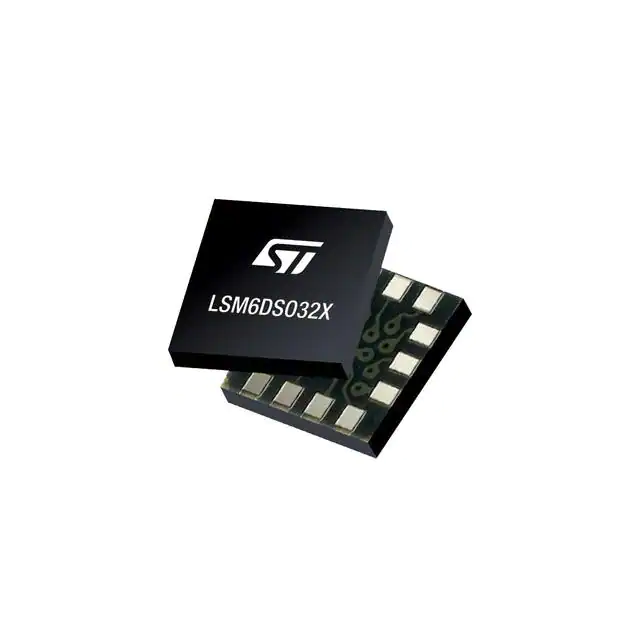
STMicroelectronics LSM6DSO32XTR
- Part No.:
- LSM6DSO32XTR
- Manufacturer:
- STMicroelectronics
- Category:
- Specialized Sensors
- Package:
- Datasheet:
-
 LSM6DSO32XTR.pdf
- Description:
- SENSOR ACCELEROMETER I2C/SPI OUT
- Quantity:
- Payment:

- Shipping:

Inventory:4,589
Please send an inquiry. Send us your inquiry, and we will respond immediately.
Product details
Overview
LSM6DSO32XTR from STMicroelectronics is a 6-axis inertial measurement unit (IMU) integrating a high-performance 3-axis digital accelerometer (±4/±8/±16/±32 g) and 3-axis digital gyroscope (±125 to ±2000 dps), with embedded Machine Learning Core (MLC), Finite State Machine (FSM), and 9 kbyte Smart FIFO - delivering 0.55 mA power consumption in combo high-performance mode for wearable motion sensing, hard-fall detection, and sensor-hub applications.
For engineers reviewing the LSM6DSO32XTR datasheet, LSM6DSO32XTR pinout, LSM6DSO32XTR application, or LSM6DSO32XTR equivalent, this page provides verified technical context, validated pin functions, real-world use cases in wearables and IoT, and confirmed alternatives aligned with Android-compliant motion processing requirements.
Technical Context
The LSM6DSO32XTR implements dual independent signal chains: one for accelerometer data (with configurable ODR up to 6.664 kHz and self-test output change of 50–1700 mg) and one for gyroscope data (ODR up to 6.664 kHz, rate noise density 3.8 mdps/√Hz in high-performance mode). Its MLC executes up to 8 concurrent flows using configurable "if-then-else" nodes on accelerometer/gyro data, while the FSM supports 16 independent state machines for gesture recognition like shake, tilt, and glance.
Hardware-accelerated Android features include significant motion detection (SMD), tilt detection, pedometer, step counter, and 6D orientation - all implemented via dedicated IP blocks with negligible power overhead. The device supports dual interface modes: Mode 1 (I²C/SPI/I3CSM slave only) and Mode 2 (slave + I²C master for external magnetometer/sensor hub expansion).
Key Specifications
| Parameter | Value and Actual Design Meaning |
|---|---|
| Accelerometer Full Scale | ±4/±8/±16/±32 g - enables robust hard-fall detection and high-g shock monitoring without saturation |
| Gyroscope Full Scale | ±125/±250/±500/±1000/±2000 dps - supports both fine-motion tracking (e.g., wrist tilt) and aggressive motion capture (e.g., sports impact) |
| Power Consumption (HP Mode) | 0.55 mA total - allows always-on motion awareness in battery-constrained wearables with multi-day runtime |
| FIFO Capacity | 9 kbytes with compression - reduces host processor polling frequency and system-level power by batching timestamped accel/gyro/external sensor data |
| Interface Support | SPI (3-/4-wire), I²C (up to 1 MHz), MIPI I3CSM - ensures compatibility with modern application processors and sensor-hub architectures |
| MLC & FSM | 8 concurrent MLC flows, 16 independent FSMs - offloads motion classification (e.g., walking vs. running) and gesture logic from AP to sensor, cutting system power by >30% in typical use |
| Operating Temperature | −40 °C to +85 °C - qualified for industrial-grade wearable and asset-tracking deployments |
Pinout & Package
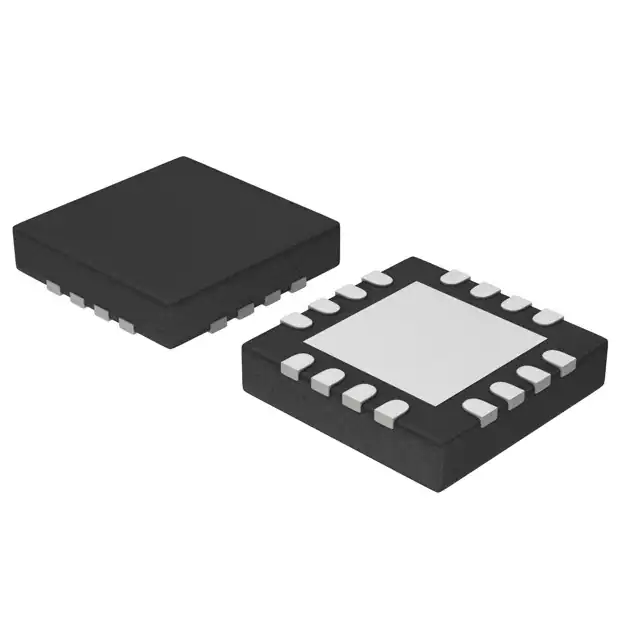
LSM6DSO32XTR is housed in a compact 14-pin LGA package (2.5 mm × 3.0 mm × 0.83 mm) with exposed pad for thermal and mechanical stability. Pin functions are mode-dependent (Mode 1: slave-only; Mode 2: slave + I²C master), requiring correct SDx/SCx configuration for external sensor connectivity.
| Pin/Terminal | Circuit Role | Design Meaning |
|---|---|---|
| 1 (SDO/SA0) | I²C address LSB / SPI SDO | Selects I²C device address (0x6A or 0x6B); in SPI mode, outputs serial data |
| 2 (SDx) & 3 (SCx) | I²C master SDA/SCL (Mode 2 only) | Enable sensor hub operation: connect external magnetometer via dedicated I²C master bus |
| 4 (INT1) & 9 (INT2) | Programmable interrupt outputs | Assert on hardware events (6D orientation, free-fall, MLC result change, FSM end state) - eliminates continuous polling |
| 5 (Vdd_IO) & 8 (Vdd) | IO supply / core supply | Independent 1.62 V IO rail supports mixed-voltage systems; core operates from 1.71–3.6 V |
| 12 (CS) & 13 (SCL) & 14 (SDA) | Interface mode select / clock / data | CS = 1 enables I²C/I3CSM; CS = 0 enables SPI; SCL/SDA serve dual role across protocols |
Key Features
| Feature | Design Value |
|---|---|
| Embedded Machine Learning Core (MLC) | Executes up to 8 concurrent motion classification flows using accelerometer/gyro data - reduces AP load and extends battery life in activity-tracking devices |
| Finite State Machine (FSM) | 16 independent, programmable state machines detect custom gestures (e.g., double-shake, wrist flick) without host intervention |
| Smart FIFO with Compression | 9 kbytes dynamically allocated across internal/external sensors and timestamps - cuts host read frequency by 70% in navigation logging |
| Android-Compliant Hardware Blocks | Dedicated IP for significant motion detection, tilt, pedometer, and step counter - meets AOSP HAL requirements without firmware overhead |
| Sensor Hub (Mode 2) | Integrated I²C master supports up to 4 external sensors (e.g., magnetometer, barometer) - enables full 9-DoF fusion on a single die |
Applications
| Wearable Fitness Tracker | Smartwatch Fall Detection |
|---|---|
Use Scenario: Continuous step counting, activity classification, and gesture control during daily wear. IC Role / Device Role / Timing Role: Primary 6-DoF motion sensor providing real-time accel/gyro streams and hardware-accelerated pedometer/tilt/SMD outputs. Use Value: 0.55 mA HP-mode current and MLC-driven activity recognition extend battery life beyond 7 days while maintaining sub-50 ms gesture response latency. | Use Scenario: Real-time detection of sudden vertical deceleration (>15 g) followed by immobility to trigger emergency alerts. IC Role / Device Role / Timing Role: High-g accelerometer (±32 g FS) with hardware free-fall + 6D orientation + MLC-based impact pattern analysis. Use Value: Self-contained hard-fall decision logic eliminates reliance on host CPU, enabling reliable detection even during OS sleep or low-power states. |
| Industrial Asset Tracker | IoT Motion-Triggered Sensor Node |
Use Scenario: GPS-denied indoor navigation and vibration-based equipment health monitoring in logistics hubs. IC Role / Device Role / Timing Role: Sensor hub controller fusing LSM6DSO32XTR's IMU data with external magnetometer/barometer via integrated I²C master. Use Value: 9 kbyte FIFO with timestamping enables 2+ hours of buffered motion history for post-event forensic analysis without host wake-up. | Use Scenario: Battery-powered environmental node that wakes only on meaningful motion (e.g., door opening, human approach). IC Role / Device Role / Timing Role: Always-on low-power motion detector using FSM-triggered interrupts to activate MCU and radio only when required. Use Value: FSM-based custom motion pattern matching reduces average system current to <10 µA - enabling 5+ year coin-cell operation. |
Equivalent & Alternatives
The following parts are listed as comparable options for similar 6-axis IMU applications.
| Alternative Part | Technical Difference | Application Difference | Selection Advice |
|---|---|---|---|
| LSM6DSOXTR | Same package and pinout; lacks 32 g accelerometer range (max ±16 g) and MLC (only FSM) | Suitable for standard wearables but not hard-fall or high-shock industrial use | Select LSM6DSOXTR when cost sensitivity outweighs need for 32 g range and ML inference |
| BMI270 | Lower power (0.42 mA HP mode); no MLC; 16 kbyte FIFO; supports wake-up on external sensor data | Better for ultra-low-power always-on nodes; weaker on Android HAL compliance and gesture complexity | Choose BMI270 for longest battery life in simple motion wake-up applications without ML classification needs |
Compared with LSM6DSOXTR and BMI270, the LSM6DSO32XTR uniquely combines 32 g shock tolerance, hardware MLC for on-sensor activity classification, and full Android HAL compliance - making it optimal for safety-critical wearables and high-fidelity motion analytics where accuracy and autonomy matter more than minimal current draw.
Availability
LSM6DSO32XTR is available at Aetrix Electronics and suitable for wearable fitness trackers, smartwatch fall detection systems, and industrial asset trackers requiring stable component supply, long-term lifecycle support, and RoHS-compliant manufacturing.
Supply support for LSM6DSO32XTR includes scheduled delivery planning, volume procurement assistance, BOM continuity management, traceable sourcing, and lifecycle availability coordination for OEM customers, industrial embedded developers, connected-device designers, and electronics production programs.
Manufacturer
STMicroelectronics is a global semiconductor leader headquartered in Geneva, specializing in MEMS, microcontrollers, power management, and automotive ICs - with over 20 years of MEMS sensor manufacturing heritage.
The iNEMO 6-DoF inertial module product line - including LSM6DSO32XTR - was designed specifically for intelligent motion sensing in space-constrained, battery-operated devices, emphasizing hardware acceleration of Android motion services and edge AI inference.
FAQ
What is the maximum supported output data rate (ODR) for both accelerometer and gyroscope?
The LSM6DSO32XTR supports synchronized ODRs up to 6664 Hz for both accelerometer and gyroscope. This high-rate capability enables precise motion capture for sports analytics and vibration diagnostics, with hardware timestamping ensuring sample alignment across axes and sensors.
How does the Machine Learning Core differ from the Finite State Machine in practical implementation?
The MLC performs pattern classification (e.g., distinguishing walking from cycling) using configurable "if-then-else" decision trees on raw sensor data, while the FSM detects discrete sequential events (e.g., "wrist up → pause → wrist down") via state transitions. MLC requires training offline and stores models in dedicated memory; FSM is programmed with Boolean logic per state.
Can the LSM6DSO32XTR operate as a standalone sensor hub without an external microcontroller?
No - the LSM6DSO32XTR requires a host processor to configure registers, read FIFO data, and interpret MLC/FSM results. However, its embedded intelligence significantly reduces host involvement: interrupts signal completed classifications or gestures, minimizing polling and background CPU load.
What is the functional difference between Mode 1 and Mode 2 pin configurations?
In Mode 1, pins SDx and SCx are tied to Vdd_IO or GND and unused; the device operates solely as an I²C/SPI/I3CSM slave. In Mode 2, SDx and SCx become active I²C master SDA/SCL lines, enabling direct connection and control of external sensors (e.g., magnetometers) - essential for 9-DoF sensor fusion without additional bridge ICs.
LSM6DSO32XTR Specifications
- Product attributes
- Attribute value
- Manufacturer:
- STMicroelectronics
- Series:
- iNEMO
- Packaging:
- Tape & Reel (TR)
- Product Status:
- Active
- Sensor Type:
- Accelerometer, Gyroscope, Temperature
- Output Type:
- I2C, SPI
- Operating Temperature:
- -40°C ~ 85°C
- Grade:
- -
- Qualification:
- -
LSM6DSO32XTR FAQ
1.How can I place an order for LSM6DSO32XTR through Aetrix?
Please submit a Request for Quotation (RFQ) for LSM6DSO32XTR on Aetrix. Our sales agent will provide a competitive quotation and guide you through the order confirmation once you accept the terms.
2.Are the price and stock information for LSM6DSO32XTR reliable?
The price and inventory of LSM6DSO32XTR are updated periodically and may fluctuate due to market conditions. Stock and pricing data are typically refreshed every 24 hours. Quotation validity for LSM6DSO32XTR is usually 5 days.
3.What payment methods are accepted for LSM6DSO32XTR?
We accept Wire Transfer, PayPal, Credit Card, Western Union, MoneyGram, and Escrow for LSM6DSO32XTR transactions.
Note: Certain payment methods may incur a processing fee.
4.How is shipping managed for LSM6DSO32XTR?
LSM6DSO32XTR orders can be shipped via leading logistics carriers, including DHL, UPS, FedEx, TNT, or Registered Mail.
Once your LSM6DSO32XTR order is processed, you will receive an email with the shipment details and tracking number.
Note: Tracking information may take up to 24 hours to appear. Express delivery typically takes 3–5 business days.
5.How can I obtain technical support or documentation for LSM6DSO32XTR?
For technical support, including LSM6DSO32XTR datasheets, pinout diagrams, or application guidance, please contact our engineering support team. They can provide detailed documentation and assistance for your LSM6DSO32XTR requirements.
6.How does Aetrix verify that LSM6DSO32XTR is sourced from the original manufacturer or authorized distributors?
All LSM6DSO32XTR products on Aetrix are procured from qualified distributors and authorized channels. Our dedicated quality assurance team conducts strict verification, including traceability checks and, if necessary, third-party testing. This ensures that LSM6DSO32XTR meets industry standards.
7.What is the process for return or replacement of LSM6DSO32XTR?
All LSM6DSO32XTR units undergo pre-shipment inspection (PSI). If there is an issue with LSM6DSO32XTR, returns or replacements are accepted under the following conditions:
1.Quantity discrepancies, incorrect items, or visible external defects (such as breakage or corrosion), acknowledged by Aetrix.
2.The issue is reported within 90 days of delivery.
3.The LSM6DSO32XTR part is unused and in its original packaging.
Return procedure for LSM6DSO32XTR:
1.Submit a request within 90 days.
2.Obtain a Return Material Authorization (RMA) from Aetrix.
LSM6DSO32XTR Tags

-
AS7057-BWLT WLP LF T&R
ams-OSRAM USA INC.
-
LSM6DSO32XTR
STMicroelectronics
-
AS3935-BQFT
ScioSense
-
BAF147B002-00A0
Amphenol Advanced Sensors (Thermometrics)
-
MAX86174AENE+T
Analog Devices Inc./Maxim Integrated
-
VL53L8CXV0GC/1
STMicroelectronics
-
BME680
Bosch Sensortec
-
SEN-12969
SparkFun Electronics
-
BME688
Bosch Sensortec
-
MAXM86161EFD+T
Analog Devices Inc./Maxim Integrated
-
A111-001-T&R
Acconeer AB

-
MAX30101EFD+T
Analog Devices Inc./Maxim Integrated
Tech Hub

Operational amplifier guide covering op amp basics, feedback, ideal vs real op amps, common configurations, buffer circuits, offset, bias current, gain-bandwidth, slew rate, rail-to-rail limits and sel…

Jumper cables guide covering safe connection order, red and black clamp placement, final ground connection, cable gauge, length, clamp quality, copper vs CCA cables, jump starter comparison and battery…

LDO regulator guide covering low dropout voltage, power dissipation, thermal design, PSRR, output noise, capacitor stability, adjustable LDO circuits, LDO vs buck converter and datasheet selection chec…

Conditional Access Module guide covering CAM meaning, CI/CI+ interface, smart card authorization, DVB security workflow, TV and set-top box compatibility, internal electronics, ESD protection, connecto…

Guide to electronic component obsolescence covering EOL risk, PCN/PDN notices, last-time buy planning, replacement options, form-fit-function validation, counterfeit risk and BOM lifecycle management.

18650 battery guide covering lithium-ion cell basics, 3.6V/3.7V voltage, 4.2V charging, mAh and Wh capacity, protected cells, chargers, BMS, series-parallel packs, holders, welding and sourcing checks.…

Hall effect sensor guide covering working principle, linear and digital sensors, Arduino circuits, current sensing, speed detection, automotive applications, A3144 examples, signal filtering and datash…

Product Change Notification guide for electronic components, covering PCN meaning, PCN vs PDN/EOL, common change types, risk levels, form-fit-function review, engineering validation, BOM control, LTB/L…

A practical guide to blend door actuators, covering HVAC function, symptoms, location, AC and heater issues, reset and calibration, replacement cost, electrical diagnosis, compatibility checks, and rep…

Engineering guide to Raspberry Pi alternatives, covering chip-level differences, Orange Pi, ROCK, Jetson, Banana Pi, NanoPi, Compute Module, Pico, GPIO, camera, HAT compatibility, and replacement risks…


