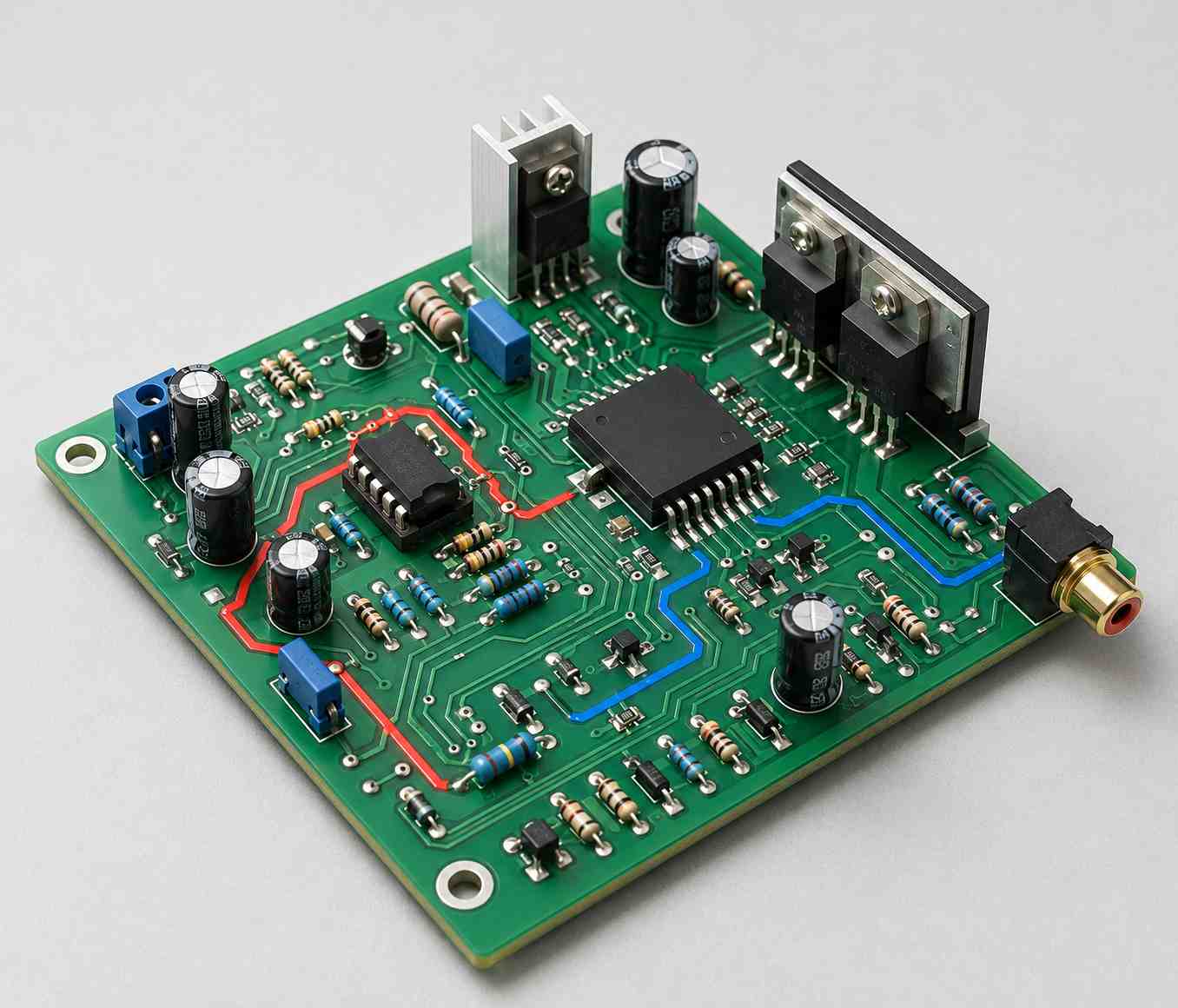
STMicroelectronics STM8AF628ATCX
- Part No.:
- STM8AF628ATCX
- Manufacturer:
- STMicroelectronics
- Category:
- Microcontrollers
- Package:
- 80-LQFP
- Datasheet:
-
STM8AF628ATCX.pdf
- Description:
- IC MCU 8BIT 64KB FLASH 80LQFP
- Quantity:
- Payment:

- Shipping:

Inventory:2,326
Please send an inquiry. Send us your inquiry, and we will respond immediately.
Product details
Overview
STM8AF628ATCX from STMicroelectronics is an AEC-Q100 Grade 0 qualified automotive 8-bit microcontroller featuring a 24 MHz STM8A core, 64 Kbyte Flash program memory, 2 Kbyte data EEPROM, and integrated CAN 2.0B interface. It operates from 3 to 5.5 V across –40 °C to 150 °C and integrates 10-bit ADC (16-channel), three 16-bit timers (including advanced control timer with dead-time insertion), LINUART, USART, SPI, I²C, and up to 68 robust I/O pins - deployed in engine control units and body electronics modules.
For engineers reviewing the STM8AF628ATCX datasheet, STM8AF628ATCX pinout, STM8AF628ATCX application, or STM8AF628ATCX equivalent, key selection criteria include automotive-grade temperature range (–40 °C to 150 °C), CAN/LIN coexistence capability, on-chip data EEPROM endurance (300 kcycles), Flash retention (20 years at 55 °C), and high-sink I/O support for direct LED/relay drive.
Technical Context
The STM8AF628ATCX implements a Harvard-architecture STM8A CPU with 3-stage pipeline and average 1.6 cycles/instruction throughput, delivering 10 MIPS at 16 MHz. Its clock system includes trimmable 16 MHz HSI, 128 kHz LSI, and external crystal oscillator support with clock security monitoring.
Interrupt handling uses a nested controller with 32 vectors and up to 37 external interrupts mapped across five vectors. The peripheral set includes a CAN 2.0B controller compliant with ISO 11898-1, LIN 2.2-compliant LINUART with automatic resynchronization, and a 10-bit ADC with ±2 LSB total unadjusted error and 1 LSB linearity.
Key Specifications
| Parameter | Value and Actual Design Meaning |
|---|---|
| Core Architecture | STM8A 8-bit Harvard core with 3-stage pipeline; enables deterministic real-time response in safety-critical automotive tasks. |
| Max fCPU | 24 MHz at VDD ≥ 4.5 V; supports time-critical CAN message scheduling and PWM generation for motor control. |
| Flash Memory | 64 Kbyte Flash with 20-year data retention at 55 °C; sufficient for dual-bank firmware updates in ECU applications. |
| Data EEPROM | 2 Kbyte true data EEPROM with 300 kcycle endurance; stores calibration data, odometer values, and fault logs without external NV memory. |
| CAN Interface | High-speed 1 Mbit/s CAN 2.0B compliant; enables communication with powertrain and chassis ECUs in distributed vehicle networks. |
| ADC Resolution | 10-bit SAR ADC with ±2 LSB TUE and 16 multiplexed inputs; meets precision requirements for battery voltage, temperature, and sensor signal acquisition. |
| Operating Temp | –40 °C to +150 °C ambient; certified per AEC-Q100 Grade 0 for under-hood deployment including transmission control modules. |
| I/O Count | Up to 68 user pins including 11 high-sink I/Os (20 mA); drives LEDs, solenoids, and discrete loads directly without buffer stages. |
Pinout & Package
LQFP64 package: 64-pin, 10 × 10 mm low-profile quad flat package with exposed thermal pad (EPAD) for enhanced heat dissipation in high-temperature automotive environments.
| Pin/Terminal | Circuit Role | Design Meaning |
|---|---|---|
| VDD, VSS | Power supply and ground | Dual VDD/VSS pairs ensure stable core and I/O rail decoupling; EPAD connects to ground for thermal management. |
| PA0–PA7, PB0–PB7, PC0–PC7, PD0–PD7, PE0–PE7, PF0–PF7 | General-purpose I/O ports | 64 total I/O pins; all support alternate functions including CAN_TX/RX, LIN, USART, SPI, I²C, and timer channels. |
| NRST | Active-low reset input | Internal pull-up; accepts external reset sources and supports programmable reset timing via option bytes. |
| SWIM | Single-wire interface module | Enables non-intrusive debugging and programming using one dedicated pin - no JTAG overhead or pin count penalty. |
| OSC_IN / OSC_OUT | Crystal oscillator connection | Supports 4–24 MHz external crystals; internal clock security system monitors loss of oscillation and triggers safe failover. |
Key Features
| Feature | Design Value |
|---|---|
| AEC-Q100 Grade 0 qualification | Validated for continuous operation at 150 °C ambient - suitable for engine bay, transmission, and brake control modules. |
| Integrated CAN 2.0B + LIN 2.2 | Single MCU handles both high-speed powertrain networking and low-cost body domain communication without external transceivers. |
| Advanced control timer (TIM1) | 16-bit timer with 4 CAPCOM channels, 3 complementary outputs, and programmable dead-time insertion - enables 3-phase motor gate driving. |
| True data EEPROM | 2 Kbyte on-chip EEPROM with 300 kcycle write endurance and 20-year data retention - eliminates need for external serial EEPROM in cost-sensitive designs. |
| Robust I/O design | Immune to current injection up to 100 mA; withstands automotive load dump and ISO 7637-2 pulse testing without latch-up. |
| Low-power modes | Wait, auto-wakeup, and Halt modes with configurable clock gating - reduces quiescent current to <1 μA in deep sleep for always-on modules. |
Applications
| Engine Control Unit (ECU) | Transmission Control Module (TCM) |
|---|---|
Use Scenario: Real-time monitoring of crankshaft position, throttle angle, and oxygen sensor signals while executing fuel injection and spark timing algorithms. IC Role / Device Role / Timing Role: Primary 8-bit controller managing closed-loop combustion control with deterministic interrupt latency and CAN-based actuator coordination. Use Value: 10-bit ADC with 16-channel multiplexing captures analog sensor data simultaneously; CAN interface synchronizes with other ECUs at 1 Mbit/s for torque arbitration. |
Use Scenario: Gear selection logic, clutch pressure regulation, and shift solenoid sequencing in automatic transmissions operating under high thermal stress. IC Role / Device Role / Timing Role: Safety-relevant controller executing ASIL-B compatible diagnostics and PWM-driven solenoid actuation with dead-time protected outputs. Use Value: Advanced control timer (TIM1) delivers precise 3-phase PWM with hardware dead-time insertion; 150 °C rating ensures reliability near hot gearbox housing. |
| Body Control Module (BCM) | Electric Power Steering (EPS) Assist Controller |
Use Scenario: Centralized management of door locks, window lifts, lighting, and interior sensors across multiple LIN sub-nodes. IC Role / Device Role / Timing Role: LIN master coordinating slave nodes while maintaining local CAN gateway functionality for gateway integration. Use Value: Integrated LINUART supports automatic resynchronization per LIN 2.2; 11 high-sink I/Os drive LEDs and relays directly without external drivers. |
Use Scenario: Torque assist calculation and motor phase current regulation in column-assist EPS systems requiring functional safety compliance. IC Role / Device Role / Timing Role: Secondary controller performing motor commutation and fault detection alongside main EPS MCU, communicating via CAN. Use Value: 2 Kbyte data EEPROM stores motor calibration offsets and fault history; CAN interface enables real-time torque request and status exchange with main controller. |
Equivalent & Alternatives
The following parts are listed as comparable options for similar automotive 8-bit microcontroller applications.
| Alternative Part | Technical Difference | Application Difference | Selection Advice |
|---|---|---|---|
| STM8AF6269TDX | 32 Kbyte Flash, same 64-pin LQFP package, identical peripherals and temperature grade. | Suitable for cost-optimized designs with smaller firmware footprint and reduced EEPROM usage. | Select when application firmware size remains below 32 Kbyte and no future feature expansion is planned. |
| STM32F042F6P6 | 32-bit ARM Cortex-M0 core, 32 Kbyte Flash, no integrated CAN, requires external CAN transceiver. | Offers higher computational throughput but lacks native CAN and automotive temperature qualification (only industrial grade). | Choose only if migrating to 32-bit architecture is justified and external CAN PHY integration is acceptable. |
Compared with STM8AF6269TDX, STM8AF628ATCX provides double Flash capacity and full backward compatibility; versus STM32F042F6P6, it delivers native CAN, AEC-Q100 Grade 0 certification, and proven 8-bit deterministic latency - critical for legacy automotive software stacks.
Availability
STM8AF628ATCX is available at Aetrix Electronics and suitable for engine control units, transmission control modules, and body control modules requiring stable component supply across extended automotive lifecycles.
Supply support for STM8AF628ATCX includes scheduled delivery planning, volume procurement assistance, BOM continuity management, traceable sourcing, and lifecycle availability coordination for OEM customers, industrial embedded developers, connected-device designers, and electronics production programs.
Manufacturer
STMicroelectronics is a global semiconductor leader headquartered in Geneva, Switzerland, designing and manufacturing microcontrollers, power devices, sensors, and analog ICs for automotive, industrial, and consumer markets.
The STM8A automotive microcontroller product line targets cost-sensitive, high-reliability applications in powertrain, chassis, and body electronics - emphasizing AEC-Q100 qualification, long-term supply assurance, and toolchain maturity.
FAQ
What is the maximum operating frequency of the STM8AF628ATCX and what supply voltage is required?
The STM8AF628ATCX achieves a maximum CPU frequency of 24 MHz when powered at VDD ≥ 4.5 V. At lower supply voltages (3.0–4.4 V), the maximum fCPU is reduced per the fCPUmax vs. VDD curve in Section 10.3.1 - for example, 16 MHz at 3.3 V. This voltage-dependent scaling ensures reliable operation across automotive battery variations.
Does the STM8AF628ATCX support in-circuit debugging and programming without dedicated debug pins?
Yes. The STM8AF628ATCX uses the Single-Wire Interface Module (SWIM), which requires only one dedicated pin (SWIM) for non-intrusive debugging, flash programming, and memory inspection. No additional debug pins (e.g., SWDIO/SWCLK) or dedicated debug interfaces are needed - simplifying PCB layout and reducing pin count overhead.
How does the integrated CAN controller differ from standard UART-based CAN implementations?
The STM8AF628ATCX features a fully integrated CAN 2.0B controller (beCAN) with hardware message filtering, transmit/receive FIFOs, automatic retransmission, and bus-off recovery - eliminating software overhead. Unlike UART-based CAN solutions, it requires only an external CAN transceiver (e.g., TJA1042) and provides deterministic timing, error confinement, and ISO 11898-1 compliance without CPU intervention.
Is the data EEPROM truly wear-levelled, and what is its guaranteed endurance?
The STM8AF628ATCX includes 2 Kbyte of true data EEPROM with guaranteed 300,000 write/erase cycles per memory location and 20-year data retention at 55 °C. Wear leveling is implemented in hardware via internal address translation - no firmware intervention is required. Endurance is validated per AEC-Q100 stress tests and documented in Table 37 of the datasheet.
STM8AF628ATCX Specifications
- Product attributes
- Attribute value
- Manufacturer:
- STMicroelectronics
- Package/Case:
- 80-LQFP
- Series:
- STM8A
- Packaging:
- Tape & Reel (TR)
- Product Status:
- Obsolete
- Programmable:
- Not Verified
- Core Processor:
- STM8A
- Core Size:
- 8-Bit
- Speed:
- 24MHz
- Connectivity:
- I2C, LINbus, SPI, UART/USART
- Peripherals:
- Brown-out Detect/Reset, POR, PWM, WDT
- Number of I/O:
- 68
- Program Memory Size:
- 64KB (64K x 8)
- Program Memory Type:
- FLASH
- EEPROM Size:
- 2K x 8
- RAM Size:
- 6K x 8
- Voltage - Supply (Vcc/Vdd):
- 3V ~ 5.5V
- Data Converters:
- A/D 16x10b
- Oscillator Type:
- Internal
- Operating Temperature:
- -40°C ~ 125°C (TA)
- Grade:
- Automotive
- Qualification:
- AEC-Q100
- Mounting Type:
- Surface Mount
- Supplier Device Package:
STM8AF628ATCX FAQ
1.How can I place an order for STM8AF628ATCX through Aetrix?
Please submit a Request for Quotation (RFQ) for STM8AF628ATCX on Aetrix. Our sales agent will provide a competitive quotation and guide you through the order confirmation once you accept the terms.
2.Are the price and stock information for STM8AF628ATCX reliable?
The price and inventory of STM8AF628ATCX are updated periodically and may fluctuate due to market conditions. Stock and pricing data are typically refreshed every 24 hours. Quotation validity for STM8AF628ATCX is usually 5 days.
3.What payment methods are accepted for STM8AF628ATCX?
We accept Wire Transfer, PayPal, Credit Card, Western Union, MoneyGram, and Escrow for STM8AF628ATCX transactions.
Note: Certain payment methods may incur a processing fee.
4.How is shipping managed for STM8AF628ATCX?
STM8AF628ATCX orders can be shipped via leading logistics carriers, including DHL, UPS, FedEx, TNT, or Registered Mail.
Once your STM8AF628ATCX order is processed, you will receive an email with the shipment details and tracking number.
Note: Tracking information may take up to 24 hours to appear. Express delivery typically takes 3–5 business days.
5.How can I obtain technical support or documentation for STM8AF628ATCX?
For technical support, including STM8AF628ATCX datasheets, pinout diagrams, or application guidance, please contact our engineering support team. They can provide detailed documentation and assistance for your STM8AF628ATCX requirements.
6.How does Aetrix verify that STM8AF628ATCX is sourced from the original manufacturer or authorized distributors?
All STM8AF628ATCX products on Aetrix are procured from qualified distributors and authorized channels. Our dedicated quality assurance team conducts strict verification, including traceability checks and, if necessary, third-party testing. This ensures that STM8AF628ATCX meets industry standards.
7.What is the process for return or replacement of STM8AF628ATCX?
All STM8AF628ATCX units undergo pre-shipment inspection (PSI). If there is an issue with STM8AF628ATCX, returns or replacements are accepted under the following conditions:
1.Quantity discrepancies, incorrect items, or visible external defects (such as breakage or corrosion), acknowledged by Aetrix.
2.The issue is reported within 90 days of delivery.
3.The STM8AF628ATCX part is unused and in its original packaging.
Return procedure for STM8AF628ATCX:
1.Submit a request within 90 days.
2.Obtain a Return Material Authorization (RMA) from Aetrix.
STM8AF628ATCX Tags

-
ATTINY4-TSHR
Microchip Technology

-
ATTINY10-TSHR
Microchip Technology

-
ATTINY10-TS8R
Microchip Technology

-
ATTINY202-SSNR
Microchip Technology

-
ATTINY202-SSFR
Microchip Technology

-
ATTINY402-SSNR
Microchip Technology
-
PIC16F15213T-I/MF
Microchip Technology

-
PIC16F15213-E/MF
Microchip Technology

-
PIC10F200T-I/OT
Microchip Technology

-
ATTINY412-SSNR
Microchip Technology

-
PIC10F202T-I/OT
Microchip Technology
-
ATTINY404-SSNR
Microchip Technology
Tech Hub

Comparator circuit design covering voltage thresholds, input limits, open-collector outputs, LM393 wiring, op-amp differences, hysteresis, timing, window detection and practical fault diagnosis.
Schmitt triggers use separate rising and falling thresholds to stabilize slow or noisy signals. This guide covers hysteresis, 74HC14 and 74HCT14 selection, comparator calculations, RC oscillators and p…
Counterfeit components can hide behind convincing markings and passing basic function tests. This engineering reference covers source traceability, external inspection, X-ray, XRF, electrical testing, …
A practical engineering and sourcing framework covering lifecycle verification, lifetime-buy calculations, replacement qualification, supplier checks and counterfeit-risk controls.
TTL and CMOS logic families differ in thresholds, loading, output drive, power and timing. This engineering guide compares 74HC and 74HCT, calculates noise margins and checks 3.3 V/5 V compatibility.
A practical engineering guide to 3.3V and 5V logic compatibility, input thresholds, resistor dividers, translator ICs, MOSFET level shifting, I2C pull-ups, timing limits and power-sequencing risks.
The 74HC595 uses push-pull logic outputs, while the TPIC6B595 uses 50 V open-drain DMOS sinks for higher-power loads. This guide compares timing, current limits, 3.3 V interfacing, load wiring, thermal…
The 74HC595 converts serial data into eight stable parallel outputs. This guide covers pin functions, shift and storage timing, OE and MR behavior, drive-current limits, cascading, voltage compatibilit…
A technical comparison of level-sensitive latches and edge-triggered flip-flops, covering timing windows, setup and hold limits, master–slave operation, time borrowing, race-through, HDL inference and…
A D latch stores one bit while Enable controls when data can pass. This reference covers gate-level operation, truth tables, transparency, setup and hold timing, LE versus OE, common ICs and practical …