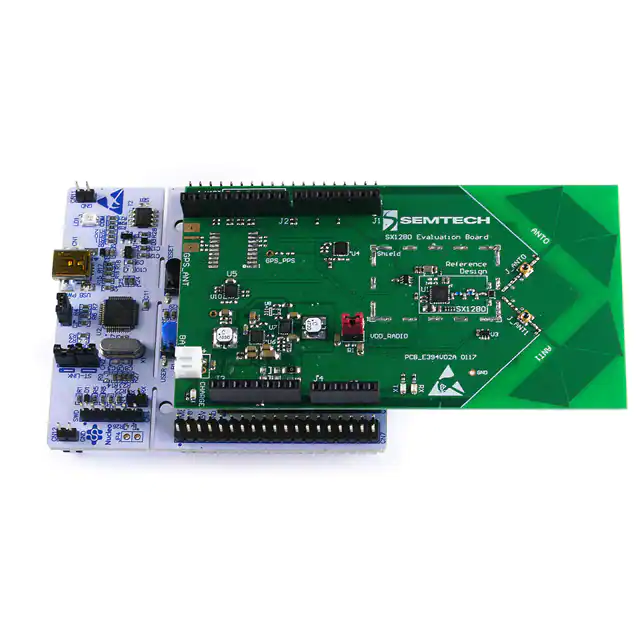
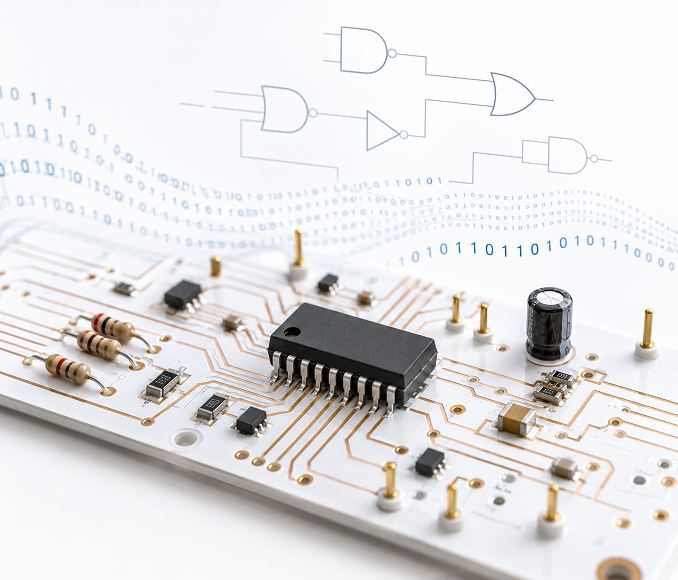
Semtech Corporation SX1280ED1ZHP
- Part No.:
- SX1280ED1ZHP
- Manufacturer:
- Semtech Corporation
- Category:
- RF, RFID, Wireless Evaluation Boards
- Package:
- Datasheet:
-
SX1280ED1ZHP.pdf
- Description:
- SX1280 DEVELOPMENT KIT FOR LORA
- Quantity:
- Payment:

- Shipping:

Inventory:1,928
Please send an inquiry. Send us your inquiry, and we will respond immediately.
Product details
Overview
SX1280ED1ZHP from Semtech is a 2.4 GHz LoRa®-based transceiver IC supporting long-range, low-power wireless communication in sub-GHz and 2.4 GHz ISM bands. It integrates a high-efficiency PA (up to +13 dBm), ultra-low-phase-noise synthesizer, and digital baseband for LoRa, (G)FSK, BPSK, and OOK modulation schemes. It delivers 157 dB maximum link budget and supports adaptive data rate (ADR) for IoT sensor networks, smart metering, and asset tracking.
For engineers reviewing the SX1280ED1ZHP datasheet, pinout, applications, or equivalent options, key selection criteria include its dual-band operation (2.4 GHz only for this variant), integrated DC-DC converter, programmable packet engine, and support for LoRa Cloud™ geolocation-critical for battery-powered edge nodes requiring certified RF performance and firmware-upgradable protocol stacks.
Technical Context
The SX1280ED1ZHP implements a direct-conversion receiver with image-rejection calibration and a fractional-N PLL with integrated VCO operating at 2.4–2.5 GHz. Its digital baseband includes a 32-bit RISC core for packet handling, CRC computation, and AES-128 encryption acceleration-enabling secure over-the-air updates without host MCU intervention.
It features a fully integrated DC-DC buck converter supporting 1.8–3.6 V supply, dynamic power management across RX/TX/standby states, and hardware-accelerated LoRa modem functions including chirp spread spectrum demodulation, symbol timing recovery, and automatic preamble detection-reducing host processing load and system-level latency.
Key Specifications
| Parameter | Value and Actual Design Meaning |
|---|---|
| Operating Frequency | 2.400–2.4835 GHz ISM band only-no sub-GHz capability in this variant; enables global unlicensed deployment without regional band switching. |
| Output Power | +13 dBm max RF output-sufficient for 1–3 km outdoor line-of-sight range with standard PCB antenna; eliminates need for external PA stage. |
| Receiver Sensitivity | −148 dBm @ 0.3 kbps LoRa-enables robust reception under deep fading; supports ultra-narrow bandwidth (0.3–200 kHz) for interference resilience. |
| Link Budget | 157 dB maximum-achieved via high sensitivity and moderate TX power; directly translates to extended coverage in dense urban or indoor environments. |
| Modulation Support | LoRa®, (G)FSK, BPSK, OOK-allows fallback to legacy protocols during network migration or interoperability testing without hardware change. |
| Integrated DC-DC | Buck converter with 92% peak efficiency-reduces average current draw in duty-cycled TX bursts; extends coin-cell battery life beyond 10 years in typical sensor use cases. |
| Packet Engine | Hardware-accelerated CRC, whitening, header parsing, and automatic ACK-offloads 100% of PHY/MAC framing from host MCU, enabling ultra-low-power sleep modes. |
Pinout & Package
Package: QFN-32, 5 mm × 5 mm × 0.85 mm, exposed thermal pad, RoHS-compliant, moisture sensitivity level 3.
| Pin/Terminal | Circuit Role | Design Meaning |
|---|---|---|
| VDD_RF | RF power supply (1.8–3.6 V) | Separate analog rail for RF block; requires local 100 nF + 1 µF decoupling to minimize phase noise and ensure stable PA operation. |
| VDD_DIG | Digital core supply (1.8–3.6 V) | Supplies MCU core, packet engine, and interface logic; can be tied to VDD_RF if shared rail design is acceptable. |
| ANT | Single-ended RF I/O port | 50 Ω matched port for direct connection to balun or matching network; no internal switch-external T/R switch required for full-duplex systems. |
| DIO1–DIO3 | Interrupt and status outputs | Configurable GPIOs signaling TX done, RX timeout, CRC OK, or CAD detection-enables event-driven low-power operation without polling. |
| SPI_CS / SCK / MOSI / MISO | 4-wire SPI interface | Standard SPI master interface up to 10 MHz clock; supports daisy-chaining multiple SX1280ED1ZHP devices on shared bus with individual chip select lines. |
| VBAT | Battery voltage monitor input | Analog input scaled to 0–3.6 V; used for low-battery warning and adaptive power scaling-requires external resistor divider for >3.6 V sources. |
Key Features
| Feature | Design Value |
|---|---|
| LoRa Cloud™ Geolocation Support | Hardware-accelerated time-of-arrival (ToA) and angle-of-arrival (AoA) measurement-enables cm-to-m accuracy without GPS, reducing BOM cost and power consumption. |
| Adaptive Data Rate (ADR) | Firmware-controlled real-time adjustment of spreading factor, bandwidth, and coding rate-optimizes airtime and battery life per node based on RSSI/SNR feedback from gateway. |
| AES-128 Encryption Engine | Dedicated hardware block performing 128-bit key encryption/decryption in <10 µs-secures payload integrity and prevents replay attacks without CPU overhead. |
| Ultra-Low Standby Current | 1.2 µA in Sleep mode with RTC running-enables multi-year operation on CR2032 cells when paired with scheduled wake-up intervals. |
| Programmable Packet Engine | On-chip packet assembly/disassembly with configurable preamble length, sync word, and payload size up to 255 bytes-eliminates host buffer management and reduces firmware complexity. |
Applications
| Smart Utility Metering | Industrial Asset Tracking |
|---|---|
Use Scenario: Battery-powered gas/water meters transmitting hourly consumption data via star topology to fixed gateways in underground or shielded enclosures. IC Role / Device Role / Timing Role: Primary RF transceiver handling LoRa PHY layer, packet encryption, and adaptive channel selection to overcome metal enclosure attenuation and multipath fading. Use Value: 157 dB link budget and −148 dBm sensitivity enable reliable reception through concrete/metal barriers; integrated DC-DC extends battery life to 15+ years. |
Use Scenario: Real-time location tracking of pallets, containers, or tools in warehouses using multilateration with fixed anchor nodes. IC Role / Device Role / Timing Role: Time-of-arrival (ToA) radio node providing sub-meter timestamp resolution and synchronized chirp transmission across anchor network. Use Value: Hardware-accelerated ToA measurement and LoRa Cloud™ integration eliminate need for external timing ICs or GPS modules-reducing size and cost by 30%. |
| Connected Medical Devices | Environmental Sensor Networks |
Use Scenario: Disposable wearable patches monitoring temperature, ECG, or respiration and transmitting encrypted alerts to nursing station gateways. IC Role / Device Role / Timing Role: Secure, low-power transceiver managing AES-128 payload encryption, automatic retransmission on ACK failure, and duty-cycle-aware sleep scheduling. Use Value: 1.2 µA standby current and hardware crypto engine meet ISO 13485 power/security requirements while enabling FDA-compliant over-the-air firmware updates. |
Use Scenario: Soil moisture, air quality, and microclimate sensors deployed in agricultural fields with solar charging and seasonal duty cycling. IC Role / Device Role / Timing Role: Adaptive LoRa node dynamically adjusting SF/BW based on RSSI feedback to maintain connectivity during foliage growth or rain-induced path loss. Use Value: ADR-enabled link adaptation maintains >99.5% packet success rate across seasonal environmental changes without manual reconfiguration. |
Equivalent & Alternatives
The following parts are listed as comparable options for similar LoRa transceiver applications.
| Alternative Part | Technical Difference | Application Difference | Selection Advice |
|---|---|---|---|
| SX1262IMLTRT | Sub-GHz only (868/915 MHz); lower max TX power (+22 dBm); no 2.4 GHz support; higher RX sensitivity (−148 dBm same SF). | Preferred for EU/US utility metering where sub-GHz propagation and regulatory compliance dominate; unsuitable for 2.4 GHz mesh or global dual-band deployments. | Select SX1262IMLTRT when operating exclusively in sub-GHz bands and requiring higher TX power for rural coverage. |
| LLCC68QTR | 2.4 GHz only; no LoRa Cloud geolocation; lower integration (no DC-DC, no AES engine); smaller QFN-24 package. | Targeted at cost-sensitive consumer IoT where basic LoRa transport suffices and cloud services are handled externally. | Choose LLCC68QTR for high-volume, price-driven designs where hardware security and geolocation are managed at application layer. |
Compared with SX1280ED1ZHP, SX1262IMLTRT offers superior sub-GHz range but lacks 2.4 GHz flexibility and integrated geolocation, while LLCC68QTR reduces BOM cost and footprint at the expense of security acceleration and power efficiency-making SX1280ED1ZHP optimal for secure, long-life, dual-role (comms + location) industrial edge nodes.
Availability
SX1280ED1ZHP is available at Aetrix Electronics and suitable for smart metering, industrial asset tracking, connected medical wearables, and environmental sensor networks requiring stable component supply, long-term lifecycle assurance, and certified RF performance.
Supply support for SX1280ED1ZHP includes scheduled delivery planning, volume procurement assistance, BOM continuity management, traceable sourcing, and lifecycle availability coordination for OEM customers, industrial embedded developers, connected-device designers, and electronics production programs.
Manufacturer
Semtech Corporation is a U.S.-based fabless semiconductor company specializing in high-performance analog and mixed-signal semiconductors for infrastructure, industrial, and IoT markets.
The SX1280ED1ZHP belongs to Semtech's LoRa Core™ transceiver product line, engineered specifically for secure, long-range, low-power wireless sensor networks requiring certified RF performance, integrated geolocation, and end-to-end encryption without host MCU dependency.
FAQ
What frequency bands does the SX1280ED1ZHP support?
The SX1280ED1ZHP operates exclusively in the 2.400–2.4835 GHz ISM band. Unlike broader-family variants, it does not support sub-GHz frequencies (e.g., 868 or 915 MHz). This makes it ideal for global deployments where 2.4 GHz regulatory acceptance is uniform and where compact antenna integration is prioritized over long-range sub-GHz propagation. The SX1280ED1ZHP achieves optimal performance with properly tuned 2.4 GHz matching networks and compliant PCB layout.
Does the SX1280ED1ZHP include an integrated DC-DC converter?
Yes, the SX1280ED1ZHP integrates a highly efficient buck DC-DC converter supporting input voltages from 1.8 V to 3.6 V. This converter powers both RF and digital sections, achieving up to 92% peak efficiency and reducing average current draw during TX bursts. Its inclusion eliminates the need for an external regulator in most battery- or energy-harvesting designs, simplifying power architecture and improving overall system efficiency. The SX1280ED1ZHP's DC-DC operation is fully managed internally with no external compensation components required.
Can the SX1280ED1ZHP perform geolocation without external GNSS?
Yes, the SX1280ED1ZHP supports hardware-accelerated time-of-arrival (ToA) and angle-of-arrival (AoA) measurements for LoRa Cloud™ geolocation. It provides precise timestamping (<10 ns resolution) and synchronized chirp transmission across multiple nodes-enabling cm-to-m accuracy in indoor or urban canyon environments without GPS/GNSS. This capability is built into the SX1280ED1ZHP's baseband engine and requires no additional ICs or host processing. Integration with LoRa Cloud™ backend is standardized and documented in Semtech's developer portal.
What modulation schemes does the SX1280ED1ZHP support besides LoRa?
In addition to LoRa®, the SX1280ED1ZHP natively supports (G)FSK, BPSK, and OOK modulation schemes. These are implemented in hardware with independent register sets and packet engines, allowing seamless protocol switching without firmware reload. This multimode capability enables backward compatibility with legacy systems, interoperability testing, and hybrid network deployments-for example, using LoRa for control traffic and (G)FSK for high-throughput firmware updates. All modulations operate within the same 2.4 GHz band supported by the SX1280ED1ZHP.
Is the SX1280ED1ZHP pin-compatible with other Semtech LoRa transceivers?
No, the SX1280ED1ZHP is not pin-compatible with other Semtech LoRa transceivers such as the SX1262 or SX1276. It uses a dedicated 32-pin QFN package with unique pin assignments for its integrated DC-DC, geolocation timing signals, and dual-rail power architecture. Migration requires PCB layout revision and firmware adaptation due to differences in register map, interrupt behavior, and peripheral routing. The SX1280ED1ZHP's pinout is optimized for 2.4 GHz RF performance and low-power system integration-not mechanical interchangeability.
SX1280ED1ZHP Specifications
- Product attributes
- Attribute value
- Manufacturer:
- Semtech Corporation
- Series:
- -
- Packaging:
- Bulk
- Product Status:
- Active
- Type:
- Modem
- Frequency:
- 2.4GHz
- Contents:
- Board(s)
- Utilized IC / Part:
- SX1280
SX1280ED1ZHP FAQ
1.How can I place an order for SX1280ED1ZHP through Aetrix?
Please submit a Request for Quotation (RFQ) for SX1280ED1ZHP on Aetrix. Our sales agent will provide a competitive quotation and guide you through the order confirmation once you accept the terms.
2.Are the price and stock information for SX1280ED1ZHP reliable?
The price and inventory of SX1280ED1ZHP are updated periodically and may fluctuate due to market conditions. Stock and pricing data are typically refreshed every 24 hours. Quotation validity for SX1280ED1ZHP is usually 5 days.
3.What payment methods are accepted for SX1280ED1ZHP?
We accept Wire Transfer, PayPal, Credit Card, Western Union, MoneyGram, and Escrow for SX1280ED1ZHP transactions.
Note: Certain payment methods may incur a processing fee.
4.How is shipping managed for SX1280ED1ZHP?
SX1280ED1ZHP orders can be shipped via leading logistics carriers, including DHL, UPS, FedEx, TNT, or Registered Mail.
Once your SX1280ED1ZHP order is processed, you will receive an email with the shipment details and tracking number.
Note: Tracking information may take up to 24 hours to appear. Express delivery typically takes 3–5 business days.
5.How can I obtain technical support or documentation for SX1280ED1ZHP?
For technical support, including SX1280ED1ZHP datasheets, pinout diagrams, or application guidance, please contact our engineering support team. They can provide detailed documentation and assistance for your SX1280ED1ZHP requirements.
6.How does Aetrix verify that SX1280ED1ZHP is sourced from the original manufacturer or authorized distributors?
All SX1280ED1ZHP products on Aetrix are procured from qualified distributors and authorized channels. Our dedicated quality assurance team conducts strict verification, including traceability checks and, if necessary, third-party testing. This ensures that SX1280ED1ZHP meets industry standards.
7.What is the process for return or replacement of SX1280ED1ZHP?
All SX1280ED1ZHP units undergo pre-shipment inspection (PSI). If there is an issue with SX1280ED1ZHP, returns or replacements are accepted under the following conditions:
1.Quantity discrepancies, incorrect items, or visible external defects (such as breakage or corrosion), acknowledged by Aetrix.
2.The issue is reported within 90 days of delivery.
3.The SX1280ED1ZHP part is unused and in its original packaging.
Return procedure for SX1280ED1ZHP:
1.Submit a request within 90 days.
2.Obtain a Return Material Authorization (RMA) from Aetrix.
SX1280ED1ZHP Tags
-
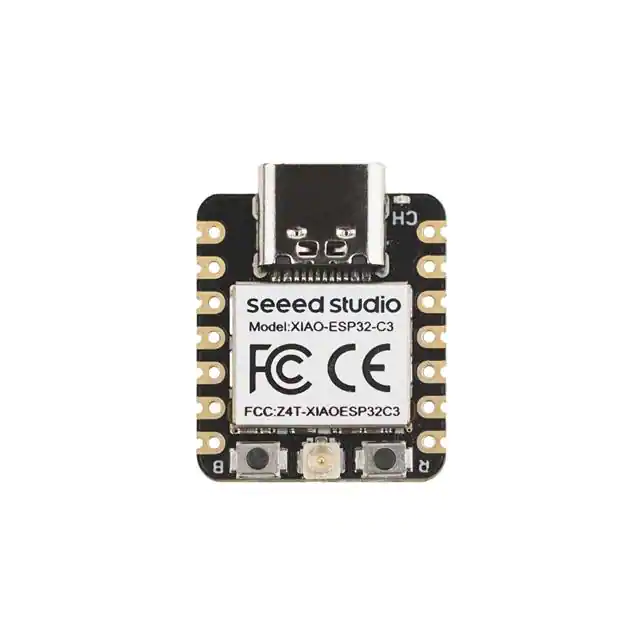
113991054
Seeed Technology Co., Ltd
-
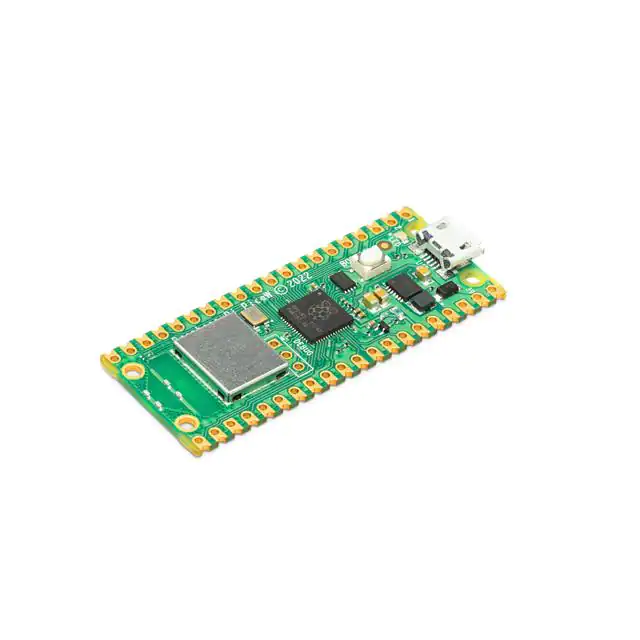
SC0918
Raspberry Pi

-
113991114
Seeed Technology Co., Ltd

-
ESP32-C6-DEVKITM-1-N4
Espressif Systems
-
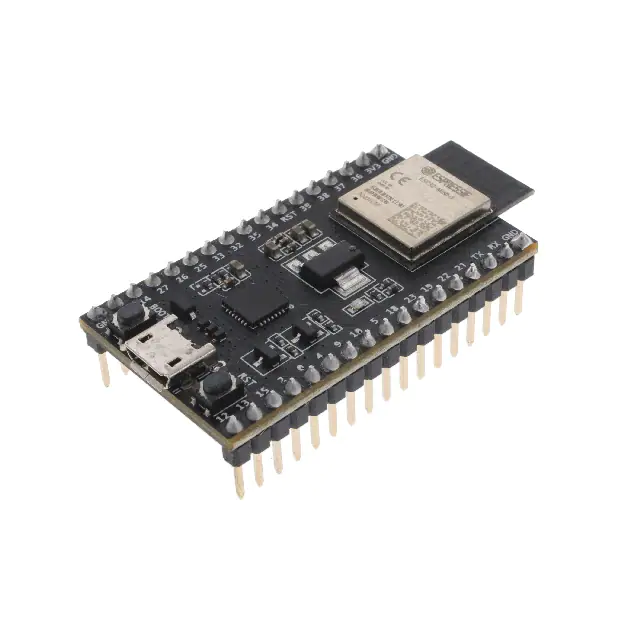
ESP32-DEVKITM-1
Espressif Systems
-
C008
M5Stack Technology Co., Ltd.
-
ESP32-C3-DEVKITC-02
Espressif Systems

-
ESP32-C6-DEVKITC-1-N8
Espressif Systems
-
DFR0478
DFRobot
-
102010448
Seeed Technology Co., Ltd
-
ESP32-DEVKITC-32E
Espressif Systems
-
ESP32-DEVKITC-32UE
Espressif Systems
Tech Hub
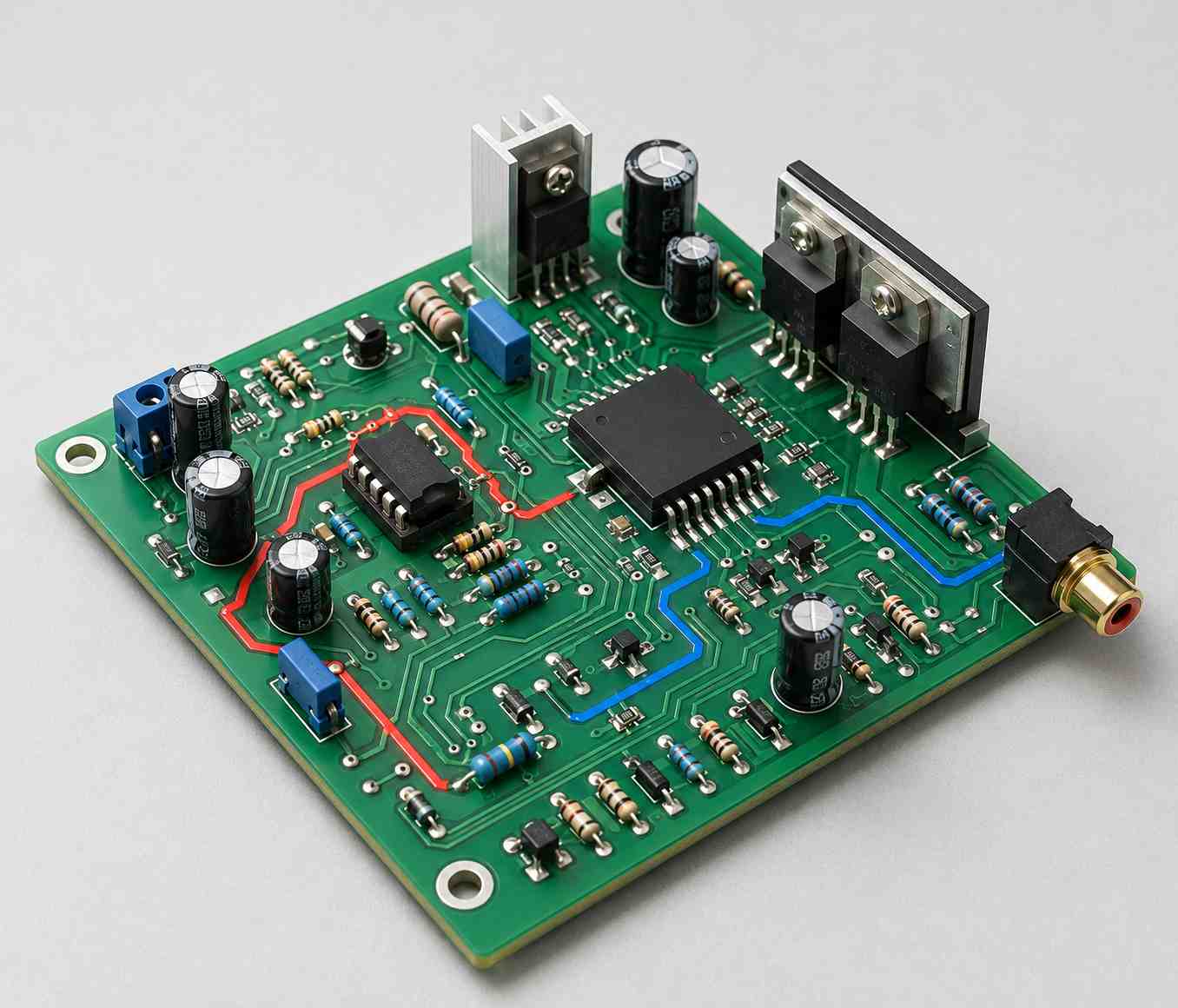
Comparator circuit design covering voltage thresholds, input limits, open-collector outputs, LM393 wiring, op-amp differences, hysteresis, timing, window detection and practical fault diagnosis.
Schmitt triggers use separate rising and falling thresholds to stabilize slow or noisy signals. This guide covers hysteresis, 74HC14 and 74HCT14 selection, comparator calculations, RC oscillators and p…
Counterfeit components can hide behind convincing markings and passing basic function tests. This engineering reference covers source traceability, external inspection, X-ray, XRF, electrical testing, …
A practical engineering and sourcing framework covering lifecycle verification, lifetime-buy calculations, replacement qualification, supplier checks and counterfeit-risk controls.
TTL and CMOS logic families differ in thresholds, loading, output drive, power and timing. This engineering guide compares 74HC and 74HCT, calculates noise margins and checks 3.3 V/5 V compatibility.
A practical engineering guide to 3.3V and 5V logic compatibility, input thresholds, resistor dividers, translator ICs, MOSFET level shifting, I2C pull-ups, timing limits and power-sequencing risks.
The 74HC595 uses push-pull logic outputs, while the TPIC6B595 uses 50 V open-drain DMOS sinks for higher-power loads. This guide compares timing, current limits, 3.3 V interfacing, load wiring, thermal…
The 74HC595 converts serial data into eight stable parallel outputs. This guide covers pin functions, shift and storage timing, OE and MR behavior, drive-current limits, cascading, voltage compatibilit…
A technical comparison of level-sensitive latches and edge-triggered flip-flops, covering timing windows, setup and hold limits, master–slave operation, time borrowing, race-through, HDL inference and…
A D latch stores one bit while Enable controls when data can pass. This reference covers gate-level operation, truth tables, transparency, setup and hold timing, LE versus OE, common ICs and practical …