
 My Inquiry
 My Account


Infineon Technologies TLE8457ALEXUMA2
- Part No.:
- TLE8457ALEXUMA2
- Manufacturer:
- Infineon Technologies
- Category:
- Drivers, Receivers, Transceivers
- Package:
- 8-TDFN Exposed Pad
- Datasheet:
-
 TLE8457ALEXUMA2.pdf
- Description:
- IC TRANSCEIVER 1/1 PGTSON81
- Quantity:
- Payment:

- Shipping:

Inventory:2,054
Please send an inquiry. Send us your inquiry, and we will respond immediately.
Product details
Overview
TLE8457ALEXUMA2 from Infineon Technologies is a monolithic automotive-grade LIN transceiver with integrated 5 V/70 mA low-dropout voltage regulator, compliant to ISO 17987-4 and SAE J2602, supporting up to 20 kBit/s data rate, ultra-low standby current (20 µA typ), and BUS short-to-GND/VBAT protection - used in battery-backed window lifter control modules.
For engineers reviewing the TLE8457ALEXUMA2 datasheet, TLE8457ALEXUMA2 pinout, TLE8457ALEXUMA2 application, or TLE8457ALEXUMA2 equivalent, key selection criteria include LIN physical layer compliance, integrated LDO output stability with 1 µF ceramic capacitor, sleep-mode leakage (<16 µA), VCC undervoltage reset behavior, and PG-TSON-8 package suitability for AOI and thermal management in compact automotive ECUs.
Technical Context
The device integrates a LIN bus driver/receiver with dominant time-out logic and an internal bandgap-referenced LDO regulator delivering regulated 5 V at up to 70 mA. Its EN-controlled state machine supports four modes: init, normal, standby, and sleep - with automatic watchdog-triggered transition to sleep on microcontroller non-response.
Bus wake-up detection occurs via RxD low pulse after BUS activity; VCC undervoltage resets NRST low for ≥100 ms; overtemperature shutdown disables both LDO and transceiver until thermal recovery, then re-enters init mode. The BUS pin features high-impedance fail-safe design with <1 µA leakage in sleep mode.
Key Specifications
| Parameter | Value and Actual Design Meaning |
|---|---|
| LIN Data Rate | Up to 20 kBit/s - meets full-speed requirement for LIN 2.2A slave node communication in body electronics. |
| VCC Output Voltage | 5.0 V ±2% - powers MCU and peripherals directly; stable with 1 µF ceramic output capacitor. |
| Standby Current | 20 µA typical - enables always-on battery-supplied modules (e.g., rain sensor) without excessive drain. |
| Sleep Mode Current | ≤16 µA max - ensures multi-year quiescent operation in parked vehicle scenarios. |
| ESD Robustness | ±8 kV HBM - exceeds automotive system-level ESD immunity requirements per IEC61000-4-2. |
| Operating Temperature | −40 °C to +150 °C - qualified per AEC-Q100 Grade 0 for under-hood and door module placement. |
| BUS Pin Leakage | <1 µA in sleep mode - prevents unintended bus loading during deep sleep, preserving network integrity. |
Pinout & Package
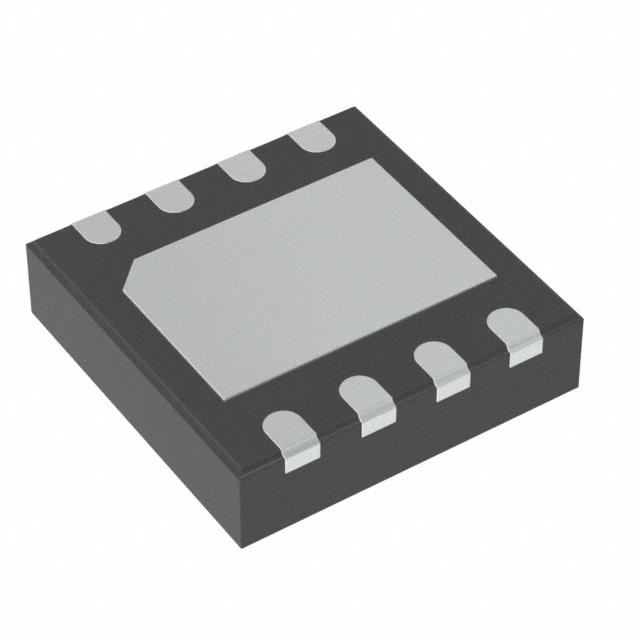
Supplied in leadless PG-TSON-8 package (3.0 mm × 3.0 mm, 0.65 mm pitch) with exposed thermal pad (PAD1) for PCB heat sink connection - supports automated optical inspection (AOI) and enhanced thermal dissipation in space-constrained automotive modules.
| Pin/Terminal | Circuit Role | Design Meaning |
|---|---|---|
| VS | Battery supply input | Accepts 5.5–27 V DC; requires local decoupling capacitor; powers internal LDO and protection circuitry. |
| EN | Enable control input | Pull-down enabled; logic high (>2.0 V) activates normal mode; low enables standby/sleep transitions. |
| GND | Power and signal reference | Common return path for VS, VCC, BUS, and digital I/O; must be low-inductance connection to minimize noise. |
| BUS | LIN physical layer interface | Single-wire bidirectional bus node; includes integrated slave termination and short-circuit protection to VBAT/GND. |
| RxD | Received data output | CMOS-level signal mirroring BUS state in normal mode; pulses low to indicate bus wake-up event in init/standby. |
| TxD | Transmit data input | CMOS-level input with internal pull-up; dominant timeout disables transmitter if held low >1.2 s to prevent bus lockup. |
| NRST | Reset output | Open-drain output pulled low during VCC undervoltage or LDO fault; active for ≥100 ms to reset MCU. |
| VCC | LDO regulated output | 5 V @ 70 mA max; supplies external MCU/peripherals; requires 1 µF ceramic capacitor for stability. |
Key Features
| Feature | Design Value |
|---|---|
| Integrated LDO regulator | 5 V output with 70 mA capability and 1 µF ceramic capacitor stability - eliminates need for external regulator in LIN slave nodes. |
| Dominant time-out protection | Automatic transmitter disable after >1.2 s dominant TxD state - prevents bus contention and ensures network recoverability. |
| Initialization watchdog | Forces transition to sleep mode if microcontroller fails to respond during power-up, wake-up, or reset - enhances system reliability. |
| VCC undervoltage reset | NRST asserts low when VCC drops below 4.5 V (typ), holding for ≥100 ms - provides deterministic MCU reset timing. |
| Thermal and overcurrent protection | Full shutdown on LDO overtemperature or output overload; automatic recovery into init mode after cooling - avoids latch-up failure. |
Applications
| Window Lifter Control | Rain & Light Sensor Module |
|---|---|
|
Use Scenario: Motor-driven glass lift mechanism requiring LIN command reception and position feedback in battery-powered door modules. IC Role / Device Role / Timing Role: LIN transceiver handles protocol-compliant command decoding and status reporting; integrated LDO powers MCU and Hall sensor. Use Value: Ultra-low 20 µA standby current extends vehicle battery life during prolonged parking; BUS short-to-GND tolerance prevents failure from wiring faults. |
Use Scenario: Integrated ambient light and rain detection unit mounted behind windshield, powered continuously from vehicle battery. IC Role / Device Role / Timing Role: Provides LIN interface to body control module while regulating power for photodiode amplifier and MCU. Use Value: ≤16 µA sleep current enables multi-year operation without battery depletion; ±8 kV ESD robustness withstands assembly handling and environmental stress. |
| Sun Roof Control Module | Ambient Lighting System |
|
Use Scenario: Sliding sun roof actuator with obstacle detection, requiring LIN-based open/close commands and status reporting. IC Role / Device Role / Timing Role: Acts as LIN slave node with integrated power regulation for motor driver logic and current sense circuitry. Use Value: PG-TSON-8 thermal pad enables reliable heat dissipation during extended motor activation; BUS wake-up allows instant response to driver LIN requests. |
Use Scenario: Interior LED lighting cluster with dimming control and color tuning, communicating via LIN to central lighting controller. IC Role / Device Role / Timing Role: LIN transceiver manages command reception and status telemetry; 5 V LDO supplies RGB LED driver IC and MCU. Use Value: Stable 5 V output with 1 µF ceramic capacitor simplifies BOM and layout; high EMC immunity prevents flicker or false triggers from nearby RF sources. |
Equivalent & Alternatives
The following parts are listed as comparable options for similar LIN transceiver with integrated regulator applications.
| Alternative Part | Technical Difference | Application Difference | Selection Advice |
|---|---|---|---|
| TLE8457ASJ | Same functionality but in PG-DSO-8 package; no thermal pad; higher thermal resistance (RthJA = 110 K/W vs. 65 K/W). | Suitable for less thermally constrained PCB layouts where AOI is not required and board space permits larger footprint. | Select when cost-sensitive DSO-8 assembly is preferred and thermal load remains below 300 mW. |
| TLE8457BLE | 3.3 V LDO output instead of 5 V; identical pinout, package, and LIN performance; standby current 20 µA typical. | Required when interfacing with 3.3 V MCUs or peripherals without level-shifting; not interchangeable without schematic revision. | Choose only when system architecture mandates 3.3 V supply rail; verify MCU VIO compatibility before substitution. |
Compared with TLE8457ASJ, the TLE8457ALEXUMA2 offers superior thermal performance and AOI support; versus TLE8457BLE, it delivers 5 V for legacy 5 V MCU designs - making it optimal for new compact, thermally demanding automotive LIN slave nodes.
Availability
TLE8457ALEXUMA2 is available at Aetrix Electronics and suitable for window lifter control, rain/light sensor modules, and sun roof actuation systems requiring stable component supply across automotive production lifecycles.
Supply support for TLE8457ALEXUMA2 includes scheduled delivery planning, volume procurement assistance, BOM continuity management, traceable sourcing, and lifecycle availability coordination for OEM customers, industrial embedded developers, connected-device designers, and electronics production programs.
Manufacturer
Infineon Technologies is a German semiconductor manufacturer specializing in power management, automotive ICs, and security solutions, with global manufacturing and qualification infrastructure.
The TLE8457A/B product line targets automotive body electronics LIN slave nodes, integrating transceiver and power regulation to reduce system BOM count and improve reliability in harsh environments.
FAQ
What is the minimum VS supply voltage required for TLE8457ALEXUMA2 to enter normal operation mode?
The device requires VS ≥ 5.5 V to guarantee reliable power-on reset and initiation of the internal LDO. Below this threshold, the VS undervoltage detector holds the device in reset, preventing VCC regulation and LIN communication - critical for cold-cranking scenarios where battery voltage dips transiently.
How does the initialization watchdog affect system startup timing?
The watchdog timer begins counting after power-on, wake-up, or reset; if the microcontroller fails to drive TxD low within ~100 ms (to confirm readiness), the device forces transition to sleep mode. This prevents indefinite init-mode hang and ensures deterministic recovery behavior in safety-critical body control units.
Can TLE8457ALEXUMA2 operate with a 2.2 µF tantalum output capacitor on VCC instead of the specified 1 µF ceramic?
Yes - while the datasheet specifies 1 µF ceramic for stability, a 2.2 µF tantalum capacitor meets phase margin requirements per functional testing. However, tantalum capacitors exhibit higher ESR and lower ripple current rating, so thermal derating and lifetime validation under 125 °C ambient are recommended for long-term automotive use.
Is NRST asserted during BUS short-to-VBAT events?
No - NRST is solely controlled by VCC undervoltage or LDO internal faults. BUS short-to-VBAT triggers overcurrent protection in the driver stage but leaves the LDO and reset circuitry unaffected; NRST remains high unless VCC drops below 4.5 V due to regulator overload or thermal shutdown.
TLE8457ALEXUMA2 Specifications
- Product attributes
- Attribute value
- Manufacturer:
- Infineon Technologies
- Series:
- -
- Package/Case:
- 8-TDFN Exposed Pad
- Packaging:
- Tape & Reel (TR)
- Product Status:
- Active
- Type:
- Transceiver
- Protocol:
- LIN
- Number of Drivers/Receivers:
- 1/1
- Duplex:
- -
- Receiver Hysteresis:
- 200 mV
- Data Rate:
- -
- Voltage - Supply:
- 3V ~ 28V, 5.5V ~ 40V
- Operating Temperature:
- -40°C ~ 150°C
- Grade:
- Automotive
- Qualification:
- AEC-Q100
- Mounting Type:
- Surface Mount, Wettable Flank
- Supplier Device Package:
- PG-TSON-8-1
TLE8457ALEXUMA2 FAQ
1.How can I place an order for TLE8457ALEXUMA2 through Aetrix?
Please submit a Request for Quotation (RFQ) for TLE8457ALEXUMA2 on Aetrix. Our sales agent will provide a competitive quotation and guide you through the order confirmation once you accept the terms.
2.Are the price and stock information for TLE8457ALEXUMA2 reliable?
The price and inventory of TLE8457ALEXUMA2 are updated periodically and may fluctuate due to market conditions. Stock and pricing data are typically refreshed every 24 hours. Quotation validity for TLE8457ALEXUMA2 is usually 5 days.
3.What payment methods are accepted for TLE8457ALEXUMA2?
We accept Wire Transfer, PayPal, Credit Card, Western Union, MoneyGram, and Escrow for TLE8457ALEXUMA2 transactions.
Note: Certain payment methods may incur a processing fee.
4.How is shipping managed for TLE8457ALEXUMA2?
TLE8457ALEXUMA2 orders can be shipped via leading logistics carriers, including DHL, UPS, FedEx, TNT, or Registered Mail.
Once your TLE8457ALEXUMA2 order is processed, you will receive an email with the shipment details and tracking number.
Note: Tracking information may take up to 24 hours to appear. Express delivery typically takes 3–5 business days.
5.How can I obtain technical support or documentation for TLE8457ALEXUMA2?
For technical support, including TLE8457ALEXUMA2 datasheets, pinout diagrams, or application guidance, please contact our engineering support team. They can provide detailed documentation and assistance for your TLE8457ALEXUMA2 requirements.
6.How does Aetrix verify that TLE8457ALEXUMA2 is sourced from the original manufacturer or authorized distributors?
All TLE8457ALEXUMA2 products on Aetrix are procured from qualified distributors and authorized channels. Our dedicated quality assurance team conducts strict verification, including traceability checks and, if necessary, third-party testing. This ensures that TLE8457ALEXUMA2 meets industry standards.
7.What is the process for return or replacement of TLE8457ALEXUMA2?
All TLE8457ALEXUMA2 units undergo pre-shipment inspection (PSI). If there is an issue with TLE8457ALEXUMA2, returns or replacements are accepted under the following conditions:
1.Quantity discrepancies, incorrect items, or visible external defects (such as breakage or corrosion), acknowledged by Aetrix.
2.The issue is reported within 90 days of delivery.
3.The TLE8457ALEXUMA2 part is unused and in its original packaging.
Return procedure for TLE8457ALEXUMA2:
1.Submit a request within 90 days.
2.Obtain a Return Material Authorization (RMA) from Aetrix.
TLE8457ALEXUMA2 Tags

-
ATA6561-GAQW-N
Microchip Technology
-
ATA6561-GBQW-N
Microchip Technology
-
AM26LS32ACDR
Texas Instruments

-
SP485CN-L/TR
MaxLinear, Inc.
-
SP485EN-L/TR
MaxLinear, Inc.
-
SP485EEN-L/TR
MaxLinear, Inc.
-
SP485ECN-L/TR
MaxLinear, Inc.
-
THVD1400DR
Texas Instruments
-
AM26C31IDR
Texas Instruments

-
TLIN1021ADRQ1
Texas Instruments
-
MAX232IDR
Texas Instruments
-
AM26C32IDR
Texas Instruments
Tech Hub

LDO regulator guide covering low dropout voltage, power dissipation, thermal design, PSRR, output noise, capacitor stability, adjustable LDO circuits, LDO vs buck converter and datasheet selection chec…

Conditional Access Module guide covering CAM meaning, CI/CI+ interface, smart card authorization, DVB security workflow, TV and set-top box compatibility, internal electronics, ESD protection, connecto…

Guide to electronic component obsolescence covering EOL risk, PCN/PDN notices, last-time buy planning, replacement options, form-fit-function validation, counterfeit risk and BOM lifecycle management.

18650 battery guide covering lithium-ion cell basics, 3.6V/3.7V voltage, 4.2V charging, mAh and Wh capacity, protected cells, chargers, BMS, series-parallel packs, holders, welding and sourcing checks.…

Hall effect sensor guide covering working principle, linear and digital sensors, Arduino circuits, current sensing, speed detection, automotive applications, A3144 examples, signal filtering and datash…

Product Change Notification guide for electronic components, covering PCN meaning, PCN vs PDN/EOL, common change types, risk levels, form-fit-function review, engineering validation, BOM control, LTB/L…

A practical guide to blend door actuators, covering HVAC function, symptoms, location, AC and heater issues, reset and calibration, replacement cost, electrical diagnosis, compatibility checks, and rep…

Engineering guide to Raspberry Pi alternatives, covering chip-level differences, Orange Pi, ROCK, Jetson, Banana Pi, NanoPi, Compute Module, Pico, GPIO, camera, HAT compatibility, and replacement risks…
Engineering guide to dynamic load response testing for high-current buck converters, covering load step setup, slew rate, Vcore undershoot, overshoot, recovery time, probe location, output capacitors a…
Engineering guide to output capacitor selection for ASIC Vcore rails, covering bulk capacitors, polymer capacitors, MLCC decoupling, DC bias, ESR, ESL, placement, transient response and substitution ri…


