Vishay Semiconductor Opto Division TLUR4400
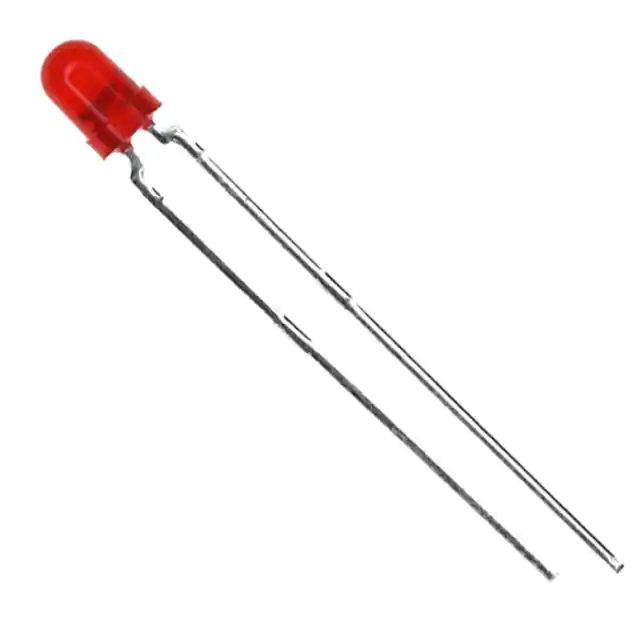
- Part No.:
- TLUR4400
- Manufacturer:
- Vishay Semiconductor Opto Division
- Category:
- LED Indication - Discrete
- Package:
- Radial
- Datasheet:
-
TLUR4400.pdf
- Description:
- LED RED DIFFUSED T-1 T/H
- Quantity:
- Payment:

- Shipping:

Inventory:2,696
Please send an inquiry. Send us your inquiry, and we will respond immediately.
Product details
Overview
TLUR4400 from Vishay Semiconductors is a red visible-light LED in a standard Ø 3 mm tinted diffused T-1 package, with dominant wavelength 630 nm, luminous intensity 4–15 mcd at 10 mA, forward voltage 2–3 V at 20 mA, and ±30° viewing angle. It is rated for DC and pulsed operation up to 20 mA, supports ESD withstand up to 2 kV (JESD22-A114-B), and targets front-panel status indication in industrial control panels.
For engineers reviewing the TLUR4400 datasheet, TLUR4400 pinout, TLUR4400 application, or TLUR4400 equivalent, key selection criteria include its 630 nm red emission, 15 mcd typical intensity at 10 mA, 3 mm through-hole package polarity marking (AS12 = cathode-first tape), thermal resistance of 500 K/W, and compliance with Vishay's standard luminous intensity binning (Group P/Q/R).
Technical Context
The TLUR4400 uses GaAsP-on-GaP semiconductor technology to deliver stable red light output with a peak wavelength of 640 nm and dominant wavelength of 630 nm. Its optical performance is characterized at 10 mA pulse (25 ms), with luminous intensity binned per Group P (4–8 mcd) or Q (6.3–12.5 mcd) - TLUR4400-AS12 ships in single-intensity-group packaging.
Rated for operation from –40 °C to +100 °C ambient, it features 6 V reverse voltage tolerance, 0.5 A surge current capability (tp ≤ 10 μs), and junction-to-ambient thermal resistance of 500 K/W. The device is not intended for reverse-bias continuous operation, though short-term reverse driving is noted as acceptable per datasheet footnote (1).
Key Specifications
| Parameter | Value and Actual Design Meaning |
|---|---|
| Color / Wavelength | Red, dominant wavelength 630 nm (typical), peak 640 nm - ensures consistent human-perceivable red signal under standard viewing conditions. |
| Luminous Intensity | 4–15 mcd at 10 mA - falls in Vishay's Group P or Q binning; enables reliable visibility at low drive current without excessive power draw. |
| Forward Voltage | 2–3 V at 20 mA - compatible with common 3.3 V and 5 V logic-level current-limiting resistor designs. |
| Viewing Angle | ±30° half-intensity - provides wide-enough dispersion for panel-mount indicator use while maintaining directional contrast. |
| Package | Ø 3 mm (T-1) tinted diffused epoxy - industry-standard through-hole form factor with matte finish to reduce glare and improve uniformity. |
| ESD Rating | 2 kV HBM (JESD22-A114-B) - sufficient for manual handling and board-level assembly without special ESD controls beyond standard practice. |
| Absolute Max Current | 20 mA DC, 0.5 A surge (≤10 μs) - defines safe operating envelope for both steady-state and transient LED drive circuits. |
Pinout & Package
TLUR4400 is a two-terminal through-hole LED in a standard Ø 3 mm T-1 package with axial leads. Polarity is marked by cathode lead (shorter lead, flat side on lens) and confirmed by tape orientation: AS12 denotes cathode-first feed direction in reel packaging.
| Pin/Terminal | Circuit Role | Design Meaning |
|---|---|---|
| Anode (A) | Positive terminal | Connected to current source or higher potential; must be biased ≥2 V above cathode to achieve nominal light output. |
| Cathode (K) | Negative terminal | Connected to ground or current sink; identified physically by shorter lead and flat edge on lens; AS12 tape feeds this lead first. |
Key Features
| Feature | Design Value |
|---|---|
| Standardized intensity binning | Shipped in single luminous intensity group (e.g., P or Q) per bag - eliminates intra-bag variation for consistent visual matching across production batches. |
| Tinted diffused lens | Matte red epoxy housing with ±30° viewing angle - delivers uniform, non-glare illumination ideal for operator-facing indicators. |
| DC/pulse operation support | Rated for continuous 20 mA DC or pulsed drive (25 ms test pulse) - enables flexible implementation in both static and multiplexed display systems. |
| Robust thermal rating | Junction temperature limit of 100 °C and RthJA = 500 K/W - allows direct PCB mounting without heatsinking in low-power indicator applications. |
| ESD-hardened construction | 2 kV HBM rating per JESD22-A114-B - reduces risk of field failure during handling and reflow assembly. |
Applications
| Industrial Control Panel Indicators | Consumer Appliance Power/Status Lights |
|---|---|
|
Use Scenario: Front-panel LED on PLC I/O modules indicating input activation or fault condition. IC Role / Device Role / Timing Role: Visual status emitter - no timing or logic function; driven directly from microcontroller GPIO via current-limiting resistor. Use Value: 15 mcd typical intensity at 10 mA ensures clear visibility in ambient lighting up to 500 lux; ±30° viewing angle accommodates angled panel mounting. |
Use Scenario: Power-on and standby status indicator on microwave oven or washing machine control board. IC Role / Device Role / Timing Role: Steady-state light source - operates continuously at 10–20 mA DC; no switching or modulation required. Use Value: 630 nm red emission provides high human eye sensitivity and strong color differentiation against white/grey appliance fascias. |
| Test Equipment Signal Lamps | Medical Device Ready/Active Indicators |
|
Use Scenario: Pass/fail indicator on handheld multimeter or oscilloscope front panel. IC Role / Device Role / Timing Role: Low-duty-cycle pulsed indicator - driven with brief 20 mA pulses synchronized to measurement completion. Use Value: 0.5 A surge rating supports reliable pulsing without derating; 25 ms pulse test condition matches typical UI response timing. |
Use Scenario: "Ready" or "Active" status lamp on infusion pump or patient monitor interface. IC Role / Device Role / Timing Role: Safety-critical visual cue - requires stable output over –40 °C to +100 °C ambient and long-term lumen maintenance. Use Value: 100 °C max junction temperature and –40 °C min operating temperature enable use in sealed, thermally constrained enclosures. |
Equivalent & Alternatives
The following parts are listed as comparable options for similar red LED indicator applications.
| Alternative Part | Technical Difference | Application Difference | Selection Advice |
|---|---|---|---|
| TLUR4401 | Higher luminous intensity range: 4–32 mcd (Group S); otherwise identical optical/electrical specs and package. | Better suited for applications requiring higher brightness in bright ambient or longer viewing distances. | Select TLUR4401 when >15 mcd typical intensity is needed; TLUR4400 remains optimal for power-sensitive or glare-controlled layouts. |
| TLHR4400 | Vishay's high-reliability variant: same 630 nm / 3 mm package but qualified to AEC-Q200 Grade 2 (–40 °C to +105 °C) and enhanced moisture resistance. | Required for automotive interior indicators or industrial equipment deployed in humid environments. | Choose TLHR4400 where extended temperature margin or humidity robustness is mandated; TLUR4400 meets standard industrial requirements. |
Compared with TLUR4400, TLUR4401 offers higher intensity headroom without changing drive circuitry, while TLHR4400 adds automotive-grade reliability at slightly higher cost - neither is pin-compatible in the sense of shared qualification or environmental rating, but all three share identical mechanical footprint and electrical interface.
Availability
TLUR4400 is available at Aetrix Electronics and suitable for industrial control panels, consumer appliance interfaces, and test equipment requiring stable component supply, consistent luminous intensity binning, and RoHS-compliant Ø 3 mm LED sourcing.
Supply support for TLUR4400 includes scheduled delivery planning, volume procurement assistance, BOM continuity management, traceable sourcing, and lifecycle availability coordination for OEM customers, industrial embedded developers, connected-device designers, and electronics production programs.
Manufacturer
Vishay Intertechnology is a global manufacturer of discrete semiconductors and passive components, founded in 1962 and headquartered in Malvern, PA, with design and manufacturing operations worldwide.
The TLUR4400 belongs to Vishay's standard visible LED product line, engineered for cost-effective, high-yield status indication in industrial, consumer, and instrumentation applications - prioritizing consistency, manufacturability, and broad ambient temperature operation.
FAQ
What is the luminous intensity range of the TLUR4400 at 10 mA?
The TLUR4400 has a luminous intensity range of 4–15 mcd at 10 mA, corresponding to Vishay's Group P (4–8 mcd) or Group Q (6.3–12.5 mcd) binning. Each TLUR4400-AS12 reel ships with LEDs from only one intensity group, ensuring batch-to-batch visual consistency without mixing bins.
Does the TLUR4400 support reverse-bias operation?
The TLUR4400 is rated for 6 V reverse voltage and the datasheet notes that short-term reverse driving is acceptable per footnote (1). However, it is not designed for continuous reverse conduction - sustained reverse bias may degrade performance or cause premature failure. TLUR4400 must be operated within its specified forward-bias parameters for reliable service life.
What does the "AS12" suffix mean in TLUR4400-AS12?
The "AS12" suffix indicates tape orientation: cathode lead exits the reel first. This is critical for automated pick-and-place placement and ensures correct polarity alignment during assembly. TLUR4400-AS12 is supplied in 5 × 2000-piece tape-and-reel format, with no bulk or ammopack options available for this variant.
Is the TLUR4400 RoHS compliant and halogen-free?
Yes, the TLUR4400 complies with RoHS Directive 2011/65/EU and is halogen-free per Vishay's material categorization standard (document 99912). Full compliance data, including substance declarations and test reports, is available upon request from Aetrix Electronics or directly via Vishay's compliance portal.
What is the maximum allowable forward current for continuous operation of the TLUR4400?
The absolute maximum DC forward current for the TLUR4400 is 20 mA at Tamb = 25 °C. Derating is required above 25 °C ambient per Fig. 1 in the datasheet; at 70 °C ambient, maximum continuous current drops to approximately 12 mA to maintain junction temperature ≤100 °C. TLUR4400 must not exceed this limit to ensure rated lifetime and lumen maintenance.
TLUR4400 Specifications
- Product attributes
- Attribute value
- Manufacturer:
- Vishay Semiconductor Opto Division
- Series:
- -
- Package/Case:
- Radial
- Packaging:
- Bulk
- Product Status:
- Active
- Color:
- Red
- Configuration:
- Standard
- Lens Color:
- -
- Lens Transparency:
- Diffused
- Millicandela Rating:
- 15mcd
- Lens Style:
- Round with Domed Top
- Lens Size:
- 3mm, T-1
- Voltage - Forward (Vf) (Typ):
- 2V
- Current - Test:
- 10mA
- Viewing Angle:
- 60°
- Mounting Type:
- Through Hole
- Wavelength - Dominant:
- 630nm
- Wavelength - Peak:
- 640nm
- Features:
- -
- Grade:
- -
- Qualification:
- -
- Supplier Device Package:
- T-1
- Size / Dimension:
- -
TLUR4400 FAQ
1.How can I place an order for TLUR4400 through Aetrix?
Please submit a Request for Quotation (RFQ) for TLUR4400 on Aetrix. Our sales agent will provide a competitive quotation and guide you through the order confirmation once you accept the terms.
2.Are the price and stock information for TLUR4400 reliable?
The price and inventory of TLUR4400 are updated periodically and may fluctuate due to market conditions. Stock and pricing data are typically refreshed every 24 hours. Quotation validity for TLUR4400 is usually 5 days.
3.What payment methods are accepted for TLUR4400?
We accept Wire Transfer, PayPal, Credit Card, Western Union, MoneyGram, and Escrow for TLUR4400 transactions.
Note: Certain payment methods may incur a processing fee.
4.How is shipping managed for TLUR4400?
TLUR4400 orders can be shipped via leading logistics carriers, including DHL, UPS, FedEx, TNT, or Registered Mail.
Once your TLUR4400 order is processed, you will receive an email with the shipment details and tracking number.
Note: Tracking information may take up to 24 hours to appear. Express delivery typically takes 3–5 business days.
5.How can I obtain technical support or documentation for TLUR4400?
For technical support, including TLUR4400 datasheets, pinout diagrams, or application guidance, please contact our engineering support team. They can provide detailed documentation and assistance for your TLUR4400 requirements.
6.How does Aetrix verify that TLUR4400 is sourced from the original manufacturer or authorized distributors?
All TLUR4400 products on Aetrix are procured from qualified distributors and authorized channels. Our dedicated quality assurance team conducts strict verification, including traceability checks and, if necessary, third-party testing. This ensures that TLUR4400 meets industry standards.
7.What is the process for return or replacement of TLUR4400?
All TLUR4400 units undergo pre-shipment inspection (PSI). If there is an issue with TLUR4400, returns or replacements are accepted under the following conditions:
1.Quantity discrepancies, incorrect items, or visible external defects (such as breakage or corrosion), acknowledged by Aetrix.
2.The issue is reported within 90 days of delivery.
3.The TLUR4400 part is unused and in its original packaging.
Return procedure for TLUR4400:
1.Submit a request within 90 days.
2.Obtain a Return Material Authorization (RMA) from Aetrix.
TLUR4400 Tags

-
LTST-C281KRKT
Lite-On Inc.
-
150060GS75000
Würth Elektronik

-
150060VS75000
Würth Elektronik

-
150060AS75000
Würth Elektronik

-
150060YS75000
Würth Elektronik

-
150060SS75000
Würth Elektronik

-
150060BS75000
Würth Elektronik
-
151031VS06000
Würth Elektronik
-
151033RS03000
Würth Elektronik
-
150080BS75000
Würth Elektronik
-
150080GS75000
Würth Elektronik
-
150141GS73100
Würth Elektronik
Tech Hub

Comparator circuit design covering voltage thresholds, input limits, open-collector outputs, LM393 wiring, op-amp differences, hysteresis, timing, window detection and practical fault diagnosis.
Schmitt triggers use separate rising and falling thresholds to stabilize slow or noisy signals. This guide covers hysteresis, 74HC14 and 74HCT14 selection, comparator calculations, RC oscillators and p…
Counterfeit components can hide behind convincing markings and passing basic function tests. This engineering reference covers source traceability, external inspection, X-ray, XRF, electrical testing, …
A practical engineering and sourcing framework covering lifecycle verification, lifetime-buy calculations, replacement qualification, supplier checks and counterfeit-risk controls.
TTL and CMOS logic families differ in thresholds, loading, output drive, power and timing. This engineering guide compares 74HC and 74HCT, calculates noise margins and checks 3.3 V/5 V compatibility.
A practical engineering guide to 3.3V and 5V logic compatibility, input thresholds, resistor dividers, translator ICs, MOSFET level shifting, I2C pull-ups, timing limits and power-sequencing risks.
The 74HC595 uses push-pull logic outputs, while the TPIC6B595 uses 50 V open-drain DMOS sinks for higher-power loads. This guide compares timing, current limits, 3.3 V interfacing, load wiring, thermal…
The 74HC595 converts serial data into eight stable parallel outputs. This guide covers pin functions, shift and storage timing, OE and MR behavior, drive-current limits, cascading, voltage compatibilit…
A technical comparison of level-sensitive latches and edge-triggered flip-flops, covering timing windows, setup and hold limits, master–slave operation, time borrowing, race-through, HDL inference and…
A D latch stores one bit while Enable controls when data can pass. This reference covers gate-level operation, truth tables, transparency, setup and hold timing, LE versus OE, common ICs and practical …