Vishay Semiconductor Opto Division TSOP38538
- Part No.:
- TSOP38538
- Manufacturer:
- Vishay Semiconductor Opto Division
- Category:
- Photo Detectors - Remote Receiver
- Package:
- Datasheet:
-
TSOP38538.pdf
- Description:
- SENSOR REMOTE REC 38.0KHZ 45M
- Quantity:
- Payment:

- Shipping:

Inventory:453
Please send an inquiry. Send us your inquiry, and we will respond immediately.
Product details
Overview
TSOP38538 from Vishay Semiconductors is a 38 kHz infrared (IR) receiver module with AGC5 configuration, optimized for very noisy environments and short-burst remote control protocols including XMP, RECS-80, r-map, and RCMM. It features active-low demodulated output, operates from 2.0 V to 5.5 V, draws only 0.35 mA typical supply current, and delivers 26 m transmission range with TSAL6200 emitter under dark ambient conditions.
For engineers reviewing the TSOP38538 datasheet, TSOP38538 pinout, TSOP38538 application, or TSOP38538 equivalent, this device is selected for noise-immune IR reception in consumer electronics remote systems where high AGC performance is required to suppress fluorescent lamp interference, Wi-Fi emissions, and LCD TV noise without sacrificing burst-length compatibility.
Technical Context
The TSOP38538 integrates a PIN photodiode, preamplifier, bandpass filter, demodulator, and AGC control circuit in a single epoxy package with built-in IR filter. Its AGC5 setting provides maximum noise suppression by dynamically reducing sensitivity during strong ambient disturbances while maintaining detection of valid 38 kHz modulated bursts as short as 6 carrier cycles.
It employs envelope-based signal discrimination: valid data must meet strict constraints on burst length (6–20 cycles), inter-burst gap (≥10 cycles), and maximum envelope duty cycle (e.g., ≤25× burst length). Output is open-collector compatible, active-low, and directly interfaces with microcontrollers without external level-shifting.
Key Specifications
| Parameter | Value and Actual Design Meaning |
|---|---|
| Carrier frequency | 38 kHz - precisely tuned center frequency for RCMM, XMP, and RECS-80 protocol compliance |
| Supply voltage range | 2.0 V to 5.5 V - supports direct interface with 3.3 V and 5 V microcontrollers without regulation |
| Supply current (typ.) | 0.35 mA at 3.3 V - enables ultra-low-power remote receiver operation in battery-powered devices |
| Output type | Active-low, open-collector - allows wired-OR logic and flexible pull-up voltage selection |
| Min. irradiance (XMP) | 0.15 mW/m² - ensures reliable decoding of XMP-coded signals under low-signal conditions |
| Directivity (±) | ±45° - provides wide horizontal field-of-view for broad user pointing tolerance |
| Operating temp. | −25 °C to +85 °C - suitable for indoor consumer electronics and industrial remote panels |
Pinout & Package
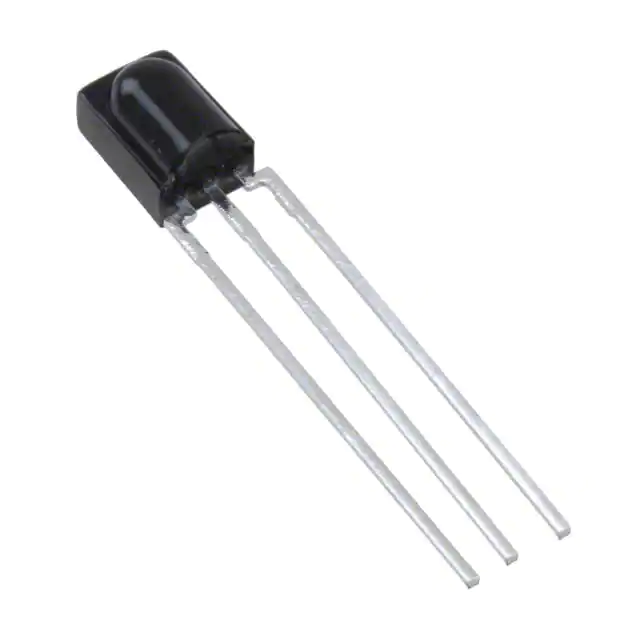
TSOP38538 uses a 3-pin Minicast surface-mount package (5.0 mm × 6.95 mm × 4.8 mm) with gull-wing leads, leaded mounting, and integrated IR filter epoxy encapsulation.
| Pin/Terminal | Circuit Role | Design Meaning |
|---|---|---|
| 1 | OUT | Active-low demodulated output; open-collector, requires external pull-up resistor |
| 2 | GND | Ground reference for analog front-end and digital output stage |
| 3 | VS | Positive supply input; accepts 2.0–5.5 V DC with ripple rejection up to 30 kHz |
Key Features
| Feature | Design Value |
|---|---|
| AGC5 noise immunity | Suppresses interference from fluorescent lamps (both low/high modulation), Wi-Fi, and LCD TV emissions via adaptive gain reduction |
| Short-burst optimization | Validates bursts as short as 6 carrier cycles (158 µs at 38 kHz) and enforces ≥10-cycle inter-burst gaps |
| Integrated IR filtering | Epoxy package blocks visible light and near-IR outside 850–1050 nm, improving ambient light rejection |
| Low-voltage operation | Functional down to 2.0 V supply enables use in single-cell lithium or alkaline battery systems |
| Direct µC interface | Demodulated output eliminates need for external decoder IC or software-based carrier recovery |
Applications
| TV Remote Control | Set-Top Box Remote |
|---|---|
Use Scenario: Consumer handheld remote transmitting RCMM or XMP codes to smart TVs in living rooms with multiple ambient IR sources. IC Role / Device Role / Timing Role: IR signal demodulator and noise filter; recovers clean digital command stream from 38 kHz modulated IR pulses. Use Value: AGC5 prevents false triggers from LED backlight leakage and nearby Wi-Fi routers, ensuring >99.5% command recognition accuracy. |
Use Scenario: Compact remote used with cable/satellite set-top boxes placed near fluorescent lighting and HDMI-connected displays. IC Role / Device Role / Timing Role: High-immunity IR receiver rejecting 20–50 kHz switching noise from power supplies and display drivers. Use Value: Maintains reliable operation at <0.2 mW/m² minimum irradiance even under 10 W/m² ambient IR from fluorescent fixtures. |
| Home Theater System Remote | Smart AC Remote Control |
Use Scenario: Multi-function remote controlling AV receivers, soundbars, and projectors in acoustically treated but electrically noisy home theater rooms. IC Role / Device Role / Timing Role: Burst-length-aware IR front-end that distinguishes valid RECS-80 commands from spurious envelope artifacts. Use Value: Supports 6–20 cycle burst validation window and enforces >25× burst-length inter-gap timing to reject repeated noise bursts. |
Use Scenario: Battery-powered air conditioner remote operating in kitchens with halogen lamps and induction cooktop EMI. IC Role / Device Role / Timing Role: Low-quiescent-current (0.35 mA typ.) IR receiver enabling >1-year battery life with alkaline cells. Use Value: Delivers 26 m line-of-sight range using TSAL6200 emitter while consuming <1.2 mW average power at 3.3 V. |
Equivalent & Alternatives
The following parts are listed as comparable options for similar IR receiver applications.
| Alternative Part | Technical Difference | Application Difference | Selection Advice |
|---|---|---|---|
| TSOP38338 | AGC3 configuration - moderate noise immunity, wider burst-length tolerance (6–35 cycles) | Better suited for mixed-noise environments where some fluorescent lamp interference occurs but not extreme | Select when balancing noise rejection and protocol flexibility across RCMM, XMP, and r-map is prioritized over maximum AGC headroom |
| TSOP38138 | AGC1 configuration - lowest noise immunity, longest supported burst (6–70 cycles) | Optimized for legacy short-burst remotes with minimal ambient noise, e.g., basic DVD players | Choose for cost-sensitive designs where EMI sources are controlled and burst compatibility with older protocols is critical |
Compared with TSOP38338 and TSOP38138, the TSOP38538 provides the highest AGC gain control depth and tightest burst validation window (6–20 cycles), making it the only variant qualified for deployment in environments with co-located high-modulation fluorescent ballasts and dense 2.4 GHz RF activity - at the expense of reduced tolerance for longer or irregular burst formats.
Availability
TSOP38538 is available at Aetrix Electronics and suitable for TV remote controls, set-top box interfaces, home theater system receivers, and smart appliance remotes requiring stable component supply, consistent AGC5 performance, and long-term lifecycle support.
Supply support for TSOP38538 includes scheduled delivery planning, volume procurement assistance, BOM continuity management, traceable sourcing, and lifecycle availability coordination for OEM customers, industrial embedded developers, connected-device designers, and electronics production programs.
Manufacturer
Vishay Intertechnology is a global semiconductor manufacturer specializing in discrete components, sensors, and optoelectronics with emphasis on reliability, precision, and application-specific integration.
The TSOP38538 belongs to Vishay's TSOP38x family of IR receiver modules designed specifically for noise-resilient, short-burst remote control systems in consumer and industrial environments - not automotive-qualified.
FAQ
What is the carrier frequency of the TSOP38538 and why is it important?
The TSOP38538 is tuned to a precise 38 kHz carrier frequency, which matches industry-standard remote control protocols such as RCMM, XMP, RECS-80, and r-map. This frequency ensures optimal signal-to-noise ratio and enables the internal bandpass filter to reject out-of-band interference from ambient light sources and electronic noise. Using TSOP38538 in a 38 kHz system guarantees full compatibility with common IR emitters like the TSAL6200 and avoids false triggering or missed commands.
How does the AGC5 setting in TSOP38538 differ from AGC1 or AGC3 variants?
The AGC5 setting in TSOP38538 provides the highest level of automatic gain control, dynamically attenuating sensitivity during strong ambient IR disturbances - such as those from high-modulation fluorescent lamps or Wi-Fi transceivers - to prevent false outputs. Unlike TSOP38138 (AGC1) or TSOP38338 (AGC3), TSOP38538 enforces stricter burst validation (6–20 cycles) and shorter inter-burst gaps (≥10 cycles), trading protocol flexibility for superior noise immunity in electrically hostile environments.
Can TSOP38538 be used with a 3.3 V microcontroller without level shifting?
Yes, TSOP38538 operates natively from 2.0 V to 5.5 V and features an open-collector active-low output. When powered at 3.3 V, its output can be pulled up to the same 3.3 V rail used by the microcontroller I/O, enabling direct connection without level-shifting circuitry. The output voltage low remains ≤100 mV at 0.5 mA sink current, ensuring solid logic-low recognition by standard CMOS inputs.
What is the minimum irradiance required for TSOP38538 to detect an XMP-coded signal?
The TSOP38538 requires a minimum irradiance of 0.15 mW/m² (typical) to reliably detect XMP-coded signals under standard test conditions (Tamb = 25 °C, dark ambient). This threshold is confirmed in the Vishay datasheet Table "Electrical and Optical Characteristics" and reflects the device's high sensitivity enabled by AGC5's optimized gain profile and low-noise preamplifier design - critical for compact remotes with limited LED drive current.
Is TSOP38538 qualified for automotive applications?
No, TSOP38538 has not been qualified to AEC-Q200 or any automotive-grade specifications. The datasheet explicitly states these components "have not been qualified to automotive specifications" and specifies an operating temperature range of −25 °C to +85 °C - narrower than typical automotive requirements. TSOP38538 is intended for consumer electronics, home appliances, and industrial remote interfaces where extended temperature or vibration qualification is not mandated.
TSOP38538 Specifications
- Product attributes
- Attribute value
- Manufacturer:
- Vishay Semiconductor Opto Division
- Series:
- -
- Packaging:
- Bulk
- Product Status:
- Active
- Sensing Distance:
- 45m
- B.P.F. Center Frequency:
- 38.0kHz
- Voltage - Supply:
- 2.5 V ~ 5.5 V
- Current - Supply:
- 350 µA
- Orientation:
- Side View
- Mounting Type:
- Through Hole
- Operating Temperature:
- -25°C ~ 85°C
TSOP38538 FAQ
1.How can I place an order for TSOP38538 through Aetrix?
Please submit a Request for Quotation (RFQ) for TSOP38538 on Aetrix. Our sales agent will provide a competitive quotation and guide you through the order confirmation once you accept the terms.
2.Are the price and stock information for TSOP38538 reliable?
The price and inventory of TSOP38538 are updated periodically and may fluctuate due to market conditions. Stock and pricing data are typically refreshed every 24 hours. Quotation validity for TSOP38538 is usually 5 days.
3.What payment methods are accepted for TSOP38538?
We accept Wire Transfer, PayPal, Credit Card, Western Union, MoneyGram, and Escrow for TSOP38538 transactions.
Note: Certain payment methods may incur a processing fee.
4.How is shipping managed for TSOP38538?
TSOP38538 orders can be shipped via leading logistics carriers, including DHL, UPS, FedEx, TNT, or Registered Mail.
Once your TSOP38538 order is processed, you will receive an email with the shipment details and tracking number.
Note: Tracking information may take up to 24 hours to appear. Express delivery typically takes 3–5 business days.
5.How can I obtain technical support or documentation for TSOP38538?
For technical support, including TSOP38538 datasheets, pinout diagrams, or application guidance, please contact our engineering support team. They can provide detailed documentation and assistance for your TSOP38538 requirements.
6.How does Aetrix verify that TSOP38538 is sourced from the original manufacturer or authorized distributors?
All TSOP38538 products on Aetrix are procured from qualified distributors and authorized channels. Our dedicated quality assurance team conducts strict verification, including traceability checks and, if necessary, third-party testing. This ensures that TSOP38538 meets industry standards.
7.What is the process for return or replacement of TSOP38538?
All TSOP38538 units undergo pre-shipment inspection (PSI). If there is an issue with TSOP38538, returns or replacements are accepted under the following conditions:
1.Quantity discrepancies, incorrect items, or visible external defects (such as breakage or corrosion), acknowledged by Aetrix.
2.The issue is reported within 90 days of delivery.
3.The TSOP38538 part is unused and in its original packaging.
Return procedure for TSOP38538:
1.Submit a request within 90 days.
2.Obtain a Return Material Authorization (RMA) from Aetrix.
TSOP38538 Tags
-
TSOP38238
Vishay Semiconductor Opto Division
-
VSOP38338
Vishay Semiconductor Opto Division
.jpg)
-
TSOP75436TT
Vishay Semiconductor Opto Division
.jpg)
-
TSOP75238TT
Vishay Semiconductor Opto Division
-
TSSP4038
Vishay Semiconductor Opto Division
-
TSSP4038SS1XB
Vishay Semiconductor Opto Division

-
TSSP6038TT
Vishay Semiconductor Opto Division
.jpg)
-
TSOP75340TT
Vishay Semiconductor Opto Division
.jpg)
-
TSOP75338TT
Vishay Semiconductor Opto Division
-
TSOP57238TT1
Vishay Semiconductor Opto Division
-
TSSP57038ETT1
Vishay Semiconductor Opto Division
_W.jpg)
-
TSOP75338WTT
Vishay Semiconductor Opto Division
Tech Hub
Comparator circuit design covering voltage thresholds, input limits, open-collector outputs, LM393 wiring, op-amp differences, hysteresis, timing, window detection and practical fault diagnosis.
Schmitt triggers use separate rising and falling thresholds to stabilize slow or noisy signals. This guide covers hysteresis, 74HC14 and 74HCT14 selection, comparator calculations, RC oscillators and p…
Counterfeit components can hide behind convincing markings and passing basic function tests. This engineering reference covers source traceability, external inspection, X-ray, XRF, electrical testing, …
A practical engineering and sourcing framework covering lifecycle verification, lifetime-buy calculations, replacement qualification, supplier checks and counterfeit-risk controls.
TTL and CMOS logic families differ in thresholds, loading, output drive, power and timing. This engineering guide compares 74HC and 74HCT, calculates noise margins and checks 3.3 V/5 V compatibility.
A practical engineering guide to 3.3V and 5V logic compatibility, input thresholds, resistor dividers, translator ICs, MOSFET level shifting, I2C pull-ups, timing limits and power-sequencing risks.
The 74HC595 uses push-pull logic outputs, while the TPIC6B595 uses 50 V open-drain DMOS sinks for higher-power loads. This guide compares timing, current limits, 3.3 V interfacing, load wiring, thermal…
The 74HC595 converts serial data into eight stable parallel outputs. This guide covers pin functions, shift and storage timing, OE and MR behavior, drive-current limits, cascading, voltage compatibilit…
A technical comparison of level-sensitive latches and edge-triggered flip-flops, covering timing windows, setup and hold limits, master–slave operation, time borrowing, race-through, HDL inference and…
A D latch stores one bit while Enable controls when data can pass. This reference covers gate-level operation, truth tables, transparency, setup and hold timing, LE versus OE, common ICs and practical …