Vishay Semiconductor Opto Division TSOP39238CZ1
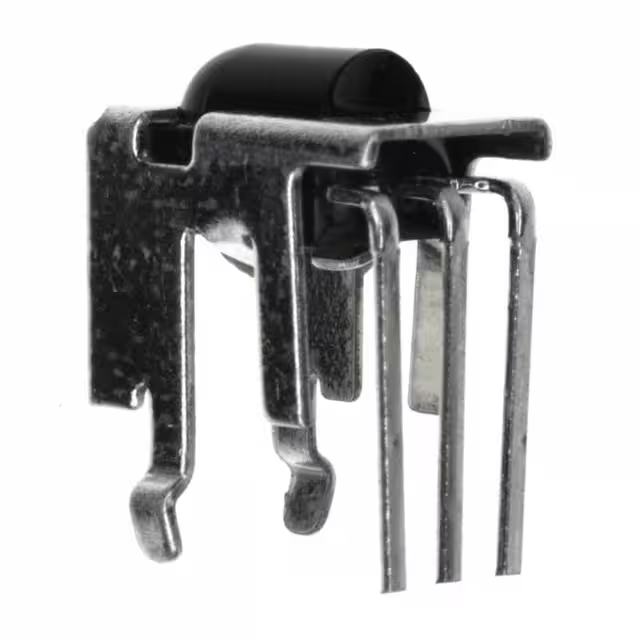
- Part No.:
- TSOP39238CZ1
- Manufacturer:
- Vishay Semiconductor Opto Division
- Category:
- Photo Detectors - Remote Receiver
- Package:
- Datasheet:
-
TSOP39238CZ1.pdf
- Description:
- SENSOR REMOTE REC 38.0KHZ 30M
- Quantity:
- Payment:

- Shipping:

Inventory:3,057
Please send an inquiry. Send us your inquiry, and we will respond immediately.
Product details
Overview
TSOP39238CZ1 from Vishay Semiconductors is a miniaturized infrared (IR) receiver module designed for remote control systems, featuring a 38 kHz carrier frequency bandpass filter, TTL/CMOS-compatible active-low demodulated output, and operation from 2.7 V to 5.5 V supply. It integrates a PIN photodiode and preamplifier in an epoxy IR-filtered package, enabling direct microprocessor decoding without external components.
For engineers reviewing the TSOP39238CZ1 datasheet, TSOP39238CZ1 pinout, TSOP39238CZ1 application, or TSOP39238CZ1 equivalent, key selection criteria include carrier frequency match (38 kHz), ambient light immunity, burst-length tolerance (≥10 cycles), low-power consumption (1.3 mA typ.), and compatibility with NEC, RC5, RC6, Sony, and Sharp IR protocols.
Technical Context
The TSOP39238CZ1 implements a three-stage signal conditioning architecture: a bandpass filter centered at 38 kHz, an integrator stage, and automatic gain control (AGC) to reject noise and ambient light interference. Its design enforces strict timing constraints-burst length ≥10 cycles, minimum gap time of 14 cycles after bursts ≤70 cycles-to distinguish valid IR data from disturbance signals.
It delivers robust performance under DC illumination (up to 10 W/m² ambient irradiance) and suppresses continuous 38 kHz signals, fluorescent lamp emissions (low/high modulation), and tungsten/sunlight interference. Sensitivity is specified at 0.6 mW/m² min irradiance (VS = 3 V, 30–40 kHz range), with ±45° half-angle directivity and 30 m transmission distance using TSAL6200 emitter.
Key Specifications
| Parameter | Value and Actual Design Meaning |
|---|---|
| Carrier Frequency | 38 kHz - precisely matched to common IR remote protocols including NEC and RC5. |
| Supply Voltage Range | 2.7 V to 5.5 V - supports direct interface with 3.3 V and 5 V microcontrollers without level-shifting. |
| Supply Current (typ.) | 1.3 mA at VS = 3.3 V, Ev = 0 - enables battery-powered remote receivers with multi-year operation. |
| Output Logic | Active-low TTL/CMOS compatible - directly drives MCU GPIO pins configured for falling-edge interrupt detection. |
| Minimum Irradiance | 0.6 mW/m² at 38 kHz, VS = 3 V - ensures reliable reception under typical indoor lighting and emitter distances. |
| Operating Temperature | −25 °C to +85 °C - validated for consumer electronics, automotive cabin remotes, and industrial HMI panels. |
| Directivity Half-Angle | ±45° - provides wide-field-of-view user experience while rejecting off-axis ambient IR noise. |
Pinout & Package
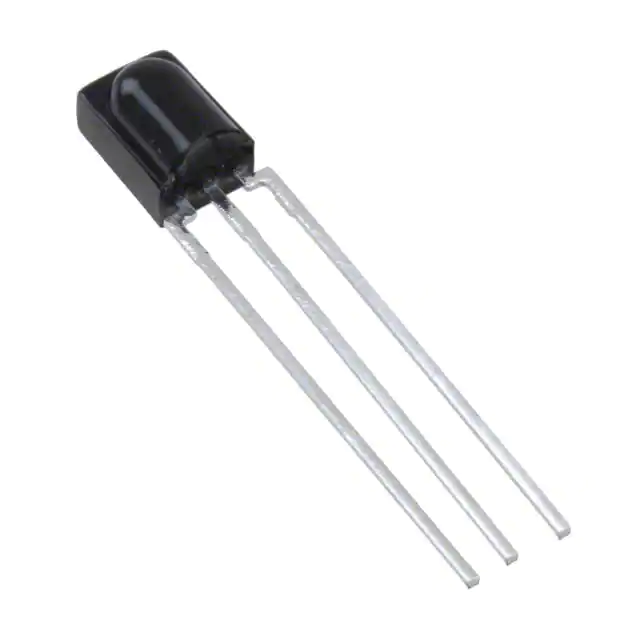
TSOP39238CZ1 uses a 3-pin surface-mount TSOP-3 (miniature plastic package) with IR-transparent epoxy lens and integrated optical bandpass filter. Dimensions conform to standard TSOP-3 footprint (2.5 mm × 2.5 mm × 1.8 mm).
| Pin/Terminal | Circuit Role | Design Meaning |
|---|---|---|
| 1 (OUT) | Digital output signal | Active-low demodulated logic output; sinks up to 10 mA; requires no pull-up for TTL/CMOS loads. |
| 2 (VS) | Positive supply input | Accepts 2.7–5.5 V DC; internal regulation enables stable operation across voltage rail variations. |
| 3 (GND) | Ground reference | Common return path for photodiode bias, amplifier, and output stage; must be low-impedance for noise immunity. |
Key Features
| Feature | Design Value |
|---|---|
| Integrated IR bandpass filter | Centered at 38 kHz with 3 dB bandwidth ~±1.9 kHz - rejects 30/40/56 kHz interference and broadband ambient light. |
| Automatic Gain Control (AGC) | Dynamic sensitivity adjustment over 100:1 irradiance range - maintains consistent pulse detection from dim to bright environments. |
| Burst-length validation | Requires ≥10 carrier cycles per burst - eliminates false triggers from short noise spikes or fluorescent lamp artifacts. |
| Electrical field shielding | Metal-can construction and internal layout - suppresses EMI from switching power supplies and digital noise sources. |
| Lead (Pb)-free & RoHS-compliant | e3 matte tin termination, compliant with RoHS 2002/95/EC and WEEE 2002/96/EC - suitable for global consumer product manufacturing. |
Applications
| TV Remote Control Receiver | Set-Top Box IR Interface |
|---|---|
Use Scenario: Consumer television remote control system operating in living room environments with mixed ambient lighting (LED, incandescent, daylight). IC Role / Device Role / Timing Role: Demodulates 38 kHz modulated IR pulses from handheld remote into clean digital logic signals for SoC GPIO interrupt handling. Use Value: Delivers 30 m line-of-sight range and immunity to 10 W/m² ambient irradiance, eliminating false triggers during daytime use. |
Use Scenario: IR receiver embedded in cable/satellite set-top box front panel, exposed to variable indoor lighting and nearby RF sources. IC Role / Device Role / Timing Role: Provides noise-immune IR signal acquisition with AGC and bandpass filtering to ensure reliable command decoding amid EMI from tuners and power supplies. Use Value: Maintains >99.9% packet reception rate under fluorescent lamp interference (low/high modulation) and 3.3 V MCU supply conditions. |
| Smart Home Hub IR Gateway | Audio System Remote Interface |
Use Scenario: Central IR hub receiving commands from multiple legacy AV remotes (NEC, RC5, Sony) in smart home automation setups. IC Role / Device Role / Timing Role: Acts as universal IR front-end, supporting protocol-agnostic burst timing validation and demodulation before software-based protocol parsing. Use Value: Enables single-hardware support for 7+ IR formats without firmware changes; tolerates burst lengths from 10 to >70 cycles with adaptive gap timing. |
Use Scenario: Integrated amplifier or soundbar with IR remote control functionality in high-noise audio environments (e.g., near Class D amplifiers). IC Role / Device Role / Timing Role: Receives and cleans 38 kHz IR data while rejecting electromagnetic coupling from adjacent power stages via internal shielding and differential signal path design. Use Value: Achieves zero false-trigger events at 10 mA output sink capability, ensuring mute/volume commands execute only on valid remote input. |
Equivalent & Alternatives
The following parts are listed as comparable options for similar IR receiver applications.
| Alternative Part | Technical Difference | Application Difference | Selection Advice |
|---|---|---|---|
| Vishay TSOP34838 | Same 38 kHz carrier, but TO-18 metal can package (larger footprint, higher ESD immunity); 1.2 mA supply current (vs. 1.3 mA). | Preferred for industrial enclosures requiring enhanced mechanical robustness and ESD protection (>8 kV contact); not SMT-compatible. | Select TSOP34838 when board space allows and environmental ruggedness outweighs miniaturization needs. |
| Everlight ITD3838 | 38 kHz receiver with identical TSOP-3 package and pinout; slightly higher min. irradiance (0.7 mW/m² vs. 0.6 mW/m²) and narrower temperature range (−25 °C to +85 °C same). | Valid drop-in alternative where Vishay supply continuity is constrained; identical PCB layout and firmware integration. | Choose ITD3838 for dual-sourcing flexibility without layout or firmware modification. |
Compared with TSOP39238CZ1, TSOP34838 offers superior ESD resilience in metal packaging but sacrifices SMT density, while ITD3838 provides true pin-to-pin replacement with minor sensitivity trade-off-making it ideal for second-source assurance in high-volume consumer production.
Availability
TSOP39238CZ1 is available at Aetrix Electronics and suitable for TV remote controls, set-top boxes, and smart home hubs requiring stable component supply, long-lifecycle support, and RoHS-compliant IR sensing.
Supply support for TSOP39238CZ1 includes scheduled delivery planning, volume procurement assistance, BOM continuity management, traceable sourcing, and lifecycle availability coordination for OEM customers, industrial embedded developers, connected-device designers, and electronics production programs.
Manufacturer
Vishay Semiconductors is a global leader in discrete semiconductors and passive components, specializing in high-reliability optoelectronics, power management, and sensing solutions for industrial and consumer markets.
The TSOP392..CZ1 series was engineered specifically for cost-sensitive, high-volume infrared remote control applications-balancing sensitivity, ambient noise rejection, and miniaturized SMT manufacturability in consumer electronics.
FAQ
What is the carrier frequency of the TSOP39238CZ1?
The TSOP39238CZ1 is tuned to a nominal carrier frequency of 38 kHz, optimized for compatibility with widely adopted IR remote protocols such as NEC, RC5, RC6, Sony, and Sharp. This frequency is fixed by internal bandpass filtering and cannot be adjusted; it is verified per datasheet Document Number 81376 Rev. 1.0.
Does the TSOP39238CZ1 require external components for basic operation?
No, the TSOP39238CZ1 operates autonomously with only a DC supply (2.7–5.5 V) applied to Pin 2 (VS) and ground on Pin 3. The demodulated active-low output on Pin 1 interfaces directly with microcontroller GPIOs-no external capacitors, resistors, or filters are needed per the application circuit in the official Vishay datasheet.
What is the minimum burst length supported by the TSOP39238CZ1?
The TSOP39238CZ1 requires a minimum burst length of 10 carrier cycles to validate an incoming IR signal and suppress noise. Bursts shorter than this threshold are rejected by the internal integrator and AGC circuitry, ensuring immunity to spurious interference like fluorescent lamp flicker or EMI transients.
How does the TSOP39238CZ1 handle ambient light interference?
The TSOP39238CZ1 combines an epoxy IR-pass filter, AGC, and bandpass filtering to maintain reliable operation under up to 10 W/m² of ambient DC irradiance (e.g., sunlight or tungsten lighting). Its spectral response peaks at 950 nm and rejects visible light, while its burst-length validation prevents false triggering from continuous IR sources.
Is the TSOP39238CZ1 RoHS-compliant and lead-free?
Yes, the TSOP39238CZ1 is a lead (Pb)-free component manufactured in accordance with RoHS Directive 2002/95/EC and WEEE Directive 2002/96/EC. It features e3 matte tin terminations and contains no restricted substances above threshold limits, as confirmed in Vishay's compliance documentation.
TSOP39238CZ1 Specifications
- Product attributes
- Attribute value
- Manufacturer:
- Vishay Semiconductor Opto Division
- Series:
- -
- Packaging:
- Bulk
- Product Status:
- Obsolete
- Sensing Distance:
- 30m
- B.P.F. Center Frequency:
- 38.0kHz
- Voltage - Supply:
- 2.7 V ~ 5.5 V
- Current - Supply:
- 1.3 mA
- Orientation:
- Top View
- Mounting Type:
- Through Hole
- Operating Temperature:
- -
TSOP39238CZ1 FAQ
1.How can I place an order for TSOP39238CZ1 through Aetrix?
Please submit a Request for Quotation (RFQ) for TSOP39238CZ1 on Aetrix. Our sales agent will provide a competitive quotation and guide you through the order confirmation once you accept the terms.
2.Are the price and stock information for TSOP39238CZ1 reliable?
The price and inventory of TSOP39238CZ1 are updated periodically and may fluctuate due to market conditions. Stock and pricing data are typically refreshed every 24 hours. Quotation validity for TSOP39238CZ1 is usually 5 days.
3.What payment methods are accepted for TSOP39238CZ1?
We accept Wire Transfer, PayPal, Credit Card, Western Union, MoneyGram, and Escrow for TSOP39238CZ1 transactions.
Note: Certain payment methods may incur a processing fee.
4.How is shipping managed for TSOP39238CZ1?
TSOP39238CZ1 orders can be shipped via leading logistics carriers, including DHL, UPS, FedEx, TNT, or Registered Mail.
Once your TSOP39238CZ1 order is processed, you will receive an email with the shipment details and tracking number.
Note: Tracking information may take up to 24 hours to appear. Express delivery typically takes 3–5 business days.
5.How can I obtain technical support or documentation for TSOP39238CZ1?
For technical support, including TSOP39238CZ1 datasheets, pinout diagrams, or application guidance, please contact our engineering support team. They can provide detailed documentation and assistance for your TSOP39238CZ1 requirements.
6.How does Aetrix verify that TSOP39238CZ1 is sourced from the original manufacturer or authorized distributors?
All TSOP39238CZ1 products on Aetrix are procured from qualified distributors and authorized channels. Our dedicated quality assurance team conducts strict verification, including traceability checks and, if necessary, third-party testing. This ensures that TSOP39238CZ1 meets industry standards.
7.What is the process for return or replacement of TSOP39238CZ1?
All TSOP39238CZ1 units undergo pre-shipment inspection (PSI). If there is an issue with TSOP39238CZ1, returns or replacements are accepted under the following conditions:
1.Quantity discrepancies, incorrect items, or visible external defects (such as breakage or corrosion), acknowledged by Aetrix.
2.The issue is reported within 90 days of delivery.
3.The TSOP39238CZ1 part is unused and in its original packaging.
Return procedure for TSOP39238CZ1:
1.Submit a request within 90 days.
2.Obtain a Return Material Authorization (RMA) from Aetrix.
TSOP39238CZ1 Tags
-
TSOP38238
Vishay Semiconductor Opto Division
-
VSOP38338
Vishay Semiconductor Opto Division
.jpg)
-
TSOP75436TT
Vishay Semiconductor Opto Division
.jpg)
-
TSOP75238TT
Vishay Semiconductor Opto Division
-
TSSP4038
Vishay Semiconductor Opto Division
-
TSSP4038SS1XB
Vishay Semiconductor Opto Division

-
TSSP6038TT
Vishay Semiconductor Opto Division
.jpg)
-
TSOP75340TT
Vishay Semiconductor Opto Division
.jpg)
-
TSOP75338TT
Vishay Semiconductor Opto Division
-
TSOP57238TT1
Vishay Semiconductor Opto Division
-
TSSP57038ETT1
Vishay Semiconductor Opto Division
_W.jpg)
-
TSOP75338WTT
Vishay Semiconductor Opto Division
Tech Hub
Comparator circuit design covering voltage thresholds, input limits, open-collector outputs, LM393 wiring, op-amp differences, hysteresis, timing, window detection and practical fault diagnosis.
Schmitt triggers use separate rising and falling thresholds to stabilize slow or noisy signals. This guide covers hysteresis, 74HC14 and 74HCT14 selection, comparator calculations, RC oscillators and p…
Counterfeit components can hide behind convincing markings and passing basic function tests. This engineering reference covers source traceability, external inspection, X-ray, XRF, electrical testing, …
A practical engineering and sourcing framework covering lifecycle verification, lifetime-buy calculations, replacement qualification, supplier checks and counterfeit-risk controls.
TTL and CMOS logic families differ in thresholds, loading, output drive, power and timing. This engineering guide compares 74HC and 74HCT, calculates noise margins and checks 3.3 V/5 V compatibility.
A practical engineering guide to 3.3V and 5V logic compatibility, input thresholds, resistor dividers, translator ICs, MOSFET level shifting, I2C pull-ups, timing limits and power-sequencing risks.
The 74HC595 uses push-pull logic outputs, while the TPIC6B595 uses 50 V open-drain DMOS sinks for higher-power loads. This guide compares timing, current limits, 3.3 V interfacing, load wiring, thermal…
The 74HC595 converts serial data into eight stable parallel outputs. This guide covers pin functions, shift and storage timing, OE and MR behavior, drive-current limits, cascading, voltage compatibilit…
A technical comparison of level-sensitive latches and edge-triggered flip-flops, covering timing windows, setup and hold limits, master–slave operation, time borrowing, race-through, HDL inference and…
A D latch stores one bit while Enable controls when data can pass. This reference covers gate-level operation, truth tables, transparency, setup and hold timing, LE versus OE, common ICs and practical …