Vishay Semiconductor Opto Division TSOP58238
- Part No.:
- TSOP58238
- Manufacturer:
- Vishay Semiconductor Opto Division
- Category:
- Photo Detectors - Remote Receiver
- Package:
- Datasheet:
-
TSOP58238.pdf
- Description:
- SENSOR REMOTE REC 38.0KHZ 40M
- Quantity:
- Payment:

- Shipping:

Inventory:497
Please send an inquiry. Send us your inquiry, and we will respond immediately.
Product details
Overview
TSOP58238 from Vishay Semiconductors is a 38 kHz infrared (IR) receiver module optimized for long-burst remote control systems, featuring AGC4 configuration for enhanced noise immunity against fluorescent lamps, Wi-Fi, and LCD TV interference. It integrates a PIN photodiode and preamplifier in a leaded Minicast epoxy package with built-in IR filter, operates from 2.0–5.5 V, draws ≤0.45 mA supply current, and delivers active-low demodulated output directly compatible with microcontrollers.
For engineers reviewing the TSOP58238 datasheet, TSOP58238 pinout, TSOP58238 application, or TSOP58238 equivalent, this device is selected for NEC, RC5, RC6, Sharp, and Sejin 4PPM protocols in consumer remote control designs where ambient light rejection, burst-length tolerance (>10 cycles), and stable sensitivity down to 0.3 mW/m² are critical.
Technical Context
The TSOP58238 implements a band-pass filter centered at 38 kHz with ±5% frequency tolerance and AGC4 gain control, enabling reliable detection of long-burst IR signals while suppressing continuous or modulated ambient interference. Its internal control circuit enforces strict burst timing constraints: minimum gap time ≥10 cycles and >3× burst length for extended data streams.
It features optical directivity of ±45° half-angle, spectral peak sensitivity at 950 nm, and maintains functional operation across –25°C to +85°C ambient temperature. Output pulse width conforms to tpi ± 4/f₀ (f₀ = 38 kHz), ensuring compatibility with standard IR protocol timing envelopes.
Key Specifications
| Parameter | Value and Actual Design Meaning |
|---|---|
| Carrier frequency | 38 kHz - precisely matched to NEC, Sharp, and Sejin 4PPM remote protocols |
| Supply voltage range | 2.0 V to 5.5 V - supports direct interface with 3.3 V and 5 V microcontrollers without level shifting |
| Supply current (typ.) | 0.35 mA at 3.3 V - enables low-power remote receiver designs with battery life extension |
| Minimum irradiance (NEC) | 0.3 mW/m² - ensures reliable reception under typical indoor lighting conditions |
| Output logic polarity | Active-low - simplifies MCU GPIO interrupt handling with falling-edge triggering |
| Transmission distance | 18 m with TSAL6200 emitter at 50 mA - meets consumer remote range requirements |
| Operating temperature | –25°C to +85°C - suitable for indoor consumer electronics without thermal derating |
Pinout & Package
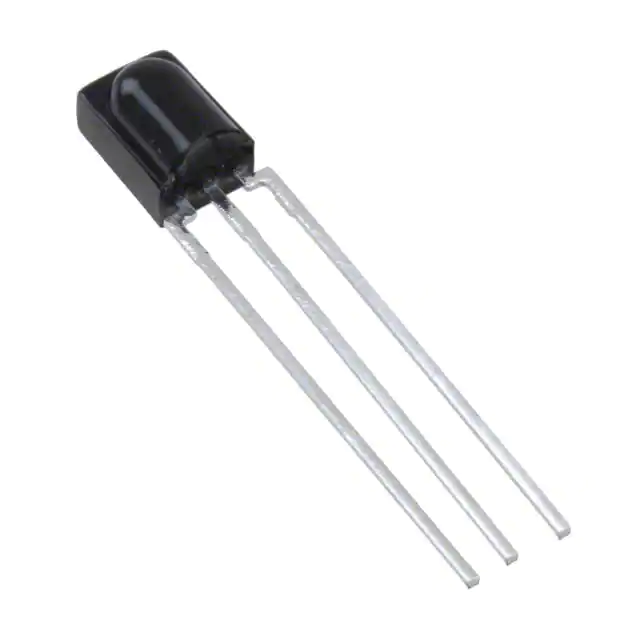
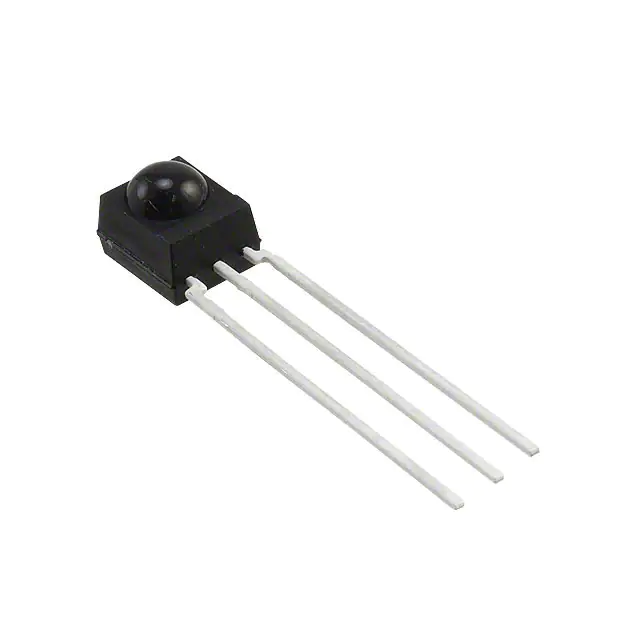
TSOP58238 uses a 3-pin Minicast through-hole package (5.0 mm × 6.95 mm × 4.8 mm) with leaded mounting and integrated IR-filtering epoxy encapsulation.
| Pin/Terminal | Circuit Role | Design Meaning |
|---|---|---|
| 1 | OUT | Demodulated active-low output signal - directly drives MCU GPIO or interrupt pin |
| 2 | GND | Analog ground reference - must be connected to system ground with low-impedance path |
| 3 | VS | Positive supply input - requires local 100 nF ceramic decoupling capacitor per datasheet recommendation |
Key Features
| Feature | Design Value |
|---|---|
| AGC4 configuration | Optimized for long-burst codes (e.g., NEC, RC6) with superior suppression of fluorescent lamp noise patterns shown in Fig. 14/15 |
| Integrated IR filter | Blocks visible and near-IR ambient light outside 850–1050 nm band, reducing false triggers from sunlight or incandescent sources |
| Burst timing compliance | Enforces ≥10-cycle minimum burst and >3× burst-length gap timing - ensures robust decoding of RC5/RC6 frame structures |
| DC supply ripple immunity | Maintains sensitivity up to 30 kHz AC disturbance on VS (Fig. 7), eliminating need for ultra-clean LDO in cost-sensitive remotes |
| Horizontal directivity | ±45° half-angle (Fig. 11) - provides wide-angle user coverage while rejecting off-axis interference sources |
Applications
| Consumer Remote Control | Home Theater System |
|---|---|
|
Use Scenario: Handheld IR remote transmitting NEC or Sharp protocol commands to TVs, set-top boxes, or soundbars. IC Role / Device Role / Timing Role: Demodulates 38 kHz carrier, extracts envelope, and outputs clean digital pulses synchronized to protocol burst timing. Use Value: AGC4 setting ensures reliable command recognition even under LED-backlit TV glare and 2.4 GHz Wi-Fi co-location. |
Use Scenario: IR receiver embedded in AV receiver or projector for multi-device control via universal remote. IC Role / Device Role / Timing Role: Acts as front-end signal conditioner, rejecting ambient IR from room lighting while preserving RC6 frame integrity. Use Value: ±45° directivity and 0.3 mW/m² sensitivity enable consistent performance across wide viewing angles and varying ambient irradiance. |
| Smart Appliance Interface | Audio Equipment Remote |
|
Use Scenario: IR receiver in smart air conditioner or washing machine control panel receiving Sejin 4PPM or Mitsubishi codes. IC Role / Device Role / Timing Role: Provides protocol-agnostic envelope detection with burst-length validation before MCU software decoding. Use Value: Supports >10-cycle bursts and gap timing >3× burst length - matches Sejin 4PPM's extended preamble structure. |
Use Scenario: Compact IR receiver in Bluetooth speaker or headphone charging dock accepting Sony or RCA 56 kHz commands. IC Role / Device Role / Timing Role: Delivers active-low output compatible with low-voltage MCU I/O, minimizing external component count. Use Value: 2.0–5.5 V operation and 0.35 mA typical supply current allow direct integration into battery-powered audio accessories. |
Equivalent & Alternatives
The following parts are listed as comparable options for similar IR receiver applications.
| Alternative Part | Technical Difference | Application Difference | Selection Advice |
|---|---|---|---|
| TSOP58438 | Same AGC4 configuration and 38 kHz center frequency, but rated for higher maximum envelope duty cycle in long-burst mode | Preferred for RC6 and r-step protocols requiring >72-cycle burst gaps; slightly higher cost | Select TSOP58438 when designing for RC6-compliant systems needing extended burst tolerance |
| TSOP38238 | Legacy 38 kHz receiver with AGC2, lower noise immunity, no explicit support for RC6 or Sejin 4PPM in datasheet | Limited to basic NEC/Sony protocols; lacks suppression for complex fluorescent lamp modulation (Fig. 15) | Choose TSOP38238 only for cost-sensitive legacy NEC-only remotes without Wi-Fi or modern display interference |
Compared with TSOP58238, TSOP58438 offers improved burst-gap handling for RC6, while TSOP38238 sacrifices noise immunity and protocol breadth for lower unit cost - making TSOP58238 the balanced choice for multi-protocol, interference-prone environments.
Availability
TSOP58238 is available at Aetrix Electronics and suitable for consumer remote control, home theater system integration, and smart appliance interface applications requiring stable component supply and long-term manufacturing continuity.
Supply support for TSOP58238 includes scheduled delivery planning, volume procurement assistance, BOM continuity management, traceable sourcing, and lifecycle availability coordination for OEM customers, industrial embedded developers, connected-device designers, and electronics production programs.
Manufacturer
Vishay Intertechnology is a global semiconductor manufacturer specializing in discrete components, sensors, and optoelectronics with emphasis on reliability and application-specific optimization.
The TSOP582xx series was designed specifically for high-immunity, long-burst infrared remote control systems in consumer electronics, targeting NEC, RC5, RC6, Sharp, and Sejin protocols under real-world ambient interference.
FAQ
What is the carrier frequency and AGC setting of the TSOP58238?
The TSOP58238 is configured for 38 kHz carrier frequency with AGC4 gain control. This setting optimizes noise suppression for long-burst protocols like NEC and RC6 while maintaining compatibility with Sharp and Sejin 4PPM codes. AGC4 provides stronger rejection of fluorescent lamp and Wi-Fi interference compared to lower AGC variants, as confirmed in the Vishay datasheet section "SUITABLE DATA FORMAT" and Fig. 6–7.
Does the TSOP58238 require external components for basic operation?
Yes - the TSOP58238 requires a 100 nF ceramic decoupling capacitor between VS (pin 3) and GND (pin 2), as specified in the Application Circuit diagram (page 2). No pull-up or series resistor is needed on the OUT (pin 1) line due to its active-low open-collector-like output stage, which interfaces directly with 3.3 V or 5 V MCU GPIO pins.
Is the TSOP58238 qualified for automotive applications?
No - the TSOP58238 is explicitly stated in the Vishay datasheet to "have not been qualified to automotive specifications." Its operating temperature range is –25°C to +85°C and it lacks AEC-Q200 stress testing or automotive-grade qualification. It is intended solely for consumer and industrial indoor remote control use.
What is the minimum detectable irradiance for NEC code with the TSOP58238?
The TSOP58238 has a minimum irradiance threshold of 0.3 mW/m² for NEC code, as specified in the "ELECTRICAL AND OPTICAL CHARACTERISTICS" table (page 3). This value is measured under dark ambient conditions with Tamb = 25°C and confirms reliable reception at typical indoor distances using standard IR emitters like TSAL6200.
How does the TSOP58238 handle ambient light interference from fluorescent lamps?
The TSOP58238 suppresses both mild and complex fluorescent lamp IR disturbances - including those shown in Fig. 14 (low-modulation) and Fig. 15 (high-modulation) of the datasheet - via its AGC4-controlled band-pass architecture and burst-length validation logic. This ensures no spurious output pulses occur during lamp flicker, unlike lower-AGC receivers such as TSOP38238.
TSOP58238 Specifications
- Product attributes
- Attribute value
- Manufacturer:
- Vishay Semiconductor Opto Division
- Series:
- -
- Packaging:
- Bulk
- Product Status:
- Active
- Sensing Distance:
- 40m
- B.P.F. Center Frequency:
- 38.0kHz
- Voltage - Supply:
- 2.5 V ~ 5.5 V
- Current - Supply:
- 700 µA
- Orientation:
- Side View
- Mounting Type:
- Through Hole
- Operating Temperature:
- -25°C ~ 85°C
TSOP58238 FAQ
1.How can I place an order for TSOP58238 through Aetrix?
Please submit a Request for Quotation (RFQ) for TSOP58238 on Aetrix. Our sales agent will provide a competitive quotation and guide you through the order confirmation once you accept the terms.
2.Are the price and stock information for TSOP58238 reliable?
The price and inventory of TSOP58238 are updated periodically and may fluctuate due to market conditions. Stock and pricing data are typically refreshed every 24 hours. Quotation validity for TSOP58238 is usually 5 days.
3.What payment methods are accepted for TSOP58238?
We accept Wire Transfer, PayPal, Credit Card, Western Union, MoneyGram, and Escrow for TSOP58238 transactions.
Note: Certain payment methods may incur a processing fee.
4.How is shipping managed for TSOP58238?
TSOP58238 orders can be shipped via leading logistics carriers, including DHL, UPS, FedEx, TNT, or Registered Mail.
Once your TSOP58238 order is processed, you will receive an email with the shipment details and tracking number.
Note: Tracking information may take up to 24 hours to appear. Express delivery typically takes 3–5 business days.
5.How can I obtain technical support or documentation for TSOP58238?
For technical support, including TSOP58238 datasheets, pinout diagrams, or application guidance, please contact our engineering support team. They can provide detailed documentation and assistance for your TSOP58238 requirements.
6.How does Aetrix verify that TSOP58238 is sourced from the original manufacturer or authorized distributors?
All TSOP58238 products on Aetrix are procured from qualified distributors and authorized channels. Our dedicated quality assurance team conducts strict verification, including traceability checks and, if necessary, third-party testing. This ensures that TSOP58238 meets industry standards.
7.What is the process for return or replacement of TSOP58238?
All TSOP58238 units undergo pre-shipment inspection (PSI). If there is an issue with TSOP58238, returns or replacements are accepted under the following conditions:
1.Quantity discrepancies, incorrect items, or visible external defects (such as breakage or corrosion), acknowledged by Aetrix.
2.The issue is reported within 90 days of delivery.
3.The TSOP58238 part is unused and in its original packaging.
Return procedure for TSOP58238:
1.Submit a request within 90 days.
2.Obtain a Return Material Authorization (RMA) from Aetrix.
TSOP58238 Tags
-
TSOP38238
Vishay Semiconductor Opto Division
-
VSOP38338
Vishay Semiconductor Opto Division
.jpg)
-
TSOP75436TT
Vishay Semiconductor Opto Division
.jpg)
-
TSOP75238TT
Vishay Semiconductor Opto Division
-
TSSP4038
Vishay Semiconductor Opto Division
-
TSSP4038SS1XB
Vishay Semiconductor Opto Division

-
TSSP6038TT
Vishay Semiconductor Opto Division
.jpg)
-
TSOP75340TT
Vishay Semiconductor Opto Division
.jpg)
-
TSOP75338TT
Vishay Semiconductor Opto Division
-
TSOP57238TT1
Vishay Semiconductor Opto Division
-
TSSP57038ETT1
Vishay Semiconductor Opto Division
_W.jpg)
-
TSOP75338WTT
Vishay Semiconductor Opto Division
Tech Hub
Comparator circuit design covering voltage thresholds, input limits, open-collector outputs, LM393 wiring, op-amp differences, hysteresis, timing, window detection and practical fault diagnosis.
Schmitt triggers use separate rising and falling thresholds to stabilize slow or noisy signals. This guide covers hysteresis, 74HC14 and 74HCT14 selection, comparator calculations, RC oscillators and p…
Counterfeit components can hide behind convincing markings and passing basic function tests. This engineering reference covers source traceability, external inspection, X-ray, XRF, electrical testing, …
A practical engineering and sourcing framework covering lifecycle verification, lifetime-buy calculations, replacement qualification, supplier checks and counterfeit-risk controls.
TTL and CMOS logic families differ in thresholds, loading, output drive, power and timing. This engineering guide compares 74HC and 74HCT, calculates noise margins and checks 3.3 V/5 V compatibility.
A practical engineering guide to 3.3V and 5V logic compatibility, input thresholds, resistor dividers, translator ICs, MOSFET level shifting, I2C pull-ups, timing limits and power-sequencing risks.
The 74HC595 uses push-pull logic outputs, while the TPIC6B595 uses 50 V open-drain DMOS sinks for higher-power loads. This guide compares timing, current limits, 3.3 V interfacing, load wiring, thermal…
The 74HC595 converts serial data into eight stable parallel outputs. This guide covers pin functions, shift and storage timing, OE and MR behavior, drive-current limits, cascading, voltage compatibilit…
A technical comparison of level-sensitive latches and edge-triggered flip-flops, covering timing windows, setup and hold limits, master–slave operation, time borrowing, race-through, HDL inference and…
A D latch stores one bit while Enable controls when data can pass. This reference covers gate-level operation, truth tables, transparency, setup and hold timing, LE versus OE, common ICs and practical …