Vishay Semiconductor Opto Division VEMT3700-GS18
- Part No.:
- VEMT3700-GS18
- Manufacturer:
- Vishay Semiconductor Opto Division
- Category:
- Phototransistors
- Package:
- 2-SMD, J-Lead
- Datasheet:
-
VEMT3700-GS18.pdf
- Description:
- PHOTO TRANS. SMD PLCC2
- Quantity:
- Payment:

- Shipping:

Inventory:1,424
Please send an inquiry. Send us your inquiry, and we will respond immediately.
Product details
Overview
VEMT3700-GS18 from Vishay Semiconductors is a high-speed silicon NPN epitaxial planar phototransistor in a PLCC-2 surface-mount package, rated for 70 VCEO, 0.5 mA collector light current at 950 nm, ±60° half-sensitivity angle, and 6 µs rise/fall time with 1 kΩ load. It operates from −40 °C to +100 °C and is used in photo interrupters and position sensors where visible-to-NIR detection with fast response is required.
For engineers reviewing the VEMT3700-GS18 datasheet, VEMT3700-GS18 pinout, VEMT3700-GS18 application, or VEMT3700-GS18 equivalent, key selection criteria include radiant sensitivity (450–1080 nm spectral range), thermal resistance (400 K/W), MSL 3 floor life (168 h), and compatibility with VSML3710 IR emitters in compact optical sensing designs.
Technical Context
The VEMT3700-GS18 functions as a light-controlled NPN switch with emitter-grounded configuration and collector output. Its epitaxial planar structure enables fast carrier transport, yielding 2 µs response under 100 Ω load and 180 kHz cutoff frequency-critical for encoder and counter timing accuracy.
It features a defined angular sensitivity profile (±60° half-power angle) and peak spectral response at 850 nm, optimized for pairing with standard 950 nm IR emitters. The PLCC-2 package includes a notch marking the collector terminal and supports lead-free reflow per J-STD-020.
Key Specifications
| Parameter | Value and Actual Design Meaning |
|---|---|
| VCEO | 70 V - Maximum collector-emitter voltage before breakdown; defines safe operating voltage headroom in open-collector switching circuits. |
| Ica | 0.5 mA typical - Collector light current under 1 mW/cm² irradiance at 950 nm; sets minimum detectable signal level for reliable logic-level output. |
| ϕ | ±60° - Half-sensitivity viewing angle; determines mechanical alignment tolerance in slotted optocoupler or reflective sensor assemblies. |
| tr/tf | 6 µs (1 kΩ), 2 µs (100 Ω) - Rise/fall times define maximum pulse repetition rate support; critical for >100 kHz encoder line counts. |
| λ0.1 | 450–1080 nm - Spectral bandwidth enabling operation under ambient visible light or dedicated NIR illumination without filtering. |
| RthJA | 400 K/W - Junction-to-ambient thermal resistance on 4 mm × 4 mm PCB pad; informs derating requirements above 25 °C ambient. |
| VCEsat | 0.3 V max - Saturation voltage at IC = 0.1 mA; ensures low power loss and clean TTL/CMOS-compatible low-state output. |
Pinout & Package
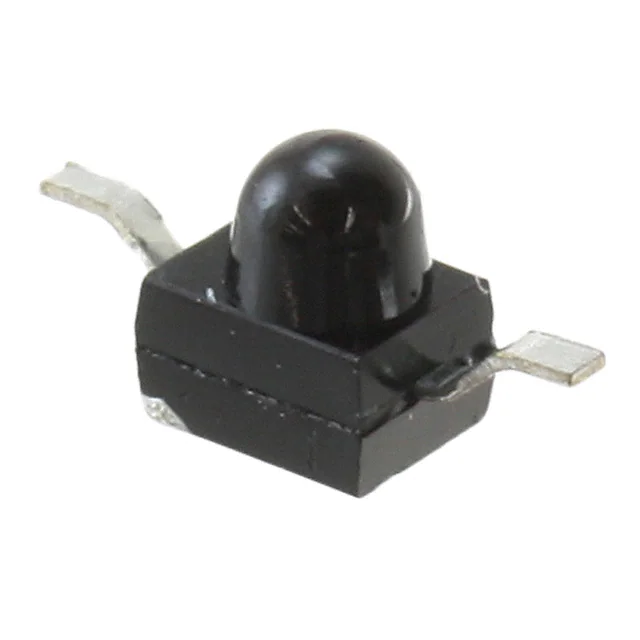
Package: PLCC-2 (Plastic Leaded Chip Carrier, 2-terminal), dimensions 3.5 mm × 2.8 mm × 1.75 mm, notch-marked collector lead, surface-mount compatible with lead-free reflow.
| Pin/Terminal | Circuit Role | Design Meaning |
|---|---|---|
| Collector | Output node, NPN drain | Marked by package notch; connects to pull-up resistor or logic input; carries photogenerated current to external load. |
| Emitter | Reference node, NPN source | Internally grounded in standard configuration; provides return path for photocurrent; must be tied to system ground for proper biasing. |
Key Features
| Feature | Design Value |
|---|---|
| High radiant sensitivity | 0.5 mA output at 1 mW/cm² irradiance enables low-power emitter drive and reduced EMI in battery-operated sensors. |
| Fast response time | 2 µs with 100 Ω load supports real-time position feedback in motor commutation and high-speed counting applications. |
| Visible/NIR spectral range | 450–1080 nm coverage allows use with LED, incandescent, or IR sources without optical filtering in multi-source environments. |
| MSL 3 moisture sensitivity | 168 h floor life at ≤30 °C / ≤60 % RH permits standard SMT handling without baking unless exposed beyond limit. |
| PLCC-2 mechanical compatibility | Matched footprint and optical axis alignment with VSML3710 emitter simplifies dual-component optical module layout and assembly. |
Applications
| Photo Interrupters | Miniature Switches |
|---|---|
Use Scenario: Slotted optocoupler detecting object presence/absence in vending machines or printer paper-path monitoring. IC Role / Device Role / Timing Role: Light-controlled switch providing digital ON/OFF output synchronized to mechanical motion. Use Value: ±60° angular tolerance accommodates minor misalignment during assembly; 6 µs response ensures accurate edge detection at conveyor speeds up to 2 m/s. | Use Scenario: Non-contact tactile feedback in medical device control panels or industrial HMI buttons. IC Role / Device Role / Timing Role: Reflective-mode proximity detector triggering microcontroller GPIO interrupts. Use Value: 850 nm peak sensitivity matches common IR LEDs; 0.3 V VCEsat guarantees noise-immune logic-low state under varying supply conditions. |
| Encoders | Position Sensors |
Use Scenario: Incremental rotary encoder disk with alternating opaque/transparent segments on motor shafts. IC Role / Device Role / Timing Role: High-speed edge detector converting optical transitions into quadrature A/B pulses. Use Value: 180 kHz cutoff frequency supports >100 kpps line counts; 2 µs response prevents pulse distortion at 10,000 RPM. | Use Scenario: Linear position tracking in automated test equipment using calibrated reflective tape patterns. IC Role / Device Role / Timing Role: Analog light-current transducer feeding ADC or comparator for sub-millimeter resolution. Use Value: 0.25–0.5 mA Ica range provides sufficient dynamic span for 10-bit ADC digitization without amplification. |
Equivalent & Alternatives
The following parts are listed as comparable options for similar phototransistor applications.
| Alternative Part | Technical Difference | Application Difference | Selection Advice |
|---|---|---|---|
| VEMT3705 | Direct replacement per Vishay EOL notice; identical PLCC-2 package, ±60° angle, 450–1080 nm range, but improved Ica = 0.6 mA typ. at 950 nm. | Same photo interrupter, encoder, and position sensor use cases; higher output current improves SNR in low-irradiance environments. | Select VEMT3705 for new designs requiring extended lifetime beyond February 2025 and marginally higher sensitivity. |
| TEFT4300 | TO-92 through-hole package; 0.4 mA Ica; ±35° angle; slower 12 µs response; same 70 VCEO and −40 to +100 °C rating. | Suitable for prototyping or legacy through-hole boards; narrower viewing angle demands tighter mechanical alignment. | Choose TEFT4300 only when PLCC-2 SMT is unavailable or board redesign is impractical. |
Compared with VEMT3705, the VEMT3700-GS18 offers identical form factor and optical performance but lower light current and end-of-life status; versus TEFT4300, it delivers superior speed, wider angular tolerance, and surface-mount compatibility-making it preferable for space-constrained, high-reliability optical sensing.
Availability
VEMT3700-GS18 is available at Aetrix Electronics and suitable for photo interrupters, encoders, miniature switches, and position sensors requiring stable component supply during the transition to VEMT3705 before its February 2025 end-of-life date.
Supply support for VEMT3700-GS18 includes scheduled delivery planning, volume procurement assistance, BOM continuity management, traceable sourcing, and lifecycle availability coordination for OEM customers, industrial embedded developers, connected-device designers, and electronics production programs.
Manufacturer
Vishay Intertechnology is a global manufacturer of discrete semiconductors and passive components, specializing in high-reliability optoelectronics, power MOSFETs, and precision resistors.
The VEMT series targets compact, high-speed optical sensing applications-including industrial automation, consumer electronics, and medical devices-where miniaturized PLCC-2 packaging and NIR responsiveness are essential.
FAQ
What is the maximum operating temperature for the VEMT3700-GS18?
The VEMT3700-GS18 has an operating temperature range of −40 °C to +100 °C, verified per its absolute maximum ratings table. This rating applies to ambient conditions with proper PCB thermal relief; junction temperature must not exceed 100 °C, requiring derating above 25 °C ambient based on its 400 K/W thermal resistance. The VEMT3700-GS18 maintains specified Ica and response time across this full range.
Is the VEMT3700-GS18 RoHS-compliant and lead-free?
Yes, the VEMT3700-GS18 is lead (Pb)-free and compliant with RoHS Directive 2011/65/EU, as confirmed in its datasheet revision 1.7. It supports lead-free reflow soldering per J-STD-020, with peak temperature up to 260 °C. The device uses matte tin plating and meets Vishay's material categorization standards per document 99912.
What is the spectral response range of the VEMT3700-GS18?
The VEMT3700-GS18 has a spectral bandwidth of λ0.1 = 450 nm to 1080 nm, meaning it responds to light intensities down to 10% of peak sensitivity across that range. Its peak sensitivity occurs at 850 nm, and it delivers 0.5 mA collector light current at 950 nm under 1 mW/cm² irradiance. This broad range supports both visible-light ambient sensing and dedicated NIR emitter applications.
How does the VEMT3700-GS18 differ from the VEMT3705 alternative?
The VEMT3705 is Vishay's designated direct replacement for the VEMT3700-GS18, sharing identical PLCC-2 packaging, ±60° half-sensitivity angle, and 450–1080 nm spectral range. Key differences include a higher typical collector light current (0.6 mA vs. 0.5 mA at 950 nm) and continued production beyond February 2025. The VEMT3700-GS18 remains functional but is end-of-life; no PCB changes are needed when migrating to VEMT3705.
What is the recommended load resistance for achieving 2 µs response time with the VEMT3700-GS18?
A 100 Ω load resistance is required to achieve the 2 µs rise/fall time specified in the VEMT3700-GS18 datasheet under VS = 5 V, IC = 1 mA, and λ = 950 nm conditions. Using a 1 kΩ load increases response time to 6 µs. Designers must balance speed against output voltage swing: 100 Ω yields ~0.05 V logic-low but maximizes bandwidth, while higher values improve signal amplitude at the cost of timing fidelity.
VEMT3700-GS18 Specifications
- Product attributes
- Attribute value
- Manufacturer:
- Vishay Semiconductor Opto Division
- Series:
- -
- Package/Case:
- 2-SMD, J-Lead
- Packaging:
- Tape & Reel (TR)
- Product Status:
- Obsolete
- Voltage - Collector Emitter Breakdown (Max):
- -
- Current - Collector (Ic) (Max):
- 50 mA
- Current - Dark (Id) (Max):
- 200 nA
- Wavelength:
- 850nm
- Viewing Angle:
- 120°
- Power - Max:
- 100 mW
- Mounting Type:
- Surface Mount
- Orientation:
- Top View
- Operating Temperature:
- -40°C ~ 100°C
- Grade:
- -
- Qualification:
- -
VEMT3700-GS18 FAQ
1.How can I place an order for VEMT3700-GS18 through Aetrix?
Please submit a Request for Quotation (RFQ) for VEMT3700-GS18 on Aetrix. Our sales agent will provide a competitive quotation and guide you through the order confirmation once you accept the terms.
2.Are the price and stock information for VEMT3700-GS18 reliable?
The price and inventory of VEMT3700-GS18 are updated periodically and may fluctuate due to market conditions. Stock and pricing data are typically refreshed every 24 hours. Quotation validity for VEMT3700-GS18 is usually 5 days.
3.What payment methods are accepted for VEMT3700-GS18?
We accept Wire Transfer, PayPal, Credit Card, Western Union, MoneyGram, and Escrow for VEMT3700-GS18 transactions.
Note: Certain payment methods may incur a processing fee.
4.How is shipping managed for VEMT3700-GS18?
VEMT3700-GS18 orders can be shipped via leading logistics carriers, including DHL, UPS, FedEx, TNT, or Registered Mail.
Once your VEMT3700-GS18 order is processed, you will receive an email with the shipment details and tracking number.
Note: Tracking information may take up to 24 hours to appear. Express delivery typically takes 3–5 business days.
5.How can I obtain technical support or documentation for VEMT3700-GS18?
For technical support, including VEMT3700-GS18 datasheets, pinout diagrams, or application guidance, please contact our engineering support team. They can provide detailed documentation and assistance for your VEMT3700-GS18 requirements.
6.How does Aetrix verify that VEMT3700-GS18 is sourced from the original manufacturer or authorized distributors?
All VEMT3700-GS18 products on Aetrix are procured from qualified distributors and authorized channels. Our dedicated quality assurance team conducts strict verification, including traceability checks and, if necessary, third-party testing. This ensures that VEMT3700-GS18 meets industry standards.
7.What is the process for return or replacement of VEMT3700-GS18?
All VEMT3700-GS18 units undergo pre-shipment inspection (PSI). If there is an issue with VEMT3700-GS18, returns or replacements are accepted under the following conditions:
1.Quantity discrepancies, incorrect items, or visible external defects (such as breakage or corrosion), acknowledged by Aetrix.
2.The issue is reported within 90 days of delivery.
3.The VEMT3700-GS18 part is unused and in its original packaging.
Return procedure for VEMT3700-GS18:
1.Submit a request within 90 days.
2.Obtain a Return Material Authorization (RMA) from Aetrix.
VEMT3700-GS18 Tags
-
ALS-PT19-315C/L177/TR8
Everlight Electronics Co Ltd
-
PT19-21C/L41/TR8
Everlight Electronics Co Ltd
-
PT12-21C/TR8
Everlight Electronics Co Ltd
-
PT12-21B/TR8
Everlight Electronics Co Ltd

-
ALS-PT204-6C/L177
Everlight Electronics Co Ltd
.jpg)
-
APA3010P3BT-GX
Kingbright

-
PT26-51B/TR8(DGK)
Everlight Electronics Co Ltd
-
OP550A
TT Electronics/Optek Technology
-
OP505A
TT Electronics/Optek Technology
-
OP598A
TT Electronics/Optek Technology

-
PT42-21B/TR8
Everlight Electronics Co Ltd
-
QSB363ZR
onsemi
Tech Hub

Comparator circuit design covering voltage thresholds, input limits, open-collector outputs, LM393 wiring, op-amp differences, hysteresis, timing, window detection and practical fault diagnosis.
Schmitt triggers use separate rising and falling thresholds to stabilize slow or noisy signals. This guide covers hysteresis, 74HC14 and 74HCT14 selection, comparator calculations, RC oscillators and p…
Counterfeit components can hide behind convincing markings and passing basic function tests. This engineering reference covers source traceability, external inspection, X-ray, XRF, electrical testing, …
A practical engineering and sourcing framework covering lifecycle verification, lifetime-buy calculations, replacement qualification, supplier checks and counterfeit-risk controls.
TTL and CMOS logic families differ in thresholds, loading, output drive, power and timing. This engineering guide compares 74HC and 74HCT, calculates noise margins and checks 3.3 V/5 V compatibility.
A practical engineering guide to 3.3V and 5V logic compatibility, input thresholds, resistor dividers, translator ICs, MOSFET level shifting, I2C pull-ups, timing limits and power-sequencing risks.
The 74HC595 uses push-pull logic outputs, while the TPIC6B595 uses 50 V open-drain DMOS sinks for higher-power loads. This guide compares timing, current limits, 3.3 V interfacing, load wiring, thermal…
The 74HC595 converts serial data into eight stable parallel outputs. This guide covers pin functions, shift and storage timing, OE and MR behavior, drive-current limits, cascading, voltage compatibilit…
A technical comparison of level-sensitive latches and edge-triggered flip-flops, covering timing windows, setup and hold limits, master–slave operation, time borrowing, race-through, HDL inference and…
A D latch stores one bit while Enable controls when data can pass. This reference covers gate-level operation, truth tables, transparency, setup and hold timing, LE versus OE, common ICs and practical …