
 My Inquiry
 My Account


Analog Devices Inc. 105786-HMC438MS8G
- Part No.:
- 105786-HMC438MS8G
- Manufacturer:
- Analog Devices Inc.
- Category:
- RF, RFID, Wireless Evaluation Boards
- Package:
- Datasheet:
-
 105786-HMC438MS8G.pdf
- Description:
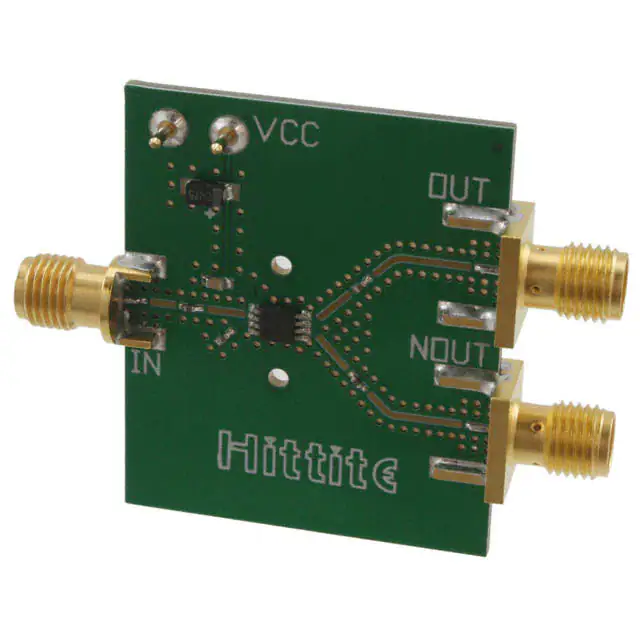
- BOARD EVAL DIVIDER HMC438
- Quantity:
- Payment:

- Shipping:

Inventory:2,762
Please send an inquiry. Send us your inquiry, and we will respond immediately.
Product details
Overview
HMC438MS8G from Analog Devices is a GaAs HBT MMIC divide-by-5 static frequency divider operating from DC (square-wave input) to 7 GHz with -1 dBm output power, -153 dBc/Hz SSB phase noise at 100 kHz offset, and +5 V / 80 mA supply. It serves as a prescaler in C-band PLL systems for UNII radios, 802.11a WLAN, fiber optic links, and cellular infrastructure.
For engineers reviewing the HMC438MS8G datasheet, HMC438MS8G pinout, HMC438MS8G application, or HMC438MS8G equivalent, key selection criteria include its DC–7 GHz input bandwidth, differential RF I/O capability, low additive phase noise, 8-lead Mini-SO-EP package, and compatibility with high-frequency PLL feedback paths requiring stable division ratio and minimal jitter contribution.
Technical Context
The HMC438MS8G implements a static CMOS-compatible divide-by-5 logic core using InGaP GaAs HBT technology, enabling operation down to DC with square-wave inputs and supporting sine-wave inputs from 100 MHz to 7 GHz. Its dual differential outputs (pins 6 and 7) provide complementary 882 MHz signals when driven at 4.41 GHz, with 100 ps transition time and < −50 dBm reverse leakage under terminated conditions.
It requires external DC blocking capacitors on all RF ports and operates within −40 °C to +85 °C ambient, with thermal resistance of 88.5 °C/W (junction-to-ground paddle). The device is ESD-sensitive (HBM Class 1A) and rated for 1 million hour MTTF at 122 °C junction temperature.
Key Specifications
| Parameter | Value and Actual Design Meaning |
|---|---|
| Division Ratio | Fixed divide-by-5; provides deterministic frequency reduction without programmability or lock detection. |
| Input Frequency Range | DC–7 GHz (square wave); 100 MHz–7 GHz (sine wave); defines usable bandwidth for PLL prescaling. |
| Output Power | −4 to −1 dBm typical; sufficient to drive subsequent RF stages or mixer LO inputs without amplification. |
| SSB Phase Noise | −153 dBc/Hz @ 100 kHz offset (Fin = 6 GHz, Pin = 0 dBm); preserves system-level spectral purity in sensitive receivers. |
| Supply Voltage & Current | +5 V ±0.25 V @ 80 mA; single-rail operation simplifies biasing in RF subsystems. |
| Operating Temperature | −40 °C to +85 °C; validated for industrial and outdoor wireless infrastructure environments. |
| Package Type | 8-Lead Mini-SO-EP (RH-8-1); exposed paddle enhances thermal dissipation and RF grounding. |
Pinout & Package
Package: 8-Lead Mini Small Outline Package with Exposed Pad (RH-8-1), JEDEC MO-187-AA-T compliant, 3.0 × 3.0 × 0.94 mm body size, exposed thermal paddle on underside.
| Pin/Terminal | Circuit Role | Design Meaning |
|---|---|---|
| 1 | Vcc | +5 V DC supply input; must be decoupled locally with 100 pF and 4.7 µF capacitors per evaluation board layout. |
| 2 | IN | Primary RF input; requires external DC blocking capacitor; accepts square or sine wave up to 7 GHz. |
| 3 | IN (Differential) | 180° out-of-phase RF input for differential drive; AC grounded for single-ended use. |
| 4, 5 | GND | RF/DC ground connections; must be soldered directly to PCB ground plane with multiple vias. |
| 6 | OUT (Complementary) | Divided output 180° out-of-phase with pin 7; enables balanced signal routing or differential clock distribution. |
| 7 | OUT | Main divided RF output; delivers 882 MHz signal when input is 4.41 GHz (divide-by-5). |
| 8 | N/C | No internal connection; externally grounded per evaluation board design to minimize parasitic coupling. |
Key Features
| Feature | Design Value |
|---|---|
| DC-coupled square-wave input support | Enables direct interface with digital logic or FPGA clock outputs without AC coupling constraints. |
| Dual complementary RF outputs | Provides matched, low-skew differential signals for improved noise immunity in high-speed PLL feedback loops. |
| Low additive phase noise | −153 dBc/Hz @ 100 kHz offset minimizes jitter accumulation in cascaded frequency synthesis chains. |
| Exposed thermal paddle | Reduces junction-to-board thermal resistance to 88.5 °C/W, supporting continuous operation at full RF power. |
| ESD robustness (HBM Class 1A) | Validated handling protocol ensures reliability during SMT assembly and board-level test without special precautions beyond standard ESD controls. |
Applications
| UNII & VSAT Radios | 802.11a/HiperLAN WLAN |
|---|---|
Use Scenario: High-reliability point-to-point backhaul links operating in 5.25–5.85 GHz UNII bands and C-band VSAT terminals. IC Role / Device Role / Timing Role: Prescaler in PLL-based local oscillator generation, reducing VCO frequency before phase comparison. Use Value: Maintains low phase noise floor across full 7 GHz input range, ensuring adjacent-channel rejection and spectral mask compliance. | Use Scenario: Dual-band 802.11a access points and client devices requiring stable 5 GHz LO synthesis. IC Role / Device Role / Timing Role: Fixed-ratio divider in fractional-N synthesizer feedback path for 5 GHz channel selection. Use Value: Delivers −1 dBm output power and 100 ps edge rate to drive mixer LO ports without additional buffering. |
| Fiber Optic Transceivers | Cellular / 3G Infrastructure |
Use Scenario: Clock recovery and data retiming circuits in 10 Gbps+ optical line cards and forward error correction modules. IC Role / Device Role / Timing Role: Reference frequency divider generating precise sub-harmonics for CDR PLL reference clocks. Use Value: DC–7 GHz input supports wideband clock input recovery; low phase noise prevents BER degradation in high-order QAM systems. | Use Scenario: Base station transceivers and remote radio heads operating in 1.9–2.2 GHz PCS/IMT bands. IC Role / Device Role / Timing Role: Prescaler in transmit/receive LO synthesis chains for multi-carrier WCDMA and LTE FDD systems. Use Value: −15 to +12 dBm input sensitivity window accommodates variable gain amplifier outputs without external attenuation. |
Equivalent & Alternatives
The following parts are listed as comparable options for similar frequency divider applications.
| Alternative Part | Technical Difference | Application Difference | Selection Advice |
|---|---|---|---|
| HMC363S8G | Divide-by-4, 0.1–8 GHz input, −152 dBc/Hz phase noise @ 100 kHz, same MS8G package. | Used where integer-N PLL requires exact 4× division; lacks DC input capability. | Select when system architecture mandates divide-by-4 and higher input bandwidth is needed. |
| HMC492LP5E | Divide-by-5, 0.1–13 GHz input, −150 dBc/Hz phase noise, 32-lead QFN package. | Supports Ka-band applications; larger footprint and different thermal profile than MS8G. | Choose for millimeter-wave designs above 7 GHz where extended bandwidth outweighs package size penalty. |
Compared with HMC438MS8G, HMC363S8G offers wider input bandwidth but no DC operation, while HMC492LP5E extends frequency coverage to 13 GHz at the cost of increased package complexity and thermal management requirements-making HMC438MS8G optimal for C-band infrastructure where DC-coupled flexibility and compact thermal design are critical.
Availability
HMC438MS8G is available at Aetrix Electronics and suitable for UNII radios, 802.11a WLAN equipment, and fiber optic transceivers requiring stable component supply, consistent parametric performance across production lots, and long-term lifecycle availability for industrial deployments.
Supply support for HMC438MS8G includes scheduled delivery planning, volume procurement assistance, BOM continuity management, traceable sourcing, and lifecycle availability coordination for OEM customers, industrial embedded developers, connected-device designers, and electronics production programs.
Manufacturer
Analog Devices, Inc. is a global leader in high-performance analog, mixed-signal, and RF ICs, serving precision instrumentation, communications, and industrial markets since 1965.
The HMC438MS8G belongs to Analog Devices' Hittite Microwave MMIC product line, engineered specifically for high-frequency wireless infrastructure applications demanding low phase noise, wide bandwidth, and robust RF performance in compact surface-mount packages.
FAQ
What is the minimum input frequency supported by the HMC438MS8G?
The HMC438MS8G supports DC input for square-wave signals, meaning it can operate with zero-Hz fundamental frequency when driven by a clean digital waveform. For sine-wave inputs, the minimum specified frequency is 100 MHz per the datasheet's "Minimum Input Frequency" parameter. This dual-mode capability makes the HMC438MS8G uniquely suited for hybrid digital/analog PLL architectures where clock sources may originate from either logic gates or RF oscillators.
Does the HMC438MS8G require external DC blocking capacitors?
Yes, the HMC438MS8G requires external DC blocking capacitors on both RF input (pins 2 and 3) and RF output (pins 6 and 7) ports. The datasheet explicitly states this in the "Application Circuit" and "Evaluation PCB" sections, specifying 100 pF 0402 capacitors for RF paths. Omitting these capacitors risks bias disruption, degraded matching, and potential damage due to unintended DC paths through the GaAs HBT core.
What is the thermal resistance and maximum junction temperature rating for the HMC438MS8G?
The HMC438MS8G has a thermal resistance of 88.5 °C/W (junction-to-ground paddle) and is rated for 1 million hour MTTF at 122 °C junction temperature. Its absolute maximum junction temperature is 135 °C. These values assume proper soldering of all ground leads and the exposed paddle to a thermally optimized PCB layout with adequate via density-critical for sustained operation in base station or outdoor radio applications where ambient temperatures exceed 70 °C.
Can the HMC438MS8G be used in differential mode?
Yes, the HMC438MS8G supports true differential operation: pin 3 is the 180° out-of-phase complement to pin 2 (IN), and pins 6 and 7 provide complementary divided outputs. The datasheet's "Pin Description" and "Interface Schematic" confirm this configuration. When used differentially, common-mode noise rejection improves, and output skew is minimized-key advantages in high-speed PLL feedback paths where timing integrity directly impacts loop stability and spurious performance.
Is the HMC438MS8G RoHS-compliant?
The HMC438MS8G is not RoHS-compliant; it uses Sn/Pb solder finish and low-stress injection-molded plastic packaging. Its RoHS-compliant variant is the HMC438MS8GE, which substitutes 100% matte tin lead finish and RoHS-compliant body material. Both share identical electrical specifications and pinout, but reflow profiles differ: HMC438MS8G max peak temperature is 235 °C, while HMC438MS8GE supports 260 °C. System designers must select based on assembly process requirements and regulatory compliance targets.
105786-HMC438MS8G Specifications
- Product attributes
- Attribute value
- Manufacturer:
- Analog Devices Inc.
- Series:
- -
- Packaging:
- Bag
- Product Status:
- Active
- Type:
- Prescaler
- Frequency:
- 0Hz ~ 7GHz
- Contents:
- Board(s)
- Utilized IC / Part:
- HMC438MS8G
105786-HMC438MS8G FAQ
1.How can I place an order for 105786-HMC438MS8G through Aetrix?
Please submit a Request for Quotation (RFQ) for 105786-HMC438MS8G on Aetrix. Our sales agent will provide a competitive quotation and guide you through the order confirmation once you accept the terms.
2.Are the price and stock information for 105786-HMC438MS8G reliable?
The price and inventory of 105786-HMC438MS8G are updated periodically and may fluctuate due to market conditions. Stock and pricing data are typically refreshed every 24 hours. Quotation validity for 105786-HMC438MS8G is usually 5 days.
3.What payment methods are accepted for 105786-HMC438MS8G?
We accept Wire Transfer, PayPal, Credit Card, Western Union, MoneyGram, and Escrow for 105786-HMC438MS8G transactions.
Note: Certain payment methods may incur a processing fee.
4.How is shipping managed for 105786-HMC438MS8G?
105786-HMC438MS8G orders can be shipped via leading logistics carriers, including DHL, UPS, FedEx, TNT, or Registered Mail.
Once your 105786-HMC438MS8G order is processed, you will receive an email with the shipment details and tracking number.
Note: Tracking information may take up to 24 hours to appear. Express delivery typically takes 3–5 business days.
5.How can I obtain technical support or documentation for 105786-HMC438MS8G?
For technical support, including 105786-HMC438MS8G datasheets, pinout diagrams, or application guidance, please contact our engineering support team. They can provide detailed documentation and assistance for your 105786-HMC438MS8G requirements.
6.How does Aetrix verify that 105786-HMC438MS8G is sourced from the original manufacturer or authorized distributors?
All 105786-HMC438MS8G products on Aetrix are procured from qualified distributors and authorized channels. Our dedicated quality assurance team conducts strict verification, including traceability checks and, if necessary, third-party testing. This ensures that 105786-HMC438MS8G meets industry standards.
7.What is the process for return or replacement of 105786-HMC438MS8G?
All 105786-HMC438MS8G units undergo pre-shipment inspection (PSI). If there is an issue with 105786-HMC438MS8G, returns or replacements are accepted under the following conditions:
1.Quantity discrepancies, incorrect items, or visible external defects (such as breakage or corrosion), acknowledged by Aetrix.
2.The issue is reported within 90 days of delivery.
3.The 105786-HMC438MS8G part is unused and in its original packaging.
Return procedure for 105786-HMC438MS8G:
1.Submit a request within 90 days.
2.Obtain a Return Material Authorization (RMA) from Aetrix.
105786-HMC438MS8G Tags
-
113991054
Seeed Technology Co., Ltd
-
SC0918
Raspberry Pi

-
113991114
Seeed Technology Co., Ltd
-
ESP32-C6-DEVKITM-1-N4
Espressif Systems
-
ESP32-DEVKITM-1
Espressif Systems
-
C008
M5Stack Technology Co., Ltd.
-
ESP32-C3-DEVKITC-02
Espressif Systems
-
ESP32-C6-DEVKITC-1-N8
Espressif Systems
-
DFR0478
DFRobot
-
102010448
Seeed Technology Co., Ltd
-
ESP32-DEVKITC-32E
Espressif Systems
-
ESP32-DEVKITC-32UE
Espressif Systems
Tech Hub

A practical engineering guide to 3.3V and 5V logic compatibility, input thresholds, resistor dividers, translator ICs, MOSFET level shifting, I2C pull-ups, timing limits and power-sequencing risks.

The 74HC595 uses push-pull logic outputs, while the TPIC6B595 uses 50 V open-drain DMOS sinks for higher-power loads. This guide compares timing, current limits, 3.3 V interfacing, load wiring, thermal…

The 74HC595 converts serial data into eight stable parallel outputs. This guide covers pin functions, shift and storage timing, OE and MR behavior, drive-current limits, cascading, voltage compatibilit…

A technical comparison of level-sensitive latches and edge-triggered flip-flops, covering timing windows, setup and hold limits, master–slave operation, time borrowing, race-through, HDL inference and…

A D latch stores one bit while Enable controls when data can pass. This reference covers gate-level operation, truth tables, transparency, setup and hold timing, LE versus OE, common ICs and practical …

An SR latch stores one bit through cross-coupled feedback. This engineering reference covers NOR and NAND implementations, truth tables, forbidden-state recovery, gated operation, switch debouncing, fa…

Latch circuits retain one bit through feedback. This technical reference covers SR and D latches, truth tables, transparency, timing limits, latch-versus-flip-flop behavior, applications and common log…

An engineering guide to LED driver operation, constant-current and constant-voltage outputs, linear and switching topologies, dimming, IC selection, calculations, replacement compatibility, and fault c…

Operational amplifier guide covering op amp basics, feedback, ideal vs real op amps, common configurations, buffer circuits, offset, bias current, gain-bandwidth, slew rate, rail-to-rail limits and sel…

Jumper cables guide covering safe connection order, red and black clamp placement, final ground connection, cable gauge, length, clamp quality, copper vs CCA cables, jump starter comparison and battery…


