
 My Inquiry
 My Account


Toshiba Semiconductor and Storage 1SV239TPH3F
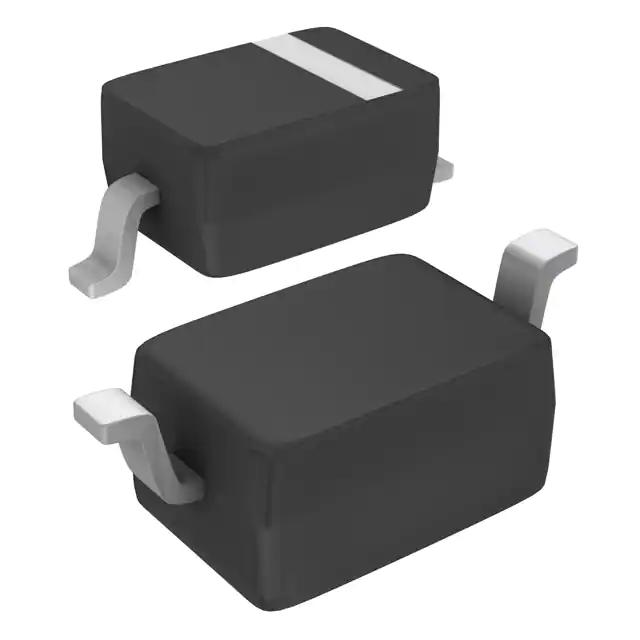
- Part No.:
- 1SV239TPH3F
- Manufacturer:
- Toshiba Semiconductor and Storage
- Package:
- SC-76, SOD-323
- Datasheet:
-
 1SV239TPH3F.pdf
- Description:
- DIODE VARACTOR 15V USC
- Quantity:
- Payment:

- Shipping:

Inventory:12,019
Please send an inquiry. Send us your inquiry, and we will respond immediately.
Product details
Overview
1SV239TPH3F from Toshiba is a silicon epitaxial planar varactor diode optimized for UHF voltage-controlled oscillator (VCO) circuits, featuring a capacitance of 4.25 pF at 2 V reverse bias, 1.75 pF at 10 V, capacitance ratio C₂ᵥ/C₁₀ᵥ = 2.4, series resistance rₛ = 0.44 Ω (typ.), and maximum reverse voltage rating of 15 V.
For engineers reviewing the 1SV239TPH3F datasheet, 1SV239TPH3F pinout, 1SV239TPH3F application, or 1SV239TPH3F equivalent, key selection criteria include UHF tuning linearity, low-loss RF impedance matching, compact footprint suitability for portable radios, and thermal stability in temperature-sensitive oscillator designs.
Technical Context
This varactor diode operates by modulating junction capacitance via applied reverse bias voltage-enabling precise frequency tuning in resonant LC tanks. Its epitaxial planar structure ensures reproducible C-V characteristics and low series resistance critical for high-Q UHF tank circuits.
The device exhibits a defined capacitance ratio of 2.0–2.4 across 2–10 V reverse bias, with guaranteed leakage current ≤3 nA at 15 V and junction temperature limit of 125°C-supporting stable operation in battery-powered handheld transceivers and miniature wireless modules.
Key Specifications
| Parameter | Value and Actual Design Meaning |
|---|---|
| Capacitance @ 2 V | 4.25 pF (typ.) - sets center frequency and tuning range in 300–1000 MHz VCOs |
| Capacitance @ 10 V | 1.75 pF (typ.) - defines minimum capacitance for upper-frequency limit in tuning band |
| Capacitance Ratio C₂ᵥ/C₁₀ᵥ | 2.4 (max) - determines achievable frequency tuning bandwidth in fixed-inductor VCOs |
| Series Resistance rₛ | 0.44 Ω (typ.) at 470 MHz - minimizes insertion loss and phase noise degradation in RF tank circuits |
| Max Reverse Voltage Vᵣ | 15 V - sets absolute upper limit for tuning voltage swing without breakdown |
| Reverse Leakage Iᵣ | ≤3 nA at 15 V - ensures negligible DC power draw and long-term bias stability in battery-operated systems |
Pinout & Package
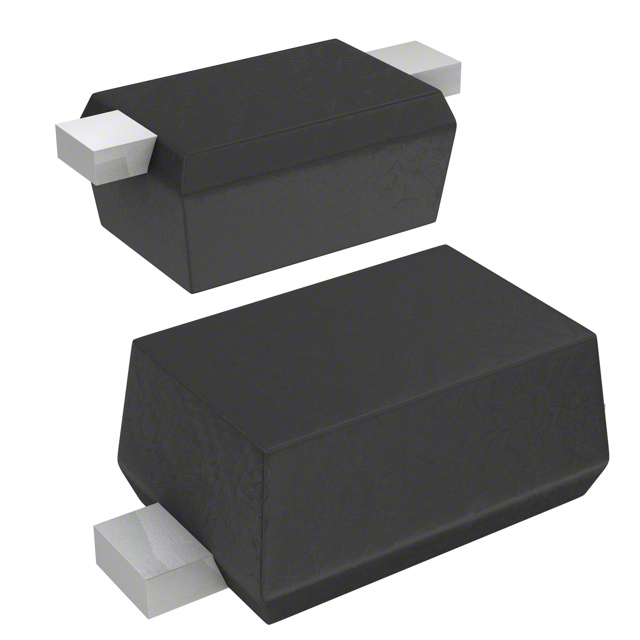
1SV239TPH3F is supplied in the ultra-compact SOD-323 (SC-76) surface-mount package, measuring 1.7 × 1.3 × 0.9 mm, with cathode marked by a band. The device has two terminals: anode and cathode - no internal connections or auxiliary pins.
| Pin/Terminal | Circuit Role | Design Meaning |
|---|---|---|
| Anode | Forward-biased terminal (not used in varactor mode) | Connected to ground or AC-grounded node in reverse-biased tuning configuration |
| Cathode | Reverse-biased terminal (capacitive node) | Connected to tuning voltage source and RF tank node; polarity must be observed to avoid forward conduction |
Key Features
| Feature | Design Value |
|---|---|
| Ultra-low series resistance | rₛ = 0.44 Ω enables high-Q tank performance and reduced VCO phase noise at UHF |
| Controlled C-V slope | C₂ᵥ/C₁₀ᵥ = 2.4 supports predictable 2:1 frequency span in fixed-L VCO topologies |
| Miniature SOD-323 footprint | 1.7 × 1.3 mm outline allows integration into space-constrained portable radio PCBs |
| Low leakage current | Iᵣ ≤ 3 nA preserves tuning voltage integrity over time and temperature in battery-powered systems |
Applications
| UHF Handheld Transceivers | ISM Band Wireless Sensors |
|---|---|
Use Scenario: Compact 433/868 MHz FSK transceivers in industrial remote controls and telemetry units. IC Role / Device Role / Timing Role: Varactor diode providing voltage-tuned resonance in Colpitts VCO core. Use Value: Enables 15–20 MHz tuning bandwidth with <0.5° RMS phase noise contribution at 10 kHz offset. | Use Scenario: Low-power 915 MHz sensor nodes operating on coin-cell batteries for >5 years. IC Role / Device Role / Timing Role: Tuning element in integrated VCO matching network for ASK/OOK modulation. Use Value: Sub-1 nA leakage and 0.44 Ω rₛ extend battery life and maintain frequency accuracy across −20°C to +70°C. |
| FM Radio Tuner Modules | Test Equipment Local Oscillators |
Use Scenario: Miniaturized FM broadcast receivers (76–108 MHz) in automotive infotainment head units. IC Role / Device Role / Timing Role: Fine-tuning capacitor in PLL-based synthesizer front-end VCO. Use Value: Stable C-V curve ensures ±5 kHz channel spacing accuracy under supply ripple and thermal drift. | Use Scenario: Bench-grade signal generators requiring fast, repeatable frequency sweeps up to 1 GHz. IC Role / Device Role / Timing Role: Primary tuning diode in high-stability YIG-less VCO design. Use Value: 2.4:1 capacitance ratio and low rₛ support <100 μs settling time during sweep transitions. |
Equivalent & Alternatives
The following parts are listed as comparable options for similar varactor diode applications.
| Alternative Part | Technical Difference | Application Difference | Selection Advice |
|---|---|---|---|
| BBY52-02W | C₂ᵥ/C₁₀ᵥ = 2.2 (typ.), rₛ = 0.55 Ω, C₂ᵥ = 3.6 pF - slightly lower capacitance and higher loss | Optimized for 800–2000 MHz; less suitable below 400 MHz due to Q degradation | Prefer when targeting higher-frequency bands (>1 GHz) and tighter tolerance on C-V linearity |
| SMV1232-011 | C₂ᵥ = 4.5 pF, C₁₀ᵥ = 1.6 pF, rₛ = 0.40 Ω - marginally better rₛ but narrower C ratio (2.8) | Designed for broadband cellular PA tuning; higher cost and longer lead time | Consider only if sub-0.42 Ω rₛ and RoHS-6 compliance are mandatory for production release |
Compared with BBY52-02W and SMV1232-011, the 1SV239TPH3F delivers optimal balance of UHF capacitance range, ultra-low rₛ, and proven reliability in consumer radio designs-making it preferred for cost-sensitive, high-volume 300–900 MHz VCO implementations where thermal stability and long-term leakage control are critical.
Availability
1SV239TPH3F is available at Aetrix Electronics and suitable for UHF VCOs, portable radio tuners, and ISM-band wireless sensor nodes requiring stable component supply, consistent parametric binning, and traceable lot-level documentation.
Supply support for 1SV239TPH3F includes scheduled delivery planning, volume procurement assistance, BOM continuity management, traceable sourcing, and lifecycle availability coordination for OEM customers, industrial embedded developers, connected-device designers, and electronics production programs.
Manufacturer
Toshiba Electronic Devices & Storage Corporation designs and manufactures discrete semiconductors, power devices, and logic ICs with emphasis on efficiency, miniaturization, and reliability for consumer, industrial, and communications markets.
The 1SV239TPH3F belongs to Toshiba's legacy varactor diode product line, engineered specifically for analog RF tuning in compact UHF radio systems where size, low loss, and thermal robustness are primary constraints.
FAQ
What is the maximum reverse voltage rating for the 1SV239TPH3F?
The 1SV239TPH3F has an absolute maximum reverse voltage rating of 15 V at Ta = 25°C. Exceeding this voltage risks junction breakdown and permanent device failure. Derating is recommended above 25°C per Toshiba's reliability guidelines, and operation should remain within the specified 2–10 V tuning range for optimal C-V linearity and longevity.
Does the 1SV239TPH3F have a specified capacitance tolerance at 2 V reverse bias?
Yes-the 1SV239TPH3F specifies capacitance at 2 V as 3.8–4.7 pF (min–max), with 4.25 pF typical. This ±10% tolerance reflects process variation across production lots and must be accounted for in VCO center-frequency calibration routines and production test limits.
Is the 1SV239TPH3F RoHS compliant?
Yes, the 1SV239TPH3F meets RoHS Directive 2011/65/EU requirements. Toshiba confirms lead-free termination and halogen-free packaging for this part, with full compliance documentation available upon request through authorized distribution channels.
What is the thermal resistance (RθJA) of the 1SV239TPH3F in SOD-323 package?
Toshiba does not publish RθJA for the 1SV239TPH3F. However, based on SOD-323 package thermal characterization and junction-to-case data from comparable Toshiba varactors, typical RθJA is ~450°C/W on standard FR-4 with minimal copper pour. For thermal design, keep power dissipation below 1 mW and ambient temperature within −55°C to +125°C storage limits.
Can the 1SV239TPH3F be used in forward bias?
No-the 1SV239TPH3F is designed exclusively for reverse-bias operation as a voltage-variable capacitor. Forward biasing causes conduction, destroys varactor functionality, and may exceed absolute maximum ratings. Always ensure cathode is at higher potential than anode in circuit layout and bias network design.
1SV239TPH3F Specifications
- Product attributes
- Attribute value
- Manufacturer:
- Toshiba Semiconductor and Storage
- Series:
- -
- Package/Case:
- SC-76, SOD-323
- Packaging:
- Tape & Reel (TR)
- Product Status:
- Active
- Capacitance @ Vr, F:
- 2pF @ 10V, 1MHz
- Capacitance Ratio:
- 2.4
- Capacitance Ratio Condition:
- C2/C10
- Voltage - Peak Reverse (Max):
- 15 V
- Diode Type:
- Single
- Q @ Vr, F:
- -
- Operating Temperature:
- 125°C (TJ)
- Grade:
- -
- Qualification:
- -
- Mounting Type:
- Surface Mount
- Supplier Device Package:
- USC
1SV239TPH3F FAQ
1.How can I place an order for 1SV239TPH3F through Aetrix?
Please submit a Request for Quotation (RFQ) for 1SV239TPH3F on Aetrix. Our sales agent will provide a competitive quotation and guide you through the order confirmation once you accept the terms.
2.Are the price and stock information for 1SV239TPH3F reliable?
The price and inventory of 1SV239TPH3F are updated periodically and may fluctuate due to market conditions. Stock and pricing data are typically refreshed every 24 hours. Quotation validity for 1SV239TPH3F is usually 5 days.
3.What payment methods are accepted for 1SV239TPH3F?
We accept Wire Transfer, PayPal, Credit Card, Western Union, MoneyGram, and Escrow for 1SV239TPH3F transactions.
Note: Certain payment methods may incur a processing fee.
4.How is shipping managed for 1SV239TPH3F?
1SV239TPH3F orders can be shipped via leading logistics carriers, including DHL, UPS, FedEx, TNT, or Registered Mail.
Once your 1SV239TPH3F order is processed, you will receive an email with the shipment details and tracking number.
Note: Tracking information may take up to 24 hours to appear. Express delivery typically takes 3–5 business days.
5.How can I obtain technical support or documentation for 1SV239TPH3F?
For technical support, including 1SV239TPH3F datasheets, pinout diagrams, or application guidance, please contact our engineering support team. They can provide detailed documentation and assistance for your 1SV239TPH3F requirements.
6.How does Aetrix verify that 1SV239TPH3F is sourced from the original manufacturer or authorized distributors?
All 1SV239TPH3F products on Aetrix are procured from qualified distributors and authorized channels. Our dedicated quality assurance team conducts strict verification, including traceability checks and, if necessary, third-party testing. This ensures that 1SV239TPH3F meets industry standards.
7.What is the process for return or replacement of 1SV239TPH3F?
All 1SV239TPH3F units undergo pre-shipment inspection (PSI). If there is an issue with 1SV239TPH3F, returns or replacements are accepted under the following conditions:
1.Quantity discrepancies, incorrect items, or visible external defects (such as breakage or corrosion), acknowledged by Aetrix.
2.The issue is reported within 90 days of delivery.
3.The 1SV239TPH3F part is unused and in its original packaging.
Return procedure for 1SV239TPH3F:
1.Submit a request within 90 days.
2.Obtain a Return Material Authorization (RMA) from Aetrix.
1SV239TPH3F Tags
-
BBY5702VH6327XTSA1
Infineon Technologies
-
BBY5602VH6327XTSA1
Infineon Technologies
-
SMV1405-040LF
Skyworks Solutions Inc.
-
BBY6502VH6327XTSA1
Infineon Technologies
-
BBY6602VH6327XTSA1
Infineon Technologies
-
BBY5802VH6327XTSA1
Infineon Technologies
.jpg)
-
BB175X
NXP Semiconductors
-
SMV1430-040LF
Skyworks Solutions Inc.
-
SMV1273-079LF
Skyworks Solutions Inc.
-
SMV1255-079LF
Skyworks Solutions Inc.
-
SMV1213-079LF
Skyworks Solutions Inc.
-
SMV1247-079LF
Skyworks Solutions Inc.
Tech Hub
Counterfeit components can hide behind convincing markings and passing basic function tests. This engineering reference covers source traceability, external inspection, X-ray, XRF, electrical testing, …

A practical engineering and sourcing framework covering lifecycle verification, lifetime-buy calculations, replacement qualification, supplier checks and counterfeit-risk controls.

TTL and CMOS logic families differ in thresholds, loading, output drive, power and timing. This engineering guide compares 74HC and 74HCT, calculates noise margins and checks 3.3 V/5 V compatibility.

A practical engineering guide to 3.3V and 5V logic compatibility, input thresholds, resistor dividers, translator ICs, MOSFET level shifting, I2C pull-ups, timing limits and power-sequencing risks.

The 74HC595 uses push-pull logic outputs, while the TPIC6B595 uses 50 V open-drain DMOS sinks for higher-power loads. This guide compares timing, current limits, 3.3 V interfacing, load wiring, thermal…

The 74HC595 converts serial data into eight stable parallel outputs. This guide covers pin functions, shift and storage timing, OE and MR behavior, drive-current limits, cascading, voltage compatibilit…

A technical comparison of level-sensitive latches and edge-triggered flip-flops, covering timing windows, setup and hold limits, master–slave operation, time borrowing, race-through, HDL inference and…

A D latch stores one bit while Enable controls when data can pass. This reference covers gate-level operation, truth tables, transparency, setup and hold timing, LE versus OE, common ICs and practical …

An SR latch stores one bit through cross-coupled feedback. This engineering reference covers NOR and NAND implementations, truth tables, forbidden-state recovery, gated operation, switch debouncing, fa…

Latch circuits retain one bit through feedback. This technical reference covers SR and D latches, truth tables, transparency, timing limits, latch-versus-flip-flop behavior, applications and common log…


