
 My Inquiry
 My Account


Microchip Technology 24LC08BHT-E/OT
- Part No.:
- 24LC08BHT-E/OT
- Manufacturer:
- Microchip Technology
- Category:
- Memory
- Package:
- SC-74A, SOT-753
- Datasheet:
-
 24LC08BHT-E/OT.pdf
- Description:
- IC EEPROM 8KBIT I2C SOT23-5
- Quantity:
- Payment:

- Shipping:

Inventory:3,849
Please send an inquiry. Send us your inquiry, and we will respond immediately.
Product details
Overview
24LC08BHT-E/OT from Microchip Technology Inc. is an 8 Kbit I²C-compatible serial EEPROM organized as four 256 × 8-bit memory blocks, operating from 2.5V to 5.5V with 400 kHz max clock frequency, 16-byte page write buffer, and hardware write-protect for addresses 0x200–0x3FF. It targets embedded system configuration storage in space-constrained industrial controllers.
For engineers reviewing the 24LC08BHT-E/OT datasheet, 24LC08BHT-E/OT pinout, 24LC08BHT-E/OT application, or 24LC08BHT-E/OT equivalent, key selection criteria include its SOT-23-5 package footprint, automotive-grade temperature range (−40°C to +125°C), half-array write-protection via WP pin, and guaranteed 1 million erase/write cycles with >200-year data retention.
Technical Context
The 24LC08BHT-E/OT implements a slave-only I²C interface with fixed 7-bit device address prefix '1010', block-select addressing (B2–B0) for selecting one of four 256-word memory blocks, and Schmitt-triggered SDA/SCL inputs for noise immunity on noisy buses. Its internal address pointer auto-increments during sequential reads and page writes.
Write protection is implemented via the WP pin: tied to VCC, it disables writes to the upper half-array (0x200–0x3FF); tied to VSS, full-array access is enabled. The device supports byte and page write modes, with self-timed internal erase/write cycles completing in ≤5 ms, and uses acknowledge polling to detect write completion without fixed delay timing.
Key Specifications
| Parameter | Value and Actual Design Meaning |
|---|---|
| Memory size | 8 Kbit (1024 × 8), organized as four 256-word blocks for flexible partitioning |
| VCC range | 2.5V to 5.5V - ensures compatibility with 3.3V and 5V logic systems, excludes sub-2.5V operation |
| Max clock frequency | 400 kHz at VCC ≥ 2.5V - enables high-speed configuration loading vs. legacy 100 kHz EEPROMs |
| Page write buffer | 16 bytes - reduces I²C transaction count by up to 16× vs. byte-write for contiguous updates |
| Endurance | 1 million erase/write cycles - supports frequent firmware parameter logging in industrial edge nodes |
| Data retention | >200 years at +85°C - guarantees long-term calibration data integrity in unattended equipment |
| ESD protection | >4 kV HBM - withstands handling and board-level ESD events without latch-up or corruption |
Pinout & Package
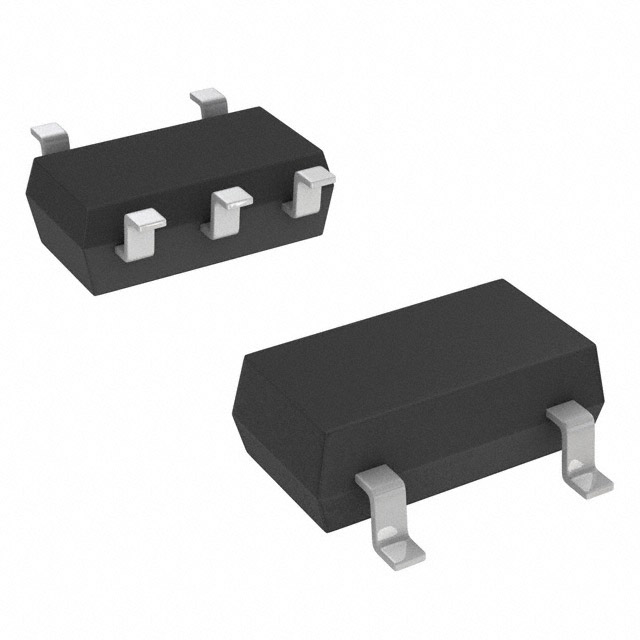
24LC08BHT-E/OT is housed in a RoHS-compliant 5-lead SOT-23 package (1.6 mm × 2.9 mm × 1.1 mm), optimized for ultra-compact PCB layouts in automotive body control modules and portable instrumentation.
| Pin/Terminal | Circuit Role | Design Meaning |
|---|---|---|
| SCL | Serial Clock input | Synchronizes all I²C transactions; requires external pull-up; Schmitt trigger enables robust timing on noisy lines |
| SDA | Serial Data bidirectional I/O | Open-drain output; must be pulled up externally (2 kΩ typical for 400 kHz); carries address, data, and ACK signals |
| WP | Hardware write-protect control | Active-high: ties VCC to disable writes to 0x200–0x3FF; tied to VSS for full-array access |
| VSS | Ground reference | System common return; must be low-impedance to minimize ground bounce during write cycles |
| VCC | Power supply input | Accepts 2.5–5.5V; internal voltage detector disables writes below ~1.5V to prevent partial writes |
Key Features
| Feature | Design Value |
|---|---|
| Half-array hardware write-protect | Prevents accidental overwrites of critical calibration or security data stored in upper 2 Kbytes (0x200–0x3FF) |
| 16-byte page write buffer | Enables single I²C transaction to update up to 16 contiguous bytes, reducing bus occupancy and host CPU overhead |
| Schmitt-trigger inputs with spike filtering | Rejects noise transients ≤50 ns on SDA/SCL, eliminating need for external RC filters in harsh EMI environments |
| Automotive temperature grade (−40°C to +125°C) | Validated for under-hood and powertrain applications where ambient thermal stress exceeds industrial limits |
| Self-timed write cycle with ACK polling | Allows host to poll completion status instead of fixed delays, maximizing I²C bus utilization in real-time systems |
Applications
| Industrial PLC Configuration Storage | Automotive Body Control Module (BCM) |
|---|---|
Use Scenario: Storing user-defined I/O mapping, scaling factors, and alarm thresholds in programmable logic controllers deployed in factory automation cabinets. IC Role / Device Role / Timing Role: Nonvolatile configuration register holding persistent settings that survive power loss and firmware updates. Use Value: Hardware write-protect prevents field technicians from unintentionally corrupting calibrated sensor offsets during routine maintenance. | Use Scenario: Retaining door lock state history, mirror position presets, and lighting profiles across ignition cycles in automotive BCMs. IC Role / Device Role / Timing Role: Dedicated EEPROM for user preference storage, isolated from main MCU flash to avoid wear-out and enable independent updates. Use Value: Automotive-grade temperature rating ensures reliable operation near engine compartments where ambient exceeds +105°C. |
| Medical Infusion Pump Calibration Data | Smart Energy Meter Firmware Parameters |
Use Scenario: Holding factory-calibrated flow rate coefficients and pressure sensor compensation tables in Class II medical devices requiring traceable calibration records. IC Role / Device Role / Timing Role: Tamper-resistant nonvolatile memory storing safety-critical calibration constants referenced during each dose calculation. Use Value: >200-year data retention meets ISO 13485 requirements for lifetime device traceability without periodic recalibration. | Use Scenario: Storing tariff schedules, metering constants, and communication keys in utility-grade smart meters exposed to outdoor temperature extremes. IC Role / Device Role / Timing Role: Secure parameter vault for time-of-use billing logic and cryptographic keys, accessed only during secure boot or firmware update. Use Value: 1 million endurance cycles support daily firmware patching and key rotation over 10+ year field life without wear-out failure. |
Equivalent & Alternatives
The following parts are listed as comparable options for similar serial EEPROM applications.
| Alternative Part | Technical Difference | Application Difference | Selection Advice |
|---|---|---|---|
| 24AA08HT-I/OT | Lower VCC min (1.7V), industrial temp only (−40°C to +85°C), same pinout and function | Suitable for battery-powered portable devices but not automotive under-hood use | Select when operating below 2.5V or cost-sensitive industrial designs without extended temperature needs |
| AT24C08D-MAHM-T | Same 8 Kbit capacity, 1.7–5.5V range, industrial temp, TSSOP-8 package (not SOT-23) | Requires PCB layout change due to 8-pin vs. 5-pin footprint; lacks automotive qualification | Choose for higher-volume production where TSSOP-8 is already standardized and automotive temp is unnecessary |
Compared with 24LC08BHT-E/OT, the 24AA08HT-I/OT offers wider voltage flexibility but sacrifices automotive temperature capability, while the AT24C08D-MAHM-T provides identical functionality in a larger package without AEC-Q200 validation - making 24LC08BHT-E/OT the sole choice for space-constrained, high-reliability automotive applications.
Availability
24LC08BHT-E/OT is available at Aetrix Electronics and suitable for industrial PLC configuration storage, automotive body control modules, medical infusion pump calibration data, smart energy meter firmware parameters, and other applications requiring stable component supply with automotive-grade reliability.
Supply support for 24LC08BHT-E/OT includes scheduled delivery planning, volume procurement assistance, BOM continuity management, traceable sourcing, and lifecycle availability coordination for OEM customers, industrial embedded developers, connected-device designers, and electronics production programs.
Manufacturer
Microchip Technology Inc. is a leading provider of microcontrollers, analog components, and memory solutions, headquartered in Chandler, Arizona, with global design and manufacturing operations.
The 24LC08BHT-E/OT belongs to Microchip's 24LCxxH family of I²C serial EEPROMs, engineered specifically for automotive and industrial applications demanding extended temperature operation, high endurance, and hardware-based data protection.
FAQ
What is the minimum supply voltage required for reliable operation of the 24LC08BHT-E/OT?
The 24LC08BHT-E/OT requires a minimum VCC of 2.5V for guaranteed operation across its full −40°C to +125°C automotive temperature range. Operation below 2.5V is not specified and may result in incomplete writes or read errors, as confirmed in the Device Selection Table and Electrical Characteristics section of DS20002084B.
Does the 24LC08BHT-E/OT support standard I²C protocol timing at 400 kHz?
Yes, the 24LC08BHT-E/OT fully complies with standard-mode and fast-mode I²C timing specifications at up to 400 kHz when VCC ≥ 2.5V. AC characteristics including THIGH, TLOW, and TSU:DAT are explicitly validated for this condition per Table 1-2 in DS20002084B.
How does the write-protect feature work on the 24LC08BHT-E/OT?
The 24LC08BHT-E/OT uses the WP pin for hardware write-protection: when WP is tied to VCC, writes to memory addresses 0x200–0x3FF are disabled while reads remain functional; when WP is tied to VSS, full-array read/write access is enabled. This is documented in Section 6.0 and Pin Function Table (Table 8-1).
What is the maximum number of bytes that can be written in a single page write operation for the 24LC08BHT-E/OT?
The 24LC08BHT-E/OT supports a 16-byte page write buffer, allowing up to 16 contiguous bytes to be loaded into the internal buffer and committed to memory upon receipt of a Stop condition. Page boundaries align to 16-byte intervals, and crossing a boundary causes wraparound within the current page, as detailed in Section 4.2 and Figure 4-2.
Is the 24LC08BHT-E/OT qualified for automotive applications?
Yes, the 24LC08BHT-E/OT carries the 'E' temperature grade suffix, indicating qualification for the automotive temperature range of −40°C to +125°C. This is explicitly stated in the Device Selection Table, Packaging Information, and Product Identification System sections of DS20002084B.
24LC08BHT-E/OT Specifications
- Product attributes
- Attribute value
- Manufacturer:
- Microchip Technology
- Series:
- -
- Package/Case:
- SC-74A, SOT-753
- Packaging:
- Tape & Reel (TR)
- Product Status:
- Active
- Programmable:
- Not Verified
- Memory Type:
- Non-Volatile
- Memory Format:
- EEPROM
- Technology:
- EEPROM
- Memory Size:
- 8Kbit
- Memory Organization:
- 256 x 8 x 4
- Memory Interface:
- I2C
- Clock Frequency:
- 400 kHz
- Write Cycle Time - Word, Page:
- 5ms
- Access Time:
- 900 ns
- Voltage - Supply:
- 2.5V ~ 5.5V
- Operating Temperature:
- -40°C ~ 125°C (TA)
- Grade:
- -
- Qualification:
- -
- Mounting Type:
- Surface Mount
- Supplier Device Package:
- SOT-23-5
24LC08BHT-E/OT FAQ
1.How can I place an order for 24LC08BHT-E/OT through Aetrix?
Please submit a Request for Quotation (RFQ) for 24LC08BHT-E/OT on Aetrix. Our sales agent will provide a competitive quotation and guide you through the order confirmation once you accept the terms.
2.Are the price and stock information for 24LC08BHT-E/OT reliable?
The price and inventory of 24LC08BHT-E/OT are updated periodically and may fluctuate due to market conditions. Stock and pricing data are typically refreshed every 24 hours. Quotation validity for 24LC08BHT-E/OT is usually 5 days.
3.What payment methods are accepted for 24LC08BHT-E/OT?
We accept Wire Transfer, PayPal, Credit Card, Western Union, MoneyGram, and Escrow for 24LC08BHT-E/OT transactions.
Note: Certain payment methods may incur a processing fee.
4.How is shipping managed for 24LC08BHT-E/OT?
24LC08BHT-E/OT orders can be shipped via leading logistics carriers, including DHL, UPS, FedEx, TNT, or Registered Mail.
Once your 24LC08BHT-E/OT order is processed, you will receive an email with the shipment details and tracking number.
Note: Tracking information may take up to 24 hours to appear. Express delivery typically takes 3–5 business days.
5.How can I obtain technical support or documentation for 24LC08BHT-E/OT?
For technical support, including 24LC08BHT-E/OT datasheets, pinout diagrams, or application guidance, please contact our engineering support team. They can provide detailed documentation and assistance for your 24LC08BHT-E/OT requirements.
6.How does Aetrix verify that 24LC08BHT-E/OT is sourced from the original manufacturer or authorized distributors?
All 24LC08BHT-E/OT products on Aetrix are procured from qualified distributors and authorized channels. Our dedicated quality assurance team conducts strict verification, including traceability checks and, if necessary, third-party testing. This ensures that 24LC08BHT-E/OT meets industry standards.
7.What is the process for return or replacement of 24LC08BHT-E/OT?
All 24LC08BHT-E/OT units undergo pre-shipment inspection (PSI). If there is an issue with 24LC08BHT-E/OT, returns or replacements are accepted under the following conditions:
1.Quantity discrepancies, incorrect items, or visible external defects (such as breakage or corrosion), acknowledged by Aetrix.
2.The issue is reported within 90 days of delivery.
3.The 24LC08BHT-E/OT part is unused and in its original packaging.
Return procedure for 24LC08BHT-E/OT:
1.Submit a request within 90 days.
2.Obtain a Return Material Authorization (RMA) from Aetrix.
24LC08BHT-E/OT Tags

-
M24C02-WMN6TP
STMicroelectronics
-
AT24C02C-XHM-T
Microchip Technology
-
AT21CS01-STUM10-T
Microchip Technology

-
AT24C02C-SSHM-T
Microchip Technology
-
24LC01BT-I/OT
Microchip Technology
-
M24C02-FMC6TG
STMicroelectronics
-
AT24CS02-SSHM-T
Microchip Technology

-
93LC46BT-I/OT
Microchip Technology
-
AT24C04C-SSHM-T
Microchip Technology

-
24LC01BT-I/SN
Microchip Technology
-
24AA02UIDT-I/OT
Microchip Technology
-
AT24C08C-STUM-T
Microchip Technology
Tech Hub

TTL and CMOS logic families differ in thresholds, loading, output drive, power and timing. This engineering guide compares 74HC and 74HCT, calculates noise margins and checks 3.3 V/5 V compatibility.

A practical engineering guide to 3.3V and 5V logic compatibility, input thresholds, resistor dividers, translator ICs, MOSFET level shifting, I2C pull-ups, timing limits and power-sequencing risks.

The 74HC595 uses push-pull logic outputs, while the TPIC6B595 uses 50 V open-drain DMOS sinks for higher-power loads. This guide compares timing, current limits, 3.3 V interfacing, load wiring, thermal…

The 74HC595 converts serial data into eight stable parallel outputs. This guide covers pin functions, shift and storage timing, OE and MR behavior, drive-current limits, cascading, voltage compatibilit…

A technical comparison of level-sensitive latches and edge-triggered flip-flops, covering timing windows, setup and hold limits, master–slave operation, time borrowing, race-through, HDL inference and…

A D latch stores one bit while Enable controls when data can pass. This reference covers gate-level operation, truth tables, transparency, setup and hold timing, LE versus OE, common ICs and practical …

An SR latch stores one bit through cross-coupled feedback. This engineering reference covers NOR and NAND implementations, truth tables, forbidden-state recovery, gated operation, switch debouncing, fa…

Latch circuits retain one bit through feedback. This technical reference covers SR and D latches, truth tables, transparency, timing limits, latch-versus-flip-flop behavior, applications and common log…

An engineering guide to LED driver operation, constant-current and constant-voltage outputs, linear and switching topologies, dimming, IC selection, calculations, replacement compatibility, and fault c…

Operational amplifier guide covering op amp basics, feedback, ideal vs real op amps, common configurations, buffer circuits, offset, bias current, gain-bandwidth, slew rate, rail-to-rail limits and sel…


