
 My Inquiry
 My Account


onsemi 2SC3330T-AC
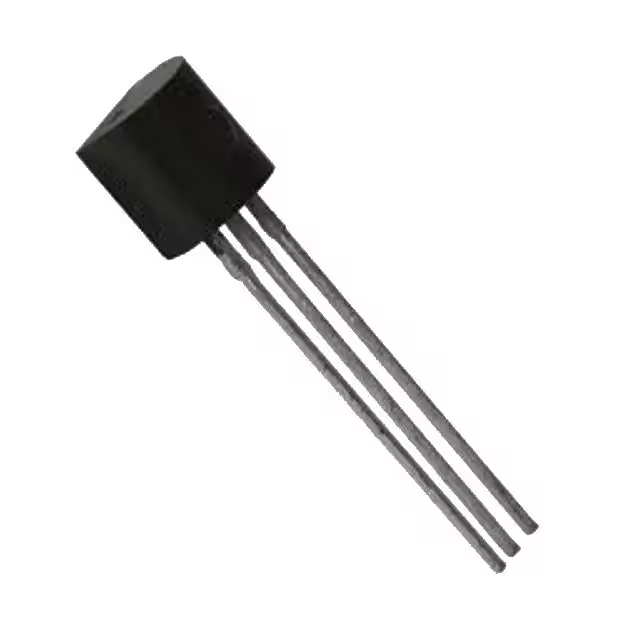
- Part No.:
- 2SC3330T-AC
- Manufacturer:
- onsemi
- Category:
- Single Bipolar Transistors
- Package:
- 3-SSIP
- Datasheet:
-
 2SC3330T-AC.pdf
- Description:
- TRANS NPN 50V 0.2A 3-SPA
- Quantity:
- Payment:

- Shipping:

Inventory:125,874
Please send an inquiry. Send us your inquiry, and we will respond immediately.
Product details
Overview
2SC3330T-AC from Toshiba is an NPN epitaxial planar silicon transistor designed for audio frequency amplification, with DC current gain (hFE) of 200–400 at IC = 2 mA, VCE = 6 V, and maximum collector current (IC) of 150 mA, used in low-noise preamplifier stages of consumer audio equipment.
For engineers reviewing the 2SC3330T-AC datasheet, pinout, applications, or equivalent options, key selection criteria include hFE range consistency, VCEO rating of 50 V, low noise figure (NF = 10 dB typ. at f = 1 kHz), and TO-92MOD package compatibility in discrete AF amplifier designs.
Technical Context
This transistor operates in linear active mode for analog signal amplification, featuring a vertical epitaxial planar structure optimized for stable hFE across temperature and low base-emitter leakage (IEO ≤ 0.1 μA). Its junction temperature rating of 150°C supports continuous operation in compact audio enclosures.
The device exhibits uniform gain distribution within the 200–400 hFE bin (designated by suffix "-AC"), enabling matched-pair use in differential input stages without external trimming, and maintains fT ≥ 180 MHz to preserve high-frequency response in wideband AF circuits.
Key Specifications
| Parameter | Value and Actual Design Meaning |
|---|---|
| VCEO | 50 V - Supports rail voltages up to ±24 V in single-supply or split-supply AF amplifier topologies. |
| IC max | 150 mA - Enables drive capability for line-level output stages and medium-power preamp loads. |
| hFE @ 2 mA / 6 V | 200–400 - Tight gain bin ensures predictable bias point stability and minimal unit-to-unit variation in production. |
| NF (1 kHz) | 10 dB typical - Meets low-noise requirements for microphone preamplifiers and phono stage inputs. |
| fT | ≥180 MHz - Preserves transient fidelity and harmonic integrity up to 20 kHz with margin. |
| PD @ TA=25°C | 400 mW - Allows thermal derating to 200 mW at 75°C ambient, suitable for sealed chassis mounting. |
Pinout & Package
Supplied in TO-92MOD plastic package with 1.27 mm lead pitch, 4.5 mm body height, and JEDEC-standard lead form for through-hole PCB assembly.
| Pin/Terminal | Circuit Role | Design Meaning |
|---|---|---|
| Emitter (E) | Current sink terminal | Connected to ground or negative rail in common-emitter configuration; sets reference for bias network. |
| Base (B) | Control input | Receives input signal or bias current; requires 10–100 kΩ series resistance to limit drive loading. |
| Collector (C) | Active output node | Drives load impedance (e.g., 4.7 kΩ collector resistor); polarity defines NPN switching/amplification behavior. |
Key Features
| Feature | Design Value |
|---|---|
| Matched hFE bin (-AC) | Guarantees 200–400 hFE at test conditions, eliminating need for manual gain sorting in volume production. |
| Low noise figure | 10 dB typical at 1 kHz enables use in first-stage amplification where SNR degradation must be minimized. |
| High fT | ≥180 MHz ensures flat small-signal gain response across full audio band (20 Hz–20 kHz) with headroom. |
| TO-92MOD package | Standardized footprint compatible with legacy audio PCB tooling and automated through-hole insertion equipment. |
Applications
| Microphone Preamplifier | Phono Preamp Stage |
|---|---|
Use Scenario: Amplifying low-level signals from condenser microphones with 2–10 mV output. IC Role / Device Role / Timing Role: NPN small-signal amplifier in common-emitter configuration with emitter degeneration. Use Value: 10 dB noise figure preserves dynamic range; 200–400 hFE bin ensures consistent gain calibration across units. | Use Scenario: Boosting RIAA-equalized signals from moving-magnet cartridges (typically 5 mV). IC Role / Device Role / Timing Role: First-gain-stage transistor in discrete two-stage phono amplifier topology. Use Value: High fT maintains phase linearity across bass frequencies; TO-92MOD allows dense layout near input jacks. |
| Portable Audio Line Driver | Instrument Input Buffer |
Use Scenario: Driving 10 kΩ line inputs from portable media players with battery-limited supply. IC Role / Device Role / Timing Role: Class-A biased emitter follower for low-output-impedance signal delivery. Use Value: 150 mA IC max supports 1 VPP into 10 kΩ with <1% THD; 400 mW PD accommodates thermal constraints. | Use Scenario: Accepting high-impedance guitar pickup signals (10–20 kΩ source) without tone loss. IC Role / Device Role / Timing Role: High-Z JFET-input replacement using NPN Darlington or common-collector buffer. Use Value: Low IEO (≤0.1 μA) prevents DC offset drift; tight hFE bin ensures repeatable input bias current. |
Equivalent & Alternatives
The following parts are listed as comparable options for similar NPN small-signal amplifier applications.
| Alternative Part | Technical Difference | Application Difference | Selection Advice |
|---|---|---|---|
| 2SC3329T-AC | Same hFE bin (200–400), but VCEO = 30 V and fT = 120 MHz. | Limited to ≤±15 V supply rails; reduced high-frequency headroom affects wideband AF fidelity. | Select only when lower voltage operation and cost sensitivity outweigh bandwidth needs. |
| KSC1845FTA | hFE = 200–450, VCEO = 50 V, but NF = 12 dB and TO-92 package (not MOD). | Slightly higher noise limits use in ultra-low-noise mic preamps; standard TO-92 may require footprint adjustment. | Prefer for general-purpose AF gain where noise is secondary and footprint flexibility exists. |
Compared with 2SC3330T-AC, the 2SC3329T-AC trades voltage and frequency headroom for cost, while KSC1845FTA offers similar voltage rating but looser noise control and non-MOD packaging-making 2SC3330T-AC optimal for noise-critical, space-constrained, and production-matched AF designs.
Availability
2SC3330T-AC is available at Aetrix Electronics and suitable for microphone preamplifiers, phono preamp stages, and portable audio line drivers requiring stable component supply and consistent gain matching across production batches.
Supply support for 2SC3330T-AC includes scheduled delivery planning, volume procurement assistance, BOM continuity management, traceable sourcing, and lifecycle availability coordination for OEM customers, industrial embedded developers, connected-device designers, and electronics production programs.
Manufacturer
Toshiba Electronic Devices & Storage Corporation designs and manufactures discrete semiconductors, power devices, and logic ICs with emphasis on reliability, efficiency, and automotive-grade qualification.
The 2SC3330T-AC belongs to Toshiba's legacy AF transistor family, engineered specifically for high-fidelity audio signal amplification in consumer and professional equipment where low noise, gain consistency, and thermal stability are critical.
FAQ
What is the maximum collector-emitter voltage rating for the 2SC3330T-AC?
The 2SC3330T-AC has a maximum collector-emitter voltage (VCEO) rating of 50 V. This specification defines the highest voltage that can be safely applied between collector and emitter with the base open, ensuring reliable operation in ±24 V or lower single-rail audio amplifier supplies. Exceeding this rating risks avalanche breakdown and permanent device failure.
Does the 2SC3330T-AC have a guaranteed hFE range, and how is it binned?
Yes, the 2SC3330T-AC is binned to a guaranteed DC current gain (hFE) range of 200–400 when measured at IC = 2 mA and VCE = 6 V. The "-AC" suffix explicitly denotes this gain group, enabling predictable bias design and facilitating matched-pair implementation in differential amplifier circuits without post-manufacture sorting.
What is the noise figure of the 2SC3330T-AC, and under what conditions is it specified?
The 2SC3330T-AC has a typical noise figure (NF) of 10 dB at f = 1 kHz, with IC = 0.1 mA and VCE = 6 V. This value reflects its suitability for low-noise small-signal amplification, particularly in first-stage microphone preamplifiers where preserving signal-to-noise ratio is essential. NF increases at higher frequencies and currents, as documented in Toshiba's EN1599A datasheet.
Can the 2SC3330T-AC be used in a common-base configuration, and what are the key considerations?
Yes, the 2SC3330T-AC can be operated in common-base mode for wideband voltage amplification. Key considerations include its VCB rating of 60 V, input impedance below 100 Ω, and need for stable emitter biasing-often achieved with a constant-current source. The device's fT ≥ 180 MHz supports bandwidths exceeding 50 MHz in properly terminated configurations, per Toshiba's application guidance in EN1599A.
Is the 2SC3330T-AC RoHS compliant and halogen-free?
Yes, the 2SC3330T-AC is RoHS compliant and halogen-free, meeting JEDEC J-STD-609 Category 1a for bromine/chlorine content and EU Directive 2011/65/EU. Toshiba confirms this status in the material declaration associated with ordering number EN1599A, supporting its use in environmentally regulated consumer audio products shipped globally.
2SC3330T-AC Specifications
- Product attributes
- Attribute value
- Manufacturer:
- onsemi
- Series:
- -
- Package/Case:
- 3-SSIP
- Packaging:
- Bulk
- Product Status:
- Active
- Transistor Type:
- NPN
- Current - Collector (Ic) (Max):
- 200 mA
- Voltage - Collector Emitter Breakdown (Max):
- 50 V
- Vce Saturation (Max) @ Ib, Ic:
- 300mV @ 10mA, 100mA
- Current - Collector Cutoff (Max):
- 100nA (ICBO)
- DC Current Gain (hFE) (Min) @ Ic, Vce:
- 200 @ 1mA, 6V
- Power - Max:
- 300 mW
- Frequency - Transition:
- 200MHz
- Operating Temperature:
- 150°C (TJ)
- Grade:
- -
- Qualification:
- -
- Mounting Type:
- Through Hole
- Supplier Device Package:
- 3-SPA
2SC3330T-AC FAQ
1.How can I place an order for 2SC3330T-AC through Aetrix?
Please submit a Request for Quotation (RFQ) for 2SC3330T-AC on Aetrix. Our sales agent will provide a competitive quotation and guide you through the order confirmation once you accept the terms.
2.Are the price and stock information for 2SC3330T-AC reliable?
The price and inventory of 2SC3330T-AC are updated periodically and may fluctuate due to market conditions. Stock and pricing data are typically refreshed every 24 hours. Quotation validity for 2SC3330T-AC is usually 5 days.
3.What payment methods are accepted for 2SC3330T-AC?
We accept Wire Transfer, PayPal, Credit Card, Western Union, MoneyGram, and Escrow for 2SC3330T-AC transactions.
Note: Certain payment methods may incur a processing fee.
4.How is shipping managed for 2SC3330T-AC?
2SC3330T-AC orders can be shipped via leading logistics carriers, including DHL, UPS, FedEx, TNT, or Registered Mail.
Once your 2SC3330T-AC order is processed, you will receive an email with the shipment details and tracking number.
Note: Tracking information may take up to 24 hours to appear. Express delivery typically takes 3–5 business days.
5.How can I obtain technical support or documentation for 2SC3330T-AC?
For technical support, including 2SC3330T-AC datasheets, pinout diagrams, or application guidance, please contact our engineering support team. They can provide detailed documentation and assistance for your 2SC3330T-AC requirements.
6.How does Aetrix verify that 2SC3330T-AC is sourced from the original manufacturer or authorized distributors?
All 2SC3330T-AC products on Aetrix are procured from qualified distributors and authorized channels. Our dedicated quality assurance team conducts strict verification, including traceability checks and, if necessary, third-party testing. This ensures that 2SC3330T-AC meets industry standards.
7.What is the process for return or replacement of 2SC3330T-AC?
All 2SC3330T-AC units undergo pre-shipment inspection (PSI). If there is an issue with 2SC3330T-AC, returns or replacements are accepted under the following conditions:
1.Quantity discrepancies, incorrect items, or visible external defects (such as breakage or corrosion), acknowledged by Aetrix.
2.The issue is reported within 90 days of delivery.
3.The 2SC3330T-AC part is unused and in its original packaging.
Return procedure for 2SC3330T-AC:
1.Submit a request within 90 days.
2.Obtain a Return Material Authorization (RMA) from Aetrix.
2SC3330T-AC Tags
-
MMBT3906LT1G
onsemi
-
MMBT3904-7-F
Diodes Incorporated
-
MMBT3904LT1G
onsemi
-
MMBT3906-7-F
Diodes Incorporated
-
MMBT3904-TP
Micro Commercial Co
-
MMBT2222A-7-F
Diodes Incorporated
-
BC846BLT1G
onsemi
-
BC847B,215
Nexperia USA Inc.
-
SMMBT3904LT1G
onsemi
-
MMBT2222A-TP
Micro Commercial Co
-
MMBTA06LT1G
onsemi
-
MMBT2222ALT1G
onsemi
Tech Hub
Counterfeit components can hide behind convincing markings and passing basic function tests. This engineering reference covers source traceability, external inspection, X-ray, XRF, electrical testing, …

A practical engineering and sourcing framework covering lifecycle verification, lifetime-buy calculations, replacement qualification, supplier checks and counterfeit-risk controls.

TTL and CMOS logic families differ in thresholds, loading, output drive, power and timing. This engineering guide compares 74HC and 74HCT, calculates noise margins and checks 3.3 V/5 V compatibility.

A practical engineering guide to 3.3V and 5V logic compatibility, input thresholds, resistor dividers, translator ICs, MOSFET level shifting, I2C pull-ups, timing limits and power-sequencing risks.

The 74HC595 uses push-pull logic outputs, while the TPIC6B595 uses 50 V open-drain DMOS sinks for higher-power loads. This guide compares timing, current limits, 3.3 V interfacing, load wiring, thermal…

The 74HC595 converts serial data into eight stable parallel outputs. This guide covers pin functions, shift and storage timing, OE and MR behavior, drive-current limits, cascading, voltage compatibilit…

A technical comparison of level-sensitive latches and edge-triggered flip-flops, covering timing windows, setup and hold limits, master–slave operation, time borrowing, race-through, HDL inference and…

A D latch stores one bit while Enable controls when data can pass. This reference covers gate-level operation, truth tables, transparency, setup and hold timing, LE versus OE, common ICs and practical …

An SR latch stores one bit through cross-coupled feedback. This engineering reference covers NOR and NAND implementations, truth tables, forbidden-state recovery, gated operation, switch debouncing, fa…

Latch circuits retain one bit through feedback. This technical reference covers SR and D latches, truth tables, transparency, timing limits, latch-versus-flip-flop behavior, applications and common log…


