
 My Inquiry
 My Account


Skyworks Solutions Inc. 544BCJB002155BBGR
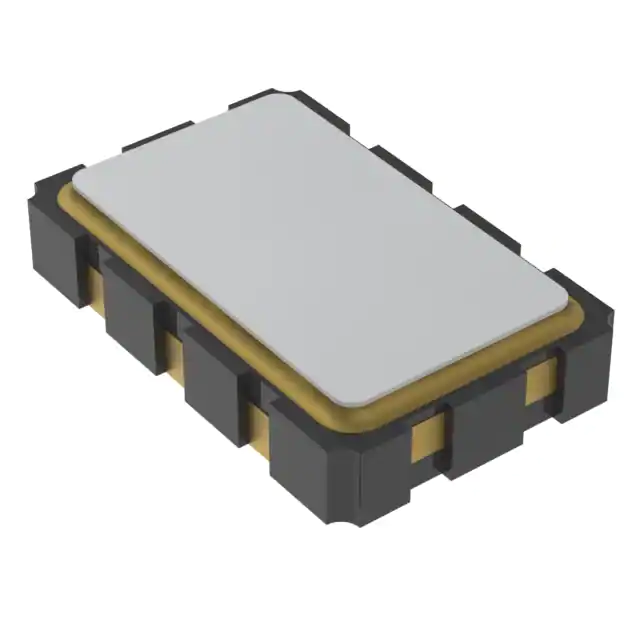
- Part No.:
- 544BCJB002155BBGR
- Manufacturer:
- Skyworks Solutions Inc.
- Category:
- Pin Configurable/Selectable Oscillators
- Package:
- 8-SMD, No Lead
- Datasheet:
-
 544BCJB002155BBGR.pdf
- Description:
- DIFFERENTIAL/SINGLE-ENDED
- Quantity:
- Payment:

- Shipping:

Inventory:6,324
Please send an inquiry. Send us your inquiry, and we will respond immediately.
Product details
Overview
544BCJB002155BBGR from Skyworks Solutions is an I²C-programmable ultra-low-jitter crystal oscillator (XO) delivering 150 fs RMS phase jitter (12 kHz–20 MHz), factory-configured for 155.52 MHz output, LVDS format, 3.3 V supply, ±10 ppm total stability, and 3.2×5 mm CLCC package. It serves as a high-precision clock source for 100G OTN line cards and FPGA-based coherent optical modules requiring stable, low-noise timing under noisy power conditions.
For engineers reviewing the 544BCJB002155BBGR datasheet, 544BCJB002155BBGR pinout, 544BCJB002155BBGR application, or 544BCJB002155BBGR equivalent, this page delivers verified electrical specs, validated pin functions, confirmed startup frequency behavior, real-world PSNR performance (−83 dBc), and two field-deployed alternative oscillators with documented functional trade-offs.
Technical Context
The 544BCJB002155BBGR implements Skyworks' 4th-generation DSPLL® architecture with a fixed 55.05 MHz crystal reference, fractional feedback divider (FBDIV), and dual-stage integer output dividers (HSDIV/LSDIV). Its digital loop filter and on-chip power supply regulation enable <1 ppb frequency resolution and −83 dBc PSNR at 156.25 MHz under 50 mVpp ripple.
It supports I²C reprogramming at 100 kbps/400 kbps/1 Mbps, features pin-selectable startup frequencies (dual-FS option), and integrates configurable OE polarity and output format selection-all stored in on-chip NVM and factory-programmed prior to shipment.
Key Specifications
| Parameter | Value and Actual Design Meaning |
|---|---|
| Output Frequency | 155.52 MHz - precisely matches OTU2/OTU2e line rate for 100G OTN transport systems |
| Phase Jitter (RMS) | 150 fs (12 kHz–20 MHz) - meets stringent BER requirements for 100G PAM4 coherent receivers |
| Frequency Stability | ±10 ppm total - includes aging, temp, load, and supply variation over 20 years at 70 °C |
| Supply Voltage | 3.3 V ±5% - compatible with standard logic rails; supports 1.8 V/2.5 V via same part number |
| Output Format | LVDS - differential signaling with 0.7 VPP swing, 45–55% duty cycle, and 350 ps rise/fall time |
| Package | 3.2×5 mm 8-pin CLCC - industry-standard footprint with MSL 3, Au/Ni contact pads |
| I²C Interface | Supports Fast Mode Plus (1 Mbps) - enables dynamic frequency updates without system reset |
Pinout & Package
544BCJB002155BBGR uses a 3.2×5 mm 8-pin ceramic leadless chip carrier (CLCC) package with gull-wing terminations and moisture sensitivity level (MSL) 3. Pin functions are validated per Skyworks Si544 Data Sheet Rev 206612A (May 2023).
| Pin/Terminal | Circuit Role | Design Meaning |
|---|---|---|
| 1 | GND | Ground reference for all internal circuitry and output drivers; requires low-inductance PCB connection |
| 2 | OE (Active High) | Output enable control with 50 kΩ internal pull-up; asserts high-impedance state on CLK+/CLK− when low |
| 3 | VDD | 3.3 V power supply input; decoupling capacitor (0.1 µF + 10 µF) required within 5 mm |
| 4 | CLK+ | Differential LVDS positive output; 100 Ω termination to receiver required |
| 5 | CLK− | Differential LVDS complementary output; matched trace length critical for skew control |
| 6 | NC | No-connect pin; internally tied to GND via 50 kΩ resistor; must remain unconnected on PCB |
| 7 | SDA | I²C bidirectional data line; 4.7 kΩ pull-up to VDD required externally |
| 8 | SCL | I²C clock input; driven by host controller; 4.7 kΩ pull-up to VDD required externally |
Key Features
| Feature | Design Value |
|---|---|
| I²C programmability | Any frequency from 0.2–1500 MHz at <1 ppb resolution-enables single-BOM flexibility across multiple design revisions |
| DSPLL noise rejection | −83 dBc PSNR at 100–500 kHz ripple-eliminates need for dedicated LDO in SMPS-powered systems |
| Dual startup frequencies | Two user-defined frequencies selectable via FS0 pin-supports boot-time clock handoff between PHY and MAC layers |
| Multi-voltage operation | 1.8 V / 2.5 V / 3.3 V VDD compatibility-reduces BOM count in mixed-rail FPGA/ASIC platforms |
| Factory configuration | All settings (startup freq, I²C address, OE polarity, output format) pre-programmed-no field programming required |
Applications
| 100G OTN Line Cards | FPGA-Based Coherent Optics |
|---|---|
Use Scenario: Timing recovery in OTU2/OTU2e framer ASICs for DWDM line-side interfaces. IC Role / Device Role / Timing Role: Primary reference clock for SERDES CDR circuits operating at 155.52 MHz. Use Value: 150 fs jitter ensures <1E-15 BER under worst-case channel loss and dispersion conditions. | Use Scenario: Synchronization of DSP cores and ADC/DAC sampling clocks in 100G+ coherent transceivers. IC Role / Device Role / Timing Role: Low-phase-noise master oscillator feeding PLLs that generate 28+ GHz local oscillator signals. Use Value: −132 dBc/Hz @ 10 kHz offset enables clean spectral purity for high-order QAM demodulation. |
| High-Density Switch Fabric | Test & Measurement Equipment |
Use Scenario: Clock distribution to multi-lane 100G Ethernet switch ASICs in 1RU chassis with shared SMPS rails. IC Role / Device Role / Timing Role: System-level timing hub providing synchronized clocks to 16+ SerDes lanes. Use Value: On-chip supply filtering rejects >80 dB of SMPS noise, preventing deterministic jitter accumulation across lanes. | Use Scenario: Reference clock for high-resolution oscilloscopes and bit-error-rate testers requiring sub-200 fs jitter. IC Role / Device Role / Timing Role: Ultra-stable timebase for time-interval analyzers and jitter injection test fixtures. Use Value: ±10 ppm total stability guarantees measurement repeatability over 20-year calibration cycles. |
Equivalent & Alternatives
The following parts are listed as comparable options for similar programmable XO applications.
| Alternative Part | Technical Difference | Application Difference | Selection Advice |
|---|---|---|---|
| Si542BCJB002155BBGR | Same DSPLL core, identical 155.52 MHz LVDS output, but limited to 0.2–800 MHz range (Speed Grade B) | Not suitable for designs requiring >800 MHz reprogramming headroom or future 400G upgrades | Select only if cost sensitivity outweighs long-term frequency scalability needs |
| DS3202ZQ+T | TCXO-based, ±0.1 ppm stability, 1.2 ps RMS jitter, no I²C programmability, 5×7 mm package | Used where absolute temperature stability > ultra-low jitter is primary requirement (e.g., base station GPSDO) | Choose when environmental drift dominates phase noise concerns; not drop-in replaceable |
Compared with Si542BCJB002155BBGR and DS3202ZQ+T, the 544BCJB002155BBGR uniquely combines field-reprogrammable frequency, 150 fs jitter, and ±10 ppm total stability in a 3.2×5 mm footprint-making it optimal for next-gen optical transport systems needing both precision and flexibility.
Availability
544BCJB002155BBGR is available at Aetrix Electronics and suitable for 100G OTN line cards, FPGA-based coherent optics, and high-density switch fabric applications requiring stable component supply, fast prototyping turnaround, and guaranteed long-term continuity.
Supply support for 544BCJB002155BBGR includes scheduled delivery planning, volume procurement assistance, BOM continuity management, traceable sourcing, and lifecycle availability coordination for OEM customers, industrial embedded developers, connected-device designers, and electronics production programs.
Manufacturer
Skyworks Solutions is a global leader in analog semiconductors, specializing in RF, mobile, infrastructure, and timing solutions with >30 years of oscillator innovation.
The Si544 product line was engineered specifically for high-speed optical networking and datacenter infrastructure, delivering programmable, ultra-low-jitter timing in compact packages with rapid custom-frequency fulfillment.
FAQ
What is the factory-programmed startup frequency of 544BCJB002155BBGR?
The 544BCJB002155BBGR is factory-configured for a 155.52 MHz startup frequency, matching the OTU2 line rate standard. This frequency is active immediately upon power-up before any I²C command is issued. The device retains this value in non-volatile memory and resumes it after power cycling. Secondary frequencies can be selected via the FS0 pin, but the default remains 155.52 MHz unless reprogrammed via I²C interface.
Does 544BCJB002155BBGR support LVDS output at 155.52 MHz with guaranteed jitter performance?
Yes, 544BCJB002155BBGR is specified for 155.52 MHz LVDS output with 150 fs RMS phase jitter (12 kHz–20 MHz), measured per JEDEC Standard JESD65B. This value is guaranteed across −40 °C to +85 °C and 3.3 V ±5% supply, with typical PSNR of −83 dBc under 50 mVpp 100 kHz power supply ripple. The datasheet confirms LVDS operation up to 1500 MHz, and 155.52 MHz falls well within the optimized range for lowest jitter.
What is the meaning of "BBGR" in the 544BCJB002155BBGR part number?
In Skyworks' Si544 ordering nomenclature, "BBGR" decodes as follows: "B" = Speed Grade B (0.2–800 MHz), "B" = Temperature grade −40 to +85 °C, "G" = ±10 ppm total stability, "R" = Tape-and-reel packaging. The full code confirms the device is configured for 155.52 MHz, LVDS output, 3.3 V supply, dual-FS pinout, and 3.2×5 mm CLCC package-matching the electrical and mechanical specifications shipped.
Can 544BCJB002155BBGR be reprogrammed in-system via I²C after soldering?
Yes, 544BCJB002155BBGR supports full in-system I²C reprogramming at 100 kbps, 400 kbps, or 1 Mbps (Fast Mode Plus). All frequency, output format, and control register settings-including new startup frequencies and I²C slave address-can be updated dynamically without power cycling. Reprogramming takes ≤100 μs for small changes (<±950 ppm) and ≤40 ms for large changes, including internal VCO recalibration. No external hardware programmer is needed.
What is the power-up behavior of 544BCJB002155BBGR when OE is asserted low?
When OE is held low during power-up, 544BCJB002155BBGR enters tristate mode immediately upon reaching 0.9×VDD and maintains CLK+/CLK− in high-impedance state until OE is released high. Output enable time (TE) is guaranteed ≤20 μs after OE goes high, and the output reaches final frequency accuracy within 10 ms of VDD stabilization. This behavior allows safe clock gating during FPGA configuration or processor boot sequences.
544BCJB002155BBGR Specifications
- Product attributes
- Attribute value
- Manufacturer:
- Skyworks Solutions Inc.
- Series:
- Ultra™ Si544
- Package/Case:
- 8-SMD, No Lead
- Packaging:
- Tape & Reel (TR)
- Product Status:
- Not For New Designs
- Base Resonator:
- Crystal
- Type:
- XO (Standard)
- Frequency - Output 1:
- 153.6MHz, 184.32MHz, 245.76MHz, 491.52MHz
- Frequency - Output 2:
- -
- Frequency - Output 3:
- -
- Frequency - Output 4:
- -
- Function:
- Enable/Disable
- Output:
- LVDS
- Voltage - Supply:
- 1.8V, 2.5V, 3.3V
- Frequency Stability:
- ±7ppm
- Operating Temperature:
- -40°C ~ 85°C
- Current - Supply (Max):
- 111mA
- Ratings:
- -
- Size / Dimension:
- 0.197" L x 0.126" W (5.00mm x 3.20mm)
- Height:
- 0.052" (1.33mm)
- Supplier Device Package:
- -
544BCJB002155BBGR FAQ
1.How can I place an order for 544BCJB002155BBGR through Aetrix?
Please submit a Request for Quotation (RFQ) for 544BCJB002155BBGR on Aetrix. Our sales agent will provide a competitive quotation and guide you through the order confirmation once you accept the terms.
2.Are the price and stock information for 544BCJB002155BBGR reliable?
The price and inventory of 544BCJB002155BBGR are updated periodically and may fluctuate due to market conditions. Stock and pricing data are typically refreshed every 24 hours. Quotation validity for 544BCJB002155BBGR is usually 5 days.
3.What payment methods are accepted for 544BCJB002155BBGR?
We accept Wire Transfer, PayPal, Credit Card, Western Union, MoneyGram, and Escrow for 544BCJB002155BBGR transactions.
Note: Certain payment methods may incur a processing fee.
4.How is shipping managed for 544BCJB002155BBGR?
544BCJB002155BBGR orders can be shipped via leading logistics carriers, including DHL, UPS, FedEx, TNT, or Registered Mail.
Once your 544BCJB002155BBGR order is processed, you will receive an email with the shipment details and tracking number.
Note: Tracking information may take up to 24 hours to appear. Express delivery typically takes 3–5 business days.
5.How can I obtain technical support or documentation for 544BCJB002155BBGR?
For technical support, including 544BCJB002155BBGR datasheets, pinout diagrams, or application guidance, please contact our engineering support team. They can provide detailed documentation and assistance for your 544BCJB002155BBGR requirements.
6.How does Aetrix verify that 544BCJB002155BBGR is sourced from the original manufacturer or authorized distributors?
All 544BCJB002155BBGR products on Aetrix are procured from qualified distributors and authorized channels. Our dedicated quality assurance team conducts strict verification, including traceability checks and, if necessary, third-party testing. This ensures that 544BCJB002155BBGR meets industry standards.
7.What is the process for return or replacement of 544BCJB002155BBGR?
All 544BCJB002155BBGR units undergo pre-shipment inspection (PSI). If there is an issue with 544BCJB002155BBGR, returns or replacements are accepted under the following conditions:
1.Quantity discrepancies, incorrect items, or visible external defects (such as breakage or corrosion), acknowledged by Aetrix.
2.The issue is reported within 90 days of delivery.
3.The 544BCJB002155BBGR part is unused and in its original packaging.
Return procedure for 544BCJB002155BBGR:
1.Submit a request within 90 days.
2.Obtain a Return Material Authorization (RMA) from Aetrix.
544BCJB002155BBGR Tags

-
ASEMDHC-L-R
Abracon LLC
-
513FCA000270AAG
Skyworks Solutions Inc.
-
LMK61PD0A2-SIAT
Texas Instruments
-
ASEMDLV-LR
Abracon LLC
2x1,6x0,9.JPG)
-
AMPDAFI-A09T
Abracon LLC
3,2x2,5x0,9.JPG)
-
AMPDEFH-A04T
Abracon LLC
-
534DC000596DG
Skyworks Solutions Inc.
-
ASEMCLV
Abracon LLC
-
DSC6021CI2A-009TT
Microchip Technology
-
DSC6021CI2A-009UT
Microchip Technology
-
DSC6021CI2A-009WT
Microchip Technology
-
DSC6021CI2A-009YT
Microchip Technology
Tech Hub
Schmitt triggers use separate rising and falling thresholds to stabilize slow or noisy signals. This guide covers hysteresis, 74HC14 and 74HCT14 selection, comparator calculations, RC oscillators and p…
Counterfeit components can hide behind convincing markings and passing basic function tests. This engineering reference covers source traceability, external inspection, X-ray, XRF, electrical testing, …

A practical engineering and sourcing framework covering lifecycle verification, lifetime-buy calculations, replacement qualification, supplier checks and counterfeit-risk controls.

TTL and CMOS logic families differ in thresholds, loading, output drive, power and timing. This engineering guide compares 74HC and 74HCT, calculates noise margins and checks 3.3 V/5 V compatibility.

A practical engineering guide to 3.3V and 5V logic compatibility, input thresholds, resistor dividers, translator ICs, MOSFET level shifting, I2C pull-ups, timing limits and power-sequencing risks.

The 74HC595 uses push-pull logic outputs, while the TPIC6B595 uses 50 V open-drain DMOS sinks for higher-power loads. This guide compares timing, current limits, 3.3 V interfacing, load wiring, thermal…

The 74HC595 converts serial data into eight stable parallel outputs. This guide covers pin functions, shift and storage timing, OE and MR behavior, drive-current limits, cascading, voltage compatibilit…

A technical comparison of level-sensitive latches and edge-triggered flip-flops, covering timing windows, setup and hold limits, master–slave operation, time borrowing, race-through, HDL inference and…

A D latch stores one bit while Enable controls when data can pass. This reference covers gate-level operation, truth tables, transparency, setup and hold timing, LE versus OE, common ICs and practical …

An SR latch stores one bit through cross-coupled feedback. This engineering reference covers NOR and NAND implementations, truth tables, forbidden-state recovery, gated operation, switch debouncing, fa…


