
 My Inquiry
 My Account


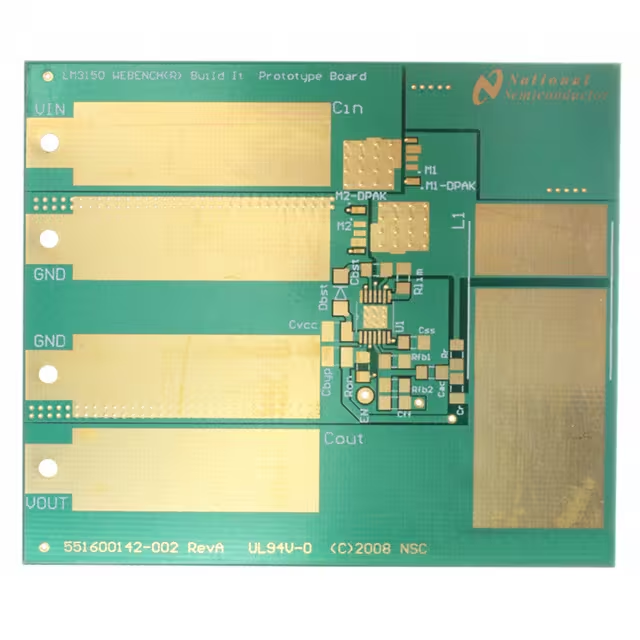
Texas Instruments 551600142-002/NOPB
- Part No.:
- 551600142-002/NOPB
- Manufacturer:
- Texas Instruments
- Package:
- Datasheet:
-
 551600142-002/NOPB.pdf
- Description:
- EVAL BOARD FOR LM3150
- Quantity:
- Payment:

- Shipping:

Inventory:3,379
Please send an inquiry. Send us your inquiry, and we will respond immediately.
Product details
Overview
LM3150-002/NOPB from Texas Instruments is a wide-input synchronous buck controller IC designed for high-efficiency DC-DC conversion in industrial and telecom power supplies. It operates from 6 V to 42 V input, delivers adjustable output down to 0.6 V, supports up to 1 MHz switching frequency, and employs constant-on-time (COT) control with emulated ripple mode (ERM) for fast transient response in telecom base station power modules.
For engineers reviewing the LM3150-002/NOPB datasheet, LM3150-002/NOPB pinout, LM3150-002/NOPB application, or LM3150-002/NOPB equivalent, key selection criteria include its valley current limit architecture, RON-based on-time programming, bootstrap gate drive capability, and compatibility with low-ESR ceramic output capacitors in space-constrained 12 A POL designs.
Technical Context
The LM3150-002/NOPB implements a proprietary emulated ripple mode (ERM) variant of constant-on-time (COT) control, enabling stable regulation without loop compensation while supporting ultra-low-ESR ceramic output capacitors. Its on-time is programmable via external RON resistor and automatically scaled inversely with VIN to maintain near-constant frequency across input range.
Fault protection includes valley current limiting via ILIM pin with temperature-compensated 85 µA sense current, overvoltage shutdown at 0.72 V FB threshold, thermal shutdown at 165°C, and pre-biased soft-start recovery - all integrated without requiring external supervision circuitry.
Key Specifications
| Parameter | Value and Actual Design Meaning |
|---|---|
| Input Voltage Range | 6 V to 42 V - supports 24 V and 48 V telecom/industrial rails with margin for transients |
| Output Voltage Range | Adjustable down to 0.6 V - enables precise regulation for modern low-voltage ASICs and FPGAs |
| Switching Frequency | Up to 1 MHz - allows compact magnetics and high-density layout in POL applications |
| Feedback Reference | 0.6 V ±1.2% - sets output voltage accuracy via external resistor divider (RFB1/RFB2) |
| Current Limit Sense | 85 µA ILIM-TH current source - enables accurate valley current limiting using RDS(ON) or discrete sense resistor |
| Soft-Start Current | 7.7 µA typical ISS - determines ramp time of FB voltage during startup via external CSS capacitor |
| Thermal Shutdown | 165°C junction temperature - disables switching and discharges SS pin to prevent thermal runaway |
Pinout & Package
LM3150-002/NOPB is housed in a thermally enhanced HTSSOP-14 (PWP) package measuring 5.00 mm × 4.40 mm with exposed pad for improved heat dissipation and SGND connection.
| Pin/Terminal | Circuit Role | Design Meaning |
|---|---|---|
| VCC | Internal LDO output | Regulated ~5.95 V supply for gate drivers and bias circuits; requires 1–4.7 µF decoupling to SGND |
| VIN | Main power input | Primary input rail (6–42 V); powers internal circuitry and supplies HG/LG drivers via VCC and BST |
| EN | Enable control | Logic-high enable (>1.26 V) or floating; grounding disables device with <55 µA shutdown current |
| FB | Voltage feedback node | Compares output voltage (via RFB1/RFB2 divider) to 0.6 V reference; triggers on-time when below threshold |
| SS | Soft-start timing | 7.7 µA current source charges external capacitor to ramp FB voltage linearly during startup |
| RON | On-time programming | Resistor from VIN sets nominal on-time; tON = K·RON/VIN (K = 100 pC) for frequency stability |
| ILIM | Valley current sense | Sinks 85 µA to set current limit threshold; compares low-side FET current against RLIM-defined ICL |
| SW | Switch node | Connection point between high-side and low-side MOSFETs; drives BST capacitor and HG driver return |
| HG | High-side gate drive | PWM output driving high-side NMOS gate; voltage swing referenced to SW node (bootstrap operation) |
| BST | Bootstrap supply | Upper rail for HG driver; requires 0.33–0.47 µF capacitor between BST and SW pins |
| LG | Low-side gate drive | PWM output driving low-side NMOS gate; powered from VCC rail |
| PGND | Power ground | Source connection for synchronous rectifier; must tie to PCB power ground plane and connect to SGND at single point |
| SGND | Signal ground | Reference for internal comparators, regulators, and feedback; isolated from PGND except at star point |
| EP | Exposed pad | Internally connected to SGND; must be soldered to thermal pad for electrical and thermal integrity |
Key Features
| Feature | Design Value |
|---|---|
| No loop compensation required | Reduces BOM count by eliminating external Type-II/III compensation network and associated tuning effort |
| Emulated ripple mode (ERM) | Enables use of low-ESR ceramic capacitors instead of high-ESR electrolytics, cutting output ripple and solution size |
| Output voltage pre-bias startup | Supports controlled ramp-up into existing output voltage (e.g., hot-swap or backup systems) without reverse current |
| Valley current limiting | Detects inductor valley current during off-time to prevent saturation and runaway under overload or short-circuit |
| Temperature-compensated ILIM-TH | Adjusts 85 µA sense current with die temperature to maintain stable current limit despite RDS(ON) drift in low-side FET |
Applications
| Telecom Power Supply | Industrial PLC Module |
|---|---|
Use Scenario: 48 V input conversion to 3.3 V/12 A for baseband processing units in 5G remote radio heads. IC Role / Device Role / Timing Role: Synchronous buck controller managing high-efficiency POL conversion with fast load-step response to burst-mode traffic. Use Value: ERM control ensures <50 mV output ripple with 22 µF ceramic output capacitance, meeting strict RF subsystem noise requirements. | Use Scenario: 24 V field bus input converted to 5 V/8 A for I/O module microcontrollers and sensor interfaces in factory automation. IC Role / Device Role / Timing Role: Primary DC-DC controller providing regulated rail with robust fault handling in dusty, high-temperature environments. Use Value: Thermal shutdown at 165°C and valley current limit prevent latch-up during motor stall-induced overloads on shared 24 V bus. |
| Networking Router PSU | Security Camera Power Module |
Use Scenario: Distributed 12 V rail generation from 48 V backplane in enterprise layer-3 switches with dynamic CPU core loading. IC Role / Device Role / Timing Role: High-frequency (800 kHz) buck controller delivering tight regulation during multi-amp load transients across 100 ns timescales. Use Value: COT architecture achieves <10 µs recovery time from 50%–100% load step, maintaining Ethernet PHY timing margins. | Use Scenario: Outdoor PoE-powered camera requiring reliable 12 V/2 A output from variable 44–57 V IEEE 802.3af/at input. IC Role / Device Role / Timing Role: Wide-VIN buck controller with UVLO hysteresis and pre-bias startup for seamless failover between PoE and local adapter. Use Value: Adjustable RON-based on-time maintains stable 850 kHz operation across full PoE voltage range, minimizing EMI filter size. |
Equivalent & Alternatives
The following parts are listed as comparable options for similar synchronous buck controller applications.
| Alternative Part | Technical Difference | Application Difference | Selection Advice |
|---|---|---|---|
| LM5116PWPR | Current-mode controller with 3–75 V input, no integrated gate drivers - requires external high/low-side drivers | Designed for higher input voltages and higher power (>30 A), less suitable for compact 12 A POL layouts | Select when >60 V input or need programmable slope compensation; not drop-in for LM3150-002/NOPB footprint |
| TPS54560RGTT | Integrated 60 V, 5 A buck converter (not controller) - includes MOSFETs, fixed 570 kHz frequency, no RON programming | Lower current rating and non-adjustable frequency limit scalability in multi-rail telecom systems | Choose for simpler 5 A designs where board space outweighs flexibility; requires redesign for >5 A or custom frequency |
Compared with LM5116PWPR and TPS54560RGTT, the LM3150-002/NOPB uniquely balances wide input range, external MOSFET flexibility, and COT-based transient performance in a 14-pin HTSSOP package - making it optimal for cost-sensitive, high-density 12 A POL applications where design reuse and WEBENCH integration matter.
Availability
LM3150-002/NOPB is available at Aetrix Electronics and suitable for telecom infrastructure, industrial PLCs, and networking equipment requiring stable component supply with long-term lifecycle support and consistent parametric performance.
Supply support for LM3150-002/NOPB includes scheduled delivery planning, volume procurement assistance, BOM continuity management, traceable sourcing, and lifecycle availability coordination for OEM customers, industrial embedded developers, connected-device designers, and electronics production programs.
Manufacturer
Texas Instruments is a global semiconductor leader specializing in analog, embedded processing, and power management technologies with broad industrial and automotive portfolio coverage.
The LM3150 product line delivers easy-to-use synchronous buck controllers targeting high-efficiency, low-external-component-count DC-DC solutions for 6–42 V input systems in telecom, networking, and industrial power applications.
FAQ
What is the recommended input capacitor for LM3150-002/NOPB in a 48 V input, 3.3 V/12 A application?
The LM3150-002/NOPB datasheet specifies that the input capacitor must have voltage rating ≥ VIN(max) and low ESR to handle peak input current. For 48 V input, a 63 V-rated 47 µF X7R ceramic or 100 µF low-ESR polymer capacitor is recommended. Layout best practice requires placing CIN within 5 mm of VIN and PGND pins to minimize high-frequency loop inductance and prevent EN oscillation.
Does LM3150-002/NOPB support diode emulation mode during light-load operation?
Yes, the LM3150-002/NOPB enters diode emulation mode at light loads: LG turns off when inductor current reaches zero, preventing reverse current flow and improving efficiency. This behavior is automatic and does not require external control signals. The mode activates during soft-start and persists below ~15% load, verified in Figure 13 of the LM3150-002/NOPB datasheet.
How is the switching frequency calculated for LM3150-002/NOPB when using RON = 100 kΩ and VIN = 24 V?
Using the LM3150-002/NOPB formula fS ≈ VOUT/(K × RON) with K = 100 pC, a 100 kΩ RON yields ~417 kHz at 1 V output. At VIN = 24 V and VOUT = 3.3 V, actual frequency is ~500 kHz due to on-time scaling (tON ∝ RON/VIN). Measured data in Figure 7 confirms 480–520 kHz across temperature for this configuration.
Can LM3150-002/NOPB safely start into a pre-biased output voltage?
Yes, the LM3150-002/NOPB supports pre-bias startup via diode emulation mode during soft-start. When VOUT is already present, the controller ramps FB voltage from 0 V to 0.6 V while keeping LG off until inductor current goes negative - preventing reverse current. This is confirmed in Section 8.3.6 and Figure 13 of the LM3150-002/NOPB datasheet.
What is the minimum recommended BST capacitor value for LM3150-002/NOPB at 1 MHz operation?
The LM3150-002/NOPB datasheet specifies 0.33 µF to 0.47 µF for BST capacitor. At 1 MHz, 0.47 µF is preferred to ensure sufficient charge reservoir for HG driver during short on-times; lower values risk BST undervoltage and HG dropout. Use X7R dielectric with ≤2 mm trace length between BST and SW pins to minimize AC impedance.
551600142-002/NOPB Specifications
- Product attributes
- Attribute value
- Manufacturer:
- Texas Instruments
- Series:
- WEBENCH® Buildit Board
- Packaging:
- Bulk
- Product Status:
- Obsolete
- Main Purpose:
- DC/DC, Step Down
- Outputs and Type:
- 1 Non-Isolated Output
- Voltage - Output:
- -
- Current - Output:
- -
- Voltage - Input:
- -
- Regulator Topology:
- -
- Frequency - Switching:
- Buck
- Contents:
- -
- Utilized IC / Part:
- Unpopulated (Bare) Board(s)
- Power - Output:
- LM3150
551600142-002/NOPB FAQ
1.How can I place an order for 551600142-002/NOPB through Aetrix?
Please submit a Request for Quotation (RFQ) for 551600142-002/NOPB on Aetrix. Our sales agent will provide a competitive quotation and guide you through the order confirmation once you accept the terms.
2.Are the price and stock information for 551600142-002/NOPB reliable?
The price and inventory of 551600142-002/NOPB are updated periodically and may fluctuate due to market conditions. Stock and pricing data are typically refreshed every 24 hours. Quotation validity for 551600142-002/NOPB is usually 5 days.
3.What payment methods are accepted for 551600142-002/NOPB?
We accept Wire Transfer, PayPal, Credit Card, Western Union, MoneyGram, and Escrow for 551600142-002/NOPB transactions.
Note: Certain payment methods may incur a processing fee.
4.How is shipping managed for 551600142-002/NOPB?
551600142-002/NOPB orders can be shipped via leading logistics carriers, including DHL, UPS, FedEx, TNT, or Registered Mail.
Once your 551600142-002/NOPB order is processed, you will receive an email with the shipment details and tracking number.
Note: Tracking information may take up to 24 hours to appear. Express delivery typically takes 3–5 business days.
5.How can I obtain technical support or documentation for 551600142-002/NOPB?
For technical support, including 551600142-002/NOPB datasheets, pinout diagrams, or application guidance, please contact our engineering support team. They can provide detailed documentation and assistance for your 551600142-002/NOPB requirements.
6.How does Aetrix verify that 551600142-002/NOPB is sourced from the original manufacturer or authorized distributors?
All 551600142-002/NOPB products on Aetrix are procured from qualified distributors and authorized channels. Our dedicated quality assurance team conducts strict verification, including traceability checks and, if necessary, third-party testing. This ensures that 551600142-002/NOPB meets industry standards.
7.What is the process for return or replacement of 551600142-002/NOPB?
All 551600142-002/NOPB units undergo pre-shipment inspection (PSI). If there is an issue with 551600142-002/NOPB, returns or replacements are accepted under the following conditions:
1.Quantity discrepancies, incorrect items, or visible external defects (such as breakage or corrosion), acknowledged by Aetrix.
2.The issue is reported within 90 days of delivery.
3.The 551600142-002/NOPB part is unused and in its original packaging.
Return procedure for 551600142-002/NOPB:
1.Submit a request within 90 days.
2.Obtain a Return Material Authorization (RMA) from Aetrix.
551600142-002/NOPB Tags
-
DFR0571
DFRobot
-
DFR0379
DFRobot
-
DFR0205
DFRobot
-
1385
Adafruit Industries LLC
-
COM-15208
SparkFun Electronics
-
1944
Adafruit Industries LLC
-
2465
Adafruit Industries LLC
-
DC2468A
Analog Devices Inc.
-
DC2841A
Analog Devices Inc.

-
TPS552892EVM-111
Texas Instruments
-
TPS55289EVM-093
Texas Instruments
-
EPC9158
EPC
Tech Hub

A practical engineering guide to 3.3V and 5V logic compatibility, input thresholds, resistor dividers, translator ICs, MOSFET level shifting, I2C pull-ups, timing limits and power-sequencing risks.

The 74HC595 uses push-pull logic outputs, while the TPIC6B595 uses 50 V open-drain DMOS sinks for higher-power loads. This guide compares timing, current limits, 3.3 V interfacing, load wiring, thermal…

The 74HC595 converts serial data into eight stable parallel outputs. This guide covers pin functions, shift and storage timing, OE and MR behavior, drive-current limits, cascading, voltage compatibilit…

A technical comparison of level-sensitive latches and edge-triggered flip-flops, covering timing windows, setup and hold limits, master–slave operation, time borrowing, race-through, HDL inference and…

A D latch stores one bit while Enable controls when data can pass. This reference covers gate-level operation, truth tables, transparency, setup and hold timing, LE versus OE, common ICs and practical …

An SR latch stores one bit through cross-coupled feedback. This engineering reference covers NOR and NAND implementations, truth tables, forbidden-state recovery, gated operation, switch debouncing, fa…

Latch circuits retain one bit through feedback. This technical reference covers SR and D latches, truth tables, transparency, timing limits, latch-versus-flip-flop behavior, applications and common log…

An engineering guide to LED driver operation, constant-current and constant-voltage outputs, linear and switching topologies, dimming, IC selection, calculations, replacement compatibility, and fault c…

Operational amplifier guide covering op amp basics, feedback, ideal vs real op amps, common configurations, buffer circuits, offset, bias current, gain-bandwidth, slew rate, rail-to-rail limits and sel…

Jumper cables guide covering safe connection order, red and black clamp placement, final ground connection, cable gauge, length, clamp quality, copper vs CCA cables, jump starter comparison and battery…


