
 My Inquiry
 My Account


Skyworks Solutions Inc. 564AAJA002160ABGR
- Part No.:
- 564AAJA002160ABGR
- Manufacturer:
- Skyworks Solutions Inc.
- Category:
- Pin Configurable/Selectable Oscillators
- Package:
- 8-SMD, No Lead
- Datasheet:
-
 564AAJA002160ABGR.pdf
- Description:
- DIFFERENTIAL/SINGLE-ENDED
- Quantity:
- Payment:

- Shipping:

Inventory:8,177
Please send an inquiry. Send us your inquiry, and we will respond immediately.
Product details
Overview
564AAJA002160ABGR from Skyworks Solutions is an I²C-programmable ultra-low-jitter crystal oscillator (XO) delivering user-defined frequencies from 0.2 to 3000 MHz with <1 ppb resolution. It features 90 fs RMS phase jitter (12 kHz–20 MHz), ±50 ppm total frequency stability over –40 to +85 °C, and supports LVPECL/LVDS/CML/HCSL/CMOS/Dual CMOS output formats in a 5×7 mm CLCC package. It serves as a programmable clock source for high-speed optical networking and FPGA timing.
For engineers reviewing the 564AAJA002160ABGR datasheet, 564AAJA002160ABGR pinout, 564AAJA002160ABGR application, or 564AAJA002160ABGR equivalent, this device enables rapid custom-frequency deployment without crystal change-critical for 100G/400G OTN, coherent optics, and high-density server clock trees where jitter, supply noise immunity, and multi-format flexibility are design-critical.
Technical Context
The 564AAJA002160ABGR implements Skyworks' 4th-generation DSPLL® architecture with a fixed 152.6 MHz crystal reference and fractional-N feedback divider (FBDIV, 11.32-bit format), high-speed integer divider (HSDIV, 4–2046), and power-of-2 low-speed divider (LSDIV, 1–32). This enables glitchless frequency reprogramming across its full range.
It integrates on-chip power supply regulation and >–80 dBc PSNR, allowing stable operation under switched-mode supply noise. Startup frequency, I²C address, OE polarity, and pin-selectable frequency select (FS0/FS1) are factory-configured per order-no field programming required for baseline operation.
Key Specifications
| Parameter | Value and Actual Design Meaning |
|---|---|
| Frequency Range | 0.2–3000 MHz (LVPECL/LVDS/CML); supports exact user-defined values with <1 ppb resolution |
| Phase Jitter (RMS) | 90 fs typ. (12 kHz–20 MHz, ≥200 MHz output); guarantees signal integrity in 100G+ serial links |
| Total Frequency Stability | ±50 ppm (–40 to +85 °C, including aging, load, and supply variation over 20 years) |
| Supply Voltage | 1.8 V / 2.5 V / 3.3 V (single part number supports all three rails without redesign) |
| Output Formats | LVPECL, LVDS, CML, HCSL, CMOS, Dual CMOS (in-phase or complementary) |
| I²C Interface | Supports 100 kbps, 400 kbps, and 1 Mbps (Fast Mode Plus); enables host-controlled dynamic frequency updates |
| Package | 5×7 mm 8-pin CLCC; industry-standard footprint with GND, VDD, CLK+/CLK−, SDA, SCL, OE/FS pins |
Pinout & Package
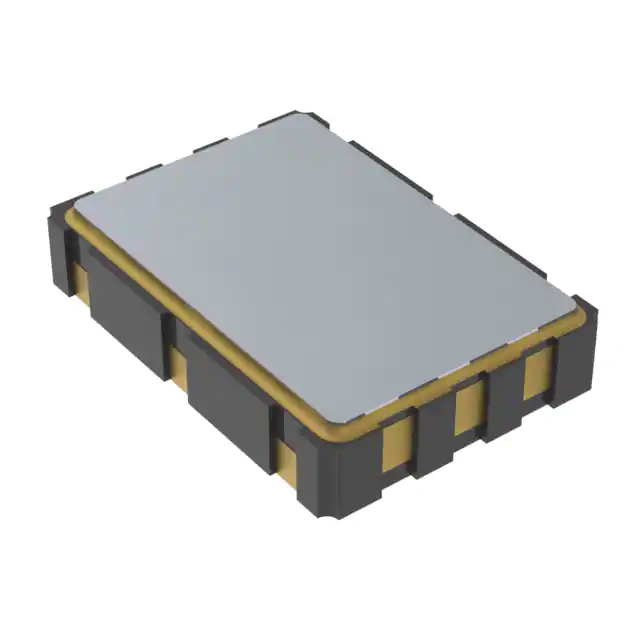
564AAJA002160ABGR is housed in a hermetically sealed 5×7 mm 8-pin CLCC package with gold-plated contact pads (Au/Ni), MSL Level 1, and JEDEC-compliant reflow profile (260 °C peak).
| Pin/Terminal | Circuit Role | Design Meaning |
|---|---|---|
| 1, 2 | Selectable OE/FS/NC | Factory-configured as Output Enable (active-high/low), Frequency Select (FS0/FS1), or No Connect; internal 50 kΩ pull-up/down |
| 3 | GND | Dedicated ground terminal; requires low-inductance PCB connection for jitter performance |
| 4 | CLK+ | Differential clock output positive leg; used for LVPECL/LVDS/CML/HCSL; unused in CMOS mode |
| 5 | CLK− | Differential clock output negative leg; complements CLK+; not used in single-ended CMOS |
| 6 | VDD | Single power supply input (1.8/2.5/3.3 V); includes on-chip filtering for >–80 dBc PSNR |
| 7 | SDA | I²C bidirectional data line; 0.3×VDD/0.7×VDD logic thresholds; requires external pull-up |
| 8 | SCL | I²C clock input; synchronous with SDA; supports up to 1 Mbps Fast Mode Plus timing |
Key Features
| Feature | Design Value |
|---|---|
| I²C programmability | Enables field or production-line frequency configuration without hardware change-replaces multiple fixed-XOs with one SKU |
| Ultra-low 90 fs jitter | Meets stringent BER requirements for 400G PAM4 and coherent optical interfaces at 64G+ baud rates |
| Multi-voltage operation | Eliminates voltage-level translation circuitry when interfacing with 1.8 V FPGAs, 2.5 V ASICs, or 3.3 V legacy logic |
| Dual CMOS output option | Provides two synchronized, identical-frequency outputs (in-phase or complementary) to drive dual-clock domains from one device |
| On-chip PSNR filtering | Reduces need for external LDOs or ferrite beads in noisy switch-mode power supply environments (e.g., server motherboards) |
Applications
| 100G/400G OTN & Coherent Optics | High-Density Server Clocking |
|---|---|
Use Scenario: Generating precise reference clocks for 400G ZR/ZR+ coherent transceivers and OTN framers requiring sub-100 fs jitter. IC Role / Device Role / Timing Role: Primary system clock source with programmable frequency agility to support multiple modulation schemes (DP-QPSK, 16-QAM) and FEC variants. Use Value: Enables single-part-number clock provisioning across line cards with varying line-rate requirements-reducing BOM count and qualification effort. | Use Scenario: Providing synchronized, low-jitter clocks to CPU, memory controller, PCIe Gen5/6 retimers, and SmartNICs in 2U/4U rack servers. IC Role / Device Role / Timing Role: Central timing hub distributing multiple independent frequencies (e.g., 100 MHz PCIe, 133.33 MHz DDR5, 322.265625 MHz SerDes) from one device. Use Value: Replaces 3–4 discrete XOs with one 564AAJA002160ABGR, reducing PCB area by >60% and eliminating inter-XO skew. |
| FPGA/ASIC Development Platforms | Broadcast Video (12G-SDI/24G-SDI) |
Use Scenario: Supplying configurable reference clocks during FPGA prototyping and ASIC bring-up where frequency requirements evolve across iterations. IC Role / Device Role / Timing Role: Reconfigurable clock generator supporting dynamic PLL reconfiguration, jitter margin testing, and multi-standard compliance validation (PCIe, USB4, CXL). Use Value: Eliminates respins due to clock frequency mismatches; enables same hardware to validate multiple SoC revisions via I²C command. | Use Scenario: Driving 24G-SDI serial digital interface receivers requiring 297 MHz or 594 MHz reference with <100 fs jitter to meet SMPTE ST 2083-1 eye diagram masks. IC Role / Device Role / Timing Role: Master timing source for video encoder/decoder ASICs and reclocking ICs in UHD broadcast infrastructure. Use Value: Guarantees deterministic setup/hold margins at 24 Gbps; avoids frame sync loss caused by excessive period jitter in long-haul fiber links. |
Equivalent & Alternatives
The following parts are listed as comparable options for similar programmable oscillator applications.
| Alternative Part | Technical Difference | Application Difference | Selection Advice |
|---|---|---|---|
| Si569AC000113AGM | Same Si564 family; 3.2×5 mm package, ±20 ppm temp stability (Grade B), LVDS-only output | Better stability for lab-grade test equipment; smaller footprint for space-constrained modules | Select when tighter temperature stability and compact size outweigh multi-format flexibility |
| Si549BB000111DG | Si54x series; 2.5×3.2 mm, 0.2–1500 MHz, 110 fs jitter, CMOS-only output, no I²C | Lower cost, simpler integration for fixed-frequency embedded control; no reprogrammability | Select for cost-sensitive industrial controllers where frequency is static and board space is premium |
Compared with Si569AC000113AGM and Si549BB000111DG, the 564AAJA002160ABGR offers broader frequency coverage (0.2–3000 MHz), lowest jitter (90 fs), and full I²C configurability-making it optimal for high-performance, multi-standard systems where flexibility and signal integrity are non-negotiable.
Availability
564AAJA002160ABGR is available at Aetrix Electronics and suitable for 100G/400G optical networking, high-density server clock trees, and FPGA-based prototyping platforms requiring stable component supply, fast sampling, and long-term lifecycle continuity.
Supply support for 564AAJA002160ABGR includes scheduled delivery planning, volume procurement assistance, BOM continuity management, traceable sourcing, and lifecycle availability coordination for OEM customers, industrial embedded developers, connected-device designers, and electronics production programs.
Manufacturer
Skyworks Solutions is a global leader in analog and mixed-signal semiconductors, specializing in RF, timing, and precision analog components for communications, automotive, and industrial markets.
The Si564 Ultra Series™ is engineered for high-speed digital systems demanding ultra-low jitter, field-programmable frequency agility, and robust supply noise rejection-targeting next-gen optical transport, AI accelerators, and real-time video infrastructure.
FAQ
What output frequency ranges does the 564AAJA002160ABGR support?
The 564AAJA002160ABGR supports 0.2 to 3000 MHz for LVPECL, LVDS, and CML outputs; 0.2 to 400 MHz for HCSL; and 0.2 to 250 MHz for CMOS and Dual CMOS formats. These ranges are guaranteed across its full operating temperature (–40 to +85 °C) and supply voltage (1.8/2.5/3.3 V) specifications per Skyworks' Si564 datasheet Rev. 206621A.
Does the 564AAJA002160ABGR require external configuration after soldering?
No-the 564AAJA002160ABGR ships with factory-programmed startup frequency, I²C address, output format, and OE/FS pin configuration. I²C reprogramming is optional and only needed if dynamic frequency changes are required during system operation; default behavior is immediate clock output at power-up.
What is the phase jitter performance of the 564AAJA002160ABGR at 156.25 MHz?
At 156.25 MHz LVPECL output, the 564AAJA002160ABGR delivers 95 fs RMS phase jitter (12 kHz–20 MHz), as specified in Table 2.3 of the Si564 datasheet. This meets OC-192/STM-64 SONET/SDH jitter limits and exceeds IEEE 802.3ba CAUI-4 requirements for 100G Ethernet.
Can the 564AAJA002160ABGR operate from a 1.8 V supply while driving LVPECL outputs?
Yes-the 564AAJA002160ABGR supports 1.8 V VDD operation with LVPECL output enabled. Its LVPECL driver is designed for 1.8/2.5/3.3 V rails; typical supply current is 110–160 mA, and output common-mode voltage shifts accordingly (e.g., VOC ≈ VDD – 1.335 V at 1.8 V).
How does the 564AAJA002160ABGR achieve –80 dBc PSNR without external filtering?
The 564AAJA002160ABGR integrates on-die power supply regulation and proprietary noise-rejection circuitry that attenuates supply ripple across 100 kHz–1 MHz bands by >–80 dBc (typ.), as measured with 50 mVpp sine-wave injection. This eliminates need for external LDOs or LC filters in most server and optical module designs.
564AAJA002160ABGR Specifications
- Product attributes
- Attribute value
- Manufacturer:
- Skyworks Solutions Inc.
- Series:
- Ultra™ Si564
- Package/Case:
- 8-SMD, No Lead
- Packaging:
- Tape & Reel (TR)
- Product Status:
- Not For New Designs
- Base Resonator:
- Crystal
- Type:
- XO (Standard)
- Frequency - Output 1:
- 25MHz, 50MHz, 72MHz, 160MHz
- Frequency - Output 2:
- -
- Frequency - Output 3:
- -
- Frequency - Output 4:
- -
- Function:
- Enable/Disable
- Output:
- LVPECL
- Voltage - Supply:
- 2.5V, 3.3V
- Frequency Stability:
- ±20ppm
- Operating Temperature:
- -40°C ~ 85°C
- Current - Supply (Max):
- 160mA
- Ratings:
- -
- Size / Dimension:
- 0.276" L x 0.197" W (7.00mm x 5.00mm)
- Height:
- 0.052" (1.33mm)
- Supplier Device Package:
- -
564AAJA002160ABGR FAQ
1.How can I place an order for 564AAJA002160ABGR through Aetrix?
Please submit a Request for Quotation (RFQ) for 564AAJA002160ABGR on Aetrix. Our sales agent will provide a competitive quotation and guide you through the order confirmation once you accept the terms.
2.Are the price and stock information for 564AAJA002160ABGR reliable?
The price and inventory of 564AAJA002160ABGR are updated periodically and may fluctuate due to market conditions. Stock and pricing data are typically refreshed every 24 hours. Quotation validity for 564AAJA002160ABGR is usually 5 days.
3.What payment methods are accepted for 564AAJA002160ABGR?
We accept Wire Transfer, PayPal, Credit Card, Western Union, MoneyGram, and Escrow for 564AAJA002160ABGR transactions.
Note: Certain payment methods may incur a processing fee.
4.How is shipping managed for 564AAJA002160ABGR?
564AAJA002160ABGR orders can be shipped via leading logistics carriers, including DHL, UPS, FedEx, TNT, or Registered Mail.
Once your 564AAJA002160ABGR order is processed, you will receive an email with the shipment details and tracking number.
Note: Tracking information may take up to 24 hours to appear. Express delivery typically takes 3–5 business days.
5.How can I obtain technical support or documentation for 564AAJA002160ABGR?
For technical support, including 564AAJA002160ABGR datasheets, pinout diagrams, or application guidance, please contact our engineering support team. They can provide detailed documentation and assistance for your 564AAJA002160ABGR requirements.
6.How does Aetrix verify that 564AAJA002160ABGR is sourced from the original manufacturer or authorized distributors?
All 564AAJA002160ABGR products on Aetrix are procured from qualified distributors and authorized channels. Our dedicated quality assurance team conducts strict verification, including traceability checks and, if necessary, third-party testing. This ensures that 564AAJA002160ABGR meets industry standards.
7.What is the process for return or replacement of 564AAJA002160ABGR?
All 564AAJA002160ABGR units undergo pre-shipment inspection (PSI). If there is an issue with 564AAJA002160ABGR, returns or replacements are accepted under the following conditions:
1.Quantity discrepancies, incorrect items, or visible external defects (such as breakage or corrosion), acknowledged by Aetrix.
2.The issue is reported within 90 days of delivery.
3.The 564AAJA002160ABGR part is unused and in its original packaging.
Return procedure for 564AAJA002160ABGR:
1.Submit a request within 90 days.
2.Obtain a Return Material Authorization (RMA) from Aetrix.
564AAJA002160ABGR Tags

-
ASEMDHC-L-R
Abracon LLC
-
513FCA000270AAG
Skyworks Solutions Inc.
-
LMK61PD0A2-SIAT
Texas Instruments
-
ASEMDLV-LR
Abracon LLC
2x1,6x0,9.JPG)
-
AMPDAFI-A09T
Abracon LLC
3,2x2,5x0,9.JPG)
-
AMPDEFH-A04T
Abracon LLC
-
534DC000596DG
Skyworks Solutions Inc.
-
ASEMCLV
Abracon LLC
-
DSC6021CI2A-009TT
Microchip Technology
-
DSC6021CI2A-009UT
Microchip Technology
-
DSC6021CI2A-009WT
Microchip Technology
-
DSC6021CI2A-009YT
Microchip Technology
Tech Hub

Counterfeit components can hide behind convincing markings and passing basic function tests. This engineering reference covers source traceability, external inspection, X-ray, XRF, electrical testing, …

A practical engineering and sourcing framework covering lifecycle verification, lifetime-buy calculations, replacement qualification, supplier checks and counterfeit-risk controls.

TTL and CMOS logic families differ in thresholds, loading, output drive, power and timing. This engineering guide compares 74HC and 74HCT, calculates noise margins and checks 3.3 V/5 V compatibility.

A practical engineering guide to 3.3V and 5V logic compatibility, input thresholds, resistor dividers, translator ICs, MOSFET level shifting, I2C pull-ups, timing limits and power-sequencing risks.

The 74HC595 uses push-pull logic outputs, while the TPIC6B595 uses 50 V open-drain DMOS sinks for higher-power loads. This guide compares timing, current limits, 3.3 V interfacing, load wiring, thermal…

The 74HC595 converts serial data into eight stable parallel outputs. This guide covers pin functions, shift and storage timing, OE and MR behavior, drive-current limits, cascading, voltage compatibilit…

A technical comparison of level-sensitive latches and edge-triggered flip-flops, covering timing windows, setup and hold limits, master–slave operation, time borrowing, race-through, HDL inference and…

A D latch stores one bit while Enable controls when data can pass. This reference covers gate-level operation, truth tables, transparency, setup and hold timing, LE versus OE, common ICs and practical …

An SR latch stores one bit through cross-coupled feedback. This engineering reference covers NOR and NAND implementations, truth tables, forbidden-state recovery, gated operation, switch debouncing, fa…

Latch circuits retain one bit through feedback. This technical reference covers SR and D latches, truth tables, transparency, timing limits, latch-versus-flip-flop behavior, applications and common log…


