
 My Inquiry
 My Account


Texas Instruments 5962-86869012A
- Part No.:
- 5962-86869012A
- Manufacturer:
- Texas Instruments
- Category:
- Signal Switches, Multiplexers, Decoders
- Package:
- -
- Datasheet:
-
 5962-86869012A.pdf
- Description:
- SN54ALS157A QUADRUPLE 1-OF-2 DAT
- Quantity:
- Payment:

- Shipping:

Inventory:374
Please send an inquiry. Send us your inquiry, and we will respond immediately.
Product details
Overview
5962-86869012A from Texas Instruments is a military-grade quad 2-line to 1-line data selector/multiplexer with true-output logic, operating across −55°C to 125°C, featuring 4-bit word selection from dual sources, buffered inputs/outputs, and a dedicated strobe (G) input. It delivers tPHL/tPLH propagation delays as low as 2 ns (A/B → Y) under VCC = 4.5–5.5 V, CL = 50 pF conditions, and is used in hardened avionics timing and signal routing subsystems.
For engineers reviewing the 5962-86869012A datasheet, 5962-86869012A pinout, 5962-86869012A application, or 5962-86869012A equivalent, key selection criteria include its LCCC-FK package, −55°C to 125°C military temperature rating, true-data output behavior (vs. inverted variants), guaranteed 4 mA IOL drive strength, and compatibility with 5-V TTL-level systems requiring high-reliability multiplexing.
Technical Context
This device implements four independent 2:1 multiplexers sharing a common select (A/B) and strobe (G) control line, with each output (1Y–4Y) driven by a totem-pole buffer. Its logic diagram confirms non-inverting data path architecture - inputs 1A/1B through 4A/4B are routed unchanged to corresponding outputs when enabled.
It uses advanced low-power Schottky (ALS) bipolar technology, delivering lower ICC (6–11 mA typical at VCC = 5.5 V) than standard TTL while maintaining full 5-V compatibility. The absence of 3-state outputs distinguishes it from bus-oriented variants, confirming its role as a fixed-direction signal router rather than a bidirectional bus switch.
Key Specifications
| Parameter | Value and Actual Design Meaning |
|---|---|
| Function | Quad 2-line to 1-line data selector/multiplexer with true (non-inverted) output logic |
| Supply Voltage (VCC) | 4.5 V to 5.5 V - compatible with standard 5-V TTL power rails; absolute max 7 V |
| Operating Temperature | −55°C to 125°C - qualified per MIL-PRF-38535 for aerospace and defense platforms |
| Propagation Delay (A/B → Y) | 2 ns (min) to 11 ns (max) - enables sub-100 MHz synchronous routing in deterministic control paths |
| Output Drive (IOL) | 4 mA (min) at VOL ≤ 0.4 V - sufficient to directly drive multiple standard TTL inputs without buffering |
| Input Thresholds (VIH/VIL) | VIH ≥ 2.0 V, VIL ≤ 0.8 V - ensures robust noise margin against 5-V TTL logic families |
| Quiescent Current (ICC) | 6 mA (min) to 11 mA (max) at VCC = 5.5 V - supports low-static-power system design in always-on modules |
Pinout & Package
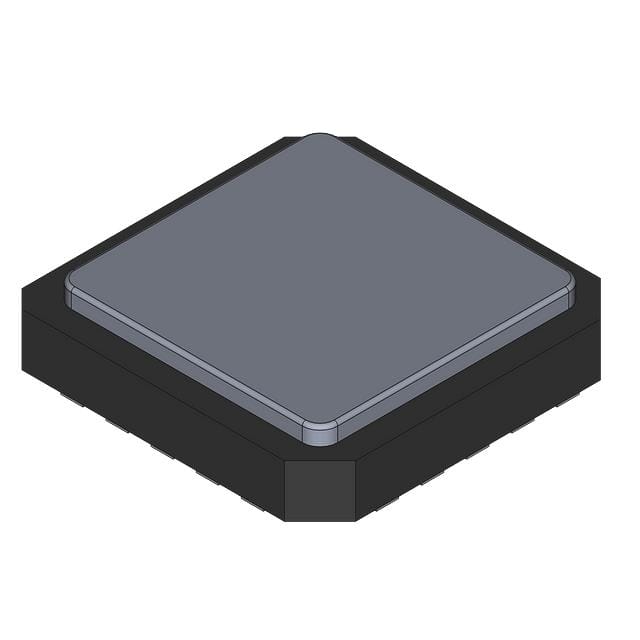
5962-86869012A is supplied in a 20-pin ceramic leadless chip carrier (LCCC), designated FK package per TI documentation. This hermetically sealed, surface-mount package provides high reliability for extended-life military deployments and eliminates lead-related failure modes.
| Pin/Terminal | Circuit Role | Design Meaning |
|---|---|---|
| 1 | A/B Select | Common 2:1 select line controlling all four multiplexers simultaneously |
| 2 | 1A Input | First input source for channel 1 (true data path) |
| 3 | 1B Input | Second input source for channel 1 (true data path) |
| 4 | NC | No internal connection - must be left unconnected |
| 5 | 1Y Output | True output of channel 1, enabled only when G = L |
| 6 | 3A Input | First input source for channel 3 |
| 7 | 1B Input (redundant label) | Documented duplicate reference; functionally identical to Pin 3 |
| 8 | 1Y Output (redundant label) | Documented duplicate reference; functionally identical to Pin 5 |
| 9 | 2A Input | First input source for channel 2 |
| 10 | 2B Input | Second input source for channel 2 |
| 11 | 2Y Output | True output of channel 2 |
| 12 | G Strobe | Active-low enable - all outputs forced low when G = H |
| 13 | 4A Input | First input source for channel 4 |
| 14 | 4B Input | Second input source for channel 4 |
| 15 | 4Y Output | True output of channel 4 |
| 16 | VCC | Positive supply terminal (4.5–5.5 V) |
| 17 | GND | Ground reference for all logic and power connections |
| 18 | 3Y Output | True output of channel 3 |
| 19 | 3B Input | Second input source for channel 3 |
| 20 | NC | No internal connection - must be left unconnected |
Key Features
| Feature | Design Value |
|---|---|
| True-output logic architecture | Delivers non-inverted data routing - eliminates need for external inverters in signal integrity-critical paths |
| Military temperature qualification | Validated operation from −55°C to 125°C per MIL-PRF-38535 - suitable for engine bay, radar, and space-qualified electronics |
| Buffered inputs and outputs | Enables fan-out of ≥10 standard TTL loads without degradation - simplifies inter-stage interfacing |
| Low propagation delay variation | Max tPHL/tPLH spread of 12 ns across all channels ensures deterministic timing alignment in parallel data paths |
| Hermetic LCCC-FK packaging | Eliminates moisture ingress and thermal cycling fatigue - extends field life in high-reliability mission-critical systems |
Applications
| Avionics Data Routing | Radar Signal Multiplexing |
|---|---|
|
Use Scenario: Selecting between redundant inertial measurement unit (IMU) data streams in flight control computers. IC Role / Device Role / Timing Role: Quad 2:1 multiplexer providing fail-operational signal arbitration with deterministic <11 ns propagation delay. Use Value: Enables real-time switching between primary and backup sensor feeds without introducing timing jitter or inversion artifacts. |
Use Scenario: Routing digitized IF samples from dual antenna channels into a shared ADC pipeline in phased-array radar receivers. IC Role / Device Role / Timing Role: Synchronized 4-channel data selector ensuring phase-coherent sampling path selection under strobe control. Use Value: Maintains signal integrity across RF front-end paths while supporting rapid beam-steering mode changes. |
| Tactical Radio Baseband Switching | Missile Guidance Interface Logic |
|
Use Scenario: Switching between encrypted and clear-text baseband audio/data paths in secure HF/VHF radios during COMSEC transitions. IC Role / Device Role / Timing Role: True-output multiplexer enabling glitch-free handover between cryptographic processing stages. Use Value: Prevents spurious transmission bursts during mode switching due to inherent non-inverting behavior and buffered outputs. |
Use Scenario: Selecting guidance command sources (autonomous vs. ground-uplink) in missile seeker electronics under environmental stress. IC Role / Device Role / Timing Role: Radiation-tolerant, wide-temperature multiplexer performing critical command path arbitration. Use Value: Guarantees functional correctness across −55°C to 125°C with no derating - essential for exoatmospheric and re-entry phases. |
Equivalent & Alternatives
The following parts are listed as comparable options for similar quad 2:1 multiplexer applications.
| Alternative Part | Technical Difference | Application Difference | Selection Advice |
|---|---|---|---|
| SNJ54ALS157AJ | Same ALS logic family and military temp range, but in 16-pin CDIP (J) package - larger footprint, through-hole mounting | Preferred where board-level repairability, manual prototyping, or legacy through-hole assembly is required | Select SNJ54ALS157AJ if LCCC rework capability is unavailable or JEDEC-standard DIP sockets are mandated |
| 5962-8862501EA | Inverted-output variant (′ALS158 function); identical pinout, temp range, and package - differs only in output polarity | Required where downstream logic expects active-low data or where inversion reduces total gate count | Choose 5962-8862501EA only when system-level timing analysis confirms benefit of inverted outputs - otherwise 5962-86869012A preserves signal polarity |
Compared with SNJ54ALS157AJ, 5962-86869012A offers superior thermal cycling resistance via LCCC packaging and smaller PCB area; compared with 5962-8862501EA, it avoids mandatory downstream inversion stages, reducing component count and propagation uncertainty in safety-critical signal chains.
Availability
5962-86869012A is available at Aetrix Electronics and suitable for avionics data routing, radar signal multiplexing, tactical radio baseband switching, and missile guidance interface logic requiring stable component supply across extended temperature and long-lifecycle programs.
Supply support for 5962-86869012A includes scheduled delivery planning, volume procurement assistance, BOM continuity management, traceable sourcing, and lifecycle availability coordination for OEM customers, industrial embedded developers, connected-device designers, and electronics production programs.
Manufacturer
Texas Instruments is a global semiconductor leader specializing in analog, embedded processing, and high-reliability logic solutions, with over 50 years of heritage in military-grade component development.
The 5962-86869012A belongs to TI's QML-38535 qualified logic portfolio, engineered specifically for aerospace, defense, and industrial systems demanding guaranteed performance across extreme environmental stressors.
FAQ
What logic family and process technology does the 5962-86869012A use?
The 5962-86869012A uses Texas Instruments' advanced low-power Schottky (ALS) bipolar technology. This process delivers improved speed-power trade-offs versus standard TTL, with typical ICC of 6–11 mA at VCC = 5.5 V and propagation delays down to 2 ns. It maintains full 5-V TTL voltage compatibility and is fully specified for operation across −55°C to 125°C.
Does the 5962-86869012A support 3-state outputs?
No, the 5962-86869012A does not feature 3-state outputs. Its outputs are totem-pole, actively driven high or low depending on input states and strobe (G) control. When G is high, all outputs are forced low; when G is low, selected inputs pass through to outputs. This fixed-drive architecture simplifies timing analysis in hard real-time systems where bus contention must be avoided.
What is the maximum clock/data rate supported by the 5962-86869012A?
The 5962-86869012A does not operate on a clock signal - it is combinatorial logic. Its maximum usable data rate is determined by propagation delay and system setup/hold timing. With worst-case tPLH/tPHL of 11 ns and guaranteed minimum pulse width of 10 ns, it supports reliable operation up to approximately 45 MHz in synchronous routing applications when interfaced with appropriate edge-aligned controls.
How does the 5962-86869012A differ from commercial-grade SN74ALS157A?
The 5962-86869012A is the QML-38535 qualified military version of the SN74ALS157A, differing in three key aspects: (1) extended temperature range (−55°C to 125°C vs. 0°C to 70°C), (2) LCCC-FK hermetic packaging (vs. SOIC/D or PDIP/N), and (3) full MIL-PRF-38535 screening including radiation hardness assurance and lot traceability. Electrical specs are otherwise identical.
Can the 5962-86869012A be used with 3.3-V logic interfaces?
No, the 5962-86869012A is strictly a 5-V TTL-compatible device. Its input thresholds (VIH ≥ 2.0 V, VIL ≤ 0.8 V) and output swing (VOH ≈ VCC − 2 V, VOL ≤ 0.4 V) are designed for 5-V operation. Interfacing with 3.3-V systems requires level-shifting circuitry; direct connection risks undriven inputs, marginal noise margins, and potential damage under bus contention scenarios.
5962-86869012A Specifications
- Product attributes
- Attribute value
- Manufacturer:
- Texas Instruments
- Series:
- *
- Package/Case:
- -
- Packaging:
- Bulk
- Product Status:
- Active
- Type:
- -
- Circuit:
- -
- Independent Circuits:
- -
- Current - Output High, Low:
- -
- Voltage Supply Source:
- -
- Voltage - Supply:
- -
- Operating Temperature:
- -
- Grade:
- -
- Qualification:
- -
- Mounting Type:
- -
- Supplier Device Package:
- -
5962-86869012A FAQ
1.How can I place an order for 5962-86869012A through Aetrix?
Please submit a Request for Quotation (RFQ) for 5962-86869012A on Aetrix. Our sales agent will provide a competitive quotation and guide you through the order confirmation once you accept the terms.
2.Are the price and stock information for 5962-86869012A reliable?
The price and inventory of 5962-86869012A are updated periodically and may fluctuate due to market conditions. Stock and pricing data are typically refreshed every 24 hours. Quotation validity for 5962-86869012A is usually 5 days.
3.What payment methods are accepted for 5962-86869012A?
We accept Wire Transfer, PayPal, Credit Card, Western Union, MoneyGram, and Escrow for 5962-86869012A transactions.
Note: Certain payment methods may incur a processing fee.
4.How is shipping managed for 5962-86869012A?
5962-86869012A orders can be shipped via leading logistics carriers, including DHL, UPS, FedEx, TNT, or Registered Mail.
Once your 5962-86869012A order is processed, you will receive an email with the shipment details and tracking number.
Note: Tracking information may take up to 24 hours to appear. Express delivery typically takes 3–5 business days.
5.How can I obtain technical support or documentation for 5962-86869012A?
For technical support, including 5962-86869012A datasheets, pinout diagrams, or application guidance, please contact our engineering support team. They can provide detailed documentation and assistance for your 5962-86869012A requirements.
6.How does Aetrix verify that 5962-86869012A is sourced from the original manufacturer or authorized distributors?
All 5962-86869012A products on Aetrix are procured from qualified distributors and authorized channels. Our dedicated quality assurance team conducts strict verification, including traceability checks and, if necessary, third-party testing. This ensures that 5962-86869012A meets industry standards.
7.What is the process for return or replacement of 5962-86869012A?
All 5962-86869012A units undergo pre-shipment inspection (PSI). If there is an issue with 5962-86869012A, returns or replacements are accepted under the following conditions:
1.Quantity discrepancies, incorrect items, or visible external defects (such as breakage or corrosion), acknowledged by Aetrix.
2.The issue is reported within 90 days of delivery.
3.The 5962-86869012A part is unused and in its original packaging.
Return procedure for 5962-86869012A:
1.Submit a request within 90 days.
2.Obtain a Return Material Authorization (RMA) from Aetrix.
5962-86869012A Tags
-
SN74HC138DR
Texas Instruments
-
TC7SB3157CFU,LF(CT
Toshiba Semiconductor and Storage
-
74CBTLV3257PW,118
Nexperia USA Inc.
-
SN74CBTLV3257PWR
Texas Instruments
-
74CBTLV3257GUX
Nexperia USA Inc.
-
74HC154BQ,118
Nexperia USA Inc.

-
P3S0200GMX
NXP USA Inc.
-
SN74CB3Q3245PWR
Texas Instruments
-
SN74CB3Q3257RGYR
Texas Instruments
-
TCA9543APWR
Texas Instruments
-
TCA9546APWR
Texas Instruments
-
SN74HC138N
Texas Instruments
Tech Hub

A practical engineering guide to 3.3V and 5V logic compatibility, input thresholds, resistor dividers, translator ICs, MOSFET level shifting, I2C pull-ups, timing limits and power-sequencing risks.

The 74HC595 uses push-pull logic outputs, while the TPIC6B595 uses 50 V open-drain DMOS sinks for higher-power loads. This guide compares timing, current limits, 3.3 V interfacing, load wiring, thermal…

The 74HC595 converts serial data into eight stable parallel outputs. This guide covers pin functions, shift and storage timing, OE and MR behavior, drive-current limits, cascading, voltage compatibilit…

A technical comparison of level-sensitive latches and edge-triggered flip-flops, covering timing windows, setup and hold limits, master–slave operation, time borrowing, race-through, HDL inference and…

A D latch stores one bit while Enable controls when data can pass. This reference covers gate-level operation, truth tables, transparency, setup and hold timing, LE versus OE, common ICs and practical …

An SR latch stores one bit through cross-coupled feedback. This engineering reference covers NOR and NAND implementations, truth tables, forbidden-state recovery, gated operation, switch debouncing, fa…

Latch circuits retain one bit through feedback. This technical reference covers SR and D latches, truth tables, transparency, timing limits, latch-versus-flip-flop behavior, applications and common log…

An engineering guide to LED driver operation, constant-current and constant-voltage outputs, linear and switching topologies, dimming, IC selection, calculations, replacement compatibility, and fault c…

Operational amplifier guide covering op amp basics, feedback, ideal vs real op amps, common configurations, buffer circuits, offset, bias current, gain-bandwidth, slew rate, rail-to-rail limits and sel…

Jumper cables guide covering safe connection order, red and black clamp placement, final ground connection, cable gauge, length, clamp quality, copper vs CCA cables, jump starter comparison and battery…


