
 My Inquiry
 My Account


Texas Instruments 5962-9675101QDA
- Part No.:
- 5962-9675101QDA
- Manufacturer:
- Texas Instruments
- Category:
- Flip Flops
- Package:
- -
- Datasheet:
-
 5962-9675101QDA.pdf
- Description:
- SN54LS73A DUAL J-K FLIP-FLOPS WI
- Quantity:
- Payment:

- Shipping:

Inventory:1,841
Please send an inquiry. Send us your inquiry, and we will respond immediately.
Product details
Overview
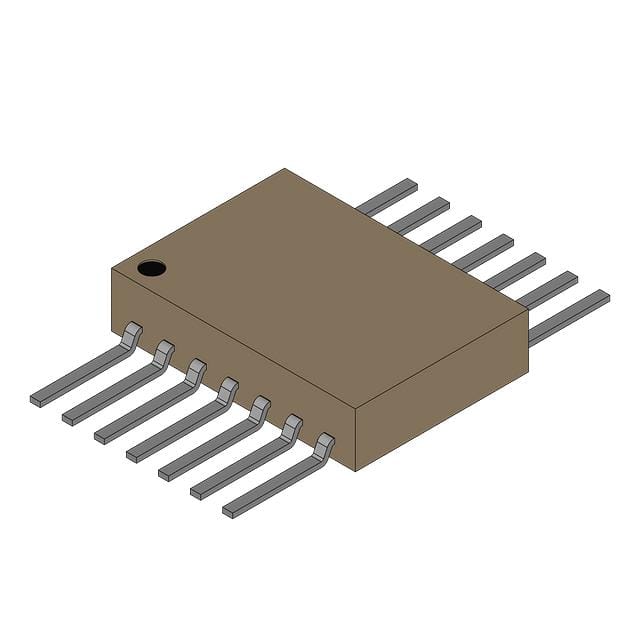
5962-9675101QDA from Texas Instruments is a dual J-K flip-flop with individual clear inputs, implemented in TTL-LS logic, operating over –55°C to +125°C, with 14-pin CFP (ceramic flatpack) package, and designed for synchronous digital control in military-grade timing and state-machine applications.
For engineers reviewing the 5962-9675101QDA datasheet, 5962-9675101QDA pinout, 5962-9675101QDA application, or 5962-9675101QDA equivalent, this device serves as a radiation-tolerant, high-reliability edge-triggered memory element requiring precise clock-to-output timing, setup/hold margin validation, and MIL-PRF-38535 Class Q/V qualification verification.
Technical Context
The 5962-9675101QDA implements two independent negative-edge-triggered J-K flip-flops, each with asynchronous active-low clear (CLR̅), no preset input, and complementary Q and Q̅ outputs. It uses bipolar TTL-LS process technology for deterministic propagation delay and noise-immune switching.
Its logic behavior follows standard J-K truth table operation: when J=K=0, output holds; J=0/K=1 clears; J=1/K=0 sets; J=K=1 toggles on clock fall. All timing parameters-including tPLH, tPHL, tsu, and th-are specified across full military temperature range and supply voltage (4.5 V to 5.5 V).
Key Specifications
| Parameter | Value and Actual Design Meaning |
|---|---|
| Logic Family | TTL-LS: ensures compatibility with legacy 74LS systems and predictable DC noise margins. |
| Operating Temperature | –55°C to +125°C: qualified per MIL-PRF-38535 for extended environmental resilience in avionics and space platforms. |
| Supply Voltage | 4.5 V to 5.5 V: supports stable operation under regulated or filtered 5 V rails in harsh power environments. |
| Propagation Delay | 25 ns max (tPLH/tPHL): enables reliable operation up to ~20 MHz clock frequency in synchronous counters and registers. |
| Input Loading | 2 LS-TTL loads per input: allows direct fan-out to multiple downstream LS devices without buffering. |
| Package Type | 14-pin CFP (W drawing): hermetically sealed ceramic flatpack with glass-metal seal, rated for high-reliability long-term storage and thermal cycling. |
Pinout & Package
5962-9675101QDA is housed in a 14-pin Ceramic Flatpack (CFP, TI drawing W), with gull-wing leads, 0.050" lead pitch, and hermetic cavity sealing compliant with MIL-STD-1835 GDIP1-T14.
| Pin/Terminal | Circuit Role | Design Meaning |
|---|---|---|
| 1 | 1CLR̅ | Asynchronous clear for first flip-flop; active-low, overrides clock and J/K states. |
| 2 | 1J | Data input J for first flip-flop; controls set behavior on next clock edge. |
| 3 | 1K | Data input K for first flip-flop; controls reset/toggle behavior on next clock edge. |
| 4 | 1CLK | Clock input for first flip-flop; negative-edge triggered; requires clean falling transition. |
| 5 | 1Q̅ | Inverted output of first flip-flop; provides complementary logic state for feedback or decoding. |
| 6 | 1Q | True output of first flip-flop; used for state storage and sequential logic chaining. |
| 7 | GND | Power ground reference; must be low-impedance connection to minimize switching noise. |
| 8 | 2Q | True output of second flip-flop; electrically isolated from first section except shared supply. |
| 9 | 2Q̅ | Inverted output of second flip-flop; supports differential signaling or XOR-based toggle detection. |
| 10 | 2CLK | Clock input for second flip-flop; independent negative-edge trigger, no inter-section coupling. |
| 11 | 2K | Data input K for second flip-flop; functionally identical to Pin 3 but for second section. |
| 12 | 2J | Data input J for second flip-flop; functionally identical to Pin 2 but for second section. |
| 13 | 2CLR̅ | Asynchronous clear for second flip-flop; independent of first section's clear signal. |
| 14 | VCC | +5 V supply rail; requires local 0.1 µF ceramic decoupling adjacent to pin. |
Key Features
| Feature | Design Value |
|---|---|
| Dual independent J-K sections | Enables compact implementation of 2-bit synchronous counters or shift registers without external gating. |
| Asynchronous active-low clear per section | Allows selective reset of one flip-flop while preserving state in the other-critical for pipeline control. |
| MIL-PRF-38535 Class Q/V qualification | Guarantees screening, testing, and traceability for defense and aerospace programs requiring DLA-approved parts. |
| Hermetic CFP packaging | Prevents moisture ingress and corrosion in high-humidity, vacuum, or thermal-cycling environments. |
| LS-TTL compatible input thresholds | Ensures interoperability with SN74LSxx and SN54LSxx families without level-shifting circuitry. |
Applications
| Rad-Hard Synchronous Counter | Avionics Mode Control Logic |
|---|---|
Use Scenario: Counting telemetry frame sync pulses in satellite command decoders where single-event upset (SEU) tolerance is required. IC Role / Device Role / Timing Role: Edge-triggered state register providing deterministic 2-bit modulo-4 counting with asynchronous reset on error detection. Use Value: Dual-section independence allows separate reset of counter LSB/MSB; CFP hermeticity prevents latch-up in ionizing radiation environments. | Use Scenario: Managing flight control surface position modes (e.g., normal/reversion/direct law) in fly-by-wire ECUs. IC Role / Device Role / Timing Role: Synchronous state-holding element capturing pilot switch transitions synchronized to system master clock. Use Value: Guaranteed –55°C to +125°C operation ensures reliability during rapid cabin pressure/temperature transients; LS-TTL drive strength interfaces directly with discrete gate arrays. |
| Secure Boot State Machine | Missile Guidance Sequencer |
Use Scenario: Enforcing cryptographic key loading sequence integrity during cold-start initialization of secure microcontrollers. IC Role / Device Role / Timing Role: Two-bit state tracker validating correct order of hardware-enforced boot steps before releasing execution. Use Value: Asynchronous clear per section enables atomic rollback to known-good state on any step failure; MIL-spec screening ensures zero latent defects in mission-critical firmware paths. | Use Scenario: Timing critical arming/firing sequences in tactical missile guidance electronics under high-G launch conditions. IC Role / Device Role / Timing Role: Clock-synchronized decision latch holding safe/arm status until validated sensor inputs and time-gated release signals align. Use Value: Propagation delay consistency across temperature ensures predictable timing margins; CFP mechanical stability prevents lead fatigue or solder joint fracture during vibration. |
Equivalent & Alternatives
The following parts are listed as comparable options for similar dual J-K flip-flop applications.
| Alternative Part | Technical Difference | Application Difference | Selection Advice |
|---|---|---|---|
| SNJ54LS73AW | Identical electrical specs and CFP package; same MIL-PRF-38535 Class V qualification; differs only in device marking and internal lot traceability. | No functional difference; accepted interchangeably in DoD BOMs per TI's qualified alternatives list. | Select SNJ54LS73AW if sourcing through legacy DLA-assigned part numbers or specific contract line items referencing that designation. |
| 5962-9675101QCA | Same die and functionality, but packaged in 14-pin CDIP (J drawing) instead of CFP; higher profile, through-hole mounting, different thermal resistance. | Preferred for prototyping or board-level repair where socket compatibility or manual rework is required; unsuitable for high-vibration or hermetic chamber use. | Choose 5962-9675101QCA only when mechanical integration mandates DIP footprint or when CFP reflow capability is unavailable. |
Compared with SNJ54LS73AW and 5962-9675101QCA, the 5962-9675101QDA offers identical logic behavior and military qualification but distinguishes itself via CFP-specific mechanical robustness, lower mass, and superior thermal cycling endurance-making it optimal for embedded systems where size, weight, and long-term reliability outweigh socketing convenience.
Availability
5962-9675101QDA is available at Aetrix Electronics and suitable for avionics data acquisition, missile guidance sequencers, and secure boot controllers requiring stable component supply, full traceability, and long-lifecycle support.
Supply support for 5962-9675101QDA includes scheduled delivery planning, volume procurement assistance, BOM continuity management, traceable sourcing, and lifecycle availability coordination for OEM customers, industrial embedded developers, connected-device designers, and electronics production programs.
Manufacturer
Texas Instruments is a U.S.-based semiconductor company founded in 1930, specializing in analog, embedded processing, and high-reliability logic solutions for industrial, automotive, and defense markets.
The SN54LS73A product line was developed to deliver radiation-tolerant, temperature-stable TTL-LS logic for mission-critical aerospace and military systems requiring guaranteed performance under extreme environmental stress.
FAQ
What is the qualified reliability standard for 5962-9675101QDA?
The 5962-9675101QDA is qualified per MIL-PRF-38535 Class Q and Class V, including rigorous screening for burn-in, temperature cycling, hermeticity, and parametric limits across –55°C to +125°C. It meets DLA Land and Maritime requirements for high-reliability logic in defense electronics, with full traceability to wafer lot and assembly batch.
Does 5962-9675101QDA support preset functionality?
No, the 5962-9675101QDA does not include preset (PRE̅) inputs. Each of its two J-K flip-flops provides only asynchronous active-low clear (CLR̅), clock (CLK), J, K, Q, and Q̅ terminals. Preset capability is absent in all SN54LS73A variants, including 5962-9675101QDA.
What is the maximum clock frequency supported by 5962-9675101QDA?
The 5962-9675101QDA supports reliable operation up to approximately 20 MHz, derived from its maximum propagation delay of 25 ns (tPLH/tPHL) and minimum pulse width requirements. Actual usable frequency depends on setup/hold timing margins, PCB layout, and supply stability-but 20 MHz represents the conservative upper bound for guaranteed timing compliance.
Is 5962-9675101QDA RoHS-compliant?
No, the 5962-9675101QDA is not RoHS-compliant. As a Class Q/V military-grade CFP device, it uses leaded solder and non-RoHS materials consistent with MIL-PRF-38535 requirements. Its lead finish is SnPb, and it falls outside JEDEC J-STD-609 Category 1 definitions for lead-free labeling.
Can 5962-9675101QDA be used in place of commercial SN74LS73AD?
No, 5962-9675101QDA is not a drop-in replacement for SN74LS73AD. While functionally identical at the logic level, it differs in package (CFP vs SOIC), temperature range (–55°C to +125°C vs 0°C to +70°C), qualification level (MIL-PRF-38535 vs commercial), and pin construction (gull-wing vs gull-wing/SOIC). PCB layout, thermal design, and reliability validation must be requalified.
5962-9675101QDA Specifications
- Product attributes
- Attribute value
- Manufacturer:
- Texas Instruments
- Series:
- *
- Package/Case:
- -
- Packaging:
- Bulk
- Product Status:
- Active
- Function:
- -
- Type:
- -
- Output Type:
- -
- Number of Elements:
- -
- Number of Bits per Element:
- -
- Clock Frequency:
- -
- Max Propagation Delay @ V, Max CL:
- -
- Trigger Type:
- -
- Current - Output High, Low:
- -
- Voltage - Supply:
- -
- Current - Quiescent (Iq):
- -
- Input Capacitance:
- -
- Operating Temperature:
- -
- Grade:
- -
- Qualification:
- -
- Mounting Type:
- -
- Supplier Device Package:
- -
5962-9675101QDA FAQ
1.How can I place an order for 5962-9675101QDA through Aetrix?
Please submit a Request for Quotation (RFQ) for 5962-9675101QDA on Aetrix. Our sales agent will provide a competitive quotation and guide you through the order confirmation once you accept the terms.
2.Are the price and stock information for 5962-9675101QDA reliable?
The price and inventory of 5962-9675101QDA are updated periodically and may fluctuate due to market conditions. Stock and pricing data are typically refreshed every 24 hours. Quotation validity for 5962-9675101QDA is usually 5 days.
3.What payment methods are accepted for 5962-9675101QDA?
We accept Wire Transfer, PayPal, Credit Card, Western Union, MoneyGram, and Escrow for 5962-9675101QDA transactions.
Note: Certain payment methods may incur a processing fee.
4.How is shipping managed for 5962-9675101QDA?
5962-9675101QDA orders can be shipped via leading logistics carriers, including DHL, UPS, FedEx, TNT, or Registered Mail.
Once your 5962-9675101QDA order is processed, you will receive an email with the shipment details and tracking number.
Note: Tracking information may take up to 24 hours to appear. Express delivery typically takes 3–5 business days.
5.How can I obtain technical support or documentation for 5962-9675101QDA?
For technical support, including 5962-9675101QDA datasheets, pinout diagrams, or application guidance, please contact our engineering support team. They can provide detailed documentation and assistance for your 5962-9675101QDA requirements.
6.How does Aetrix verify that 5962-9675101QDA is sourced from the original manufacturer or authorized distributors?
All 5962-9675101QDA products on Aetrix are procured from qualified distributors and authorized channels. Our dedicated quality assurance team conducts strict verification, including traceability checks and, if necessary, third-party testing. This ensures that 5962-9675101QDA meets industry standards.
7.What is the process for return or replacement of 5962-9675101QDA?
All 5962-9675101QDA units undergo pre-shipment inspection (PSI). If there is an issue with 5962-9675101QDA, returns or replacements are accepted under the following conditions:
1.Quantity discrepancies, incorrect items, or visible external defects (such as breakage or corrosion), acknowledged by Aetrix.
2.The issue is reported within 90 days of delivery.
3.The 5962-9675101QDA part is unused and in its original packaging.
Return procedure for 5962-9675101QDA:
1.Submit a request within 90 days.
2.Obtain a Return Material Authorization (RMA) from Aetrix.
5962-9675101QDA Tags
-
SN74HC74DR
Texas Instruments
-
SN74HC74PWR
Texas Instruments
-
74LVC1G74GT,115
Nexperia USA Inc.
-
SN74LVC2G74DCUR
Texas Instruments
-
CD4013BM96
Texas Instruments
-
SN74HCT273PWR
Texas Instruments
-
SN74LVC1G74DCUR
Texas Instruments
-
SN74HC574DWR
Texas Instruments
-
74LVC1G74DC,125
Nexperia USA Inc.
-
SN74HC273DWR
Texas Instruments
-
SN74HCT574DWR
Texas Instruments
-
SN74LVC1G74DCTR
Texas Instruments
Tech Hub

A practical engineering guide to 3.3V and 5V logic compatibility, input thresholds, resistor dividers, translator ICs, MOSFET level shifting, I2C pull-ups, timing limits and power-sequencing risks.

The 74HC595 uses push-pull logic outputs, while the TPIC6B595 uses 50 V open-drain DMOS sinks for higher-power loads. This guide compares timing, current limits, 3.3 V interfacing, load wiring, thermal…

The 74HC595 converts serial data into eight stable parallel outputs. This guide covers pin functions, shift and storage timing, OE and MR behavior, drive-current limits, cascading, voltage compatibilit…

A technical comparison of level-sensitive latches and edge-triggered flip-flops, covering timing windows, setup and hold limits, master–slave operation, time borrowing, race-through, HDL inference and…

A D latch stores one bit while Enable controls when data can pass. This reference covers gate-level operation, truth tables, transparency, setup and hold timing, LE versus OE, common ICs and practical …

An SR latch stores one bit through cross-coupled feedback. This engineering reference covers NOR and NAND implementations, truth tables, forbidden-state recovery, gated operation, switch debouncing, fa…

Latch circuits retain one bit through feedback. This technical reference covers SR and D latches, truth tables, transparency, timing limits, latch-versus-flip-flop behavior, applications and common log…

An engineering guide to LED driver operation, constant-current and constant-voltage outputs, linear and switching topologies, dimming, IC selection, calculations, replacement compatibility, and fault c…

Operational amplifier guide covering op amp basics, feedback, ideal vs real op amps, common configurations, buffer circuits, offset, bias current, gain-bandwidth, slew rate, rail-to-rail limits and sel…

Jumper cables guide covering safe connection order, red and black clamp placement, final ground connection, cable gauge, length, clamp quality, copper vs CCA cables, jump starter comparison and battery…


