
 My Inquiry
 My Account


NXP Semiconductors 74HC393DB,112
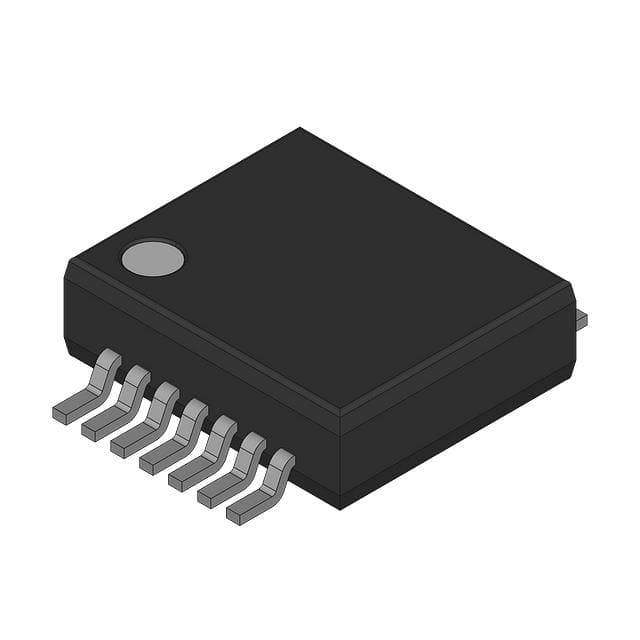
- Part No.:
- 74HC393DB,112
- Manufacturer:
- NXP Semiconductors
- Category:
- Counters, Dividers
- Package:
- 14-SSOP (0.209", 5.30mm Width)
- Datasheet:
-
 74HC393DB,112.pdf
- Description:
- IC BINARY COUNTR DL 4BIT 14SSOP
- Quantity:
- Payment:

- Shipping:

Inventory:6,542
Please send an inquiry. Send us your inquiry, and we will respond immediately.
Product details
Overview
74HC393DB,112 from Nexperia is a dual 4-bit binary ripple counter IC with two independent asynchronous master reset inputs (1MR, 2MR), two edge-triggered clock inputs (1CP, 2CP), and eight buffered outputs (1Q0–1Q3, 2Q0–2Q3). It operates from 2.0 V to 6.0 V, advances on HIGH-to-LOW clock transitions, and clears all outputs to LOW when MR is HIGH - used in frequency division, timing control, and digital logic state sequencing.
For engineers reviewing the 74HC393DB,112 datasheet, 74HC393DB,112 pinout, 74HC393DB,112 application, or 74HC393DB,112 equivalent, this device supports precise binary division by 2n (n ≤ 4 per counter), requires no external pull-ups for TTL/CMOS interfacing due to integrated clamp diodes, and delivers sub-25 ns propagation delay at 4.5 V with 50 pF load.
Technical Context
The 74HC393DB,112 implements two cascaded T-type flip-flops per 4-bit section, forming asynchronous ripple counters where each stage triggers the next on its output transition - resulting in cumulative propagation delay across bits. Its dual-counter architecture enables independent clocking and resetting, supporting divide-by-16 operations per channel or combined modulo-256 counting via external interconnect.
Input clamp diodes allow direct interface to voltages exceeding VCC when used with current-limiting resistors. The device complies with JEDEC JESD7A (2.0–6.0 V) and JESD8C (2.7–3.6 V), supports HBM ESD >2000 V and CDM >1000 V, and meets latch-up immunity >100 mA per JESD78 Class II Level B.
Key Specifications
| Parameter | Value and Actual Design Meaning |
|---|---|
| Supply voltage range | 2.0 V to 6.0 V - supports mixed-voltage system integration and battery-powered operation down to 2 V. |
| Max clock frequency | 107 MHz at VCC = 6.0 V, CL = 50 pF - enables high-speed timing division up to 16× per counter. |
| Propagation delay (nCP → nQ0) | 12 ns typ. at VCC = 6.0 V - determines minimum clock period for reliable state capture in synchronous systems. |
| Output drive strength | ±4.0 mA at VCC = 4.5 V - sufficient to directly drive multiple CMOS inputs without buffering. |
| Input leakage current | ±0.1 μA max at VCC = 6.0 V - ensures minimal power loss in low-power sleep or standby modes. |
| Power dissipation capacitance | 23 pF - used to calculate dynamic power: PD = CPD × VCC² × fin × N + Σ(CL × VCC² × fout). |
| Operating temperature | −40 °C to +125 °C - qualified for industrial and extended-temperature embedded applications. |
Pinout & Package
74HC393DB,112 is packaged in SO14 (SOT108-1): plastic small outline, 14-lead, 3.9 mm body width, with standard pin 1 index marking.
| Pin/Terminal | Circuit Role | Design Meaning |
|---|---|---|
| 1 | 1CP | First counter clock input - edge-triggered on HIGH-to-LOW transition; drives Q0 of Counter 1. |
| 2 | 1MR | First counter master reset - asynchronous, active HIGH; forces 1Q0–1Q3 LOW regardless of clock state. |
| 3–6 | 1Q0, 1Q1, 1Q2, 1Q3 | Buffered outputs of Counter 1 - represent binary count (LSB to MSB); fan-out ≥ 10 CMOS loads. |
| 7 | GND | Ground reference - must be connected to system 0 V plane; decoupling capacitor recommended near pin. |
| 8–11 | 2Q3, 2Q2, 2Q1, 2Q0 | Buffered outputs of Counter 2 - bit order reversed vs. pin numbering (2Q3 on pin 8, 2Q0 on pin 11); LSB is 2Q0. |
| 12 | 2MR | Second counter master reset - asynchronous, active HIGH; independent of 1MR and 2CP. |
| 13 | 2CP | Second counter clock input - identical timing behavior to 1CP; enables separate clock domains. |
| 14 | VCC | Positive supply - must be bypassed with 100 nF ceramic capacitor close to pin; no internal regulation. |
Key Features
| Feature | Design Value |
|---|---|
| Dual independent 4-bit counters | Enables two separate divide-by-2n chains (n ≤ 4) with no shared control signals - reduces board space vs. two discrete counters. |
| Asynchronous master reset per counter | Allows selective clearing of either counter without affecting the other - critical for multi-phase timing sequences. |
| Clamp diode-equipped inputs | Permits safe interfacing to 5 V or 3.3 V logic even when VCC = 2.0 V, using series current-limiting resistors. |
| High noise immunity | Guaranteed VIH/VIL margins exceed 30% of VCC across full operating range - resists EMI-induced false triggering. |
| Low dynamic power consumption | CPD = 23 pF enables <1 mW typical dynamic power at 10 MHz and 5 V - suitable for portable and energy-sensitive designs. |
Applications
| Frequency Division | Digital Timing Control |
|---|---|
Use Scenario: Generating precise sub-harmonics from a crystal oscillator or MCU clock source (e.g., dividing 1 MHz to 62.5 kHz). IC Role / Device Role / Timing Role: Binary ripple counter performing fixed-ratio frequency division with deterministic phase relationship between input and outputs. Use Value: Eliminates need for programmable dividers or microcontroller-based timing; achieves exact integer division with zero software overhead. | Use Scenario: Controlling LED blink patterns, relay activation intervals, or stepper motor step timing in industrial PLC modules. IC Role / Device Role / Timing Role: Standalone timing sequencer generating periodic enable pulses with adjustable duration via output bit selection. Use Value: Reduces firmware complexity and CPU load; provides jitter-free, hardware-determined timing unaffected by interrupt latency. |
| State Machine Sequencing | Event Counting Interface |
Use Scenario: Implementing 4-bit state progression in vending machine controllers or test equipment sequencers. IC Role / Device Role / Timing Role: Synchronous state register advancing on external event edges (e.g., sensor trigger pulses). Use Value: Provides deterministic, glitch-free state transitions without metastability risk from asynchronous inputs. | Use Scenario: Capturing pulse counts from flow meters, RPM sensors, or encoder quadrature signals in data acquisition systems. IC Role / Device Role / Timing Role: Hardware counter front-end that accumulates events before transfer to microcontroller via parallel read. Use Value: Prevents count loss during MCU servicing delays; supports burst-mode counting at up to 107 MHz input rate. |
Equivalent & Alternatives
The following parts are listed as comparable options for similar dual 4-bit binary counter applications.
| Alternative Part | Technical Difference | Application Difference | Selection Advice |
|---|---|---|---|
| 74HCT393DB,112 | TTL-compatible inputs (VIH = 2.0 V min), otherwise identical pinout, timing, and function. | Better interoperability with legacy 5 V TTL logic families; slightly higher ICC at VCC = 5 V. | Select when interfacing with 74LS/74F series or mixed-logic systems requiring guaranteed TTL-level recognition. |
| SN74HC393N | DIP-14 package (SOT27-1), same electrical specs but through-hole mounting and larger footprint. | Suitable for prototyping, educational labs, or legacy PCBs requiring DIP sockets; not RoHS-compliant. | Choose only for hand-soldered development boards or replacement in existing through-hole designs. |
Compared with 74HCT393DB,112, the HC variant offers wider supply range (2–6 V) and lower static current, while SN74HC393N trades surface-mount compactness for mechanical robustness and ease of manual assembly - all share identical logic behavior and pin mapping.
Availability
74HC393DB,112 is available at Aetrix Electronics and suitable for industrial automation timing, embedded instrumentation signal conditioning, and consumer electronics frequency synthesis requiring stable component supply and long-term obsolescence management.
Supply support for 74HC393DB,112 includes scheduled delivery planning, volume procurement assistance, BOM continuity management, traceable sourcing, and lifecycle availability coordination for OEM customers, industrial embedded developers, connected-device designers, and electronics production programs.
Manufacturer
Nexperia is a global semiconductor expert focused on high-volume, high-reliability logic, analog, and MOSFET solutions - delivering energy-efficient, automotive-qualified, and industrial-grade components with rigorous quality control.
The 74HC393 belongs to Nexperia's 74HC logic family, designed specifically for low-power, high-noise-immunity digital signal routing and timing in space-constrained industrial and consumer applications.
FAQ
What is the maximum clock frequency supported by the 74HC393DB,112?
The 74HC393DB,112 supports up to 107 MHz at VCC = 6.0 V with CL = 50 pF load, as specified in Table 7 of the datasheet. At 4.5 V, the maximum clock frequency is 90 MHz under the same conditions. Performance degrades linearly below 4.5 V - e.g., 625 kHz at 2.0 V - due to increased propagation delay.
Can the two counters operate with different clock sources?
Yes - the 74HC393DB,112 features fully independent clock inputs (1CP and 2CP) and master reset lines (1MR and 2MR), allowing simultaneous operation with unrelated clock domains. No internal coupling exists between counters; each advances only on its own clock edge and resets only on its dedicated MR signal.
Is the 74HC393DB,112 compatible with 3.3 V logic systems?
Yes - the 74HC393DB,112 operates reliably from 2.0 V to 6.0 V, with guaranteed VIH = 3.15 V and VIL = 1.35 V at VCC = 4.5 V, and VIH = 1.5 V at VCC = 2.0 V. When powered at 3.3 V, it meets standard 3.3 V CMOS thresholds and interfaces cleanly with 3.3 V microcontrollers and FPGAs.
Does the 74HC393DB,112 require external pull-up or pull-down resistors on its inputs?
No - the inputs include integrated clamp diodes, enabling direct connection to voltages above VCC when used with appropriate current-limiting resistors. For standard CMOS-level signals within the VCC range, no external biasing is needed; the device has negligible input leakage (<0.1 μA) and defined VIH/VIL thresholds across temperature and supply.
74HC393DB,112 Specifications
- Product attributes
- Attribute value
- Manufacturer:
- NXP Semiconductors
- Series:
- 74HC
- Package/Case:
- 14-SSOP (0.209", 5.30mm Width)
- Packaging:
- Tube
- Product Status:
- Active
- Logic Type:
- Binary Counter
- Direction:
- Up
- Number of Elements:
- 2
- Number of Bits per Element:
- 4
- Reset:
- Asynchronous
- Timing:
- -
- Count Rate:
- 107 MHz
- Trigger Type:
- Negative Edge
- Voltage - Supply:
- 2 V ~ 6 V
- Operating Temperature:
- -40°C ~ 125°C
- Grade:
- -
- Qualification:
- -
- Mounting Type:
- Surface Mount
- Supplier Device Package:
- 14-SSOP
74HC393DB,112 FAQ
1.How can I place an order for 74HC393DB,112 through Aetrix?
Please submit a Request for Quotation (RFQ) for 74HC393DB,112 on Aetrix. Our sales agent will provide a competitive quotation and guide you through the order confirmation once you accept the terms.
2.Are the price and stock information for 74HC393DB,112 reliable?
The price and inventory of 74HC393DB,112 are updated periodically and may fluctuate due to market conditions. Stock and pricing data are typically refreshed every 24 hours. Quotation validity for 74HC393DB,112 is usually 5 days.
3.What payment methods are accepted for 74HC393DB,112?
We accept Wire Transfer, PayPal, Credit Card, Western Union, MoneyGram, and Escrow for 74HC393DB,112 transactions.
Note: Certain payment methods may incur a processing fee.
4.How is shipping managed for 74HC393DB,112?
74HC393DB,112 orders can be shipped via leading logistics carriers, including DHL, UPS, FedEx, TNT, or Registered Mail.
Once your 74HC393DB,112 order is processed, you will receive an email with the shipment details and tracking number.
Note: Tracking information may take up to 24 hours to appear. Express delivery typically takes 3–5 business days.
5.How can I obtain technical support or documentation for 74HC393DB,112?
For technical support, including 74HC393DB,112 datasheets, pinout diagrams, or application guidance, please contact our engineering support team. They can provide detailed documentation and assistance for your 74HC393DB,112 requirements.
6.How does Aetrix verify that 74HC393DB,112 is sourced from the original manufacturer or authorized distributors?
All 74HC393DB,112 products on Aetrix are procured from qualified distributors and authorized channels. Our dedicated quality assurance team conducts strict verification, including traceability checks and, if necessary, third-party testing. This ensures that 74HC393DB,112 meets industry standards.
7.What is the process for return or replacement of 74HC393DB,112?
All 74HC393DB,112 units undergo pre-shipment inspection (PSI). If there is an issue with 74HC393DB,112, returns or replacements are accepted under the following conditions:
1.Quantity discrepancies, incorrect items, or visible external defects (such as breakage or corrosion), acknowledged by Aetrix.
2.The issue is reported within 90 days of delivery.
3.The 74HC393DB,112 part is unused and in its original packaging.
Return procedure for 74HC393DB,112:
1.Submit a request within 90 days.
2.Obtain a Return Material Authorization (RMA) from Aetrix.
74HC393DB,112 Tags
-
74HC393BQ,115
Nexperia USA Inc.
-
SN74LV8154PWR
Texas Instruments
-
MC14516BDR2G
onsemi
-
MC14020BDR2G
onsemi
-
MC100EP32DTR2G
onsemi
-
MC100EP016AMNG
onsemi
-
MC100EP016AFAG
onsemi
-
SN74LV163ADR
Texas Instruments
-
SN74LV163APWR
Texas Instruments
-
SN74HC393DR
Texas Instruments
-
SN74HC161DR
Texas Instruments
-
SN74HC163DR
Texas Instruments
Tech Hub

Operational amplifier guide covering op amp basics, feedback, ideal vs real op amps, common configurations, buffer circuits, offset, bias current, gain-bandwidth, slew rate, rail-to-rail limits and sel…

Jumper cables guide covering safe connection order, red and black clamp placement, final ground connection, cable gauge, length, clamp quality, copper vs CCA cables, jump starter comparison and battery…

LDO regulator guide covering low dropout voltage, power dissipation, thermal design, PSRR, output noise, capacitor stability, adjustable LDO circuits, LDO vs buck converter and datasheet selection chec…

Conditional Access Module guide covering CAM meaning, CI/CI+ interface, smart card authorization, DVB security workflow, TV and set-top box compatibility, internal electronics, ESD protection, connecto…

Guide to electronic component obsolescence covering EOL risk, PCN/PDN notices, last-time buy planning, replacement options, form-fit-function validation, counterfeit risk and BOM lifecycle management.

18650 battery guide covering lithium-ion cell basics, 3.6V/3.7V voltage, 4.2V charging, mAh and Wh capacity, protected cells, chargers, BMS, series-parallel packs, holders, welding and sourcing checks.…

Hall effect sensor guide covering working principle, linear and digital sensors, Arduino circuits, current sensing, speed detection, automotive applications, A3144 examples, signal filtering and datash…

Product Change Notification guide for electronic components, covering PCN meaning, PCN vs PDN/EOL, common change types, risk levels, form-fit-function review, engineering validation, BOM control, LTB/L…

A practical guide to blend door actuators, covering HVAC function, symptoms, location, AC and heater issues, reset and calibration, replacement cost, electrical diagnosis, compatibility checks, and rep…

Engineering guide to Raspberry Pi alternatives, covering chip-level differences, Orange Pi, ROCK, Jetson, Banana Pi, NanoPi, Compute Module, Pico, GPIO, camera, HAT compatibility, and replacement risks…


