
 My Inquiry
 My Account


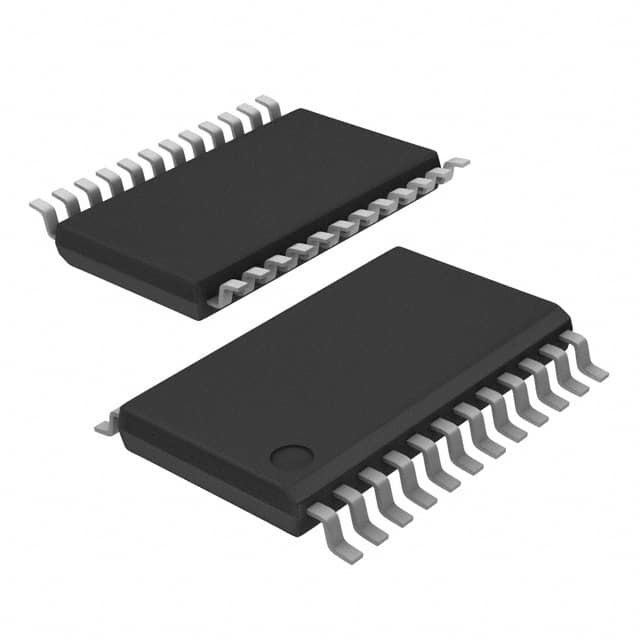
onsemi 74LVTH646MTC
- Part No.:
- 74LVTH646MTC
- Manufacturer:
- onsemi
- Package:
- 24-TSSOP (0.173", 4.40mm Width)
- Datasheet:
-
 74LVTH646MTC.pdf
- Description:
- IC TXRX NON-INVERT 3.6V 24TSSOP
- Quantity:
- Payment:

- Shipping:

Inventory:3,584
Please send an inquiry. Send us your inquiry, and we will respond immediately.
Product details
Overview
74LVTH646MTC from Fairchild Semiconductor is a low-voltage octal transceiver/register with 3-STATE outputs, designed for bidirectional data flow between 3.3V buses while interfacing to 5V TTL systems. It features bushold inputs, ±32 mA/64 mA drive capability, and registered storage with dual-clock (CPAB/CPBA) and direction control (DIR). It is used in backplane bus interfaces requiring real-time or stored-mode data transfer.
For engineers reviewing the 74LVTH646MTC datasheet, pinout, applications, or equivalent options, key selection criteria include 3.3V supply operation with 5V-tolerant I/O, bus-hold functionality eliminating pull-ups, live insertion support, and precise timing parameters including tPLH/tPHL ≤ 6.3 ns at 3.3V.
Technical Context
The 74LVTH646MTC integrates eight D-type flip-flops per register bank (A and B), enabling synchronous loading of data on LOW-to-HIGH clock transitions at CPAB or CPBA. Its DIR input selects data direction (A→B or B→A), while OE enables/disables all outputs independently of register operation.
Bus-hold circuitry maintains valid logic levels on unused A/B data pins without external resistors. The device supports transparent mode (real-time pass-through) and stored mode (clocked register output), with SAB/SBA selecting source path-allowing multiplexed access to either live bus or internal register contents.
Key Specifications
| Parameter | Value and Actual Design Meaning |
|---|---|
| VCC Range | 2.7 V to 3.6 V - Operates within standard 3.3V rail tolerances, compatible with LVTTL and LVCMOS systems. |
| I/O Voltage Tolerance | 0 V to 5.5 V - Enables direct connection to 5V TTL buses without level shifters. |
| Output Drive | −32 mA / +64 mA - Supports heavy capacitive loads and fan-out to multiple TTL inputs. |
| Propagation Delay | tPLH/tPHL ≤ 6.3 ns @ 3.3V - Ensures sub-7 ns timing for high-speed bus arbitration and synchronous transfers. |
| Bus-Hold Current | ±75 µA @ VI = 0.8V/2.0V - Actively retains logic state on floating inputs, removing need for external pull-up/down resistors. |
| Max Clock Frequency | 150 MHz - Supports high-throughput register-to-bus transfers in real-time control and communications subsystems. |
| Power-Up/Down Hi-Z | Glitch-free bus loading - Prevents transient contention during power sequencing in hot-swap applications. |
Pinout & Package
74LVTH646MTC is housed in a 24-lead Thin Shrink Small Outline Package (TSSOP), JEDEC MO-153 compliant, 4.4 mm wide, with 0.65 mm lead pitch.
| Pin/Terminal | Circuit Role | Design Meaning |
|---|---|---|
| A0–A7 | Data Register A Inputs/Outputs | Bidirectional I/O pins for Bus A; function as inputs when loading into A register, outputs when driving Bus A from A register. |
| B0–B7 | Data Register B Inputs/Outputs | Bidirectional I/O pins for Bus B; function as inputs when loading into B register, outputs when driving Bus B from B register. |
| CPAB | Register A Clock Input | LOW-to-HIGH transition loads data from Bus A into A register and optionally drives it to Bus B in stored mode. |
| CPBA | Register B Clock Input | LOW-to-HIGH transition loads data from Bus B into B register and optionally drives it to Bus A in stored mode. |
| DIR | Direction Control Input | Determines primary data flow direction: DIR = HIGH → A→B; DIR = LOW → B→A. |
| OE | Output Enable Input | Active-LOW; disables all A/B outputs to high-impedance state regardless of DIR or clock activity. |
| SAB | Select A-to-B Path | Controls whether A register output or Bus A drives Bus B in stored/transparent modes. |
| SBA | Select B-to-A Path | Controls whether B register output or Bus B drives Bus A in stored/transparent modes. |
Key Features
| Feature | Design Value |
|---|---|
| 5V-Tolerant I/O | Supports mixed-voltage system integration without external level translation circuitry. |
| Bushold Inputs | Eliminates external pull-up resistors on unused data lines, reducing BOM count and board space. |
| Live Insertion/Extraction | Enables safe hot-plug operation in modular backplanes and telecom line cards. |
| Glitch-Free Power Sequencing | Hi-Z outputs during power-up/down prevent bus contention and system lockup. |
| Functional Compatibility | Pin- and logic-compatible with industry-standard 74 series 646, easing legacy design upgrades. |
Applications
| Backplane Data Routing | Hot-Swappable Module Interface |
|---|---|
Use Scenario: Bidirectional data exchange between processor and peripheral modules across a shared 3.3V backplane with legacy 5V peripherals. IC Role / Device Role / Timing Role: Octal transceiver/register managing synchronous data handoff between CPU and I/O modules using CPAB/CPBA clocks and DIR-controlled direction. Use Value: Enables real-time or register-staged transfers with 150 MHz clock support and 5V-tolerant I/O, avoiding level shifters and simplifying interconnect. | Use Scenario: Hot-plug capable slot interface in telecom chassis where modules are inserted/removed without powering down the system. IC Role / Device Role / Timing Role: Provides isolated, glitch-free bus access during insertion via power-up/down high-impedance behavior and live-insertion-rated I/O structure. Use Value: Prevents bus contention and signal corruption during module insertion, supported by bushold inputs retaining valid states on floating lines. |
| Legacy System Voltage Bridging | Configurable Bus Arbitration Node |
Use Scenario: Interfacing a modern 3.3V FPGA to an existing 5V TTL-based control bus in industrial PLC backplanes. IC Role / Device Role / Timing Role: Acts as voltage-translating transceiver with registered storage, allowing synchronized sampling of 5V signals into 3.3V domain using CPAB-triggered capture. Use Value: Delivers robust 5V-tolerant inputs and strong 3.3V outputs (64 mA sink), eliminating discrete translation components and improving noise margin. | Use Scenario: Centralized bus arbitration node in a multi-master embedded system where multiple controllers share a common data path. IC Role / Device Role / Timing Role: Registers and routes data between masters using SAB/SBA-selectable paths and DIR-governed direction, with OE enabling dynamic bus release. Use Value: Supports both transparent forwarding and buffered staging, enabling deterministic arbitration windows and reducing bus turnaround latency. |
Equivalent & Alternatives
The following parts are listed as comparable options for similar octal transceiver/register applications.
| Alternative Part | Technical Difference | Application Difference | Selection Advice |
|---|---|---|---|
| SN74LVC646APW | LVC family: lower drive (−24/+24 mA), no bushold, 1.65–3.6V VCC range. | Lacks bus-hold and live-insertion rating; suited for cost-sensitive, non-hot-swap 3.3V-only designs. | Choose when 5V tolerance and bushold are unnecessary and power budget is tighter. |
| 74ALVCH16646DL | 16-bit version in 48-pin TSSOP; higher density, same 3.3V/5V I/O, includes advanced bus-hold and power-down modes. | Designed for wider data paths and more complex bus architectures; not pin-compatible. | Choose for scalable 16-bit implementations requiring identical functional behavior in larger packages. |
Compared with SN74LVC646APW and 74ALVCH16646DL, the 74LVTH646MTC uniquely combines 5V-tolerant I/O, bushold, live-insertion support, and 3.3V operation in a compact 24-pin TSSOP-making it optimal for space-constrained, mixed-voltage, hot-plug-capable bus nodes.
Availability
74LVTH646MTC is available at Aetrix Electronics and suitable for backplane routing, hot-swap module interfaces, legacy voltage bridging, and configurable bus arbitration requiring stable component supply and long-term industrial availability.
Supply support for 74LVTH646MTC includes scheduled delivery planning, volume procurement assistance, BOM continuity management, traceable sourcing, and lifecycle availability coordination for OEM customers, industrial embedded developers, connected-device designers, and electronics production programs.
Manufacturer
Fairchild Semiconductor was a leading analog and power IC manufacturer, acquired by ON Semiconductor in 2016; its legacy logic portfolio remains widely deployed in industrial and telecom infrastructure.
The 74LVTH646MTC belongs to Fairchild's LVTH (Low-Voltage Transistor-Transistor Logic with High speed) family, engineered for high-speed 3.3V bus interfacing with backward compatibility to 5V TTL environments.
FAQ
What is the maximum clock frequency supported by the 74LVTH646MTC?
The 74LVTH646MTC supports a maximum clock frequency of 150 MHz under recommended operating conditions (VCC = 2.7–3.6 V, TA = −40°C to +85°C). This specification applies to both CPAB and CPBA inputs and is guaranteed across the full temperature and voltage range, enabling high-throughput register loading in synchronous bus systems.
Does the 74LVTH646MTC require external pull-up resistors on unused inputs?
No, the 74LVTH646MTC does not require external pull-up resistors on unused inputs due to its integrated bushold circuitry. Each data input (A0–A7, B0–B7) actively maintains its last-valid logic state with ±75 µA hold current, eliminating floating nodes and reducing BOM complexity and PCB area.
Can the 74LVTH646MTC interface directly with 5V TTL logic?
Yes, the 74LVTH646MTC supports direct interface with 5V TTL logic: its inputs tolerate up to 5.5 V, and its outputs drive 3.3V logic levels compatible with TTL input thresholds. This eliminates external level-shifting components when connecting 3.3V controllers to legacy 5V subsystems.
What is the output drive strength of the 74LVTH646MTC?
The 74LVTH646MTC provides asymmetrical output drive: −32 mA (source) and +64 mA (sink) per output. This allows robust driving of multiple TTL inputs or moderate capacitive loads (e.g., 50 pF traces), ensuring signal integrity in noisy industrial bus environments.
Is the 74LVTH646MTC suitable for hot-swap applications?
Yes, the 74LVTH646MTC is explicitly rated for live insertion/extraction and features power-up/down high-impedance behavior. Its outputs enter a glitch-free Hi-Z state during power transitions, preventing bus contention-a critical requirement for hot-plug capable telecom and modular computing backplanes.
74LVTH646MTC Specifications
- Product attributes
- Attribute value
- Manufacturer:
- onsemi
- Series:
- 74LVTH
- Package/Case:
- 24-TSSOP (0.173", 4.40mm Width)
- Packaging:
- Tube
- Product Status:
- Obsolete
- Logic Type:
- Transceiver, Non-Inverting
- Number of Elements:
- 1
- Number of Bits per Element:
- 8
- Input Type:
- -
- Output Type:
- 3-State
- Current - Output High, Low:
- 32mA, 64mA
- Voltage - Supply:
- 2.7V ~ 3.6V
- Operating Temperature:
- -40°C ~ 85°C (TA)
- Grade:
- -
- Qualification:
- -
- Mounting Type:
- Surface Mount
- Supplier Device Package:
- 24-TSSOP
74LVTH646MTC FAQ
1.How can I place an order for 74LVTH646MTC through Aetrix?
Please submit a Request for Quotation (RFQ) for 74LVTH646MTC on Aetrix. Our sales agent will provide a competitive quotation and guide you through the order confirmation once you accept the terms.
2.Are the price and stock information for 74LVTH646MTC reliable?
The price and inventory of 74LVTH646MTC are updated periodically and may fluctuate due to market conditions. Stock and pricing data are typically refreshed every 24 hours. Quotation validity for 74LVTH646MTC is usually 5 days.
3.What payment methods are accepted for 74LVTH646MTC?
We accept Wire Transfer, PayPal, Credit Card, Western Union, MoneyGram, and Escrow for 74LVTH646MTC transactions.
Note: Certain payment methods may incur a processing fee.
4.How is shipping managed for 74LVTH646MTC?
74LVTH646MTC orders can be shipped via leading logistics carriers, including DHL, UPS, FedEx, TNT, or Registered Mail.
Once your 74LVTH646MTC order is processed, you will receive an email with the shipment details and tracking number.
Note: Tracking information may take up to 24 hours to appear. Express delivery typically takes 3–5 business days.
5.How can I obtain technical support or documentation for 74LVTH646MTC?
For technical support, including 74LVTH646MTC datasheets, pinout diagrams, or application guidance, please contact our engineering support team. They can provide detailed documentation and assistance for your 74LVTH646MTC requirements.
6.How does Aetrix verify that 74LVTH646MTC is sourced from the original manufacturer or authorized distributors?
All 74LVTH646MTC products on Aetrix are procured from qualified distributors and authorized channels. Our dedicated quality assurance team conducts strict verification, including traceability checks and, if necessary, third-party testing. This ensures that 74LVTH646MTC meets industry standards.
7.What is the process for return or replacement of 74LVTH646MTC?
All 74LVTH646MTC units undergo pre-shipment inspection (PSI). If there is an issue with 74LVTH646MTC, returns or replacements are accepted under the following conditions:
1.Quantity discrepancies, incorrect items, or visible external defects (such as breakage or corrosion), acknowledged by Aetrix.
2.The issue is reported within 90 days of delivery.
3.The 74LVTH646MTC part is unused and in its original packaging.
Return procedure for 74LVTH646MTC:
1.Submit a request within 90 days.
2.Obtain a Return Material Authorization (RMA) from Aetrix.
74LVTH646MTC Tags

-
SN74LVC1G17DBVR
Texas Instruments
-
SN74LVC1G07DCKR
Texas Instruments
-
SN74LVC1G17DCKR
Texas Instruments
-
SN74LVC1G07DBVR
Texas Instruments
-
SN74LVC1G125DCKR
Texas Instruments
-
SN74AHCT1G126DBVR
Texas Instruments
-
SN74LVC1G125DBVR
Texas Instruments
-
SN74AHCT1G125DBVR
Texas Instruments

-
SN74LVC2G17DBVR
Texas Instruments
-
SN74LVC2G07DCKR
Texas Instruments
-
SN74LVC1G34DCKR
Texas Instruments
-
SN74LVC2G17DCKR
Texas Instruments
Tech Hub

Counterfeit components can hide behind convincing markings and passing basic function tests. This engineering reference covers source traceability, external inspection, X-ray, XRF, electrical testing, …

A practical engineering and sourcing framework covering lifecycle verification, lifetime-buy calculations, replacement qualification, supplier checks and counterfeit-risk controls.

TTL and CMOS logic families differ in thresholds, loading, output drive, power and timing. This engineering guide compares 74HC and 74HCT, calculates noise margins and checks 3.3 V/5 V compatibility.

A practical engineering guide to 3.3V and 5V logic compatibility, input thresholds, resistor dividers, translator ICs, MOSFET level shifting, I2C pull-ups, timing limits and power-sequencing risks.

The 74HC595 uses push-pull logic outputs, while the TPIC6B595 uses 50 V open-drain DMOS sinks for higher-power loads. This guide compares timing, current limits, 3.3 V interfacing, load wiring, thermal…

The 74HC595 converts serial data into eight stable parallel outputs. This guide covers pin functions, shift and storage timing, OE and MR behavior, drive-current limits, cascading, voltage compatibilit…

A technical comparison of level-sensitive latches and edge-triggered flip-flops, covering timing windows, setup and hold limits, master–slave operation, time borrowing, race-through, HDL inference and…

A D latch stores one bit while Enable controls when data can pass. This reference covers gate-level operation, truth tables, transparency, setup and hold timing, LE versus OE, common ICs and practical …

An SR latch stores one bit through cross-coupled feedback. This engineering reference covers NOR and NAND implementations, truth tables, forbidden-state recovery, gated operation, switch debouncing, fa…

Latch circuits retain one bit through feedback. This technical reference covers SR and D latches, truth tables, transparency, timing limits, latch-versus-flip-flop behavior, applications and common log…


