
 My Inquiry
 My Account


STMicroelectronics 74V1GU04CTR
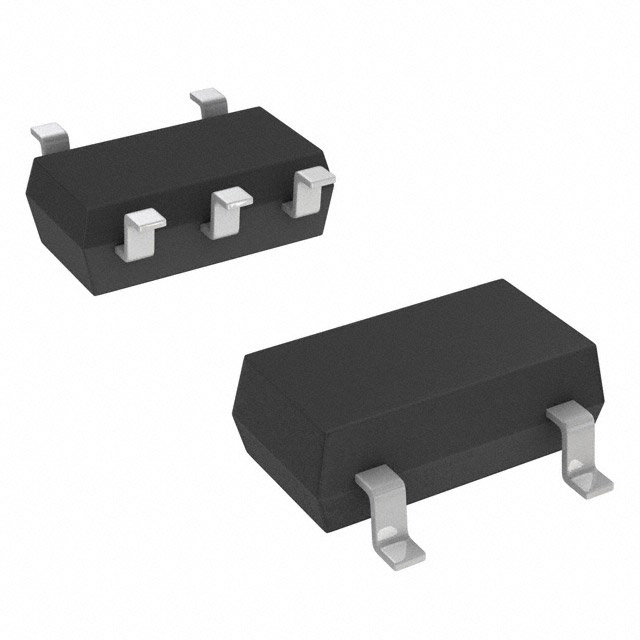
- Part No.:
- 74V1GU04CTR
- Manufacturer:
- STMicroelectronics
- Category:
- Gates and Inverters
- Package:
- 5-TSSOP, SC-70-5, SOT-353
- Datasheet:
-
 74V1GU04CTR.pdf
- Description:
- IC INVERTER 1CH 1-INP SOT323-5
- Quantity:
- Payment:

- Shipping:

Inventory:3,084
Please send an inquiry. Send us your inquiry, and we will respond immediately.
Product details
Overview
74V1GU04CTR from STMicroelectronics is a single-stage unbuffered CMOS inverter optimized for high-speed logic and analog oscillator applications, featuring 3.5ns typical propagation delay at 5V, 2V–5.5V operating voltage range, ±8mA symmetrical output drive, input tolerance up to 7V independent of VCC, and power-down protection. It is commonly used in crystal oscillator buffer stages and level-shifting interfaces between 3V and 5V systems.
For engineers reviewing the 74V1GU04CTR datasheet, 74V1GU04CTR pinout, 74V1GU04CTR application, or 74V1GU04CTR equivalent, key selection criteria include unbuffered inverter topology, rail-to-rail input tolerance, symmetrical output impedance, latch-up immunity, and SOT323-5L package compatibility with space-constrained PCB layouts.
Technical Context
This device implements a single-stage inverter without internal buffering, enabling direct integration into Pierce oscillator configurations where phase inversion and minimal propagation skew are critical. Its input structure accepts 0–7V regardless of VCC, supporting hot-swap and mixed-voltage interface scenarios.
The output stage delivers matched |IOH| = IOL ≥ 8mA at 4.5V with balanced tPLH ≅ tPHL, ensuring minimal duty-cycle distortion in clock generation. Built on sub-micron C2MOS technology, it achieves 1µA max ICC at 25°C while maintaining -55°C to +125°C operational range.
Key Specifications
| Parameter | Value and Actual Design Meaning |
|---|---|
| tPD (Typ) | 3.5ns at VCC = 5V - enables >100MHz fundamental clock operation in oscillator loops |
| VCC Range | 2V to 5.5V - supports direct use in both 3.3V and 5V systems without level shifters |
| Input Voltage Range | 0V to 7V - allows safe interfacing with overvoltage signals and hot-plug operation |
| IOL / IOH (Min) | 8mA at VCC = 4.5V - provides robust drive capability for capacitive loads up to 50pF |
| ICC (Max) | 1µA at TA = 25°C - ensures ultra-low static power in battery-backed or always-on timing circuits |
| Operating Temp | -55°C to +125°C - qualified for automotive under-hood and industrial control environments |
| CIN (Max) | 10pF - minimizes loading on sensitive oscillator nodes and high-impedance signal sources |
Pinout & Package
SOT323-5L package: 1.6mm × 1.6mm × 0.9mm body, 0.65mm pitch, 5-terminal surface-mount outline with exposed pad not present. Pin 1 marked by notch or bevel.
| Pin/Terminal | Circuit Role | Design Meaning |
|---|---|---|
| 1 | NC | No internal connection - must remain unconnected to avoid parasitic coupling |
| 2 | 1A | Inverter input - accepts 0–7V logic levels independent of VCC |
| 3 | GND | Ground reference - return path for all internal current and noise suppression |
| 4 | 1Y | Inverter output - unbuffered, symmetrical sourcing/sinking, drives crystal or downstream gate |
| 5 | VCC | Positive supply - powers internal logic; input protection remains active even when VCC = 0V |
Key Features
| Feature | Design Value |
|---|---|
| Unbuffered single-stage inverter | Eliminates internal propagation delay variation - essential for stable crystal oscillator loop gain and phase margin |
| Input voltage tolerance (0–7V) | Enables direct connection to higher-voltage sensors or legacy logic without external clamping diodes |
| Symmetrical output drive (|IOH| = IOL) | Maintains 50% duty cycle in clock distribution paths and reduces EMI from asymmetric edge rates |
| Power-down input protection | Permits safe input assertion before VCC ramp-up or after VCC removal - prevents back-powering and latch-up |
| Improved latch-up immunity | Qualified per JEDEC JESD78 - withstands transient currents without destructive latch-up in noisy industrial environments |
Applications
| Crystal Oscillator Buffer | 3V/5V Level Translation |
|---|---|
Use Scenario: Driving AT-cut quartz crystals in Pierce oscillator topologies requiring precise 180° phase inversion and low capacitive loading. IC Role / Device Role / Timing Role: Unbuffered inverter providing gain and phase inversion in the oscillator feedback loop. Use Value: 10pF max CIN and matched tPLH/tPHL minimize frequency pulling and jitter accumulation in precision timing references. | Use Scenario: Interfacing 5V microcontroller GPIO to 3.3V FPGA configuration pins during power sequencing. IC Role / Device Role / Timing Role: Bidirectional voltage translator leveraging rail-tolerant inputs and CMOS-compatible outputs. Use Value: Input accepts 5V while VCC = 3.3V, eliminating need for external resistors or dedicated level-shift ICs. |
| Hot-Swap Signal Conditioning | Low-Power Clock Distribution |
Use Scenario: Conditioning reset or interrupt signals in modular backplane systems where cards may be inserted while main power is active. IC Role / Device Role / Timing Role: Input protector and signal inverter with zero-VCC input tolerance. Use Value: Withstands 7V input transients with VCC = 0V - prevents damage and false triggering during live insertion. | Use Scenario: Distributing 1MHz watchdog clock across multiple low-power sensor nodes in battery-operated IoT endpoints. IC Role / Device Role / Timing Role: Low-quiescent-current inverter replicating and isolating clock signal to multiple loads. Use Value: 1µA max ICC at 25°C extends battery life while maintaining <10ns pulse fidelity across temperature. |
Equivalent & Alternatives
The following parts are listed as comparable options for similar single unbuffered inverter applications.
| Alternative Part | Technical Difference | Application Difference | Selection Advice |
|---|---|---|---|
| SN74LVC1G04DBVR | Buffered output stage; 3.3V-only VCC range (1.65–5.5V); no 7V input tolerance | Not suitable for crystal oscillator buffering due to added delay and phase uncertainty | Select only for general-purpose logic inversion where rail-to-rail input is unnecessary |
| NC7SZ04P5X | Unbuffered architecture; 1.65–5.5V VCC; 5.5V absolute max input; no power-down protection | Lacks 0V-VCC input safety margin - requires external clamping for hot-swap use | Acceptable for fixed-supply digital logic but not for oscillator or mixed-voltage interface roles |
Compared with SN74LVC1G04DBVR and NC7SZ04P5X, the 74V1GU04CTR uniquely combines unbuffered topology, 7V input tolerance, and power-down protection - making it irreplaceable in crystal oscillator and live-insertion applications where phase integrity and input robustness are non-negotiable.
Availability
74V1GU04CTR is available at Aetrix Electronics and suitable for crystal oscillator design, 3V/5V level translation, and hot-swap signal conditioning requiring stable component supply across automotive, industrial, and communications end markets.
Supply support for 74V1GU04CTR includes scheduled delivery planning, volume procurement assistance, BOM continuity management, traceable sourcing, and lifecycle availability coordination for OEM customers, industrial embedded developers, connected-device designers, and electronics production programs.
Manufacturer
STMicroelectronics is a global semiconductor leader headquartered in Geneva, designing and manufacturing analog, MCU, power, and MEMS products for industrial, automotive, and consumer applications.
The 74V series targets high-speed, low-power logic functions with enhanced robustness for mixed-signal and timing-critical systems - specifically engineered for oscillator buffering, level translation, and noise-immune digital interfacing.
FAQ
Can the 74V1GU04CTR be used with a 1.8V supply?
No. The recommended operating VCC range is 2V to 5.5V per datasheet Section 2. Absolute minimum VCC is 2V; operation below this violates guaranteed functionality and may result in undefined output states or increased propagation delay variability. For 1.8V systems, consider the 74LVC1G04 or similar 1.65V–5.5V logic families.
Is Pin 1 (NC) required to be left floating, or can it be tied to GND?
Pin 1 is internally unconnected and must remain floating - tying it to GND or any other node introduces parasitic capacitance and potential coupling paths that degrade oscillator phase noise and increase susceptibility to crosstalk. STMicroelectronics explicitly specifies "Not Connected" with no provision for external biasing.
Does the 74V1GU04CTR support true analog operation in oscillator circuits?
Yes. Its unbuffered single-stage CMOS topology operates in the linear region when biased via external feedback resistors, enabling reliable Pierce oscillator startup and sustained oscillation with standard AT-cut crystals. This behavior is documented in ST's AN2867 and verified in production oscillator designs across automotive and telecom applications.
What is the maximum capacitive load the 74V1GU04CTR can drive while maintaining specified tPD?
The AC Electrical Characteristics table specifies tPD values at CL = 15pF and CL = 50pF. At 5V supply, tPD remains within 3.5–5.5ns (typ–max) up to 50pF. Beyond 50pF, propagation delay increases nonlinearly and output rise/fall times degrade - ST does not characterize performance above 50pF, and oscillator loop stability may be compromised.
74V1GU04CTR Specifications
- Product attributes
- Attribute value
- Manufacturer:
- STMicroelectronics
- Series:
- 74V
- Package/Case:
- 5-TSSOP, SC-70-5, SOT-353
- Packaging:
- Tape & Reel (TR)
- Product Status:
- Obsolete
- Logic Type:
- Inverter
- Number of Circuits:
- 1
- Number of Inputs:
- 1
- Features:
- -
- Voltage - Supply:
- 2V ~ 5.5V
- Current - Quiescent (Max):
- 1 µA
- Current - Output High, Low:
- 8mA, 8mA
- Input Logic Level - Low:
- 0.3V
- Input Logic Level - High:
- 1.7V
- Max Propagation Delay @ V, Max CL:
- 6ns @ 5V, 50pF
- Operating Temperature:
- -55°C ~ 125°C
- Grade:
- -
- Qualification:
- -
- Mounting Type:
- Surface Mount
- Supplier Device Package:
- SOT-323-5
74V1GU04CTR FAQ
1.How can I place an order for 74V1GU04CTR through Aetrix?
Please submit a Request for Quotation (RFQ) for 74V1GU04CTR on Aetrix. Our sales agent will provide a competitive quotation and guide you through the order confirmation once you accept the terms.
2.Are the price and stock information for 74V1GU04CTR reliable?
The price and inventory of 74V1GU04CTR are updated periodically and may fluctuate due to market conditions. Stock and pricing data are typically refreshed every 24 hours. Quotation validity for 74V1GU04CTR is usually 5 days.
3.What payment methods are accepted for 74V1GU04CTR?
We accept Wire Transfer, PayPal, Credit Card, Western Union, MoneyGram, and Escrow for 74V1GU04CTR transactions.
Note: Certain payment methods may incur a processing fee.
4.How is shipping managed for 74V1GU04CTR?
74V1GU04CTR orders can be shipped via leading logistics carriers, including DHL, UPS, FedEx, TNT, or Registered Mail.
Once your 74V1GU04CTR order is processed, you will receive an email with the shipment details and tracking number.
Note: Tracking information may take up to 24 hours to appear. Express delivery typically takes 3–5 business days.
5.How can I obtain technical support or documentation for 74V1GU04CTR?
For technical support, including 74V1GU04CTR datasheets, pinout diagrams, or application guidance, please contact our engineering support team. They can provide detailed documentation and assistance for your 74V1GU04CTR requirements.
6.How does Aetrix verify that 74V1GU04CTR is sourced from the original manufacturer or authorized distributors?
All 74V1GU04CTR products on Aetrix are procured from qualified distributors and authorized channels. Our dedicated quality assurance team conducts strict verification, including traceability checks and, if necessary, third-party testing. This ensures that 74V1GU04CTR meets industry standards.
7.What is the process for return or replacement of 74V1GU04CTR?
All 74V1GU04CTR units undergo pre-shipment inspection (PSI). If there is an issue with 74V1GU04CTR, returns or replacements are accepted under the following conditions:
1.Quantity discrepancies, incorrect items, or visible external defects (such as breakage or corrosion), acknowledged by Aetrix.
2.The issue is reported within 90 days of delivery.
3.The 74V1GU04CTR part is unused and in its original packaging.
Return procedure for 74V1GU04CTR:
1.Submit a request within 90 days.
2.Obtain a Return Material Authorization (RMA) from Aetrix.
74V1GU04CTR Tags

-
SN74LVC1G14DBVR
Texas Instruments
-
SN74LVC1G14DCKR
Texas Instruments
-
SN74AHC1G14DBVR
Texas Instruments
-
SN74LVC1G08DBVR
Texas Instruments
-
SN74LVC1G08DCKR
Texas Instruments
-
SN74LVC1G32DCKR
Texas Instruments
-
SN74LVC1G04DBVR
Texas Instruments
.jpg)
-
74LVC1G08GW,125
Nexperia USA Inc.
-
SN74LVC1G04DCKR
Texas Instruments
-
SN74AHC1G08DBVR
Texas Instruments
-
SN74LVC1G32DBVR
Texas Instruments
-
SN74AHCT1G08DBVR
Texas Instruments
Tech Hub
An SR latch stores one bit through cross-coupled feedback. This engineering reference covers NOR and NAND implementations, truth tables, forbidden-state recovery, gated operation, switch debouncing, fa…

Latch circuits retain one bit through feedback. This technical reference covers SR and D latches, truth tables, transparency, timing limits, latch-versus-flip-flop behavior, applications and common log…

An engineering guide to LED driver operation, constant-current and constant-voltage outputs, linear and switching topologies, dimming, IC selection, calculations, replacement compatibility, and fault c…

Operational amplifier guide covering op amp basics, feedback, ideal vs real op amps, common configurations, buffer circuits, offset, bias current, gain-bandwidth, slew rate, rail-to-rail limits and sel…

Jumper cables guide covering safe connection order, red and black clamp placement, final ground connection, cable gauge, length, clamp quality, copper vs CCA cables, jump starter comparison and battery…

LDO regulator guide covering low dropout voltage, power dissipation, thermal design, PSRR, output noise, capacitor stability, adjustable LDO circuits, LDO vs buck converter and datasheet selection chec…

Conditional Access Module guide covering CAM meaning, CI/CI+ interface, smart card authorization, DVB security workflow, TV and set-top box compatibility, internal electronics, ESD protection, connecto…

Guide to electronic component obsolescence covering EOL risk, PCN/PDN notices, last-time buy planning, replacement options, form-fit-function validation, counterfeit risk and BOM lifecycle management.

18650 battery guide covering lithium-ion cell basics, 3.6V/3.7V voltage, 4.2V charging, mAh and Wh capacity, protected cells, chargers, BMS, series-parallel packs, holders, welding and sourcing checks.…

Hall effect sensor guide covering working principle, linear and digital sensors, Arduino circuits, current sensing, speed detection, automotive applications, A3144 examples, signal filtering and datash…


