
 My Inquiry
 My Account


STMicroelectronics 74VHC245TTR
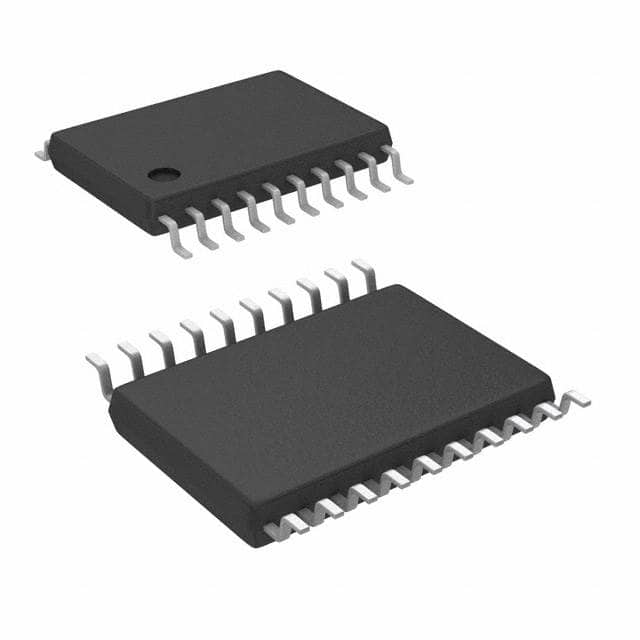
- Part No.:
- 74VHC245TTR
- Manufacturer:
- STMicroelectronics
- Package:
- 20-TSSOP (0.173", 4.40mm Width)
- Datasheet:
-
 74VHC245TTR.pdf
- Description:
- IC TXRX NON-INVERT 5.5V 20TSSOP
- Quantity:
- Payment:

- Shipping:

Inventory:2,076
Please send an inquiry. Send us your inquiry, and we will respond immediately.
Product details
Overview
74VHC245TTR from STMicroelectronics is an advanced high-speed CMOS octal bus transceiver (3-state) with directional control and output enable, operating from 2V to 5.5V supply. It provides bidirectional data flow between two 8-bit buses, features 4.0 ns typical propagation delay at 5V, ±8 mA symmetrical drive strength, and 2 kV ESD protection on all I/O pins. Used in level-shifting and bus-isolation applications within industrial microcontroller interfaces.
For engineers reviewing the 74VHC245TTR datasheet, 74VHC245TTR pinout, 74VHC245TTR application, or 74VHC245TTR equivalent, key selection criteria include directional control logic (DIR), 3-state enable timing (tPZL/tPLZ), VCC operating range (2–5.5 V), symmetrical output drive (|IOH| = IOL ≥ 8 mA), and TSSOP-20 package compatibility with space-constrained PCB layouts.
Technical Context
The 74VHC245TTR implements a dual-bus, directionally controlled transceiver architecture where DIR selects data flow direction (A→B or B→A), while G enables or disables all outputs into high-impedance state. Its sub-micron C2MOS process ensures low dynamic power and latch-up immunity.
It supports asynchronous bidirectional communication without internal clocking or handshaking. All inputs tolerate overvoltage up to VCC + 0.5 V, and outputs maintain rail-to-rail voltage compliance under load, enabling robust interfacing across mixed-voltage domains (e.g., 3.3 V MCU ↔ 5 V peripheral bus).
Key Specifications
| Parameter | Value and Actual Design Meaning |
|---|---|
| VCC Range | 2 V to 5.5 V - supports interoperability between 2.5 V, 3.3 V, and 5 V logic domains |
| tPD (Typ.) | 4.0 ns at VCC = 5 V - enables high-speed data transfer in ≤25 MHz bus cycles |
| IOL / IOH | ≥8 mA - drives standard TTL loads and sustains signal integrity across 15 pF trace capacitance |
| VIH / VIL | 0.7VCC / 0.3VCC - ensures noise margin ≥28% of VCC for reliable switching in noisy environments |
| ICC (Max) | 4 µA at TA = 25°C - enables ultra-low static power in battery-backed or standby systems |
| ESD Rating | 2 kV HBM - protects against handling-induced discharge without external TVS diodes |
| tPZL (Max) | 10.0 ns at VCC = 5 V - guarantees fast bus isolation during mode transitions or fault recovery |
Pinout & Package
TSSOP-20 package: 6.5 mm × 4.4 mm body, 0.65 mm pitch, exposed pad not present, JEDEC MO-153 compliant.
| Pin/Terminal | Circuit Role | Design Meaning |
|---|---|---|
| 1 | DIR | Direction control input: LOW = A→B, HIGH = B→A; referenced to VCC/GND, no pull-up required |
| 2–9 | A1–A8 | Bus A I/O terminals: bidirectional when enabled; high-impedance when G = HIGH |
| 11–18 | B1–B8 | Bus B I/O terminals: mirror function of A1–A8, opposite direction per DIR state |
| 19 | G | Active-low output enable: LOW = transceiver active, HIGH = all A/B pins in high-Z |
| 10 | GND | Ground reference for all logic and I/O; must be low-inductance connection |
| 20 | VCC | Positive supply: decoupling capacitor (100 nF ceramic) required within 5 mm |
Key Features
| Feature | Design Value |
|---|---|
| Pin- and function-compatible with 74LS245 | Direct drop-in replacement for legacy TTL bus transceivers without logic redesign |
| Symmetrical output impedance | Ensures matched rise/fall times (tPLH ≅ tPHL), minimizing skew across all 8 channels |
| Power-down protection on control inputs | Prevents unintended output activation during power ramp-up/down sequences |
| Low dynamic noise (VOLP ≤ 0.9 V) | Reduces ground bounce and crosstalk in dense multi-transceiver bus systems |
| Improved latch-up immunity | Withstands transient current spikes without destructive parasitic thyristor triggering |
Applications
| Industrial PLC Backplane Interface | Embedded MCU Memory Expansion |
|---|---|
Use Scenario: Isolating CPU address/data bus from modular I/O expansion slots in programmable logic controllers. IC Role / Device Role / Timing Role: Bidirectional bus transceiver managing 8-bit parallel data flow between ARM Cortex-M4 core and isolated CAN/RS-485 interface modules. Use Value: Enables hot-swap-safe bus arbitration via G-controlled high-Z state and meets IEC 61000-4-2 Level 3 ESD requirements without added protection circuitry. | Use Scenario: Extending external SRAM or flash memory bandwidth for resource-constrained microcontrollers. IC Role / Device Role / Timing Role: Direction-controlled data path between STM32H743 ZI's Flexible Memory Controller (FSMC) and 8-bit parallel NOR flash device. Use Value: Delivers 4 ns propagation delay and <10 ns disable time to sustain >20 MHz memory read/write cycles without wait states. |
| Automotive Body Control Module | Test Equipment Digital I/O Subsystem |
Use Scenario: Level-shifting and isolating LIN cluster microcontroller I/O from 5 V sensor interface circuits. IC Role / Device Role / Timing Role: Voltage-tolerant transceiver translating 3.3 V MCU GPIO signals to 5 V analog multiplexer control lines. Use Value: Operates reliably across -40°C to 125°C ambient with guaranteed VI/O = 0 to VCC specification and 2 kV HBM ESD rating. | Use Scenario: Configurable digital stimulus/response channel in automated test equipment (ATE) racks. IC Role / Device Role / Timing Role: Reconfigurable 8-bit bidirectional port managed by FPGA-based controller for DUT signal injection and capture. Use Value: Supports rapid direction reversal and bus float management via DIR/G control, enabling per-pin functional test sequencing without external multiplexers. |
Equivalent & Alternatives
The following parts are listed as comparable options for similar octal bus transceiver applications.
| Alternative Part | Technical Difference | Application Difference | Selection Advice |
|---|---|---|---|
| SN74LVC245APWR | Lower VCC min (1.65 V), higher speed (tPD = 3.5 ns typ.), but only rated to 125°C (not -55°C) | Preferred for portable 1.8 V/3.3 V systems; unsuitable for extended temperature industrial deployments | Select when operating below 2 V or requiring tighter timing margins; verify thermal derating for -55°C operation |
| 74HC245D,653 | Slower (tPD = 18 ns typ. at 4.5 V), higher ICC (≤160 µA), same TSSOP-20 footprint | Acceptable for low-frequency (<5 MHz) legacy designs where power and speed are secondary | Choose only for cost-sensitive, non-performance-critical replacements where existing layout reuse is mandatory |
Compared with SN74LVC245APWR and 74HC245D,653, the 74VHC245TTR uniquely balances wide VCC range (2–5.5 V), extended temperature support (-55°C to +125°C), and sub-5 ns speed-making it optimal for industrial and automotive bus isolation where voltage flexibility and ruggedness are prioritized over absolute minimum propagation delay.
Availability
74VHC245TTR is available at Aetrix Electronics and suitable for industrial PLC backplanes, embedded memory expansion subsystems, and automotive body control modules requiring stable component supply across extended temperature ranges and mixed-voltage interfaces.
Supply support for 74VHC245TTR includes scheduled delivery planning, volume procurement assistance, BOM continuity management, traceable sourcing, and lifecycle availability coordination for OEM customers, industrial embedded developers, connected-device designers, and electronics production programs.
Manufacturer
STMicroelectronics is a global semiconductor leader headquartered in Geneva, Switzerland, delivering silicon solutions for automotive, industrial, and consumer markets with emphasis on reliability, longevity, and automotive-grade qualification.
The 74VHC series targets high-speed, low-power CMOS logic replacement for legacy TTL, emphasizing robustness in harsh environments and seamless integration into mixed-voltage digital systems.
FAQ
What is the maximum recommended operating frequency for 74VHC245TTR in a 5 V system?
The 74VHC245TTR has a typical propagation delay of 4.0 ns at VCC = 5 V, supporting reliable operation up to approximately 25 MHz in worst-case bus timing (accounting for setup/hold and enable/disable delays). System-level frequency is constrained by board trace length, load capacitance, and driver strength-not by internal clocking, as it is asynchronous.
Can 74VHC245TTR safely interface a 3.3 V microcontroller with a 5 V peripheral without level shifters?
Yes-its inputs tolerate VI up to VCC + 0.5 V, and outputs swing rail-to-rail. When powered at 5 V, it accepts 3.3 V logic-high inputs (VIH = 0.7×5 = 3.5 V min, so 3.3 V is marginal but functional with noise margin); when powered at 3.3 V, outputs meet 5 V TTL thresholds only if peripheral inputs are 3.3 V tolerant. For guaranteed 5 V peripheral drive, use 5 V VCC with appropriate input clamping.
Is the TSSOP-20 package of 74VHC245TTR RoHS-compliant and lead-free?
Yes-the 74VHC245TTR is manufactured in a RoHS-compliant, lead-free TSSOP-20 package per STMicroelectronics' ECOPACK2 specifications. The device carries the "E" suffix in ordering codes indicating lead-free finish, and its JEDEC MO-153 mechanical drawing confirms Pb-free terminal plating (matte tin).
How does the DIR and G pin interaction affect bus contention risk?
Bus contention is prevented by strict priority: G is dominant-when G = HIGH, all A and B pins enter high-impedance regardless of DIR state. Only when G = LOW does DIR determine direction. This ensures no simultaneous drive from both buses, eliminating shoot-through current. External pull-downs on G are recommended in systems where power sequencing may leave G floating during startup.
74VHC245TTR Specifications
- Product attributes
- Attribute value
- Manufacturer:
- STMicroelectronics
- Series:
- 74VHC
- Package/Case:
- 20-TSSOP (0.173", 4.40mm Width)
- Packaging:
- Tape & Reel (TR)
- Product Status:
- Obsolete
- Logic Type:
- Transceiver, Non-Inverting
- Number of Elements:
- 1
- Number of Bits per Element:
- 8
- Input Type:
- -
- Output Type:
- 3-State
- Current - Output High, Low:
- 8mA, 8mA
- Voltage - Supply:
- 2V ~ 5.5V
- Operating Temperature:
- -55°C ~ 125°C (TA)
- Grade:
- -
- Qualification:
- -
- Mounting Type:
- Surface Mount
- Supplier Device Package:
- 20-TSSOP
74VHC245TTR FAQ
1.How can I place an order for 74VHC245TTR through Aetrix?
Please submit a Request for Quotation (RFQ) for 74VHC245TTR on Aetrix. Our sales agent will provide a competitive quotation and guide you through the order confirmation once you accept the terms.
2.Are the price and stock information for 74VHC245TTR reliable?
The price and inventory of 74VHC245TTR are updated periodically and may fluctuate due to market conditions. Stock and pricing data are typically refreshed every 24 hours. Quotation validity for 74VHC245TTR is usually 5 days.
3.What payment methods are accepted for 74VHC245TTR?
We accept Wire Transfer, PayPal, Credit Card, Western Union, MoneyGram, and Escrow for 74VHC245TTR transactions.
Note: Certain payment methods may incur a processing fee.
4.How is shipping managed for 74VHC245TTR?
74VHC245TTR orders can be shipped via leading logistics carriers, including DHL, UPS, FedEx, TNT, or Registered Mail.
Once your 74VHC245TTR order is processed, you will receive an email with the shipment details and tracking number.
Note: Tracking information may take up to 24 hours to appear. Express delivery typically takes 3–5 business days.
5.How can I obtain technical support or documentation for 74VHC245TTR?
For technical support, including 74VHC245TTR datasheets, pinout diagrams, or application guidance, please contact our engineering support team. They can provide detailed documentation and assistance for your 74VHC245TTR requirements.
6.How does Aetrix verify that 74VHC245TTR is sourced from the original manufacturer or authorized distributors?
All 74VHC245TTR products on Aetrix are procured from qualified distributors and authorized channels. Our dedicated quality assurance team conducts strict verification, including traceability checks and, if necessary, third-party testing. This ensures that 74VHC245TTR meets industry standards.
7.What is the process for return or replacement of 74VHC245TTR?
All 74VHC245TTR units undergo pre-shipment inspection (PSI). If there is an issue with 74VHC245TTR, returns or replacements are accepted under the following conditions:
1.Quantity discrepancies, incorrect items, or visible external defects (such as breakage or corrosion), acknowledged by Aetrix.
2.The issue is reported within 90 days of delivery.
3.The 74VHC245TTR part is unused and in its original packaging.
Return procedure for 74VHC245TTR:
1.Submit a request within 90 days.
2.Obtain a Return Material Authorization (RMA) from Aetrix.
74VHC245TTR Tags
-
SN74LVC1G17DBVR
Texas Instruments
-
SN74LVC1G07DCKR
Texas Instruments
-
SN74LVC1G17DCKR
Texas Instruments
-
SN74LVC1G07DBVR
Texas Instruments
-
SN74LVC1G125DCKR
Texas Instruments
-
SN74AHCT1G126DBVR
Texas Instruments
-
SN74LVC1G125DBVR
Texas Instruments
-
SN74AHCT1G125DBVR
Texas Instruments

-
SN74LVC2G17DBVR
Texas Instruments
-
SN74LVC2G07DCKR
Texas Instruments
-
SN74LVC1G34DCKR
Texas Instruments
-
SN74LVC2G17DCKR
Texas Instruments
Tech Hub

A practical engineering and sourcing framework covering lifecycle verification, lifetime-buy calculations, replacement qualification, supplier checks and counterfeit-risk controls.

TTL and CMOS logic families differ in thresholds, loading, output drive, power and timing. This engineering guide compares 74HC and 74HCT, calculates noise margins and checks 3.3 V/5 V compatibility.

A practical engineering guide to 3.3V and 5V logic compatibility, input thresholds, resistor dividers, translator ICs, MOSFET level shifting, I2C pull-ups, timing limits and power-sequencing risks.

The 74HC595 uses push-pull logic outputs, while the TPIC6B595 uses 50 V open-drain DMOS sinks for higher-power loads. This guide compares timing, current limits, 3.3 V interfacing, load wiring, thermal…

The 74HC595 converts serial data into eight stable parallel outputs. This guide covers pin functions, shift and storage timing, OE and MR behavior, drive-current limits, cascading, voltage compatibilit…

A technical comparison of level-sensitive latches and edge-triggered flip-flops, covering timing windows, setup and hold limits, master–slave operation, time borrowing, race-through, HDL inference and…

A D latch stores one bit while Enable controls when data can pass. This reference covers gate-level operation, truth tables, transparency, setup and hold timing, LE versus OE, common ICs and practical …

An SR latch stores one bit through cross-coupled feedback. This engineering reference covers NOR and NAND implementations, truth tables, forbidden-state recovery, gated operation, switch debouncing, fa…

Latch circuits retain one bit through feedback. This technical reference covers SR and D latches, truth tables, transparency, timing limits, latch-versus-flip-flop behavior, applications and common log…

An engineering guide to LED driver operation, constant-current and constant-voltage outputs, linear and switching topologies, dimming, IC selection, calculations, replacement compatibility, and fault c…


