
 My Inquiry
 My Account


Allegro MicroSystems A1309KUA-9-T
- Part No.:
- A1309KUA-9-T
- Manufacturer:
- Allegro MicroSystems
- Category:
- Linear, Compass (ICs)
- Package:
- 3-SSIP
- Datasheet:
-
 A1309KUA-9-T.pdf
- Description:
- SENSOR HALL EFFECT ANALOG 3SIP
- Quantity:
- Payment:

- Shipping:

Inventory:8,347
Please send an inquiry. Send us your inquiry, and we will respond immediately.
Product details
Overview
A1309KUA-9-T from Allegro MicroSystems is a ratiometric linear Hall-effect sensor IC with analog voltage output, designed for high-accuracy angular and displacement sensing in automotive and industrial systems. It delivers 9 mV/G sensitivity, operates from –40°C to 125°C, features programmable QVO temperature coefficient, and uses dynamic offset cancellation for stable quiescent output (2.5 V at 5 V supply) across temperature and supply variation.
For engineers reviewing the A1309KUA-9-T datasheet, A1309KUA-9-T pinout, A1309KUA-9-T application, or A1309KUA-9-T equivalent, this device supports precision position feedback in throttle valves, pedal sensors, and rotary actuators where low-drift analog linearity and AEC-Q100 qualification are required.
Technical Context
The A1309KUA-9-T integrates a BiCMOS monolithic circuit with Hall element, high-gain amplifier, tuned filter, and proprietary dynamic offset cancellation. Its chopper-stabilized architecture operates at 400 kHz to suppress thermal and mechanical stress-induced drift, enabling precise recoverability after temperature cycling.
It implements ratiometric operation-QVO, sensitivity, and output clamps scale with VCC-and includes undervoltage lockout (UVLO) with 2.5 V turn-off and 3 V turn-on thresholds, plus output voltage clamps (0.4–0.7 V low, 4.35–4.65 V high) for short-circuit diagnostics.
Key Specifications
| Parameter | Value and Actual Design Meaning |
|---|---|
| Sensitivity | 9 mV/G (typ), ±0.27 mV/G tolerance - enables high-resolution magnetic field measurement with minimal gain error |
| Quiescent Output Voltage | 2.5 V ±12 mV at 5 V supply - centered ratiometric baseline for bidirectional field detection |
| Operating Temperature | –40°C to +125°C - qualified for under-hood automotive and industrial control environments |
| Supply Voltage | 4.5–5.5 V - compatible with standard 5 V rail; UVLO ensures clean startup/shutdown |
| Output Bandwidth | 20 kHz (–3 dB) - supports fast-response position tracking in dynamic motion systems |
| QVO Temp Coefficient | 0.12 %/°C (programmed at 125°C) - actively compensated drift for stable zero-field output over full range |
| Linearity Error | ±1.5 % - ensures monotonic analog response across magnetic input range without correction |
Pinout & Package
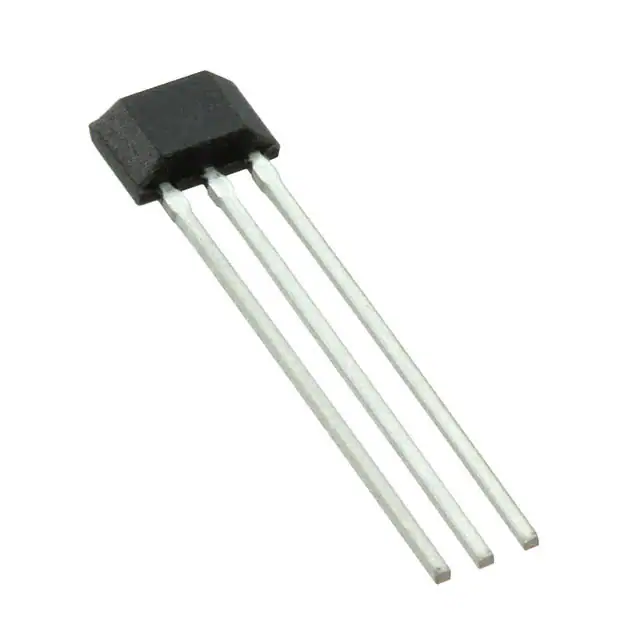
Package: 3-pin ultramini SIP (UA), through-hole mounting, 1.5 mm × 4 mm × 3 mm, lead-free with 100% matte-tin plating.
| Pin/Terminal | Circuit Role | Design Meaning |
|---|---|---|
| VCC (Pin 1) | Power supply input | Must be bypassed to GND with ≥0.1 µF capacitor; powers internal regulator and analog core |
| VOUT (Pin 3) | Analog output signal | Low-impedance ratiometric voltage proportional to magnetic flux; clamped for fault detection |
| GND (Pin 2) | Reference ground | Return path for supply current and output load; critical for noise immunity and offset stability |
Key Features
| Feature | Design Value |
|---|---|
| Dynamic offset cancellation | Eliminates thermal and mechanical stress drift, enabling <±10 mV QVO drift over –40°C to 125°C |
| Programmable QVO temp coefficient | Calibrated at end-of-line to 0.12 %/°C, ensuring consistent zero-field output across temperature |
| Output voltage clamps | 0.40–0.70 V low clamp and 4.35–4.65 V high clamp enable real-time short-circuit diagnostics |
| AEC-Q100 qualification | Qualified to Grade 0 (–40°C to +150°C ambient) - validated for automotive safety-critical subsystems |
| High-speed chopping | 400 kHz modulation frequency minimizes 1/f noise and improves long-term stability of analog output |
Applications
| Throttle Position Sensing | Brake Pedal Angle Detection |
|---|---|
Use Scenario: Continuous monitoring of throttle plate rotation in gasoline/diesel engine management systems. IC Role / Device Role / Timing Role: Linear Hall-effect sensor providing analog voltage proportional to angular displacement of ferrous target. Use Value: Delivers ±1.5 % linearity and <±10 mV QVO drift over –40°C to 125°C, eliminating need for post-calibration compensation. |
Use Scenario: Measuring brake pedal travel in electronic braking systems (EBS) and brake-by-wire architectures. IC Role / Device Role / Timing Role: Analog position transducer converting mechanical stroke into ratiometric voltage output referenced to vehicle battery. Use Value: UVLO and output clamps provide fail-safe diagnostics; AEC-Q100 qualification ensures reliability in safety-critical braking functions. |
| Steering Column Torque Sensing | Industrial Valve Actuation Feedback |
Use Scenario: Detecting torsional deflection in electric power steering (EPS) torque-sensing shafts. IC Role / Device Role / Timing Role: High-bandwidth (20 kHz) linear sensor capturing rapid torque transients during steering maneuvers. Use Value: 400 kHz chopping reduces noise floor to 1.5 mG/√Hz, enabling resolution of sub-degree angular changes. |
Use Scenario: Closed-loop position verification in pneumatic/hydraulic control valves for process automation. IC Role / Device Role / Timing Role: Through-hole mounted analog sensor interfacing with PLC analog inputs for valve stem position reporting. Use Value: SIP-UA package withstands vibration and thermal cycling; ratiometric output rejects supply rail fluctuations common in factory power systems. |
Equivalent & Alternatives
The following parts are listed as comparable options for similar linear Hall-effect sensor applications.
| Alternative Part | Technical Difference | Application Difference | Selection Advice |
|---|---|---|---|
| A1309LLHLX-9-T | SOT-23W surface-mount package; wider –40°C to 150°C operating range; identical 9 mV/G sensitivity and QVO spec | Preferred for space-constrained PCBs and high-temp under-hood locations requiring surface-mount assembly | Select when board area is limited or extended temperature operation beyond 125°C is required |
| TLV493D-A1B6 | 3D Hall sensor with I²C digital output; 12-bit resolution; lower sensitivity (100 mV/mT); no analog clamps or UVLO | Used in multi-axis orientation sensing; requires microcontroller interface and firmware calibration | Choose for digital position fusion or multi-axis vector measurement-not for direct analog replacement |
Compared with A1309KUA-9-T, the A1309LLHLX-9-T offers identical analog performance in a smaller SMT footprint and higher temperature grade, while the TLV493D-A1B6 trades analog simplicity for digital flexibility and 3D capability-neither is pin-compatible, but both serve distinct design priorities in position sensing.
Availability
A1309KUA-9-T is available at Aetrix Electronics and suitable for automotive throttle control, brake pedal sensing, and industrial valve actuation requiring stable component supply, AEC-Q100 compliance, and through-hole mounting robustness.
Supply support for A1309KUA-9-T includes scheduled delivery planning, volume procurement assistance, BOM continuity management, traceable sourcing, and lifecycle availability coordination for OEM customers, industrial embedded developers, connected-device designers, and electronics production programs.
Manufacturer
Allegro MicroSystems is a U.S.-based semiconductor company specializing in magnetic sensing, power ICs, and motor driver solutions for automotive and industrial markets.
The A1309KUA-9-T belongs to Allegro's linear Hall-effect sensor family, engineered for high-accuracy analog position feedback in safety-critical motion control systems where drift, noise, and environmental resilience are paramount.
FAQ
What is the operating temperature range for the A1309KUA-9-T?
The A1309KUA-9-T operates from –40°C to +125°C, matching the "K" temperature option defined in Allegro's selection guide. This range is validated per AEC-Q100 Grade 0 requirements and supports under-hood automotive use cases such as throttle and pedal sensing where ambient heat exposure is significant. The device maintains specified sensitivity and QVO accuracy across this full span due to end-of-line programming of temperature coefficients.
Does the A1309KUA-9-T require an external bypass capacitor?
Yes, the A1309KUA-9-T requires a minimum 0.1 µF ceramic bypass capacitor between VCC and GND, placed as close as possible to the package pins. This capacitor stabilizes the internal regulator, suppresses supply noise, and ensures proper operation of the chopper-stabilized analog front-end. Omission or improper placement degrades noise performance and may cause instability in the output voltage, especially under fast magnetic transients.
How does the A1309KUA-9-T implement undervoltage lockout (UVLO)?
The A1309KUA-9-T incorporates integrated UVLO with asymmetric thresholds: it powers on when VCC rises above 3 V and powers off when VCC falls below 2.5 V. This hysteresis prevents output oscillation near the threshold and ensures clean state transitions. During UVLO, VOUT is actively pulled low to GND-providing a known fault state that supports diagnostic logic in host controllers interfacing with the A1309KUA-9-T.
Can the A1309KUA-9-T be used in reverse-polarity magnetic field detection?
No-the A1309KUA-9-T has forward-polarity output only, meaning its voltage increases with south-pole field strength and decreases with north-pole field strength. For true bipolar (reverse-polarity) operation, Allegro offers the A1309LLHLX-RP9-T variant, which provides –9 mV/G sensitivity. The A1309KUA-9-T's output remains within its 0.4–4.65 V clamped range for valid field inputs but does not invert polarity relative to field direction.
What is the purpose of the output voltage clamps in the A1309KUA-9-T?
The A1309KUA-9-T features active output clamps: VCLPLOW (0.40–0.70 V) and VCLPHIGH (4.35–4.65 V) referenced to VCC. These clamps limit the analog output swing during over-field conditions or wiring faults, allowing downstream circuitry to detect open-load, short-to-ground, or short-to-VCC events. Because the clamps scale ratiometrically with VCC, they maintain diagnostic integrity across supply variations-a key requirement for functional safety in automotive applications using the A1309KUA-9-T.
A1309KUA-9-T Specifications
- Product attributes
- Attribute value
- Manufacturer:
- Allegro MicroSystems
- Series:
- -
- Package/Case:
- 3-SSIP
- Packaging:
- Bulk
- Product Status:
- Active
- Technology:
- Hall Effect
- Axis:
- Single
- Output Type:
- Analog Voltage
- Sensing Range:
- -
- Voltage - Supply:
- 4.5V ~ 5.5V
- Current - Supply (Max):
- 11.5mA
- Current - Output (Max):
- 10mA
- Resolution:
- -
- Bandwidth:
- 20kHz
- Operating Temperature:
- -40°C ~ 125°C
- Grade:
- -
- Qualification:
- -
- Features:
- -
- Supplier Device Package:
- 3-SIP
- Mounting Type:
- Through Hole
A1309KUA-9-T FAQ
1.How can I place an order for A1309KUA-9-T through Aetrix?
Please submit a Request for Quotation (RFQ) for A1309KUA-9-T on Aetrix. Our sales agent will provide a competitive quotation and guide you through the order confirmation once you accept the terms.
2.Are the price and stock information for A1309KUA-9-T reliable?
The price and inventory of A1309KUA-9-T are updated periodically and may fluctuate due to market conditions. Stock and pricing data are typically refreshed every 24 hours. Quotation validity for A1309KUA-9-T is usually 5 days.
3.What payment methods are accepted for A1309KUA-9-T?
We accept Wire Transfer, PayPal, Credit Card, Western Union, MoneyGram, and Escrow for A1309KUA-9-T transactions.
Note: Certain payment methods may incur a processing fee.
4.How is shipping managed for A1309KUA-9-T?
A1309KUA-9-T orders can be shipped via leading logistics carriers, including DHL, UPS, FedEx, TNT, or Registered Mail.
Once your A1309KUA-9-T order is processed, you will receive an email with the shipment details and tracking number.
Note: Tracking information may take up to 24 hours to appear. Express delivery typically takes 3–5 business days.
5.How can I obtain technical support or documentation for A1309KUA-9-T?
For technical support, including A1309KUA-9-T datasheets, pinout diagrams, or application guidance, please contact our engineering support team. They can provide detailed documentation and assistance for your A1309KUA-9-T requirements.
6.How does Aetrix verify that A1309KUA-9-T is sourced from the original manufacturer or authorized distributors?
All A1309KUA-9-T products on Aetrix are procured from qualified distributors and authorized channels. Our dedicated quality assurance team conducts strict verification, including traceability checks and, if necessary, third-party testing. This ensures that A1309KUA-9-T meets industry standards.
7.What is the process for return or replacement of A1309KUA-9-T?
All A1309KUA-9-T units undergo pre-shipment inspection (PSI). If there is an issue with A1309KUA-9-T, returns or replacements are accepted under the following conditions:
1.Quantity discrepancies, incorrect items, or visible external defects (such as breakage or corrosion), acknowledged by Aetrix.
2.The issue is reported within 90 days of delivery.
3.The A1309KUA-9-T part is unused and in its original packaging.
Return procedure for A1309KUA-9-T:
1.Submit a request within 90 days.
2.Obtain a Return Material Authorization (RMA) from Aetrix.
A1309KUA-9-T Tags
-
DRV5053VAQDBZR
Texas Instruments
-
MMC5603NJ
Memsic Inc.
-
DRV5055A1QDBZR
Texas Instruments
-
MLX90392ELQ-AAA-011-RE
Melexis Technologies NV

-
CT100LW-HS6
Allegro MicroSystems
-
DRV5056A1ELPGMQ1
Texas Instruments
-
A1304ELHLX-T
Allegro MicroSystems
-
MMC5633NJL
Memsic Inc.
-
A1308KUA-2-T
Allegro MicroSystems
-
A1308KUA-1-T
Allegro MicroSystems
-
SI7210-B-04-IVR
Silicon Labs
-
A1308LLHLT-2-T
Allegro MicroSystems
Tech Hub

A practical engineering and sourcing framework covering lifecycle verification, lifetime-buy calculations, replacement qualification, supplier checks and counterfeit-risk controls.

TTL and CMOS logic families differ in thresholds, loading, output drive, power and timing. This engineering guide compares 74HC and 74HCT, calculates noise margins and checks 3.3 V/5 V compatibility.

A practical engineering guide to 3.3V and 5V logic compatibility, input thresholds, resistor dividers, translator ICs, MOSFET level shifting, I2C pull-ups, timing limits and power-sequencing risks.

The 74HC595 uses push-pull logic outputs, while the TPIC6B595 uses 50 V open-drain DMOS sinks for higher-power loads. This guide compares timing, current limits, 3.3 V interfacing, load wiring, thermal…

The 74HC595 converts serial data into eight stable parallel outputs. This guide covers pin functions, shift and storage timing, OE and MR behavior, drive-current limits, cascading, voltage compatibilit…

A technical comparison of level-sensitive latches and edge-triggered flip-flops, covering timing windows, setup and hold limits, master–slave operation, time borrowing, race-through, HDL inference and…

A D latch stores one bit while Enable controls when data can pass. This reference covers gate-level operation, truth tables, transparency, setup and hold timing, LE versus OE, common ICs and practical …

An SR latch stores one bit through cross-coupled feedback. This engineering reference covers NOR and NAND implementations, truth tables, forbidden-state recovery, gated operation, switch debouncing, fa…

Latch circuits retain one bit through feedback. This technical reference covers SR and D latches, truth tables, transparency, timing limits, latch-versus-flip-flop behavior, applications and common log…

An engineering guide to LED driver operation, constant-current and constant-voltage outputs, linear and switching topologies, dimming, IC selection, calculations, replacement compatibility, and fault c…


