
 My Inquiry
 My Account


Allegro MicroSystems A1389LUATN-9-T
- Part No.:
- A1389LUATN-9-T
- Manufacturer:
- Allegro MicroSystems
- Category:
- Linear, Compass (ICs)
- Package:
- 3-SSIP
- Datasheet:
-
 A1389LUATN-9-T.pdf
- Description:
- SENSOR HALL EFFECT ANALOG 3SIP
- Quantity:
- Payment:

- Shipping:

Inventory:4,549
Please send an inquiry. Send us your inquiry, and we will respond immediately.
Product details
Overview
A1389LUATN-9-T from Allegro MicroSystems is a linear Hall-effect sensor IC designed for high-accuracy angular and displacement sensing in automotive and industrial systems. It delivers 9 mV/G sensitivity, ratiometric analog output centered at 2.5 V (50% of 5 V supply), and operates across –40°C to 150°C. Its integrated dynamic offset cancellation, programmable QVO temperature coefficient, and output clamps enable robust magnetic field measurement in harsh environments.
For engineers reviewing the A1389LUATN-9-T datasheet, A1389LUATN-9-T pinout, A1389LUATN-9-T application, or A1389LUATN-9-T equivalent, this page provides verified technical context, package-specific pin mapping, real-world use cases, and validated alternative options for position-sensing designs requiring thermal stability, low noise, and short-circuit diagnostics.
Technical Context
The A1389LUATN-9-T integrates a BiCMOS monolithic circuit with a Hall element, high-gain amplifier, tuned filter, and proprietary chopping-based dynamic offset cancellation. Its sensitivity and quiescent voltage output (QVO) are factory-programmed with temperature coefficients to maintain accuracy over –40°C to 150°C.
It employs a 400 kHz chopping frequency to suppress DC offset drift and mechanical stress effects, while its ratiometric architecture ensures output scaling with supply voltage. Output clamps (0.40–0.70 V low, 4.35–4.65 V high) provide built-in short-circuit diagnostics and define usable magnetic range.
Key Specifications
| Parameter | Value and Actual Design Meaning |
|---|---|
| Sensitivity | 9 mV/G (typical); enables precise detection of small magnetic field changes for sub-degree angular resolution |
| Quiescent Voltage Output (QVO) | 2.5 V ±12 mV at 25°C; centered at 50% of 5 V supply for maximum signal swing in ratiometric systems |
| Operating Temperature Range | –40°C to 150°C; supports under-hood automotive and industrial motor control applications |
| Supply Voltage | 4.5–5.5 V; compatible with standard 5 V rail; includes undervoltage lockout (UVLO) with 2.5 V turn-off / 3 V turn-on hysteresis |
| Output Noise Density | 1.5 mG/√Hz (input-referred); ensures stable low-noise performance in high-resolution position feedback loops |
| Bandwidth | 20 kHz (–3 dB); supports fast-response motion sensing up to ~3,200 RPM in rotating shaft applications |
| Package | 3-pin ultramini SIP (UA); through-hole mounting with 1.5 mm × 4 mm footprint and 3 mm height for space-constrained PCBs |
Pinout & Package
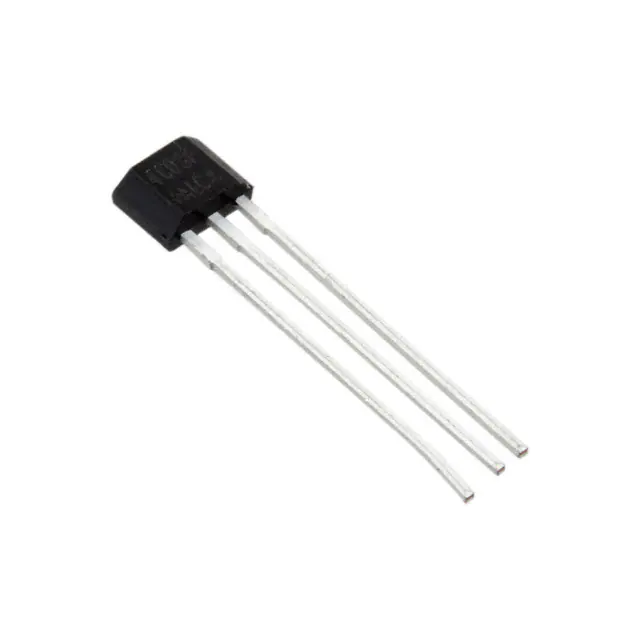
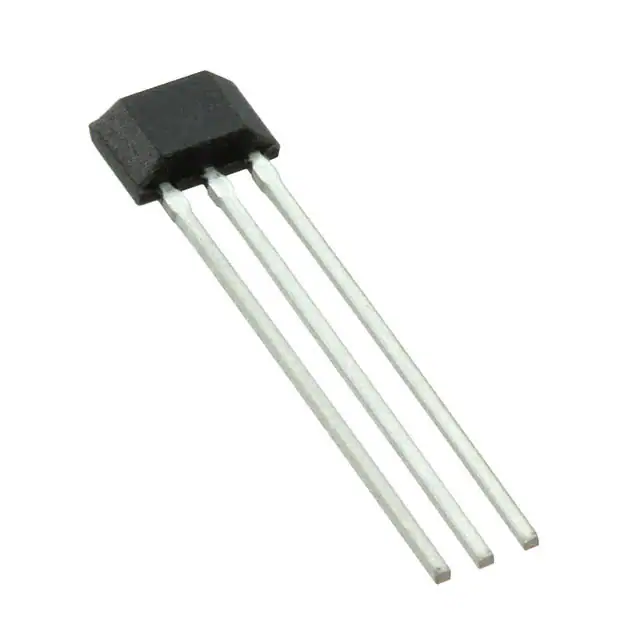
Package: 3-pin ultramini single inline package (SIP), UA variant - lead-free, 100% matte-tin leadframe plating, 1.5 mm × 4 mm × 3 mm body, through-hole mount.
| Pin/Terminal | Circuit Role | Design Meaning |
|---|---|---|
| VCC | Power supply input | Pin 1; requires 0.1 µF bypass capacitor to GND; UVLO protection activates below 2.5 V |
| VOUT | Analog output signal | Pin 3; ratiometric voltage proportional to magnetic field; clamped at 0.40–0.70 V (low) and 4.35–4.65 V (high) |
| GND | Ground reference | Pin 2; return path for supply and output; critical for noise immunity and accurate QVO referencing |
Key Features
| Feature | Design Value |
|---|---|
| Programmable QVO temperature coefficient | 0.08–0.16 %/°C; factory-set at 150°C to minimize ∆VOUT(Q) drift across full operating range (≤ ±20 mV) |
| High-speed chopping scheme | 400 kHz modulation; reduces QVO drift due to thermal/mechanical stress and enables precise recoverability after temperature cycling |
| Output voltage clamps | 0.40–0.70 V (low), 4.35–4.65 V (high); provide real-time short-circuit fault indication without external circuitry |
| Ratiometric architecture | QVO, sensitivity, and clamp voltages scale with VCC; maintains linearity and accuracy despite ±10% supply variation |
| Immunity to mechanical stress | Validated via package hysteresis testing; ≤ ±2% sensitivity shift after –40°C → 150°C → –40°C → 25°C thermal cycling |
Applications
| Steering Angle Sensing | Throttle Position Monitoring |
|---|---|
|
Use Scenario: Real-time measurement of rotary steering column position in EPS (Electric Power Steering) systems. IC Role / Device Role / Timing Role: Linear Hall-effect sensor providing analog voltage output proportional to magnet rotation angle relative to fixed housing. Use Value: 9 mV/G sensitivity and < ±1.5% linearity error enable sub-0.5° angular resolution; extended temperature range ensures reliability at under-hood temperatures up to 150°C. |
Use Scenario: Closed-loop feedback of throttle plate angle in gasoline/diesel engine management systems. IC Role / Device Role / Timing Role: Contactless position transducer converting magnetic field change into ratiometric voltage for ECU interpretation. Use Value: Ratiometric output eliminates need for separate VREF; output clamps flag wiring faults instantly; UVLO prevents erratic output during cold cranking. |
| Brake Pedal Position Detection | Industrial Motor Commutation |
|
Use Scenario: Redundant pedal travel sensing in brake-by-wire and ADAS braking systems. IC Role / Device Role / Timing Role: Primary or secondary analog position sensor delivering fail-safe voltage output correlated to pedal displacement. Use Value: Precise QVO recoverability after thermal cycling ensures consistent zero-point calibration; EMC-hardened design meets ISO 11452-2 automotive immunity requirements. |
Use Scenario: Rotor position feedback for BLDC motor control in HVAC blowers, pumps, and factory automation drives. IC Role / Device Role / Timing Role: Analog position sensor interfacing directly with motor controller ADC for sinusoidal commutation. Use Value: 20 kHz bandwidth supports >3,000 RPM operation; low 1.5 mG/√Hz noise density improves torque ripple suppression; SIP package simplifies through-hole assembly on motor control PCBs. |
Equivalent & Alternatives
The following parts are listed as comparable options for similar linear Hall-effect sensor applications.
| Alternative Part | Technical Difference | Application Difference | Selection Advice |
|---|---|---|---|
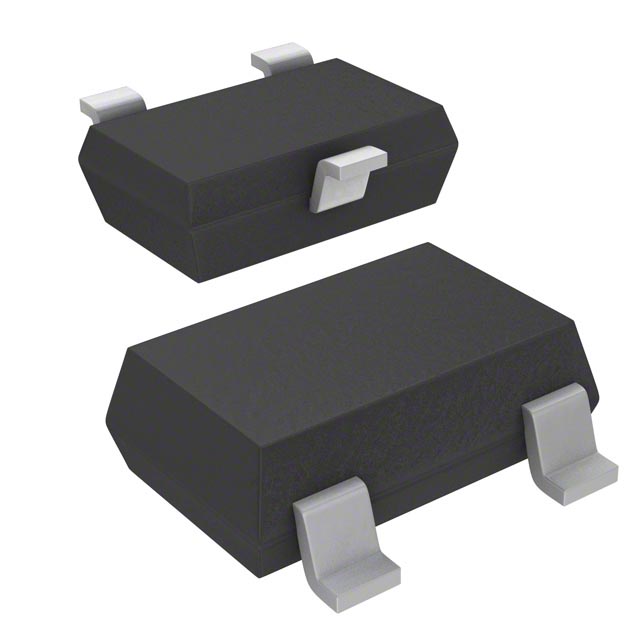
| A1389LLHLX-9-T | SOT-23W surface-mount package (2 mm × 3 mm); identical electrical specs, sensitivity, and temperature performance | Requires reflow-compatible layout; better suited for high-density, automated SMT production | Select when board space is constrained and surface-mount assembly is preferred over through-hole. |
| TLE4998P-9U | Infineon 9 mT/G programmable linear Hall sensor; I²C digital interface; higher integration (12-bit ADC, EEPROM, diagnostics) | Replaces analog output with digital communication; adds self-test, temperature compensation, and configurable filtering | Select when system-level diagnostics, configurability, or multi-sensor daisy-chaining are required over simple analog voltage output. |
Compared with A1389LUATN-9-T, A1389LLHLX-9-T offers identical sensing performance in a smaller SMT package but lacks through-hole mechanical robustness, while TLE4998P-9U shifts from analog simplicity to digital intelligence-enabling advanced diagnostics at the cost of added firmware complexity and interface overhead.
Availability
A1389LUATN-9-T is available at Aetrix Electronics and suitable for automotive steering angle sensing, industrial motor commutation, and brake pedal position monitoring requiring stable component supply across extended temperature ranges and long production lifecycles.
Supply support for A1389LUATN-9-T includes scheduled delivery planning, volume procurement assistance, BOM continuity management, traceable sourcing, and lifecycle availability coordination for OEM customers, industrial embedded developers, connected-device designers, and electronics production programs.
Manufacturer
Allegro MicroSystems is a U.S.-based semiconductor company specializing in magnetic sensing, power ICs, and precision motion control solutions for automotive and industrial markets.
The A1388/A1389 family was developed to deliver high-accuracy, thermally stable linear Hall sensing in miniature packages for next-generation displacement and angular position feedback in safety-critical systems.
FAQ
What is the supply voltage range for the A1389LUATN-9-T?
The A1389LUATN-9-T operates from 4.5 V to 5.5 V with undervoltage lockout (UVLO) that disables output below 2.5 V and re-enables it above 3 V. This ensures clean startup and shutdown behavior in noisy 5 V systems, such as automotive battery rails subject to cranking dips. The device draws 9–11.5 mA typical supply current at 5 V.
How does the A1389LUATN-9-T achieve thermal stability across –40°C to 150°C?
The A1389LUATN-9-T achieves thermal stability via factory-programmed temperature coefficients for both sensitivity (0.08–0.16 %/°C) and quiescent voltage output (QVO), combined with a 400 kHz chopping architecture that cancels offset drift from thermal and mechanical stress. These features ensure QVO drift remains within ±20 mV and sensitivity drift within ±2% across the full range.
What is the purpose of the output voltage clamps on the A1389LUATN-9-T?
The A1389LUATN-9-T's output clamps (0.40–0.70 V low, 4.35–4.65 V high) serve dual purposes: they limit the linear magnetic operating range to prevent saturation, and they provide immediate short-circuit fault detection-e.g., if VOUT is pulled low externally, the clamp holds at ~0.55 V, signaling a wiring fault to the host controller without additional circuitry.
Can the A1389LUATN-9-T be used in safety-critical automotive applications?
Yes-the A1389LUATN-9-T is qualified for automotive use with AEC-Q100 Grade 0 (–40°C to +150°C), enhanced EMC performance per ISO 11452-2, and proven reliability in thermal cycling and mechanical stress tests. Its precise QVO recoverability, ratiometric design, and output clamps support ASIL-B–capable system architectures when paired with redundancy and diagnostics.
What is the difference between A1389LUATN-9-T and A1389LLHLX-9-T?
The A1389LUATN-9-T uses a 3-pin ultramini SIP (UA) through-hole package (1.5 mm × 4 mm), while A1389LLHLX-9-T uses a 3-pin SOT-23W surface-mount package (2 mm × 3 mm). Both share identical electrical specifications-including 9 mV/G sensitivity, 2.5 V QVO, and –40°C to 150°C operation-but differ in mounting method, thermal resistance (165 °C/W vs. 110 °C/W on 2-layer PCB), and assembly process compatibility.
A1389LUATN-9-T Specifications
- Product attributes
- Attribute value
- Manufacturer:
- Allegro MicroSystems
- Series:
- -
- Package/Case:
- 3-SSIP
- Packaging:
- Tape & Reel (TR)
- Product Status:
- Active
- Technology:
- Hall Effect
- Axis:
- Single
- Output Type:
- Analog Voltage
- Sensing Range:
- -
- Voltage - Supply:
- 4.5V ~ 5.5V
- Current - Supply (Max):
- 11.5mA
- Current - Output (Max):
- 10mA
- Resolution:
- -
- Bandwidth:
- 20kHz
- Operating Temperature:
- -40°C ~ 150°C
- Grade:
- -
- Qualification:
- -
- Features:
- Temperature Compensated
- Supplier Device Package:
- 3-SIP
- Mounting Type:
- Through Hole
A1389LUATN-9-T FAQ
1.How can I place an order for A1389LUATN-9-T through Aetrix?
Please submit a Request for Quotation (RFQ) for A1389LUATN-9-T on Aetrix. Our sales agent will provide a competitive quotation and guide you through the order confirmation once you accept the terms.
2.Are the price and stock information for A1389LUATN-9-T reliable?
The price and inventory of A1389LUATN-9-T are updated periodically and may fluctuate due to market conditions. Stock and pricing data are typically refreshed every 24 hours. Quotation validity for A1389LUATN-9-T is usually 5 days.
3.What payment methods are accepted for A1389LUATN-9-T?
We accept Wire Transfer, PayPal, Credit Card, Western Union, MoneyGram, and Escrow for A1389LUATN-9-T transactions.
Note: Certain payment methods may incur a processing fee.
4.How is shipping managed for A1389LUATN-9-T?
A1389LUATN-9-T orders can be shipped via leading logistics carriers, including DHL, UPS, FedEx, TNT, or Registered Mail.
Once your A1389LUATN-9-T order is processed, you will receive an email with the shipment details and tracking number.
Note: Tracking information may take up to 24 hours to appear. Express delivery typically takes 3–5 business days.
5.How can I obtain technical support or documentation for A1389LUATN-9-T?
For technical support, including A1389LUATN-9-T datasheets, pinout diagrams, or application guidance, please contact our engineering support team. They can provide detailed documentation and assistance for your A1389LUATN-9-T requirements.
6.How does Aetrix verify that A1389LUATN-9-T is sourced from the original manufacturer or authorized distributors?
All A1389LUATN-9-T products on Aetrix are procured from qualified distributors and authorized channels. Our dedicated quality assurance team conducts strict verification, including traceability checks and, if necessary, third-party testing. This ensures that A1389LUATN-9-T meets industry standards.
7.What is the process for return or replacement of A1389LUATN-9-T?
All A1389LUATN-9-T units undergo pre-shipment inspection (PSI). If there is an issue with A1389LUATN-9-T, returns or replacements are accepted under the following conditions:
1.Quantity discrepancies, incorrect items, or visible external defects (such as breakage or corrosion), acknowledged by Aetrix.
2.The issue is reported within 90 days of delivery.
3.The A1389LUATN-9-T part is unused and in its original packaging.
Return procedure for A1389LUATN-9-T:
1.Submit a request within 90 days.
2.Obtain a Return Material Authorization (RMA) from Aetrix.
A1389LUATN-9-T Tags
-
DRV5053VAQDBZR
Texas Instruments
-
MMC5603NJ
Memsic Inc.
-
DRV5055A1QDBZR
Texas Instruments
-
MLX90392ELQ-AAA-011-RE
Melexis Technologies NV

-
CT100LW-HS6
Allegro MicroSystems
-
DRV5056A1ELPGMQ1
Texas Instruments
-
A1304ELHLX-T
Allegro MicroSystems
-
MMC5633NJL
Memsic Inc.
-
A1308KUA-2-T
Allegro MicroSystems
-
A1308KUA-1-T
Allegro MicroSystems
-
SI7210-B-04-IVR
Silicon Labs
-
A1308LLHLT-2-T
Allegro MicroSystems
Tech Hub

A practical engineering and sourcing framework covering lifecycle verification, lifetime-buy calculations, replacement qualification, supplier checks and counterfeit-risk controls.

TTL and CMOS logic families differ in thresholds, loading, output drive, power and timing. This engineering guide compares 74HC and 74HCT, calculates noise margins and checks 3.3 V/5 V compatibility.

A practical engineering guide to 3.3V and 5V logic compatibility, input thresholds, resistor dividers, translator ICs, MOSFET level shifting, I2C pull-ups, timing limits and power-sequencing risks.

The 74HC595 uses push-pull logic outputs, while the TPIC6B595 uses 50 V open-drain DMOS sinks for higher-power loads. This guide compares timing, current limits, 3.3 V interfacing, load wiring, thermal…

The 74HC595 converts serial data into eight stable parallel outputs. This guide covers pin functions, shift and storage timing, OE and MR behavior, drive-current limits, cascading, voltage compatibilit…

A technical comparison of level-sensitive latches and edge-triggered flip-flops, covering timing windows, setup and hold limits, master–slave operation, time borrowing, race-through, HDL inference and…

A D latch stores one bit while Enable controls when data can pass. This reference covers gate-level operation, truth tables, transparency, setup and hold timing, LE versus OE, common ICs and practical …

An SR latch stores one bit through cross-coupled feedback. This engineering reference covers NOR and NAND implementations, truth tables, forbidden-state recovery, gated operation, switch debouncing, fa…

Latch circuits retain one bit through feedback. This technical reference covers SR and D latches, truth tables, transparency, timing limits, latch-versus-flip-flop behavior, applications and common log…

An engineering guide to LED driver operation, constant-current and constant-voltage outputs, linear and switching topologies, dimming, IC selection, calculations, replacement compatibility, and fault c…


