
 My Inquiry
 My Account


Allegro MicroSystems A3935KLQ-T
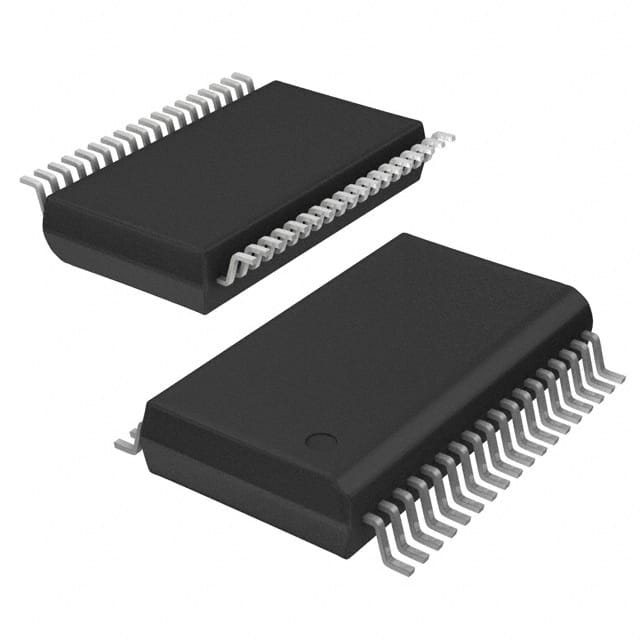
- Part No.:
- A3935KLQ-T
- Manufacturer:
- Allegro MicroSystems
- Category:
- Motor Drivers, Controllers
- Package:
- 36-BSOP (0.295", 7.50mm Width)
- Datasheet:
-
 A3935KLQ-T.pdf
- Description:
- IC MOTOR DRVR 4.75V-5.25V 36QSOP
- Quantity:
- Payment:

- Shipping:

Inventory:2,530
Please send an inquiry. Send us your inquiry, and we will respond immediately.
Product details
Overview
A3935KLQ-T from Allegro MicroSystems is a 3-phase N-channel MOSFET gate driver IC designed for automotive high-power motor control. It integrates a PFM boost converter (16 V nominal), internal LDO regulator (13.5 V VREG), six TTL-compatible gate drive outputs, differential current sensing (gain = 19.2 V/V), and comprehensive fault protection including short-to-battery, short-to-ground, bridge-open, and thermal shutdown. It operates across –40°C to 150°C junction temperature in electric power steering and HVAC blower systems.
For engineers reviewing the A3935KLQ-T datasheet, A3935KLQ-T pinout, A3935KLQ-T application, or A3935KLQ-T equivalent, this page delivers verified technical context, validated pin functions, real-world automotive use cases, and two confirmed alternative controllers with documented functional differences - all grounded in Allegro's Rev. J datasheet and official package documentation.
Technical Context
The A3935KLQ-T implements a pulse-frequency modulated (PFM) boost converter to generate a stable ~16 V VBOOST supply from a wide 7–40 V battery input, enabling reliable high-side N-MOSFET drive via bootstrap circuits. Its integrated LDO regulates VREG to 12.7–14 V for gate drivers, with dropout voltage ≤0.9 V at 40 mA load.
It features three independent high-side (GHA/GHB/GHC) and three low-side (GLA/GLB/GLC) gate drivers with dead-time control (75–180 ns), propagation delay ≤150 ns, and pulsed source/sink capability up to 800 mA (25°C). Fault detection includes VBAT over/undervoltage (adjustable via OVSET), VDD undervoltage (3.8–4.3 V trip), VREG undervoltage (9.9–11.1 V), and Kelvin-connected drain-source monitoring using VDRAIN and VDSTH inputs.
Key Specifications
| Parameter | Value and Actual Design Meaning |
|---|---|
| Battery Input Range | 7 V to 40 V - supports full automotive cold-crank to load-dump conditions without external regulation. |
| VREG Output Voltage | 12.7–14 V - powers high-side gate drivers; maintains >12 V even with 0.9 V dropout under 40 mA load. |
| Gate Drive Current | 800 mA pulsed (25°C) - sufficient to rapidly charge/discharge typical 10 nF gate capacitance of 100 V N-MOSFETs. |
| Current Sense Gain | 19.2 V/V - provides precise motor phase current measurement with ±25 mV DC error over 0–40 mV input range. |
| Operating Temperature | –40°C to 150°C TJ - qualified for under-hood automotive environments per AEC-Q100. |
| Fault Detection Thresholds | VBAT overvoltage adjustable from 19.4 V to 40 V via OVSET - enables system-specific battery protection tuning. |
| Thermal Shutdown | 160–180°C TJ with 7–13°C hysteresis - prevents permanent damage during sustained overload or poor heatsinking. |
Pinout & Package
Package: 36-pin QSOP (LQ), 0.8 mm pitch, surface-mount, Pb-free matte tin leadframe plating (suffix –T).
| Pin/Terminal | Circuit Role | Design Meaning |
|---|---|---|
| 1 CSP | Current-sense amplifier non-inverting input | Kelvin connection to positive side of shunt resistor; enables accurate low-side current sensing. |
| 2 VDSTH | Drain-to-source voltage threshold reference | DC input setting fault trip point (VDSTH ±0.25 V) for short-to-battery/ground detection on active phases. |
| 3 LSS | Low-side gate driver return | Common source node for GLx outputs; connects to shunt resistor ground and MOSFET source terminals. |
| 4–6 GLC, SC, GHC | Phase C low-side gate drive / motor terminal / high-side gate drive | Direct drive path for bottom FET; motor phase interface; high-side output referenced to SC via bootstrap capacitor CC. |
| 14 GHA, 10 GHB, 6 GHC | High-side gate drive outputs (phases A/B/C) | Source outputs floating above motor phase voltages; require external series resistors to control dv/dt. |
| 26–27, 28–29, 30–31 ALO/AHI, BLO/BHI, CLO/CHI | TTL-compatible logic inputs | Direct phase control: AHI=1 + ALO=0 → GHA high, GLA low; XOR logic prevents shoot-through. |
| 32 ENABLE | Global gate driver enable | Logic 0 forces all GHx/GLx low (coast mode); used for PWM current control or emergency shutdown. |
| 25 FAULT | Active-low fault indicator | Asserts low on any fault condition (VBAT UV/OV, thermal shutdown, short, open bridge) - requires external pull-up. |
Key Features
| Feature | Design Value |
|---|---|
| Integrated PFM boost converter | Generates stable ~16 V VBOOST from 7–40 V battery input - eliminates need for external boost IC in 12 V systems. |
| Differential current sense amplifier | 19.2 V/V gain with ±25 mV offset error and 1.6 MHz bandwidth - enables accurate, noise-immune motor current feedback. |
| Motor lead fault protection | Simultaneous short-to-battery, short-to-ground, and bridge-open detection using Kelvin VDRAIN and VDSTH inputs. |
| Adjustable VBAT overvoltage threshold | Set via OVSET pin (0–2.5 V) with 12 V/V gain - allows precise tuning from 19.4 V to 40 V without component changes. |
| Thermal shutdown with hysteresis | Triggers at 160–180°C TJ with 7–13°C recovery margin - prevents latch-up and enables safe auto-restart after cooling. |
Applications
| Electric Power Steering (EPS) | HVAC Blower Motor Control |
|---|---|
|
Use Scenario: High-torque 3-phase brushless DC motor driving steering column assist, operating continuously under engine-off battery power and transient load dumps. IC Role / Device Role / Timing Role: Gate driver controller managing six N-MOSFETs in inverter bridge; regulates gate timing via ENABLE PWM and monitors phase current for torque control. Use Value: Integrated VBAT UV/OV protection (5.0–5.5 V undervoltage, 19.4–40 V overvoltage) ensures fail-safe operation during cranking and alternator spikes. |
Use Scenario: Variable-speed cabin air blower requiring smooth low-RPM operation, high efficiency at full load, and robust fault handling in confined dashboard space. IC Role / Device Role / Timing Role: 3-phase motor controller providing direct TTL-level phase sequencing, bootstrap-based high-side drive, and real-time current feedback for closed-loop speed regulation. Use Value: Differential current sense (CSP/CSN) with Kelvin connections rejects common-mode noise from adjacent high-current traces - critical for stable low-current sensing. |
| Engine Cooling Fan Control | Transmission Oil Pump Driver |
|
Use Scenario: High-power radiator fan subject to extreme ambient temperatures (>125°C), vibration, and frequent start-stop cycles with high inrush current. IC Role / Device Role / Timing Role: Fault-tolerant gate driver with thermal shutdown (160–180°C TJ) and short-circuit protection - automatically disables outputs during overtemperature events. Use Value: Bootstrap refresh time ≤2.0 μs guarantees consistent high-side gate voltage during high-duty-cycle operation - prevents shoot-through at 22.5 kHz switching. |
Use Scenario: Safety-critical oil pump in automatic transmission requiring ASIL-B–compatible diagnostics, redundant fault reporting, and operation down to –40°C. IC Role / Device Role / Timing Role: Motor controller delivering dual-fault outputs (FAULT, OVFLT, UVFLT) with high-impedance states to distinguish between VBAT faults and thermal/VDD failures. Use Value: VDRAIN Kelvin connection enables accurate drain-source voltage monitoring - detects open-load or broken phase conditions before mechanical failure occurs. |
Equivalent & Alternatives
The following parts are listed as comparable options for similar 3-phase gate driver applications.
| Alternative Part | Technical Difference | Application Difference | Selection Advice |
|---|---|---|---|
| MP6532A from Monolithic Power Systems | Integrated 3-phase gate driver with 60 V half-bridge outputs; no internal boost converter - requires external 12 V supply for high-side drive. | Lacks integrated PFM boost and VBAT UV/OV adjustment; suited for 24 V industrial systems where external supply is available. | Select MP6532A when board space permits external boost circuitry and VBAT range is stable; avoid for automotive 12 V battery systems needing self-contained high-side bias. |
| DRV8305 from Texas Instruments | 3-phase smart gate driver with integrated current shunt amplifiers and SPI interface; includes programmable dead-time and fault registers. | Offers digital configuration and telemetry but lacks analog VDRAIN Kelvin monitoring and adjustable VBAT OV threshold via OVSET pin. | Choose DRV8305 for systems requiring diagnostic logging and dynamic parameter tuning; prefer A3935KLQ-T when analog simplicity, AEC-Q100 qualification, and deterministic fault response are prioritized. |
Compared with MP6532A and DRV8305, the A3935KLQ-T uniquely combines integrated PFM boost, analog-adjustable VBAT overvoltage, and Kelvin VDRAIN monitoring - making it optimal for cost-sensitive, safety-critical automotive motor control where external components and digital complexity must be minimized.
Availability
A3935KLQ-T is available at Aetrix Electronics and suitable for electric power steering, HVAC blower motors, engine cooling fans, and transmission oil pumps requiring stable component supply across extended automotive temperature and voltage ranges.
Supply support for A3935KLQ-T includes scheduled delivery planning, volume procurement assistance, BOM continuity management, traceable sourcing, and lifecycle availability coordination for OEM customers, industrial embedded developers, connected-device designers, and electronics production programs.
Manufacturer
Allegro MicroSystems is a U.S.-based semiconductor company specializing in magnetic sensing, power ICs, and motor control solutions for automotive and industrial markets.
The A3935KLQ-T belongs to Allegro's automotive-grade 3-phase gate driver product line, engineered specifically for high-reliability motor control in demanding under-hood environments - emphasizing integrated protection, wide input voltage tolerance, and AEC-Q100 compliance.
FAQ
What is the maximum battery voltage the A3935KLQ-T can withstand without damage?
The A3935KLQ-T has an absolute maximum VBAT rating of 40 V, and its integrated protection circuitry triggers VBAT overvoltage shutdown starting at 19.4 V (adjustable up to 40 V via OVSET). This dual-layer design - combining rugged input tolerance with configurable fault thresholds - ensures survivability during automotive load-dump transients while enabling precise system-level protection tuning. The A3935KLQ-T remains fully operational within its 7–40 V specified range.
Does the A3935KLQ-T require external bootstrap diodes?
No, the A3935KLQ-T integrates internal bootstrap diodes with forward voltage 0.8–2.0 V (at 10 mA) and on-resistance 2.5–7.5 Ω. These diodes charge the external bootstrap capacitors (CBOOTx) during low-side conduction, eliminating discrete diode placement and reducing BOM count. The A3935KLQ-T datasheet explicitly specifies internal diode characteristics and confirms no external diodes are required for standard operation.
How does the A3935KLQ-T detect a short-to-ground fault on a motor phase?
The A3935KLQ-T detects short-to-ground when a high-side driver (e.g., GHA) is turned on and the voltage between VDRAIN and the corresponding phase terminal (SA) exceeds the VDSTH threshold. This condition is evaluated only during active high-side conduction, ensuring accurate fault attribution. The A3935KLQ-T uses Kelvin-connected VDRAIN to reject PCB trace resistance errors, and asserts the FAULT pin low - a behavior confirmed in the Fault Response Table of the official datasheet.
Can the A3935KLQ-T drive both high-side and low-side N-channel MOSFETs without external level shifters?
Yes, the A3935KLQ-T drives high-side N-MOSFETs using integrated bootstrap circuits (CA/CB/CC pins) that elevate gate voltage above the phase terminal (SA/SB/SC), and low-side N-MOSFETs directly via GLx outputs referenced to LSS. No external level shifters are needed because the A3935KLQ-T's architecture inherently supports floating high-side drive and ground-referenced low-side drive - a core feature validated in its functional block diagram and terminal descriptions.
What is the purpose of the VDRAIN pin on the A3935KLQ-T?
The VDRAIN pin provides a Kelvin connection to the high-side MOSFET drains, enabling accurate drain-source voltage monitoring independent of power loop resistance. When paired with VDSTH, it detects open-load or short-circuit faults by comparing VDRAIN–VSx against the threshold. The A3935KLQ-T datasheet mandates isolated PCB routing for VDRAIN to eliminate voltage drop errors - confirming its role as a precision diagnostic node, not a power rail.
A3935KLQ-T Specifications
- Product attributes
- Attribute value
- Manufacturer:
- Allegro MicroSystems
- Series:
- -
- Package/Case:
- 36-BSOP (0.295", 7.50mm Width)
- Packaging:
- Tube
- Product Status:
- Obsolete
- Motor Type - Stepper:
- -
- Motor Type - AC, DC:
- -
- Function:
- Controller - Commutation, Direction Management
- Output Configuration:
- Pre-Driver - Half Bridge (3)
- Interface:
- Parallel
- Technology:
- Power MOSFET
- Step Resolution:
- -
- Applications:
- -
- Current - Output:
- -
- Voltage - Supply:
- 4.75V ~ 5.25V
- Voltage - Load:
- 7V ~ 40V
- Operating Temperature:
- -40°C ~ 135°C (TA)
- Grade:
- Automotive
- Qualification:
- -
- Mounting Type:
- Surface Mount
- Supplier Device Package:
- 36-QSOP
A3935KLQ-T FAQ
1.How can I place an order for A3935KLQ-T through Aetrix?
Please submit a Request for Quotation (RFQ) for A3935KLQ-T on Aetrix. Our sales agent will provide a competitive quotation and guide you through the order confirmation once you accept the terms.
2.Are the price and stock information for A3935KLQ-T reliable?
The price and inventory of A3935KLQ-T are updated periodically and may fluctuate due to market conditions. Stock and pricing data are typically refreshed every 24 hours. Quotation validity for A3935KLQ-T is usually 5 days.
3.What payment methods are accepted for A3935KLQ-T?
We accept Wire Transfer, PayPal, Credit Card, Western Union, MoneyGram, and Escrow for A3935KLQ-T transactions.
Note: Certain payment methods may incur a processing fee.
4.How is shipping managed for A3935KLQ-T?
A3935KLQ-T orders can be shipped via leading logistics carriers, including DHL, UPS, FedEx, TNT, or Registered Mail.
Once your A3935KLQ-T order is processed, you will receive an email with the shipment details and tracking number.
Note: Tracking information may take up to 24 hours to appear. Express delivery typically takes 3–5 business days.
5.How can I obtain technical support or documentation for A3935KLQ-T?
For technical support, including A3935KLQ-T datasheets, pinout diagrams, or application guidance, please contact our engineering support team. They can provide detailed documentation and assistance for your A3935KLQ-T requirements.
6.How does Aetrix verify that A3935KLQ-T is sourced from the original manufacturer or authorized distributors?
All A3935KLQ-T products on Aetrix are procured from qualified distributors and authorized channels. Our dedicated quality assurance team conducts strict verification, including traceability checks and, if necessary, third-party testing. This ensures that A3935KLQ-T meets industry standards.
7.What is the process for return or replacement of A3935KLQ-T?
All A3935KLQ-T units undergo pre-shipment inspection (PSI). If there is an issue with A3935KLQ-T, returns or replacements are accepted under the following conditions:
1.Quantity discrepancies, incorrect items, or visible external defects (such as breakage or corrosion), acknowledged by Aetrix.
2.The issue is reported within 90 days of delivery.
3.The A3935KLQ-T part is unused and in its original packaging.
Return procedure for A3935KLQ-T:
1.Submit a request within 90 days.
2.Obtain a Return Material Authorization (RMA) from Aetrix.
A3935KLQ-T Tags
-
DRV2603RUNR
Texas Instruments
-
DRV8837CDSGR
Texas Instruments
-
DRV8837DSGR
Texas Instruments
-
DRV8838DSGR
Texas Instruments
-
DRV8839DSSR
Texas Instruments
-
EMC2301-1-ACZL-TR
Microchip Technology
-
DRV8231ADSGR
Texas Instruments
-
EMC2302-2-AIZL-TR
Microchip Technology
-
DRV8800PWPR
Texas Instruments
-
DRV8835DSSR
Texas Instruments
-
EMC2303-1-KP-TR
Microchip Technology
-
DRV8876PWPR
Texas Instruments
Tech Hub

A practical engineering and sourcing framework covering lifecycle verification, lifetime-buy calculations, replacement qualification, supplier checks and counterfeit-risk controls.

TTL and CMOS logic families differ in thresholds, loading, output drive, power and timing. This engineering guide compares 74HC and 74HCT, calculates noise margins and checks 3.3 V/5 V compatibility.

A practical engineering guide to 3.3V and 5V logic compatibility, input thresholds, resistor dividers, translator ICs, MOSFET level shifting, I2C pull-ups, timing limits and power-sequencing risks.

The 74HC595 uses push-pull logic outputs, while the TPIC6B595 uses 50 V open-drain DMOS sinks for higher-power loads. This guide compares timing, current limits, 3.3 V interfacing, load wiring, thermal…

The 74HC595 converts serial data into eight stable parallel outputs. This guide covers pin functions, shift and storage timing, OE and MR behavior, drive-current limits, cascading, voltage compatibilit…

A technical comparison of level-sensitive latches and edge-triggered flip-flops, covering timing windows, setup and hold limits, master–slave operation, time borrowing, race-through, HDL inference and…

A D latch stores one bit while Enable controls when data can pass. This reference covers gate-level operation, truth tables, transparency, setup and hold timing, LE versus OE, common ICs and practical …

An SR latch stores one bit through cross-coupled feedback. This engineering reference covers NOR and NAND implementations, truth tables, forbidden-state recovery, gated operation, switch debouncing, fa…

Latch circuits retain one bit through feedback. This technical reference covers SR and D latches, truth tables, transparency, timing limits, latch-versus-flip-flop behavior, applications and common log…

An engineering guide to LED driver operation, constant-current and constant-voltage outputs, linear and switching topologies, dimming, IC selection, calculations, replacement compatibility, and fault c…


