
 My Inquiry
 My Account


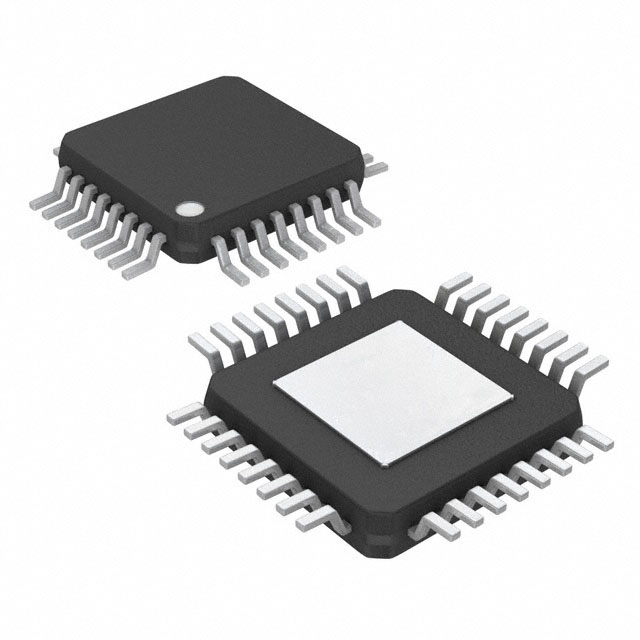
Allegro MicroSystems A4960KJPTR-T
- Part No.:
- A4960KJPTR-T
- Manufacturer:
- Allegro MicroSystems
- Category:
- Motor Drivers, Controllers
- Package:
- 32-LQFP Exposed Pad
- Datasheet:
-
 A4960KJPTR-T.pdf
- Description:
- IC MOTOR DRIVER 3V-5.5V 32LQFP
- Quantity:
- Payment:

- Shipping:

Inventory:4,293
Please send an inquiry. Send us your inquiry, and we will respond immediately.
Product details
Overview
A4960KJPTR-T from Allegro MicroSystems is a three-phase, sensorless brushless DC (BLDC) motor controller IC designed for automotive applications. It drives external N-channel MOSFETs using trapezoidal commutation, senses rotor position via back-EMF without Hall sensors, operates from 7–50 V supply, supports 3.3 V/5 V logic, and integrates gate drive, dead-time control, and serial diagnostics. It is used in hydraulic, fuel, and urea pump systems.
For engineers reviewing the A4960KJPTR-T datasheet, A4960KJPTR-T pinout, A4960KJPTR-T application, or A4960KJPTR-T equivalent, this page delivers verified technical context, validated pin functions, confirmed automotive-grade operating parameters (–40°C to 150°C), and two documented alternative parts with explicit functional and application-level differences.
Technical Context
The A4960KJPTR-T implements sensorless BLDC control using adaptive back-EMF zero-crossing detection with programmable commutation blank time (42.5–57.5 µs), BEMF hysteresis (60 mV low / 240 mV high), and BEMF window timing (5.4–7.4 µs). Its internal state sequencer executes six-step block commutation and supports direction reversal via DIR bit.
It integrates dual-regulated gate drive supplies: a 13 V VREG output for low-side drivers and bootstrap charge management for high-side N-MOSFETs, enabling operation down to 7 V battery input. Diagnostics include undervoltage (VREGUVON = 8 V), overtemperature (TJF = 170°C), and VDS fault detection with configurable blanking and threshold offsets.
Key Specifications
| Parameter | Value and Actual Design Meaning |
|---|---|
| Supply Voltage Range | 7–50 V VBB: supports full automotive battery range including cold-crank (6 V min operational) and load-dump transients. |
| Logic Compatibility | 3.3 V and 5 V tolerant inputs: enables direct interface with common microcontrollers without level-shifting. |
| VREG Output | 12.4–13.8 V at 8 mA: powers low-side gate drivers and bootstrap capacitors; regulated independently of VBB below 9 V. |
| Dead Time | 0.85–1.15 µs: prevents shoot-through during high-/low-side switching transitions in external MOSFET bridge. |
| Operating Temperature | –40°C to 150°C ambient: qualified for under-hood automotive environments per AEC-Q100 stress requirements. |
| Diagnostic Interface | SPI-compatible 16-bit serial interface: provides real-time fault register readout (undervoltage, overtemp, VDS short) and configuration of start-up, commutation, and protection parameters. |
| Motor Start-up Mode | Programmable open-loop acceleration: configurable hold torque (37.5% VREF), ramp torque (56.25% VREF), and commutation timing for robust initial rotation. |
Pinout & Package
Package: 32-pin LQFP with exposed thermal pad (JP suffix), lead-free, 100% matte-tin plating - optimized for automotive thermal dissipation and reflow compatibility.
| Pin/Terminal | Circuit Role | Design Meaning |
|---|---|---|
| VBB | Main power supply input | Connects to battery rail (7–50 V); powers internal regulators, charge pump, and high-side gate drivers via bootstrap network. |
| VDD | Logic supply input | Accepts 3.3 V or 5 V; powers digital core, SPI interface, and internal logic; requires local 100 nF decoupling. |
| GHA/GHB/GHC | High-side gate drive outputs | Drive external N-channel MOSFET gates; each floats relative to phase voltage; require bootstrap capacitor (CA/CB/CC). |
| GLA/GLB/GLC | Low-side gate drive outputs | Drive external N-channel MOSFET sources; referenced to LSS; powered by VREG (13 V typical). |
| SA/SB/SC | Motor phase connections & bootstrap return | Connect to motor windings; serve as negative terminals for bootstrap capacitors and sense points for BEMF detection. |
| CSP/CSM | Differential current sense inputs | Interface to shunt resistor; enable integrated PWM current limiting with ±5% trip point accuracy at 2 V reference. |
| DIAG | Programmable diagnostic output | Configurable as fault flag, sensorless operation indicator, timer output, or VDS threshold monitor - supports system-level fault signaling. |
| TACHO | Motor speed pulse output | Open-drain output; pulses per electrical revolution; remains low until first valid BEMF zero-crossing is detected. |
| RESETN | Active-low standby control | Pulled low ≥10 µs enters sleep mode (IBBS ≤ 10 µA); pulsed low clears faults; can be tied to VBB via 22 kΩ resistor. |
| SCK/SDI/SDO/STRN | SPI serial interface | 16-bit MSB-first interface; STRN enables slave select; SDO tri-states when STRN high; supports configuration and diagnostic readback. |
Key Features
| Feature | Design Value |
|---|---|
| Sensorless BEMF commutation | Eliminates Hall sensors and associated wiring; uses adaptive zero-crossing detection with programmable hysteresis and blank time for reliable startup and run. |
| N-channel MOSFET gate drive | Integrated high-current drivers (RDS(on)DN = 3.0 Ω typ @ 25°C) for both high- and low-side switches; supports bootstrap operation down to 7 V VBB. |
| Integrated diagnostics | Real-time fault reporting via DIAG pin and SPI register: VREG/VDD undervoltage, junction overtemperature (170°C trip), and VDS short-to-battery/ground detection. |
| Configurable start-up sequence | Adjustable hold/ramp torque, commutation timing, and acceleration rate via SPI registers - enables tuning across diverse motor/load combinations. |
| Automotive thermal design | 32-pin LQFP with exposed pad (RθJP = 2°C/W); supports 150°C junction max; qualified for under-hood use with derated power on 2-layer PCBs. |
Applications
| Hydraulic Pump Control | Fuel Pump Drive |
|---|---|
|
Use Scenario: Precise speed and torque control of 12 V/24 V automotive hydraulic pumps in active suspension or brake-by-wire systems. IC Role / Device Role / Timing Role: Sensorless BLDC controller executing trapezoidal commutation; manages gate timing, dead time, and BEMF-based rotor position estimation. Use Value: Enables compact, sensor-free pump modules with <150°C junction operation, integrated fault protection, and SPI-configurable startup for varying fluid viscosity. |
Use Scenario: High-reliability fuel delivery in gasoline direct injection (GDI) and diesel common-rail systems requiring continuous duty and EMI resilience. IC Role / Device Role / Timing Role: Motor controller providing PWM-gated high-side drive, current-limited acceleration, and TACHO-based closed-loop speed feedback. Use Value: Delivers stable flow across battery voltage transients (6–50 V), supports fail-safe shutdown on overtemperature or short-circuit, and reduces BOM count by integrating diagnostics. |
| Urea Dosing Pump | Blower Fan Regulation |
|
Use Scenario: Metered urea injection in SCR aftertreatment systems, demanding precise low-speed control and cold-start reliability. IC Role / Device Role / Timing Role: Sensorless controller managing open-loop start-up, BEMF tracking at low RPM, and diagnostic reporting for OBD-II compliance. Use Value: Achieves stable rotation from stall using programmable hold torque and ramp profiles; reports faults (e.g., blocked nozzle) via DIAG pin and SPI register. |
Use Scenario: HVAC blower fan in passenger compartment, requiring quiet operation, wide speed range, and thermal robustness near engine bay. IC Role / Device Role / Timing Role: BLDC driver implementing phase advance (12–18° electrical), adjustable dead time, and low-current sleep mode for energy efficiency. Use Value: Reduces acoustic noise via optimized commutation timing; maintains operation at –40°C ambient; draws ≤10 µA in sleep mode for battery preservation. |
Equivalent & Alternatives
The following parts are listed as comparable options for similar sensorless BLDC controller applications.
| Alternative Part | Technical Difference | Application Difference | Selection Advice |
|---|---|---|---|
| A4960KJPTR-A-T | Same pinout and function; updated revision with enhanced ESD robustness and improved VDS fault detection accuracy. | Approved for new designs; replaces A4960KJPTR-T in production programs requiring long-term availability and latest qualification. | Select A4960KJPTR-A-T for new designs; A4960KJPTR-T is Not for New Design and restricted to existing customer programs. |
| MP6532GQ-Z | Monolithic 3-phase gate driver (no integrated logic or BEMF sensing); requires external MCU for commutation control and diagnostics. | Used where system-level MCU handles sensorless algorithms; lacks integrated start-up sequencing, TACHO, or SPI diagnostics of A4960KJPTR-T. | Choose MP6532GQ-Z only if host MCU provides full BLDC control stack; A4960KJPTR-T offers self-contained sensorless operation with minimal firmware overhead. |
Compared with A4960KJPTR-A-T, the A4960KJPTR-T lacks updated ESD and fault detection specs and is unavailable for new designs; compared with MP6532GQ-Z, it delivers complete sensorless control without external processor dependency but occupies more board area due to integrated logic.
Availability
A4960KJPTR-T is available at Aetrix Electronics and suitable for hydraulic pump, fuel pump, and urea dosing applications requiring stable component supply, automotive temperature resilience, and legacy program continuity.
Supply support for A4960KJPTR-T includes scheduled delivery planning, volume procurement assistance, BOM continuity management, traceable sourcing, and lifecycle availability coordination for OEM customers, industrial embedded developers, connected-device designers, and electronics production programs.
Manufacturer
Allegro MicroSystems is a U.S.-based designer of high-performance magnetic sensing and power IC solutions, specializing in automotive-grade motion control, current sensing, and motor driver technologies.
The A4960 product line delivers fully integrated, sensorless BLDC controllers for automotive fluid-handling and thermal management systems, emphasizing robustness, diagnostic depth, and seamless integration with external N-MOSFET bridges.
FAQ
What is the primary function of the A4960KJPTR-T in an automotive motor control system?
The A4960KJPTR-T serves as a standalone, sensorless three-phase BLDC motor controller that replaces Hall-effect sensors and discrete gate drivers. It directly manages external N-channel MOSFETs using back-EMF detection, executes trapezoidal commutation, and provides integrated diagnostics - all within a single 32-pin LQFP package. The A4960KJPTR-T enables compact, reliable motor control in fuel, hydraulic, and urea pump modules without requiring a host microcontroller for core commutation logic.
Can the A4960KJPTR-T operate with a 12 V battery supply during cold-crank conditions?
Yes, the A4960KJPTR-T supports VBB down to 6 V in disabled-output mode and 7 V in active operation, making it compatible with automotive cold-crank transients. Its internal charge pump and bootstrap management maintain sufficient gate drive voltage for high-side N-MOSFETs even at 7 V input, while VREG regulation adapts to lower VBB levels (e.g., delivering ~10 V at 5.5–6 V VBB). This ensures uninterrupted motor control during battery dips.
How does the A4960KJPTR-T handle motor start-up without position sensors?
The A4960KJPTR-T uses a programmable open-loop start-up sequence before transitioning to sensorless BEMF commutation. It applies configured hold torque, ramp torque, and commutation timing to accelerate the motor from stall. Once stable BEMF zero-crossings are detected - validated by adaptive hysteresis and blank time - it switches to closed-loop trapezoidal drive. All parameters (e.g., tHOLD = 34 ms typ, tCOMS = 40 ms typ) are SPI-configurable to match motor inertia and load friction.
What diagnostic capabilities does the A4960KJPTR-T provide, and how are they accessed?
The A4960KJPTR-T provides real-time diagnostics for VREG/VDD undervoltage, junction overtemperature (170°C trip), and VDS faults (short-to-battery, short-to-ground, shorted winding). These are reported via the programmable DIAG pin (default = fault flag) and a 16-bit SPI-accessible diagnostic register. Fault masking, response behavior (e.g., latch vs. auto-clear), and threshold sensitivity are configurable through SPI control registers - enabling tailored system-level safety responses.
Is the A4960KJPTR-T pin-compatible with any newer Allegro devices?
Yes, the A4960KJPTR-A-T is a direct pin- and function-compatible revision of the A4960KJPTR-T, featuring enhanced ESD performance and refined VDS fault detection. However, A4960KJPTR-T is designated "Not for New Design" as of January 29, 2014; Allegro recommends A4960KJPTR-A-T for all new programs. No other Allegro part shares identical pinout and feature set - alternatives like MP6532GQ-Z require external MCU control and lack integrated BEMF sensing.
A4960KJPTR-T Specifications
- Product attributes
- Attribute value
- Manufacturer:
- Allegro MicroSystems
- Series:
- -
- Package/Case:
- 32-LQFP Exposed Pad
- Packaging:
- Tape & Reel (TR)
- Product Status:
- Not For New Designs
- Motor Type - Stepper:
- -
- Motor Type - AC, DC:
- Brushless DC (BLDC)
- Function:
- Controller - Commutation, Direction Management
- Output Configuration:
- Pre-Driver - Half Bridge (3)
- Interface:
- SPI
- Technology:
- Power MOSFET
- Step Resolution:
- -
- Applications:
- -
- Current - Output:
- -
- Voltage - Supply:
- 3V ~ 5.5V
- Voltage - Load:
- 7V ~ 50V
- Operating Temperature:
- -40°C ~ 150°C (TA)
- Grade:
- Automotive
- Qualification:
- -
- Mounting Type:
- Surface Mount
- Supplier Device Package:
- 32-LQFP (7x7)
A4960KJPTR-T FAQ
1.How can I place an order for A4960KJPTR-T through Aetrix?
Please submit a Request for Quotation (RFQ) for A4960KJPTR-T on Aetrix. Our sales agent will provide a competitive quotation and guide you through the order confirmation once you accept the terms.
2.Are the price and stock information for A4960KJPTR-T reliable?
The price and inventory of A4960KJPTR-T are updated periodically and may fluctuate due to market conditions. Stock and pricing data are typically refreshed every 24 hours. Quotation validity for A4960KJPTR-T is usually 5 days.
3.What payment methods are accepted for A4960KJPTR-T?
We accept Wire Transfer, PayPal, Credit Card, Western Union, MoneyGram, and Escrow for A4960KJPTR-T transactions.
Note: Certain payment methods may incur a processing fee.
4.How is shipping managed for A4960KJPTR-T?
A4960KJPTR-T orders can be shipped via leading logistics carriers, including DHL, UPS, FedEx, TNT, or Registered Mail.
Once your A4960KJPTR-T order is processed, you will receive an email with the shipment details and tracking number.
Note: Tracking information may take up to 24 hours to appear. Express delivery typically takes 3–5 business days.
5.How can I obtain technical support or documentation for A4960KJPTR-T?
For technical support, including A4960KJPTR-T datasheets, pinout diagrams, or application guidance, please contact our engineering support team. They can provide detailed documentation and assistance for your A4960KJPTR-T requirements.
6.How does Aetrix verify that A4960KJPTR-T is sourced from the original manufacturer or authorized distributors?
All A4960KJPTR-T products on Aetrix are procured from qualified distributors and authorized channels. Our dedicated quality assurance team conducts strict verification, including traceability checks and, if necessary, third-party testing. This ensures that A4960KJPTR-T meets industry standards.
7.What is the process for return or replacement of A4960KJPTR-T?
All A4960KJPTR-T units undergo pre-shipment inspection (PSI). If there is an issue with A4960KJPTR-T, returns or replacements are accepted under the following conditions:
1.Quantity discrepancies, incorrect items, or visible external defects (such as breakage or corrosion), acknowledged by Aetrix.
2.The issue is reported within 90 days of delivery.
3.The A4960KJPTR-T part is unused and in its original packaging.
Return procedure for A4960KJPTR-T:
1.Submit a request within 90 days.
2.Obtain a Return Material Authorization (RMA) from Aetrix.
A4960KJPTR-T Tags
-
DRV2603RUNR
Texas Instruments
-
DRV8837CDSGR
Texas Instruments
-
DRV8837DSGR
Texas Instruments
-
DRV8838DSGR
Texas Instruments
-
DRV8839DSSR
Texas Instruments
-
EMC2301-1-ACZL-TR
Microchip Technology
-
DRV8231ADSGR
Texas Instruments
-
EMC2302-2-AIZL-TR
Microchip Technology
-
DRV8800PWPR
Texas Instruments
-
DRV8835DSSR
Texas Instruments
-
EMC2303-1-KP-TR
Microchip Technology
-
DRV8876PWPR
Texas Instruments
Tech Hub

A practical engineering and sourcing framework covering lifecycle verification, lifetime-buy calculations, replacement qualification, supplier checks and counterfeit-risk controls.

TTL and CMOS logic families differ in thresholds, loading, output drive, power and timing. This engineering guide compares 74HC and 74HCT, calculates noise margins and checks 3.3 V/5 V compatibility.

A practical engineering guide to 3.3V and 5V logic compatibility, input thresholds, resistor dividers, translator ICs, MOSFET level shifting, I2C pull-ups, timing limits and power-sequencing risks.

The 74HC595 uses push-pull logic outputs, while the TPIC6B595 uses 50 V open-drain DMOS sinks for higher-power loads. This guide compares timing, current limits, 3.3 V interfacing, load wiring, thermal…

The 74HC595 converts serial data into eight stable parallel outputs. This guide covers pin functions, shift and storage timing, OE and MR behavior, drive-current limits, cascading, voltage compatibilit…

A technical comparison of level-sensitive latches and edge-triggered flip-flops, covering timing windows, setup and hold limits, master–slave operation, time borrowing, race-through, HDL inference and…

A D latch stores one bit while Enable controls when data can pass. This reference covers gate-level operation, truth tables, transparency, setup and hold timing, LE versus OE, common ICs and practical …

An SR latch stores one bit through cross-coupled feedback. This engineering reference covers NOR and NAND implementations, truth tables, forbidden-state recovery, gated operation, switch debouncing, fa…

Latch circuits retain one bit through feedback. This technical reference covers SR and D latches, truth tables, transparency, timing limits, latch-versus-flip-flop behavior, applications and common log…

An engineering guide to LED driver operation, constant-current and constant-voltage outputs, linear and switching topologies, dimming, IC selection, calculations, replacement compatibility, and fault c…


