
 My Inquiry
 My Account


Analog Devices Inc. AD594AD
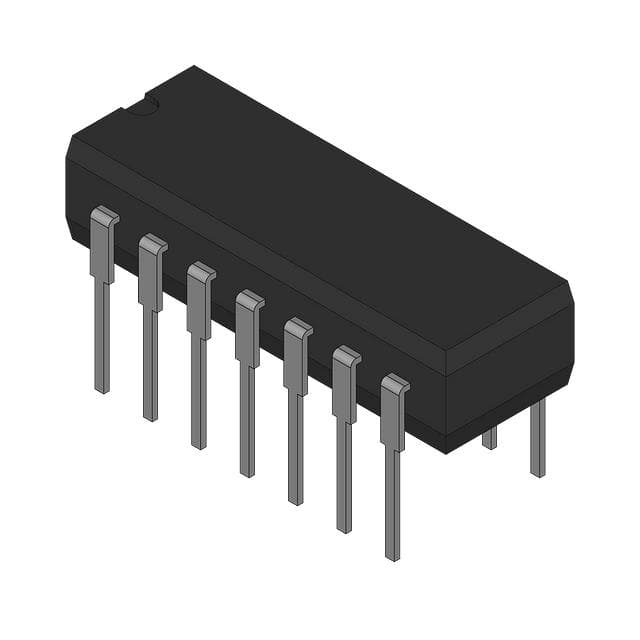
- Part No.:
- AD594AD
- Manufacturer:
- Analog Devices Inc.
- Category:
- Thermal Management
- Package:
- 14-CDIP (0.300", 7.62mm)
- Datasheet:
-
 AD594AD.pdf
- Description:
- IC THERMOCOUPLE INSTR AMP 14CDIP
- Quantity:
- Payment:

- Shipping:

Inventory:14,228
Please send an inquiry. Send us your inquiry, and we will respond immediately.
Product details
Overview
AD594AD from Analog Devices is a monolithic thermocouple amplifier with integrated cold junction compensation, pretrimmed for Type J (iron-constantan) thermocouples. It delivers a linear 10 mV/°C output voltage, supports single-supply operation down to +5 V, features thermocouple open-circuit alarm detection, and achieves ±3°C calibration accuracy over 0°C to +50°C ambient. It is used in industrial temperature monitoring systems where direct Celsius transduction and fault detection are required.
For engineers reviewing the AD594AD datasheet, AD594AD pinout, AD594AD application, or AD594AD equivalent, this page provides verified functional identity, confirmed 14-pin side-brazed DIP package mapping, validated thermocouple signal chain behavior, calibrated gain (193.4), ice-point compensation architecture, and two manufacturer-confirmed alternative options for Type J thermocouple conditioning.
Technical Context
The AD594AD implements a dual-differential amplifier topology with internal feedback summation: one stage amplifies the thermocouple EMF, the other applies a Kelvin-proportional cold-junction compensation voltage. Both stages share matched gain (G), enabling precise cancellation of reference-junction drift when the thermocouple's cold junction matches the IC's die temperature.
Its setpoint controller mode operates by comparing the 10 mV/°C output against an external voltage applied to Pin 8 (FB), while its alarm circuit uses a current-limited NPN transistor (–ALM = Pin 13, +ALM = Pin 12) to indicate thermocouple lead opens. The device is internally frequency compensated for gains ≥75 but requires external 300 pF capacitance from Pin 10 to Pin 9 if configured for lower gain.
Key Specifications
| Parameter | Value and Actual Design Meaning |
|---|---|
| Type J Calibration | Laser wafer trimmed for ANSI Type J thermocouple sensitivity (51.70 µV/°C at 25°C) |
| Output Scale Factor | 10 mV/°C nominal - enables direct interface to ADCs or analog meters without scaling |
| Calibration Accuracy | ±3°C over 0°C to +50°C ambient - specified for AD594A grade (AD suffix) |
| Supply Range | +5 V to ±15 V - supports single-ended +5 V operation and dual-supply extended-range measurement below 0°C |
| Quiescent Current | 160 µA on +VS, 100 µA on –VS - enables low-power remote sensing with minimal self-heating (<0.065°C in air) |
| Alarm Function | Dedicated TTL-compatible open-collector +ALM (Pin 12) and emitter-follower –ALM (Pin 13) for thermocouple break detection |
| Input Impedance | High-impedance differential input - rejects common-mode noise on thermocouple leads up to ±10 mV |
Pinout & Package
AD594AD is housed in a 14-pin, hermetically sealed, side-brazed ceramic DIP (TO-116/D-14) package with 0.3-inch wide body and 0.1-inch lead pitch. Thermal resistance is ~80°C/W in still air, supporting stable operation in industrial enclosures.
| Pin/Terminal | Circuit Role | Design Meaning |
|---|---|---|
| 1 (+IN) | Thermocouple positive input | High-impedance node for iron (Type J) or chromel (Type K) thermocouple lead; referenced to COM |
| 2 (+C) | Positive compensation current source | Supplies calibrated current for ice-point compensation; must not be shorted or loaded below 10 kΩ |
| 3 (+T) | Positive thermocouple compensation output | Provides Kelvin-proportional voltage for recalibration; used with –T to adjust zero point |
| 4 (COM) | Signal and power common | Reference for single-supply operation; connects to V– (Pin 7) and system ground |
| 5 (–T) | Negative thermocouple compensation output | Complementary to +T; used with resistors to shift zero point or fine-tune compensation |
| 6 (–C) | Negative compensation current sink | Completes compensation current path; must not be grounded or low-impedance loaded |
| 7 (V–) | Negative supply rail | Accepts 0 V (single supply) or negative voltage up to –16.5 V for sub-zero measurement |
| 8 (FB) | Feedback network connection | Connects to VO (Pin 9) for 10 mV/°C mode; accepts external setpoint voltage for controller operation |
| 9 (VO) | Voltage output | Low-impedance buffered output capable of ±5 mA drive; directly reads temperature in mV = 10 × °C |
| 10 (COMP) | Compensation amplifier compensation pin | Internal node for stability; requires 300 pF capacitor to VO if gain <75 |
| 11 (V+) | Positive supply rail | Accepts +5 V to +15 V; total supply range (V+ to V–) ≤30 V |
| 12 (+ALM) | Alarm high-side output | Open-collector TTL-compatible output; pulled high during normal operation, driven low on thermocouple open |
| 13 (–ALM) | Alarm low-side terminal | Emitting terminal of alarm transistor; must be held ≤ (V+) – 4 V (typically tied to COM or V–) |
| 14 (–IN) | Thermocouple negative input | High-impedance node for constantan (Type J) or alumel (Type K) thermocouple lead |
Key Features
| Feature | Design Value |
|---|---|
| Integrated cold junction compensation | Eliminates need for external ice bath or RTD sensor; compensation voltage tracks die temperature with ±0.05°C/°C stability |
| Pretrimmed Type J transfer function | Delivers 10 mV/°C output without external gain-setting resistors; reduces BOM count and calibration labor |
| Thermocouple failure alarm | Active-low +ALM output detects open thermocouple leads with <1 µA leakage, enabling fail-safe system response |
| Setpoint controller capability | Configurable as comparator by applying external voltage to FB (Pin 8); supports heater/cooler ON/OFF control without external op-amp |
| Recalibration terminals | +C/–C and +T/–T pins allow field adjustment for Type E, Type T, or custom thermocouple types using two or three resistors |
Applications
| Industrial Oven Temperature Control | Lab Equipment Thermal Monitoring |
|---|---|
Use Scenario: Precise regulation of heating elements in batch ovens using Type J thermocouples embedded in furnace walls. IC Role / Device Role / Timing Role: Thermocouple signal conditioner and setpoint comparator - converts millivolt thermocouple output to 10 mV/°C voltage and toggles heater driver based on user-defined temperature threshold. Use Value: Enables direct integration into PLC analog inputs or microcontroller ADCs; eliminates separate instrumentation amp and cold-junction sensor, reducing board space by >40%. | Use Scenario: Real-time temperature logging in environmental test chambers where thermocouple wiring runs exceed 3 meters. IC Role / Device Role / Timing Role: High-common-mode-rejection front-end amplifier - rejects induced noise on long thermocouple leads while maintaining ±3°C accuracy across 0°C–50°C ambient. Use Value: Achieves <10 µV common-mode error with >100 dB CMRR, ensuring stable readings despite EMI from adjacent AC motors or switching power supplies. |
| Medical Sterilization Autoclave | Power Transformer Winding Monitoring |
Use Scenario: Monitoring chamber temperature during steam sterilization cycles requiring traceable 0.1°C resolution over 121°C–134°C range. IC Role / Device Role / Timing Role: Standalone Celsius transducer - configured with inputs shorted to COM to generate 10 mV/°C output directly from die temperature for reference-junction tracking. Use Value: Provides self-referenced cold-junction compensation within ±0.5°C over full operating range, meeting ISO 17025 calibration traceability requirements. | Use Scenario: Continuous thermal surveillance of oil-immersed transformer windings using remotely mounted Type J thermocouples. IC Role / Device Role / Timing Role: Fault-detecting signal conditioner - monitors thermocouple continuity via +ALM output to trigger SCADA alarms on lead break or sensor disconnection. Use Value: Reduces unplanned downtime by detecting open-circuit faults before thermal runaway occurs; alarm activates within 100 ms of lead separation. |
Equivalent & Alternatives
The following parts are listed as comparable options for similar thermocouple amplifier applications.
| Alternative Part | Technical Difference | Application Difference | Selection Advice |
|---|---|---|---|
| AD8495ACPZ-R7 | Single-supply, rail-to-rail output; integrated Type K compensation only; no +C/–C recalibration pins | Lacks setpoint controller mode and thermocouple type flexibility; optimized for compact PCB layouts | Select when Type K only is needed and board space is constrained; not suitable for Type J or recalibration tasks |
| MAX31855KASA+ | Digital SPI output; built-in cold-junction compensation; supports Type K/J/T/E/R/S/N/B thermocouples | Requires microcontroller interface; no analog voltage output or setpoint comparator functionality | Select when digital integration, multi-type support, and auto-compensation are prioritized over analog simplicity and direct control |
Compared with AD594AD, AD8495ACPZ-R7 offers smaller footprint and rail-to-rail output but sacrifices Type J optimization and recalibration capability; MAX31855KASA+ provides broader thermocouple support and digital interface but removes analog setpoint control and increases system complexity.
Availability
AD594AD is available at Aetrix Electronics and suitable for industrial oven temperature control, lab equipment thermal monitoring, medical sterilization autoclaves, and power transformer winding monitoring requiring stable component supply and long-term obsolescence management.
Supply support for AD594AD includes scheduled delivery planning, volume procurement assistance, BOM continuity management, traceable sourcing, and lifecycle availability coordination for OEM customers, industrial embedded developers, connected-device designers, and electronics production programs.
Manufacturer
Analog Devices is a global leader in high-performance analog, mixed-signal, and digital signal processing semiconductors, serving industrial, automotive, communications, and healthcare markets since 1965.
The AD594AD belongs to Analog Devices' precision thermocouple amplifier product line, designed specifically for high-accuracy, low-drift temperature measurement in harsh environments where cold-junction compensation integrity and fault detection are critical.
FAQ
What is the primary thermocouple type supported by the AD594AD?
The AD594AD is laser wafer trimmed and factory calibrated for ANSI Type J (iron-constantan) thermocouples, delivering a nominal 10 mV/°C output with ±3°C accuracy over 0°C to +50°C ambient. Its internal gain of 193.4 is set to match the 51.70 µV/°C Seebeck coefficient of Type J at 25°C. While it can condition Type T inputs with minor error, AD594AD is not calibrated for Type K - that role belongs to the AD595 series.
Can the AD594AD operate from a single +5 V supply?
Yes, the AD594AD supports true single-supply operation from +5 V (applied to Pin 11) with Pin 7 (V–) and Pin 4 (COM) tied together at ground. In this configuration, it measures temperatures from 0°C to +300°C with a 10 mV/°C output swing from 0 V to ~3 V. Output headroom is limited to +VS – 2 V, so full-scale output reaches ~3 V at +5 V supply - sufficient for most 12-bit ADC interfaces.
How does the thermocouple failure alarm work on the AD594AD?
The AD594AD alarm uses a dedicated NPN transistor: +ALM (Pin 12) is an open-collector output pulled high during normal operation, and –ALM (Pin 13) is its emitter, which must be held ≤ (V+) – 4 V (typically tied to COM). When either thermocouple lead opens, +ALM is actively driven low (<0.3 V at 2 mA), signaling fault to TTL logic or LED indicators. Leakage remains <1 µA in normal state, ensuring low standby power.
Is the AD594AD pin-compatible with other variants in the AD594/AD595 family?
Yes, all AD594 and AD595 variants - including AD594CD, AD595AD, and AD595CQ - share identical 14-pin functional pinouts and electrical behavior. The AD594AD differs only in performance grade (±3°C vs. ±1°C for 'C' grade) and package (side-brazed DIP vs. cerdip). No PCB layout changes are needed when substituting within the same package type, though recalibration may be required when swapping between AD594 and AD595 due to different gain and compensation tuning.
What is the purpose of the +C and –C pins on the AD594AD?
The +C (Pin 2) and –C (Pin 6) pins provide access to the internal ice-point compensation current source/sink. They enable field recalibration for non-standard thermocouples (e.g., Type E) by adjusting the compensation slope via external resistors. These pins must never be shorted to ground or loaded with impedance <10 kΩ, as doing so risks permanent damage to the on-chip compensation network inside the AD594AD.
AD594AD Specifications
- Product attributes
- Attribute value
- Manufacturer:
- Analog Devices Inc.
- Series:
- -
- Package/Case:
- 14-CDIP (0.300", 7.62mm)
- Packaging:
- Tube
- Product Status:
- Obsolete
- Function:
- Thermocouple Amplifier
- Sensor Type:
- External
- Sensing Temperature:
- -
- Accuracy:
- -
- Topology:
- Ice Point Compensation, Overload Detection
- Output Type:
- Voltage
- Output Alarm:
- Yes
- Output Fan:
- No
- Voltage - Supply:
- 5V ~ ±15V
- Operating Temperature:
- -55°C ~ 125°C
- Grade:
- -
- Qualification:
- -
- Mounting Type:
- Through Hole
- Supplier Device Package:
- 14-CDIP
AD594AD FAQ
1.How can I place an order for AD594AD through Aetrix?
Please submit a Request for Quotation (RFQ) for AD594AD on Aetrix. Our sales agent will provide a competitive quotation and guide you through the order confirmation once you accept the terms.
2.Are the price and stock information for AD594AD reliable?
The price and inventory of AD594AD are updated periodically and may fluctuate due to market conditions. Stock and pricing data are typically refreshed every 24 hours. Quotation validity for AD594AD is usually 5 days.
3.What payment methods are accepted for AD594AD?
We accept Wire Transfer, PayPal, Credit Card, Western Union, MoneyGram, and Escrow for AD594AD transactions.
Note: Certain payment methods may incur a processing fee.
4.How is shipping managed for AD594AD?
AD594AD orders can be shipped via leading logistics carriers, including DHL, UPS, FedEx, TNT, or Registered Mail.
Once your AD594AD order is processed, you will receive an email with the shipment details and tracking number.
Note: Tracking information may take up to 24 hours to appear. Express delivery typically takes 3–5 business days.
5.How can I obtain technical support or documentation for AD594AD?
For technical support, including AD594AD datasheets, pinout diagrams, or application guidance, please contact our engineering support team. They can provide detailed documentation and assistance for your AD594AD requirements.
6.How does Aetrix verify that AD594AD is sourced from the original manufacturer or authorized distributors?
All AD594AD products on Aetrix are procured from qualified distributors and authorized channels. Our dedicated quality assurance team conducts strict verification, including traceability checks and, if necessary, third-party testing. This ensures that AD594AD meets industry standards.
7.What is the process for return or replacement of AD594AD?
All AD594AD units undergo pre-shipment inspection (PSI). If there is an issue with AD594AD, returns or replacements are accepted under the following conditions:
1.Quantity discrepancies, incorrect items, or visible external defects (such as breakage or corrosion), acknowledged by Aetrix.
2.The issue is reported within 90 days of delivery.
3.The AD594AD part is unused and in its original packaging.
Return procedure for AD594AD:
1.Submit a request within 90 days.
2.Obtain a Return Material Authorization (RMA) from Aetrix.
AD594AD Tags
-
EMC2101-ACZL-TR
Microchip Technology
-
MCP9844T-BE/MNY
Microchip Technology
-
EMC2101-R-ACZL-TR
Microchip Technology
-
MCP98244T-BE/MNY
Microchip Technology

-
TC670ECHTR
Microchip Technology
-
SE98ATP,547
NXP Semiconductors
-
AMC6821SDBQR
Texas Instruments

-
MAX6604AATA+T
Analog Devices Inc./Maxim Integrated
-
ADT7475ARQZ-REEL
onsemi
-
MAX6643LBBAEE+
Analog Devices Inc./Maxim Integrated
-
MAX6684ESA+T
Analog Devices Inc./Maxim Integrated
-
MAX6639AEE+
Analog Devices Inc./Maxim Integrated
Tech Hub

A practical engineering guide to 3.3V and 5V logic compatibility, input thresholds, resistor dividers, translator ICs, MOSFET level shifting, I2C pull-ups, timing limits and power-sequencing risks.

The 74HC595 uses push-pull logic outputs, while the TPIC6B595 uses 50 V open-drain DMOS sinks for higher-power loads. This guide compares timing, current limits, 3.3 V interfacing, load wiring, thermal…

The 74HC595 converts serial data into eight stable parallel outputs. This guide covers pin functions, shift and storage timing, OE and MR behavior, drive-current limits, cascading, voltage compatibilit…

A technical comparison of level-sensitive latches and edge-triggered flip-flops, covering timing windows, setup and hold limits, master–slave operation, time borrowing, race-through, HDL inference and…

A D latch stores one bit while Enable controls when data can pass. This reference covers gate-level operation, truth tables, transparency, setup and hold timing, LE versus OE, common ICs and practical …

An SR latch stores one bit through cross-coupled feedback. This engineering reference covers NOR and NAND implementations, truth tables, forbidden-state recovery, gated operation, switch debouncing, fa…

Latch circuits retain one bit through feedback. This technical reference covers SR and D latches, truth tables, transparency, timing limits, latch-versus-flip-flop behavior, applications and common log…

An engineering guide to LED driver operation, constant-current and constant-voltage outputs, linear and switching topologies, dimming, IC selection, calculations, replacement compatibility, and fault c…

Operational amplifier guide covering op amp basics, feedback, ideal vs real op amps, common configurations, buffer circuits, offset, bias current, gain-bandwidth, slew rate, rail-to-rail limits and sel…

Jumper cables guide covering safe connection order, red and black clamp placement, final ground connection, cable gauge, length, clamp quality, copper vs CCA cables, jump starter comparison and battery…


