
 My Inquiry
 My Account


Analog Devices Inc. AD7143ACPZ-1500RL7
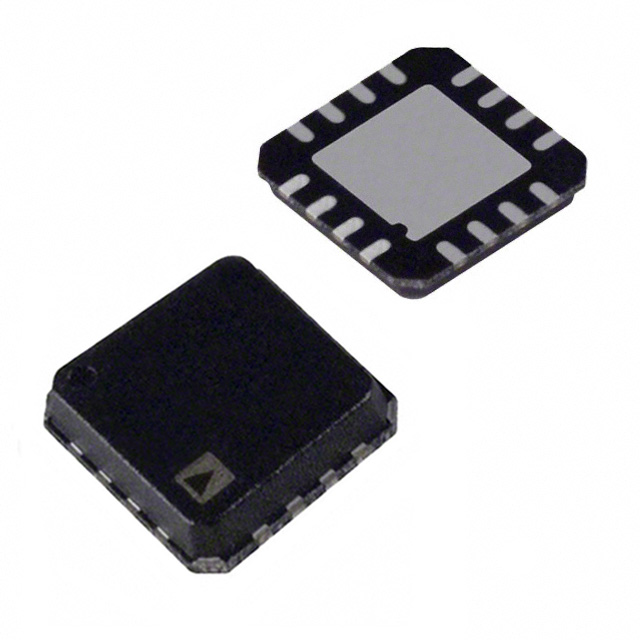
- Part No.:
- AD7143ACPZ-1500RL7
- Manufacturer:
- Analog Devices Inc.
- Category:
- Sensor and Detector Interfaces
- Package:
- 16-VQFN Exposed Pad, CSP
- Datasheet:
-
 AD7143ACPZ-1500RL7.pdf
- Description:
- IC CTLR PROGRAMMABLE CDC 16LFCSP
- Quantity:
- Payment:

- Shipping:

Inventory:4,230
Please send an inquiry. Send us your inquiry, and we will respond immediately.
Product details
Overview
AD7143ACPZ-1500RL7 from Analog Devices is a programmable capacitance-to-digital converter (CDC) IC designed for capacitive touch sensor interfaces in portable electronics. It features 8 sensor input channels, 16-bit sigma-delta conversion, better than 1 fF resolution, and on-chip environmental calibration logic. It operates from 2.6 V to 3.6 V and supports I²C communication with separate VDRIVE for 1.65 V–3.6 V interface compatibility.
For engineers reviewing the AD7143ACPZ-1500RL7 datasheet, AD7143ACPZ-1500RL7 pinout, AD7143ACPZ-1500RL7 application, or AD7143ACPZ-1500RL7 equivalent, key selection considerations include update rate (25 ms max), low-power mode current (50 μA), automatic adaptive thresholding, interrupt-driven host notification, and LFCSP-VQ 4 mm × 4 mm package compatibility with high-density PCB layouts.
Technical Context
The AD7143ACPZ-1500RL7 integrates an excitation source (240 kHz ±2.5%), 16-bit sigma-delta CDC, switch matrix routing CIN0–CIN7 inputs, and on-chip RAM (528 words) for real-time environmental compensation. Its sequencer supports configurable conversion order and decimation rates (128 or 256), enabling trade-offs between noise (0.5 codes RMS at 256) and speed (3.072 ms/stage).
It implements shunt-method capacitance sensing with CSHIELD output (VCC/2 bias, 10 nF to GND) and SRC excitation (20 mA source/50 mA sink). Calibration runs autonomously during idle periods, compensating for temperature/humidity drift without host intervention-critical for reliable button, scroll bar, or wheel detection in consumer handhelds.
Key Specifications
| Parameter | Value and Actual Design Meaning |
|---|---|
| Resolution | 16-bit with no missing codes; enables sub-femtofarad change detection for high-precision touch localization. |
| Update Rate | 25 ms maximum at full sequence (8 stages); ensures responsive user interface feedback in multimedia controls. |
| Input Channels | 8 independent CIN inputs (CIN0–CIN7); supports mixed topologies-buttons, sliders, wheels-on single IC. |
| Supply Voltage | 2.6 V to 3.6 V; matches Li-ion battery and regulated 3.3 V rail operation without level-shifting. |
| Low Power Current | 50 μA in low-power mode (400 ms delay); extends battery life in always-on touch interfaces like remote controls. |
| I²C Interface | 400 kHz max clock, VDRIVE-independent (1.65 V–3.6 V); allows direct connection to 1.8 V or 3.3 V microcontrollers. |
| Calibration Logic | On-chip auto-recalibration engine with 528-word RAM; eliminates manual recalibration and false triggers due to ambient drift. |
Pinout & Package
AD7143ACPZ-1500RL7 is housed in a 16-lead, 4 mm × 4 mm LFCSP-VQ package with exposed thermal pad (EP). The package supports fine-pitch SMT assembly and provides low thermal resistance (θJA = 135.7°C/W) for sustained operation in compact enclosures.
| Pin/Terminal | Circuit Role | Design Meaning |
|---|---|---|
| CIN0–CIN7 | Capacitance sensor inputs | Eight differential-capable analog inputs; each configurable via register to connect to positive/negative CDC input or CSHIELD for crosstalk suppression. |
| SRC | Excitation source output | 240 kHz AC drive signal (VCC amplitude); delivers up to 50 mA sink current to drive sensor electrodes directly. |
| CSHIELD | Shield bias output | Provides VCC/2 reference voltage; requires 10 nF capacitor to GND to stabilize shield potential and reduce noise coupling. |
| VCC / GND | Power supply / reference | VCC powers analog/digital core (2.6–3.6 V); GND is common reference for all circuitry-must tie to solid ground plane. |
| VDRIVE | I²C interface voltage rail | Decouples serial interface logic levels from core supply; enables interoperability with 1.8 V or 3.3 V hosts without external translators. |
| SCLK / SDA | I²C clock/data lines | Open-drain, require pull-up resistors; support standard/fast-mode I²C up to 400 kHz with 300 ns rise/fall time compliance. |
| INT | Interrupt output | Open-drain, active-low interrupt; signals host processor on sensor activation or conversion completion-reduces polling overhead. |
Key Features
| Feature | Design Value |
|---|---|
| Programmable CDC sequencer | Full register control over channel order, decimation, averaging, and stage-specific offsets-enables custom sensor mapping without firmware changes. |
| Automatic environmental calibration | Continuous background compensation using on-chip RAM; maintains stable thresholds across −40°C to +85°C and varying humidity without host CPU involvement. |
| Adaptive threshold & sensitivity | Dynamically adjusts detection limits per channel based on baseline capacitance drift; prevents false touches during temperature transients or condensation. |
| No external RC tuning components | Eliminates discrete timing resistors/capacitors; reduces BOM count and layout sensitivity-ideal for space-constrained mobile PCBs. |
| Low-power wake-up architecture | Switches from 50 μA idle current to full-speed 25 ms updates on touch detection; achieves >95% power reduction during standby in handheld devices. |
Applications
| Smartphone Touch Interface | Media Player Control Panel |
|---|---|
Use Scenario: Capacitive scroll wheel and 8-way navigation buttons integrated into smartphone bezel for one-handed UI navigation. IC Role / Device Role / Timing Role: CDC front-end converting finger-induced capacitance shifts into digital position data; handles real-time proximity detection and debounced button state reporting via INT. Use Value: Enables mechanical-free, sealed front panel design with IP54-rated durability and <25 ms response latency for tactile feedback synchronization. | Use Scenario: Scroll bar and play/pause/volume buttons on portable music player housing, operating under plastic overlay. IC Role / Device Role / Timing Role: Primary touch controller managing multi-sensor event sequencing; uses internal RAM to store calibrated baselines and suppress false triggers from sweat or pocket contact. Use Value: Delivers consistent performance across battery voltage drop (2.6–3.6 V) and ambient temperature swings (−40°C to +85°C) without recalibration. |
| TV Remote Control | Gaming Console Peripheral |
Use Scenario: Slim-profile remote with capacitive touch keys and circular slider for menu navigation, powered by coin cell. IC Role / Device Role / Timing Role: Low-power CDC managing periodic 400 ms ambient sampling and burst-mode 25 ms updates on touch; INT pin wakes host MCU only when needed. Use Value: Extends CR2032 battery life to >12 months by reducing average current to 50 μA during idle and eliminating continuous polling. | Use Scenario: Wireless gamepad with capacitive D-pad and action buttons, requiring ESD-hardened, jitter-free input detection. IC Role / Device Role / Timing Role: Dedicated touch acquisition IC providing noise-immune, 1 fF-resolution sensing; CSHIELD and SRC drive minimize RF interference from 2.4 GHz radio co-location. Use Value: Achieves <10 ms end-to-end latency from finger contact to host-reported event, meeting gaming responsiveness requirements. |
Equivalent & Alternatives
The following parts are listed as comparable options for similar capacitance-to-digital converter applications.
| Alternative Part | Technical Difference | Application Difference | Selection Advice |
|---|---|---|---|
| CY8C201A0-SX24 | CapSense® PSoC-based solution with integrated MCU; requires firmware development; 12-bit resolution; no on-chip RAM for calibration storage. | Best suited for designs needing embedded processing (e.g., gesture decoding) but lacks autonomous calibration engine of AD7143ACPZ-1500RL7. | Select CY8C201A0-SX24 only if host MCU resources are unavailable and local preprocessing is required. |
| AT42QT1070-SSUR | 7-channel QTouch® IC; fixed 16-bit resolution; no programmable sequencer or decimation control; 1.8–5.5 V supply range. | Targeted at cost-sensitive button-only applications; lacks scroll wheel support and adaptive thresholding logic present in AD7143ACPZ-1500RL7. | Choose AT42QT1070-SSUR for simple 7-button interfaces where configurability and environmental robustness are secondary to BOM cost. |
Compared with CY8C201A0-SX24 and AT42QT1070-SSUR, AD7143ACPZ-1500RL7 uniquely combines autonomous calibration, programmable 8-channel sequencing, and ultra-low 50 μA idle current-making it optimal for high-reliability, mixed-topology touch interfaces in battery-powered consumer devices.
Availability
AD7143ACPZ-1500RL7 is available at Aetrix Electronics and suitable for smartphone bezel interfaces, portable media player control panels, TV remote controls, and gaming peripheral designs requiring stable component supply, long-term lifecycle support, and guaranteed traceable sourcing.
Supply support for AD7143ACPZ-1500RL7 includes scheduled delivery planning, volume procurement assistance, BOM continuity management, traceable sourcing, and lifecycle availability coordination for OEM customers, industrial embedded developers, connected-device designers, and electronics production programs.
Manufacturer
Analog Devices, Inc. is a global leader in high-performance analog, mixed-signal, and digital signal processing semiconductors, headquartered in Norwood, MA.
The AD7143ACPZ-1500RL7 belongs to Analog Devices' Capacitance Sensing Solutions product line, engineered specifically for robust, low-power, and software-light capacitive touch interfaces in portable consumer electronics.
FAQ
What is the primary function of the AD7143ACPZ-1500RL7 in a touch interface system?
The AD7143ACPZ-1500RL7 serves as a dedicated capacitance-to-digital converter that acquires analog capacitance changes from up to eight external sensors (e.g., buttons, scroll bars), digitizes them with 16-bit resolution, and delivers calibrated results via I²C. Its on-chip logic handles environmental compensation, threshold adaptation, and interrupt generation-offloading these tasks from the host MCU. This makes AD7143ACPZ-1500RL7 ideal for resource-constrained embedded systems requiring reliable, low-latency touch detection without complex driver software.
Does the AD7143ACPZ-1500RL7 require external passive components for basic operation?
No, the AD7143ACPZ-1500RL7 requires no external RC tuning components for core CDC operation. Only three mandatory passives are needed: a 10 nF capacitor from CSHIELD to GND, and pull-up resistors on SDA and SCLK lines. The excitation source (SRC), shield bias (CSHIELD), and calibration logic are fully integrated-eliminating timing resistors, external references, or trimming capacitors typically found in discrete capacitive sensing solutions.
How does the AD7143ACPZ-1500RL7 manage power consumption in battery-powered devices?
The AD7143ACPZ-1500RL7 offers three operating modes: full power (<1 mA), low power (50 μA typical), and full shutdown (≤15 μA). In low power mode, it automatically extends the conversion interval to 200–800 ms when sensors are idle, then switches to 25 ms updates upon touch detection. This adaptive behavior-controlled entirely by on-chip logic-reduces average current by >95% versus continuous sampling, significantly extending battery life in remotes, wearables, and handhelds without host intervention.
Can the AD7143ACPZ-1500RL7 support both button and slider/wheel sensors simultaneously?
Yes, the AD7143ACPZ-1500RL7 natively supports mixed sensor topologies. Its 8-input switch matrix and programmable sequencer allow independent configuration of each CINx channel-including offset, sensitivity, and connection polarity (positive/negative input or CSHIELD). Buttons can be set for fast, debounced status reporting, while sliders or wheels use sequential sampling and host-side interpolation. No hardware change is needed; only register programming distinguishes function-making AD7143ACPZ-1500RL7 suitable for unified touch interfaces in smartphones or media players.
What is the role of the CSHIELD pin on the AD7143ACPZ-1500RL7, and how must it be connected?
The CSHIELD pin on the AD7143ACPZ-1500RL7 outputs a VCC/2 bias voltage used to drive guard traces or shield layers adjacent to sensor electrodes. Its purpose is to reduce parasitic coupling and improve noise immunity-especially critical in multi-layer PCBs or dense layouts. It must be connected to a 10 nF ceramic capacitor tied to GND; omitting this capacitor causes instability and degraded SNR. CSHIELD is not optional: proper termination ensures accurate 1 fF resolution and reliable operation under ESD or RF interference.
AD7143ACPZ-1500RL7 Specifications
- Product attributes
- Attribute value
- Manufacturer:
- Analog Devices Inc.
- Package/Case:
- 16-VQFN Exposed Pad, CSP
- Series:
- -
- Packaging:
- Tape & Reel (TR)
- Product Status:
- Obsolete
- Programmable:
- Not Verified
- Type:
- Capacitance-to-Digital Converter
- Input Type:
- Logic
- Output Type:
- Logic
- Current - Supply:
- 1 mA
- Operating Temperature:
- -40°C ~ 85°C
- Grade:
- -
- Qualification:
- -
- Mounting Type:
- Surface Mount
- Supplier Device Package:
- 16-LFCSP-VQ (4x4)
AD7143ACPZ-1500RL7 FAQ
1.How can I place an order for AD7143ACPZ-1500RL7 through Aetrix?
Please submit a Request for Quotation (RFQ) for AD7143ACPZ-1500RL7 on Aetrix. Our sales agent will provide a competitive quotation and guide you through the order confirmation once you accept the terms.
2.Are the price and stock information for AD7143ACPZ-1500RL7 reliable?
The price and inventory of AD7143ACPZ-1500RL7 are updated periodically and may fluctuate due to market conditions. Stock and pricing data are typically refreshed every 24 hours. Quotation validity for AD7143ACPZ-1500RL7 is usually 5 days.
3.What payment methods are accepted for AD7143ACPZ-1500RL7?
We accept Wire Transfer, PayPal, Credit Card, Western Union, MoneyGram, and Escrow for AD7143ACPZ-1500RL7 transactions.
Note: Certain payment methods may incur a processing fee.
4.How is shipping managed for AD7143ACPZ-1500RL7?
AD7143ACPZ-1500RL7 orders can be shipped via leading logistics carriers, including DHL, UPS, FedEx, TNT, or Registered Mail.
Once your AD7143ACPZ-1500RL7 order is processed, you will receive an email with the shipment details and tracking number.
Note: Tracking information may take up to 24 hours to appear. Express delivery typically takes 3–5 business days.
5.How can I obtain technical support or documentation for AD7143ACPZ-1500RL7?
For technical support, including AD7143ACPZ-1500RL7 datasheets, pinout diagrams, or application guidance, please contact our engineering support team. They can provide detailed documentation and assistance for your AD7143ACPZ-1500RL7 requirements.
6.How does Aetrix verify that AD7143ACPZ-1500RL7 is sourced from the original manufacturer or authorized distributors?
All AD7143ACPZ-1500RL7 products on Aetrix are procured from qualified distributors and authorized channels. Our dedicated quality assurance team conducts strict verification, including traceability checks and, if necessary, third-party testing. This ensures that AD7143ACPZ-1500RL7 meets industry standards.
7.What is the process for return or replacement of AD7143ACPZ-1500RL7?
All AD7143ACPZ-1500RL7 units undergo pre-shipment inspection (PSI). If there is an issue with AD7143ACPZ-1500RL7, returns or replacements are accepted under the following conditions:
1.Quantity discrepancies, incorrect items, or visible external defects (such as breakage or corrosion), acknowledged by Aetrix.
2.The issue is reported within 90 days of delivery.
3.The AD7143ACPZ-1500RL7 part is unused and in its original packaging.
Return procedure for AD7143ACPZ-1500RL7:
1.Submit a request within 90 days.
2.Obtain a Return Material Authorization (RMA) from Aetrix.
AD7143ACPZ-1500RL7 Tags

-
RE46C100S8TF
Microchip Technology
-
XTR111AIDRCR
Texas Instruments
-
XTR111AIDGQR
Texas Instruments
-
XTR117AIDGKR
Texas Instruments
-
XTR111AIDGQT
Texas Instruments

-
XTR115UA/2K5
Texas Instruments
-
MAX14626ETT+T
Analog Devices Inc./Maxim Integrated
-
XTR116UA/2K5
Texas Instruments
-
XTR115U/2K5
Texas Instruments
-
XTR116U/2K5
Texas Instruments
-
PGA308AIDGSR
Texas Instruments
-
XTR300AIRGWR
Texas Instruments
Tech Hub

A practical engineering guide to 3.3V and 5V logic compatibility, input thresholds, resistor dividers, translator ICs, MOSFET level shifting, I2C pull-ups, timing limits and power-sequencing risks.

The 74HC595 uses push-pull logic outputs, while the TPIC6B595 uses 50 V open-drain DMOS sinks for higher-power loads. This guide compares timing, current limits, 3.3 V interfacing, load wiring, thermal…

The 74HC595 converts serial data into eight stable parallel outputs. This guide covers pin functions, shift and storage timing, OE and MR behavior, drive-current limits, cascading, voltage compatibilit…

A technical comparison of level-sensitive latches and edge-triggered flip-flops, covering timing windows, setup and hold limits, master–slave operation, time borrowing, race-through, HDL inference and…

A D latch stores one bit while Enable controls when data can pass. This reference covers gate-level operation, truth tables, transparency, setup and hold timing, LE versus OE, common ICs and practical …

An SR latch stores one bit through cross-coupled feedback. This engineering reference covers NOR and NAND implementations, truth tables, forbidden-state recovery, gated operation, switch debouncing, fa…

Latch circuits retain one bit through feedback. This technical reference covers SR and D latches, truth tables, transparency, timing limits, latch-versus-flip-flop behavior, applications and common log…

An engineering guide to LED driver operation, constant-current and constant-voltage outputs, linear and switching topologies, dimming, IC selection, calculations, replacement compatibility, and fault c…

Operational amplifier guide covering op amp basics, feedback, ideal vs real op amps, common configurations, buffer circuits, offset, bias current, gain-bandwidth, slew rate, rail-to-rail limits and sel…

Jumper cables guide covering safe connection order, red and black clamp placement, final ground connection, cable gauge, length, clamp quality, copper vs CCA cables, jump starter comparison and battery…


